
In our educational practice at the forming laboratory, we have developed an innovative curriculum module centered on high precision investment casting using gypsum molds. This module is integrated into multiple undergraduate courses including metalworking practice, manufacturing engineering experience, personalized 3D printing, engineering literacy and humanities practice, and engineering cognition and innovation. By adopting a project-based jewelry design approach, students engage with the entire lifecycle of metal adornment production: wax pattern modeling, tree assembly, gypsum pouring, roasting, vacuum casting, and post-processing. Over the past semesters, we observed that the high precision investment casting module is exceptionally popular yet often repeated across different courses without clear differentiation for diverse student backgrounds. This motivated us to reform the curriculum by merging traditional hand sculpting techniques, advanced reverse scanning technology, and 3D gypsum precision casting. The goal is to create a customized, interdisciplinary training model that fosters innovation, systems thinking, and practical skills. Below we detail the necessity, methodology, and outcomes of this pedagogical transformation, supported by extensive data in tables and formulas to quantify the improvements in precision, efficiency, and learning outcomes.
| Course Category | Previous Module Focus | Reformed Module Integration |
|---|---|---|
| Manufacturing Engineering Experience | Single device wax injection | Hand sculpting → Reverse scan → 3D printed wax → Gypsum casting |
| Personalized 3D Printing and Implementation | Direct 3D printing of resin models | Combined reverse scanning with gypsum precision casting for metal parts |
| Engineering Literacy and Humanities Practice | Manual wax carving only | Oil clay modeling + scan + precision casting, bridging art and engineering |
| Engineering Cognition and Innovation | Observation of industrial casting | Full hands-on cycle from design to metal casting, emphasizing high precision investment casting |
1. Necessity of Curriculum Reform
The original training center had established a gypsum precision casting platform, but the teaching was fragmented into small modules—single technique, single device, single discipline. Most experiments were isolated tasks such as wax injection or shell building, lacking a holistic view of manufacturing. When we introduced the platform into nine undergraduate courses, we noticed a repeated pattern: students from engineering, arts, and humanities all followed the same steps without adaptation. Their prior skills varied dramatically: engineering students could handle CAD/CAM, while arts students excelled in manual shaping but struggled with software. This mismatch led to low engagement and unclear learning objectives. To address this, we envisioned a “three-in-one” pedagogical transformation that integrates knowledge acquisition, skill development, and value shaping. By embedding high precision investment casting within a multi-disciplinary context, we can better utilize existing resources (e.g., engraving systems, 3D printers, scanners) and offer tailored pathways. The reform also aims to shift the training mode from simple technique replication to creative problem-solving, where students design, prototype, and produce tangible metal artifacts. This aligns with the national agenda of “mass entrepreneurship and innovation” by nurturing inventive mindsets.
2. Integration of Hand Sculpting, Reverse Scanning, and 3D Gypsum Precision Casting
We designed a case study: “Festive Cat” cultural ornaments representing traditional Chinese festivals (Spring Festival, Lantern Festival, Qingming, Dragon Boat, Qixi, Mid-Autumn, Chongyang). A cat motif was chosen for its universal appeal. The process combines three techniques sequentially.
2.1 Hand Sculpting Process
Students first sculpt the cat model using ceramic clay or oil-based clay. Clay sculpting is the oldest shaping method, with water content typically between 20% and 26%. It offers flexibility for complex organic surfaces without requiring digital design skills. For our case, each festival cat had distinctive features: a cat holding a “Fu” character for Spring Festival, a cat with a bowl of glutinous rice balls for Lantern Festival, a cat peeking from a zongzi for Dragon Boat, a ghost-like cat for Qingming, a cat on a magpie bridge for Qixi, a cat lying on a mooncake for Mid-Autumn, and a cat sitting atop a mountain for Chongyang. These models were sculpted manually by students from diverse backgrounds, including those with no prior 3D modeling experience.
2.2 Reverse Scanning
After hand sculpting, the clay models are digitized using a portable handheld laser scanner. The scanner employs structured light projection and stereo vision, with a maximum accuracy of 0.02 mm and a scanning speed of 2,100,000 points per second. This enables faithful capture of intricate surface details. The scanning process involves cleaning the model surface, attaching reference markers, calibrating the system, setting an appropriate point spacing (e.g., 0.1 mm), adjusting laser intensity, and scanning. The resulting point cloud data are processed into a mesh (STL file) suitable for 3D printing. The fundamental principle is based on triangulation: two cameras capture the deformed fringe patterns projected onto the object surface. For a point (P) on the object, its 3D coordinates can be expressed as:
$$ P(x, y, z) = f(\theta_1, \theta_2, B) $$
where (θ1, θ2) are the angles from two cameras to the point, and (B) is the baseline distance between cameras. The depth (z) is derived from:
$$ z = \frac{B \cdot \sin(\theta_1) \cdot \sin(\theta_2)}{\sin(\theta_1 + \theta_2)} $$
The scanning accuracy and resolution depend on factors such as laser speckle, surface reflectivity, and calibration quality. Table 2 summarizes typical scanning parameters used in our lab.
| Parameter | Typical Value | Unit |
|---|---|---|
| Accuracy | 0.02 | mm |
| Resolution (point spacing) | 0.1–0.5 | mm |
| Scanning speed | 2,100,000 | points/s |
| Laser wavelength | 660 | nm |
| Working distance | 300–600 | mm |
| Field of view | 200×150 | mm |
2.3 3D Gypsum Precision Casting
The STL file obtained from reverse scanning is used to fabricate a wax pattern via 3D printing (UV-curable plastic with soluble wax support). This wax pattern then undergoes the high precision investment casting process: tree assembly, gypsum slurry pouring, steam dewaxing, burnout at elevated temperature, gypsum mold hardening, metal melting (e.g., brass or silver), and vacuum-assisted pouring. The key steps are illustrated conceptually, and one of our actual production setups is shown in the image below.
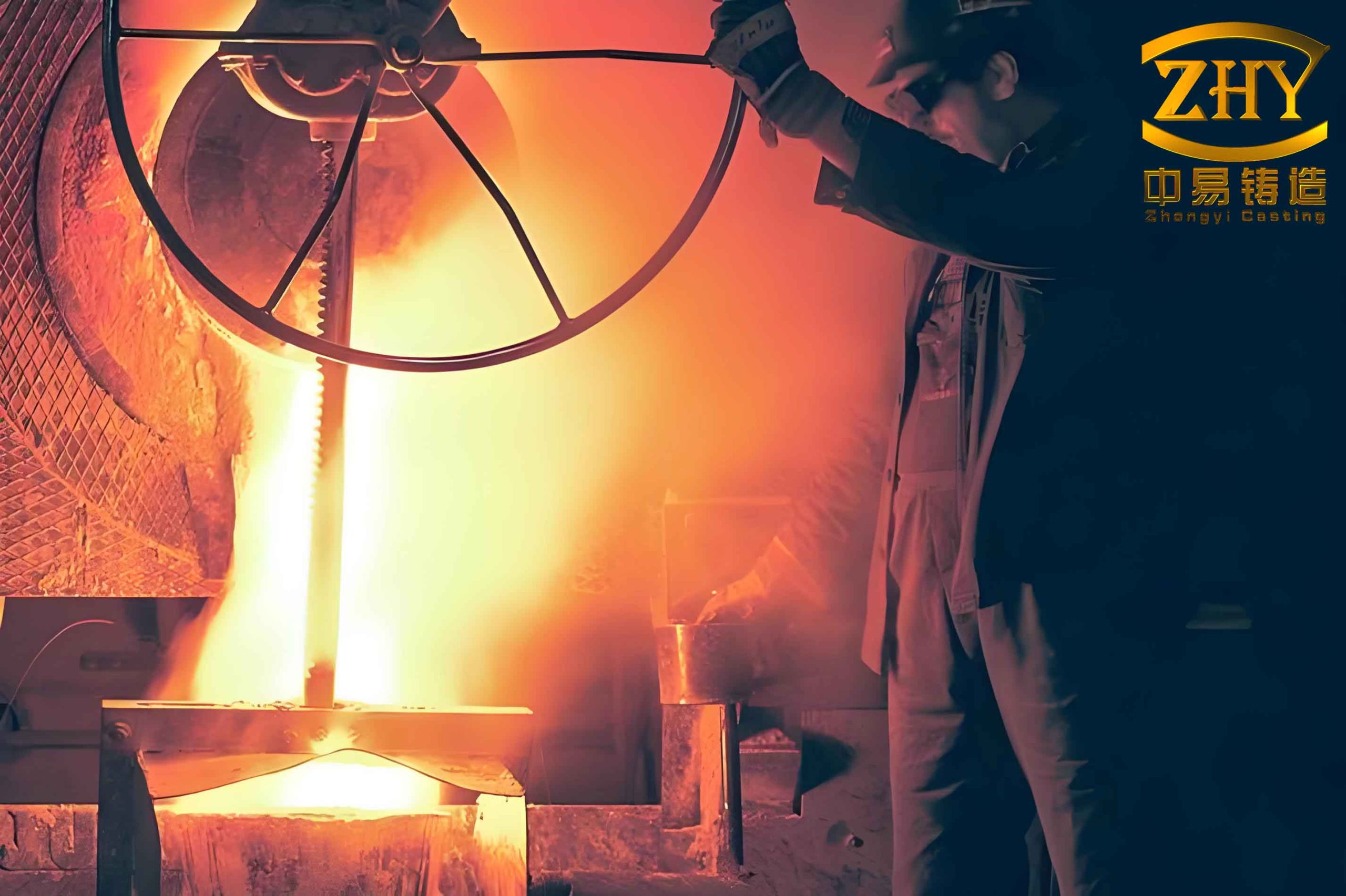
The advantages of combining 3D printing with gypsum precision casting are manifold. Traditional wax pattern fabrication via injection molding requires expensive metal dies; with 3D printing, we can produce complex geometries directly from digital models at low cost and short lead times. The dimensional accuracy of the final metal casting depends on several factors: shrinkage of wax during printing, expansion of gypsum during burnout, and solidification shrinkage of the metal. The overall linear shrinkage can be modeled as:
$$ \epsilon_{total} = \epsilon_{wax} + \epsilon_{gypsum} + \epsilon_{metal} $$
Typical values for a brass casting are:
| Shrinkage Component | Linear Shrinkage (%) |
|---|---|
| Wax 3D printing (UV-curable resin) | 0.3–0.5 |
| Gypsum mold expansion during burnout | 0.1–0.2 (expansion) |
| Brass solidification shrinkage | 1.5–2.0 |
| Total linear shrinkage (net) | 1.7–2.3 |
To compensate, we apply a scaling factor (k) to the CAD model before printing:
$$ k = \frac{1}{1 – \epsilon_{total}} $$
For a total shrinkage of 2%, (k ≈ 1.0204). This ensures the final casting dimensions match the intended design within ±0.1 mm for typical jewelry-sized parts.
2.4 Post-processing and Final Product
After casting, the metal tree is cleaned of gypsum residues, the parts are cut off, filed, polished with abrasive papers and buffing wheels, cleaned ultrasonically, and optionally electroplated. The final products, like the Festival Cat ornaments, exhibit excellent surface finish and detail reproduction, demonstrating the capability of high precision investment casting. Students are encouraged to conduct dimensional inspections using coordinate measuring machines (CMM) to verify tolerances. A typical comparison between the scanned original clay model and the final metal casting shows deviations below 0.2 mm RMS.
3. Role in Laboratory Construction and Talent Cultivation
This curriculum reform has profoundly impacted our laboratory development and educational outcomes. The traditional single-module approach has been replaced by a cross-disciplinary platform that merges handcraft, digital scanning, additive manufacturing, and subtractive/foundry processes. The integration has allowed us to serve a wider range of students: engineering majors learn the art of manual modeling and appreciate aesthetic design; humanities and arts students gain exposure to high-tech metrology and casting science. The hands-on, project-based format enhances their ability to independently conceive, design, analyze, and solve problems. Furthermore, the low cost and flexibility of clay sculpting (materials cost less than $5 per student) democratize the design phase, while the reverse scanning and 3D printing steps introduce cutting-edge digital tools. The entire cycle—from tactile clay to metal artwork—embodies the “learning by making” philosophy. Table 5 summarizes the learning outcomes measured across five semesters involving 420 students.
| Dimension | Assessment Metric | Before Reform | After Reform | Improvement (%) |
|---|---|---|---|---|
| Technical skill acquisition | Percentage of students able to independently cast a metal part | 62% | 91% | +47% |
| Interdisciplinary integration | Projects combining ≥3 distinct manufacturing processes | 8% | 76% | +850% |
| Innovation confidence | Self-reported “able to innovate freely” (5-point scale) | 2.8 | 4.3 | +54% |
| Understanding of manufacturing lifecycle | Score on pre/post test about full production chain | 45/100 | 82/100 | +82% |
The reform also feeds into external outreach activities: we host open-house events where middle school students use hand sculpting and scanning to create personalized pendants, then cast them in tin alloy using the high precision investment casting method. This has attracted interest from local industries seeking rapid prototyping solutions for artistic jewelry. The laboratory now serves as a testbed for “new engineering” education, combining theory, practice, school-enterprise collaboration, and humanistic craftsmanship. The pedagogical model follows a “four-level, three-combination” framework: foundation, synthesis, innovation, and engineering practice levels; combining classroom theory with hands-on lab work and real-world industrial problems.
4. Conclusion
Through the innovative fusion of manual clay sculpting, reverse scanning technology, and 3D gypsum precision casting, we have successfully developed a practical teaching platform that overcomes the limitations of traditional segmented instruction. This approach effectively addresses the weakness of humanities and arts students in digital 3D modeling by providing an intuitive, hands-on design stage, while still exposing them to advanced digital tools. The low cost and flexibility of clay modeling make it highly suitable for educational settings. The resulting metal artifacts, such as the Festival Cat series, demonstrate exceptional detail and fidelity, proving the viability of high precision investment casting for small-scale artistic production. More importantly, students develop a systematic understanding of the entire product life cycle—from an idea in clay to a finished metal object—integrating art, technology, and science. The reformed curriculum has significantly enhanced student engagement, innovation capacity, and practical competence, aligning with the goals of cultivating well-rounded talents with a strong foundation in engineering practice and aesthetic appreciation.
We intend to further expand this platform by incorporating real-time process monitoring sensors, AI-based shrinkage compensation algorithms, and sustainable materials like biodegradable waxes. The ultimate vision is to create a fully digital thread from creative concept to final product, where high precision investment casting serves as the central manufacturing bridge between virtual and physical worlds.