
In my extensive experience as a foundry engineer, I have observed that cast iron parts are prone to a variety of casting defects, which can significantly impact their quality, performance, and cost-effectiveness. These defects arise from complexities in the manufacturing process, including melting, molding, pouring, and solidification. Understanding their causes and implementing effective prevention strategies is crucial for producing high-quality cast iron parts. This article delves into the most common defects in cast iron parts, providing detailed insights from a first-person perspective, supported by tables and formulas to summarize key information. I will emphasize practical measures that I have found successful in mitigating these issues, ensuring that cast iron parts meet stringent industrial standards.
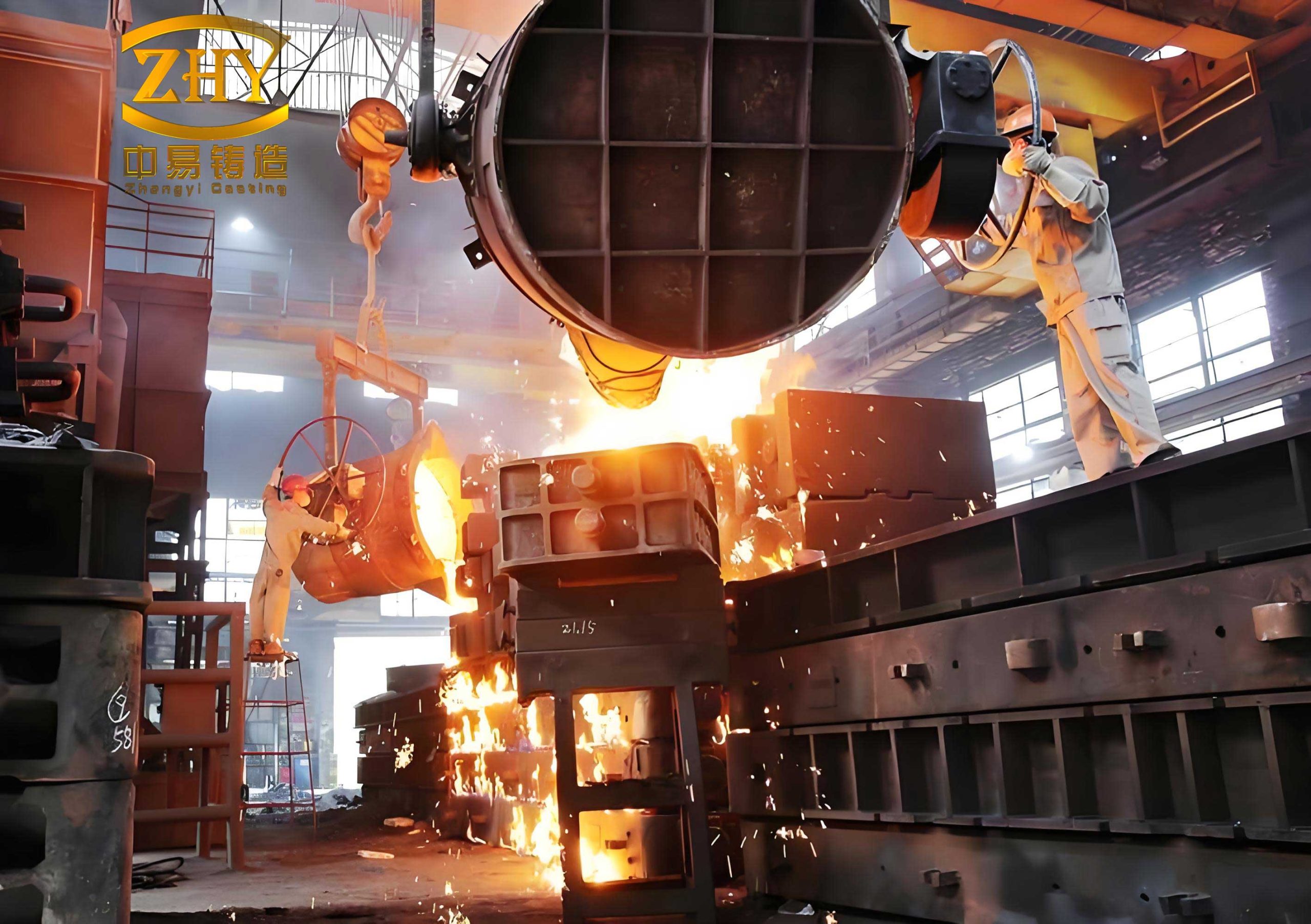
Cast iron parts, due to their widespread use in automotive, machinery, and construction applications, must exhibit durability and reliability. However, defects such as porosity, sand inclusions, shrinkage, and cracking can compromise these attributes. Through years of hands-on work, I have compiled a comprehensive guide to address these challenges. I will cover defects like blowholes, sand holes, slag inclusions, shrinkage cavities, metal penetration, cracks, distortion, uneven hardness, and specific issues in nodular iron cast iron parts, such as poor nodularization and graphite floatation. Each section will include characteristics, root causes, and prevention tactics, often summarized in tables for clarity. Additionally, I will incorporate mathematical formulas where relevant, such as for chemical composition control, to enhance the technical depth. The goal is to offer a resource that helps foundry professionals optimize their processes for superior cast iron parts.
One of the most frequent issues I encounter in cast iron parts is porosity, which manifests as smooth holes within or near the surface. Porosity can be classified into three main types: invasive blowholes, precipitated porosity, and subcutaneous pinholes. Invasive blowholes are typically larger, fewer in number, and pear-shaped, caused by gases from molds or cores invading the molten metal. To prevent this, I focus on reducing gas generation by controlling moisture in green sand—keeping water content low—and ensuring cores are thoroughly dried. Improving mold permeability through proper venting and compaction is also key. For example, I often design vents and risers to facilitate gas escape. Precipitated porosity, characterized by numerous small dispersed holes, results from gases absorbed during melting that fail to escape before solidification. My approach involves using dry, clean charge materials and maintaining dry equipment like ladles and troughs. Subcutaneous pinholes appear just below the surface and are linked to reactions with moisture; thus, I limit aluminum content in inoculants to below 1.5% and apply coatings like cryolite powder during pouring. These steps have proven effective in minimizing porosity in cast iron parts.
| Defect Type | Characteristics | Key Prevention Measures |
|---|---|---|
| Invasive Blowholes | Large, pear-shaped holes on surfaces | Reduce sand moisture; dry cores; improve mold permeability; increase pouring temperature |
| Precipitated Porosity | Many small dispersed holes throughout | Use dry charge materials; ensure dry ladles; cover molten metal with fluxes |
| Subcutaneous Pinholes | Small holes 2–3 mm below surface | Control inoculant Al content; apply cryolite powder; reduce sand moisture |
Another common problem in cast iron parts is sand and slag inclusions, which appear as cavities filled with mold material or slag. Sand holes arise from loose sand or core erosion, while slag holes contain non-metallic residues. To combat sand inclusions, I enhance sand strength by optimizing binder systems and ensuring tight mold compaction. Blowing away loose sand before closing molds is a routine practice. For slag inclusions, I prioritize melt quality by superheating iron to promote slag flotation and using slag-removing agents. Designing gating systems with filters and employing ladle skimmers help trap slag. In nodular iron cast iron parts, “secondary slag” forms from oxidation reactions, leading to subsurface defects. I address this by controlling residual magnesium levels—typically between 0.035% and 0.055%—and reducing sulfur content through desulfurization treatments. These measures significantly improve the cleanliness of cast iron parts.
| Inclusion Type | Causes | Prevention Strategies |
|---|---|---|
| Sand Holes | Erosion of molds/cores; loose sand | Increase sand strength; compact molds properly; clean molds before pouring |
| Slag Inclusions | Slag entrapment during pouring; oxidation | Superheat molten iron; use filters in gating; employ slag-removing practices |
| Secondary Slag (Nodular Iron) | Oxidation of Mg, Si, etc. | Control residual Mg; desulfurize; use rare-earth containing nodularizers |
Shrinkage defects, including shrinkage cavities and porosity, are prevalent in thick sections of cast iron parts where solidification leads to volume contraction. These defects occur when liquid and solidification shrinkage exceed available feed metal. I prevent them by adjusting chemical composition to promote feeding, such as lowering carbon equivalent in heavy sections. Proper riser and gating design is critical; I use Chvorinov’s rule to estimate solidification times and place risers accordingly. The rule is expressed as:
$$ t = k \left( \frac{V}{A} \right)^2 $$
where \( t \) is solidification time, \( V \) is volume, \( A \) is surface area, and \( k \) is a mold constant. For cast iron parts, I often set riser dimensions based on this to ensure adequate feeding. Additionally, I employ chills or internal chills in hot spots to directionalize solidification. Controlling inoculation levels—keeping primary inoculation below 0.6% and instantaneous inoculation between 0.07% and 0.15%—helps reduce shrinkage. Minimizing iron oxidation by managing furnace slag also plays a role. These techniques have reduced shrinkage-related rejections in my projects.
Metal penetration and burn-on, commonly called “sticky sand,” involve sand adhering to cast iron parts surfaces due to mechanical or chemical bonding. Mechanical penetration results from metal infiltration into sand pores, while chemical bonding forms low-melting compounds. I prevent this by using high-refractoriness sands with over 95% SiO₂ content or alternative sands like zircon or chromite for critical cast iron parts. Lowering pouring temperature and increasing pouring speed can reduce thermal and chemical interactions. Ensuring high mold hardness—above 85 on the B-scale—and uniform compaction is vital. In my practice, I also apply coatings to cores to prevent adhesion, which has improved surface finish of cast iron parts.
| Penetration Type | Mechanism | Prevention Methods |
|---|---|---|
| Mechanical Penetration | Metal infiltration into sand pores | Use high-SiO₂ sand; increase mold hardness; control pouring parameters |
| Chemical Burn-on | Formation of low-melting compounds | Apply refractory coatings; reduce pouring temperature; use specialty sands |
Cracking in cast iron parts, including hot tears and cold cracks, stems from internal stresses during cooling. Hot tears are irregular and oxidized, while cold cracks are straight and clean. To mitigate these, I control sulfur and phosphorus contents, as sulfur causes “hot shortness” and phosphorus leads to “cold brittleness.” For gray iron cast iron parts, I maintain sulfur between 0.05% and 0.12% and phosphorus below 0.15%. Using chill placements to uniformize cooling and designing fillet radii to stress concentration are effective. The stress relation can be approximated by:
$$ \sigma = E \cdot \alpha \cdot \Delta T $$
where \( \sigma \) is thermal stress, \( E \) is Young’s modulus, \( \alpha \) is thermal expansion coefficient, and \( \Delta T \) is temperature gradient. By reducing \( \Delta T \) through controlled cooling, I minimize cracking. Post-casting practices like delaying shakeout until below 600°C and avoiding water quenching are also part of my routine.
Distortion in cast iron parts, especially long or uneven sections like engine blocks, occurs due to differential cooling. To address this, I implement pattern allowances by creating反向变形 (reverse warpage) in tooling. Stress-relief annealing or aging treatments help stabilize dimensions. In my experience, avoiding stacking after shakeout and ensuring uniform wall thickness in design are key for distortion-free cast iron parts.
Uneven hardness in cast iron parts results in machining issues and performance variability. This often arises from inconsistent cooling or composition segregation. I improve this by superheating iron above 1480°C to eliminate genetic effects from pig iron. Controlling inoculation—using vibratory feeders for uniform addition—and avoiding alloy steel scraps reduce hardness variations. For complex cast iron parts, I design gating to promote even cooling and use chills in thick sections. The hardness differential can be kept within 10 HB by these measures.
Nodular iron cast iron parts face unique defects like poor nodularization, nodularization衰退, graphite floatation, and reverse chilling. Poor nodularization shows as gray fractures with low mechanical properties, while衰退 leads to degraded nodularity in later pours. I prevent these by adjusting nodularizer addition based on sulfur content, as summarized in Table 3. Using low-sulfur charge materials and controlling反球化元素 like lead and titanium are crucial. For graphite floatation, I limit carbon equivalent to 4.3–4.7% and add chilling elements like molybdenum. Reverse chilling, where carbides form in core regions, is countered by desulfurization and managing manganese-sulfur ratio per the formula:
$$ \text{Mn} = 1.7 \times \text{S} + 0.3 $$
This ensures proper graphitization in cast iron parts. Additionally, I use复合孕育剂 containing barium or calcium to increase nucleation sites.
| Defect in Nodular Iron | Causes | Prevention Measures |
|---|---|---|
| Poor Nodularization | Low residual Mg/RE; high sulfur | Adjust nodularizer dose; desulfurize; control反球化元素 |
| Nodularization衰退 | Oxidation during holding | Pour quickly; cover melt; use衰退-resistant nodularizers |
| Graphite Floatation | High carbon equivalent; slow cooling | Control CE; use chills; add反石墨化元素 |
| Reverse Chilling | S/RE/Mg segregation; hydrogen pick-up | Desulfurize; manage Mn-S ratio; dry materials |
In summary, producing defect-free cast iron parts requires a holistic approach encompassing melt control, mold design, and process optimization. From my perspective, each defect interrelates with others, so integrated strategies are essential. For instance, controlling sulfur benefits both shrinkage and nodularization in cast iron parts. I emphasize the importance of documentation and continuous improvement through data analysis. By applying the tables and formulas discussed, foundries can enhance yield and quality. As technology advances, simulation tools may further aid in predicting defects, but hands-on experience remains invaluable. I hope this guide assists practitioners in overcoming challenges and achieving excellence in casting cast iron parts.
To elaborate on chemical control, I often use formulas to determine optimal compositions. For example, the carbon equivalent (CE) for gray iron cast iron parts is calculated as:
$$ \text{CE} = \text{C} + 0.3 \times (\text{Si} + \text{P}) $$
Maintaining CE within specific ranges—like 3.8–4.2 for thin sections—helps prevent defects. Similarly, for nodular iron cast iron parts, I monitor magnesium recovery using:
$$ \text{Mg}_{\text{residual}} = \text{Mg}_{\text{added}} – k \cdot \text{S}_{\text{initial}} $$
where \( k \) is a factor based on treatment conditions. These calculations, combined with empirical adjustments, ensure consistent results. In my work, I also track defect rates using statistical process control, which has reduced variability in cast iron parts production.
Another aspect is gating system design for cast iron parts, which influences turbulence and slag entrapment. I apply Bernoulli’s principle to minimize velocity changes:
$$ \frac{v^2}{2g} + \frac{p}{\rho g} + z = \text{constant} $$
where \( v \) is velocity, \( p \) is pressure, \( \rho \) is density, \( g \) is gravity, and \( z \) is elevation. By designing tapered sprues and filters, I achieve smoother flows, reducing defects in cast iron parts. This attention to fluid dynamics has proven critical for complex geometries.
In conclusion, the journey to perfecting cast iron parts is ongoing, but with diligent application of these methods, defects can be minimized. I encourage foundry teams to share insights and adapt these practices to their specific contexts, always keeping the focus on quality and efficiency for cast iron parts.