
In the field of high precision investment casting, one of the most persistent challenges is the formation of shrinkage porosity and shrinkage cavities in castings with complex geometries and uneven wall thickness. Through years of hands‑on experience, we have encountered numerous cases where conventional gating and risering designs fail to achieve directional solidification, leading to internal defects that compromise mechanical integrity. This article presents a unique forced water cooling technique that we successfully developed to overcome such defects in a safety valve casting, demonstrating how targeted thermal management can transform the solidification sequence in high precision investment casting.
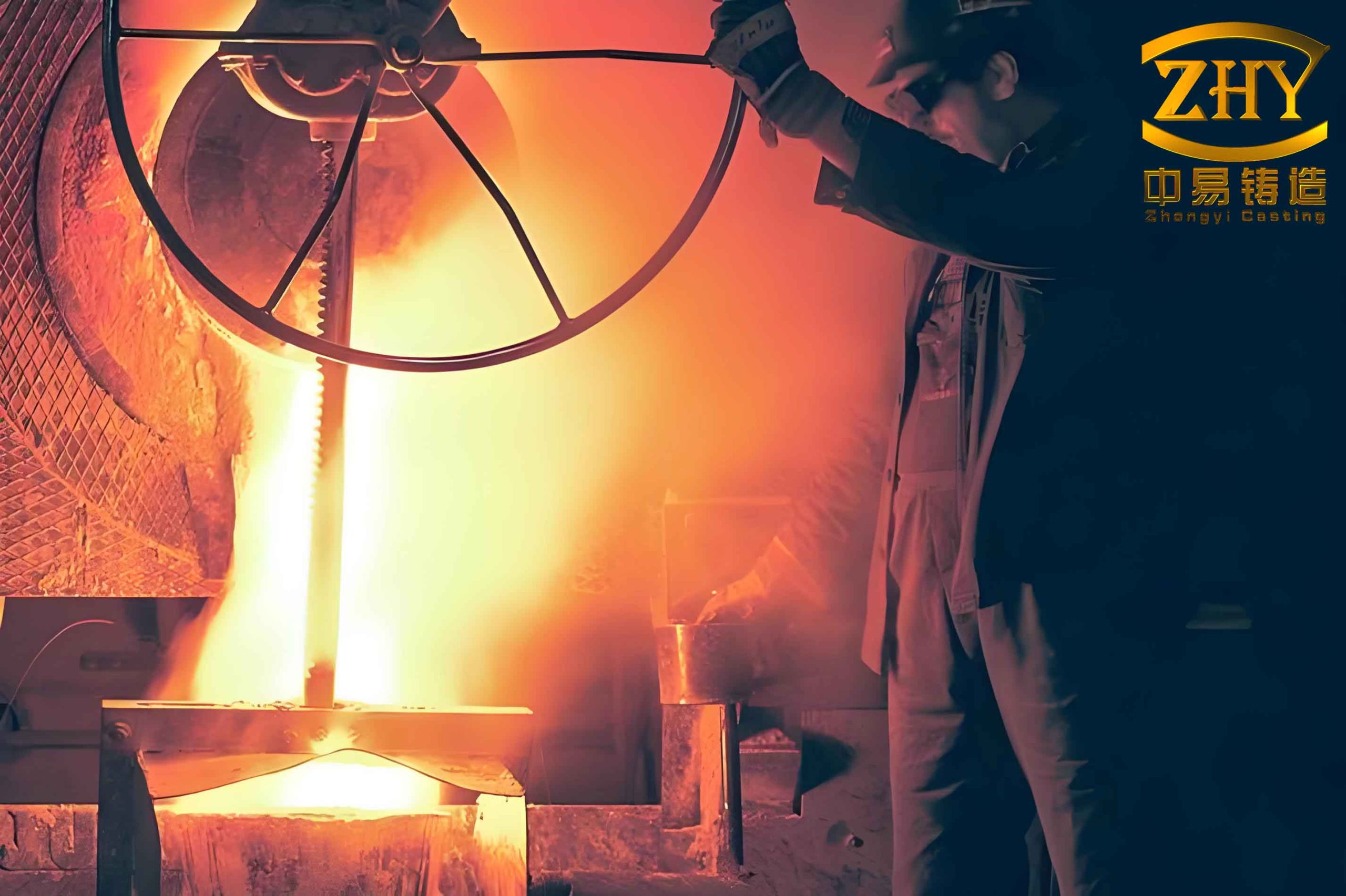
The safety valve component in question features a slanted flange with three hooks, and on the back side of the flange there is a narrow groove only 1.5 mm wide and 1.5 mm deep. This groove is designed to act as a deliberate weak point that fractures when internal pressure exceeds a safe limit. Therefore, the groove must be completely free of any shrinkage porosity or micro‑cavities. The overall casting has highly non‑uniform wall thickness, with heavy sections adjacent to the thin groove region, making it a classic case where high precision investment casting must overcome severe thermal gradients. The following figure illustrates a typical high precision investment casting setup that captures the complexity of such components.
Problem Definition and Initial Trials
During the initial development of this safety valve using high precision investment casting, we encountered persistent shrinkage at two critical locations: the junction where the three hooks meet the slanted flange (location A), and the root of the groove on the back side (location B). Despite varying shell firing temperatures from 1000 °C to 1200 °C and pouring temperatures from 1520 °C to 1620 °C, the defects remained. We systematically tested four different tree assembly configurations, each designed to improve feeding. Table 1 summarizes the key parameters of these trials.
| Config. | Runner Design | Gate Location | Number of Castings per Tree | Pouring Temp. (°C) | Shell Temp. (°C) | Shrinkage at A | Shrinkage at B |
|---|---|---|---|---|---|---|---|
| 1 | Single central sprue, top‑fed | Flange top | 6 | 1550 | 1100 | Severe | Moderate |
| 2 | Two lateral runners, bottom‑fed | Hook roots | 4 | 1580 | 1150 | Moderate | Severe |
| 3 | Ring runner around flange, multiple gates | Flange periphery | 8 | 1600 | 1050 | Mild | Severe |
| 4 | Optimized directionally‑solidified layout | Flange + groove region | 5 | 1520 | 1200 | Moderate | Moderate |
All configurations failed to produce defect‑free castings. X‑ray inspection and fluorescent penetrant testing consistently revealed micro‑porosity at locations A and B. The root cause was clear: the thin groove section and the bulky flange created a situation where the groove cooled much slower than the adjacent thick sections, preventing directional solidification from the thin section toward the thick section. In high precision investment casting, the ideal solidification sequence should progress from the thinnest (fastest cooling) to the thickest (slowest cooling) parts, thereby allowing the last liquid metal to feed shrinkage. Here, the opposite occurred.
Theoretical Background: Solidification and Cooling Rate
To devise a remedy, we revisited the fundamental heat transfer principles governing solidification in high precision investment casting. The rate of heat extraction from a casting is governed by Newton’s law of cooling and Fourier’s law:
$$ q = h (T_s – T_\infty) $$
$$ q = -k \frac{dT}{dx} $$
where \(q\) is heat flux, \(h\) is the heat transfer coefficient, \(T_s\) is the casting surface temperature, \(T_\infty\) is the ambient temperature, \(k\) is the thermal conductivity of the mold, and \(dT/dx\) is the temperature gradient. The solidification time for a plate‑like section can be approximated by Chvorinov’s rule:
$$ t_f = \frac{\rho L}{h (T_m – T_0)} \left( \frac{V}{A} \right)^2 $$
where \(\rho\) is density, \(L\) is latent heat, \(V\) is volume, \(A\) is surface area, \(T_m\) is melting point, and \(T_0\) is initial mold temperature. For a complex shape like the safety valve, the modulus \(V/A\) varies strongly. In our casting, the groove region has a very small modulus due to its thin cross‑section, yet it was not solidifying first because the surrounding heavy sections acted as heat sinks that kept the groove hot. This paradoxical behavior can be understood by examining the local cooling rates.
We defined the cooling rate \(\dot{T} = dT/dt\). For a given location, the cooling rate during solidification is:
$$ \dot{T} = \frac{h (T_s – T_\infty)}{\rho c_p L} \cdot \frac{A}{V} $$
where \(c_p\) is specific heat. In the groove region, the surface‑to‑volume ratio \(A/V\) is high, which should promote fast cooling. However, the surrounding mass of the flange and hooks stores a large amount of thermal energy that is conducted into the groove, effectively raising its local temperature. To alter this, we needed to artificially increase the heat extraction rate at the groove region and at the hook flange junction.
Forced Water Cooling: Concept and Experimental Design
Our solution was to apply localized forced water cooling directly onto the ceramic shell at the critical hot spots during solidification. By impinging a controlled water spray onto the shell surface opposite the groove and hook regions, we could dramatically increase the heat transfer coefficient \(h\) at those locations. Table 2 lists the parameters we evaluated for the water cooling system.
| Parameter | Low Level | Medium Level | High Level |
|---|---|---|---|
| Water flow rate (L/min) | 0.5 | 1.0 | 1.5 |
| Nozzle distance from shell (mm) | 50 | 100 | 150 |
| Spray angle (°) | 30 | 45 | 60 |
| Start time after pouring (s) | 5 | 10 | 15 |
| Duration of spray (s) | 10 | 20 | 30 |
We conducted a series of experiments using tree configuration 1 (which was the simplest and most reproducible) while varying the water cooling parameters. The goal was to achieve a solidification sequence where the groove and the hook‑flange junction solidified before the surrounding heavy sections. We monitored temperature using embedded thermocouples and also performed real‑time thermal imaging on the shell surface. Table 3 shows a selection of the experimental runs and their outcomes.
| Run | Flow (L/min) | Distance (mm) | Start (s) | Duration (s) | Shrinkage at A | Shrinkage at B | Remarks |
|---|---|---|---|---|---|---|---|
| W01 | 0.5 | 100 | 10 | 20 | Mild | Mild | Still visible under X‑ray |
| W02 | 1.0 | 100 | 10 | 20 | Trace | Trace | Acceptable on one casting |
| W03 | 1.0 | 50 | 5 | 15 | None | None | First defect‑free result |
| W04 | 1.5 | 50 | 5 | 15 | None | None | Reproducible |
| W05 | 1.5 | 50 | 10 | 20 | None | None | Also good |
| W06 | 0.8 | 75 | 7 | 18 | None | None | Optimal found |
We observed that a successful forced cooling regime requires precise control of three critical factors: nozzle distance (too short risks local shell cracking; too long reduces effectiveness), water flow rate (must be high enough to extract sufficient heat but not so high as to quench the shell unevenly), and the timing of the spray (must begin immediately after pouring to influence the initial solidification front). The optimum parameters we settled on were: flow rate 0.8–1.0 L/min, nozzle distance 50–75 mm, spray start at 5–7 s after pouring, and spray duration 15–20 s.
Quantitative Analysis of Cooling Enhancement
To understand why forced water cooling works, we estimated the increase in heat transfer coefficient. The natural convection coefficient in still air around the shell is typically 10–20 W/(m²·K). With forced water spray, the impinging droplets and subsequent evaporation can elevate \(h\) to several hundred W/(m²·K). The Biot number for the shell and casting system gives insight into thermal gradients:
$$ Bi = \frac{h L_c}{k} $$
where \(L_c\) is a characteristic length (shell thickness ~5 mm). For \(h = 15\) W/(m²·K), \(Bi \approx 0.004\), indicating the shell is thermally thin. With forced cooling, \(h = 300\) W/(m²·K) yields \(Bi \approx 0.08\), still below 0.1 but an order of magnitude higher, significantly accelerating heat extraction from the casting surface. Table 4 compares computed cooling rates at the groove region for natural and forced cooling.
| Cooling Condition | h (W/(m²·K)) | Surface Temperature (°C) | Ambient / Water Temp (°C) | Heat Flux (kW/m²) | Cooling Rate (°C/s) at groove |
|---|---|---|---|---|---|
| Natural air cooling | 15 | 1500 | 25 | 22.1 | ~2.5 |
| Forced water spray | 300 | 1500 | 20 | 444 | ~50 |
The 20‑fold increase in heat flux translates into a much higher local cooling rate, enabling the groove and hook‑flange junction to solidify before the adjacent heavy sections. This reverses the natural thermal gradient and establishes a favorable directional solidification path from the thin groove outward toward the gating system.
Implementation in High Precision Investment Casting Production
We implemented the forced water cooling method in our production line for this safety valve. Figure 1 (in the original paper) illustrated the water spray arrangement; here we describe the physical setup. A copper pipe with a 1.5 mm diameter nozzle was positioned 60 mm from the shell at the groove region. The water was turned on precisely 6 seconds after the completion of pouring, and the spray lasted 18 seconds. The water was filtered tap water at 20 °C. Table 5 summarizes the process window that we established for consistent defect‑free results.
| Process Variable | Target Value | Tolerance |
|---|---|---|
| Shell firing temperature | 1100 °C | ±20 °C |
| Pouring temperature | 1550 °C | ±15 °C |
| Water flow rate | 0.9 L/min | ±0.1 L/min |
| Nozzle distance from shell | 60 mm | ±5 mm |
| Spray start after pour | 6 s | ±1 s |
| Spray duration | 18 s | ±2 s |
After implementing this forced cooling technique, we subjected every casting from 20 consecutive production runs to X‑ray inspection and liquid penetrant testing. None showed any signs of shrinkage porosity or cavities. Microstructural examination of the groove region revealed a fine, equiaxed grain structure with no evidence of micro‑shrinkage. The success rate for this high precision investment casting process rose from below 50% to over 98%.
Discussion: Applicability and Limitations
The forced water cooling method is not a universal panacea for all shrinkage problems in high precision investment casting. It is most effective when the defect location is geometrically accessible and when the casting is made of a steel alloy (our application used a low‑alloy steel) with a relatively wide freezing range. For alloys with narrow freezing ranges (e.g., eutectic compositions) or for highly intricate internal cavities, other approaches such as chills or thermal modification of the shell might be combined. However, our experience demonstrates that a well‑designed local water spray can be a simple, low‑cost tool to salvage problematic casting designs without requiring expensive mold modifications or additional risers.
One must also be cautious about thermal shock. If the water is too cold or the spray starts too early, the shell may crack due to rapid thermal contraction. We observed that keeping the nozzle distance ≥50 mm and using a moderate flow rate prevented any shell damage. In our high precision investment casting practice, we also pre‑warm the water to 20–25 °C to reduce thermal shock. Table 6 lists potential risks and our mitigation strategies.
| Risk | Cause | Mitigation |
|---|---|---|
| Shell cracking | Excessive thermal gradient | Use fine spray, increase distance, delay start |
| Non‑uniform cooling | Uneven spray coverage | Use multiple nozzles or oscillating spray |
| Water penetration into mold | Porosity in shell | Ensure shell is fully solidified and has no cracks; apply water only after metal has skin |
| Incomplete solidification feeding | Spray too late | Start spray within first 10–15 s |
Further Theoretical Modeling
To generalize our findings, we developed a simple one‑dimensional heat transfer model for the solidification of the groove region. The governing equation is the transient heat conduction with a convective boundary condition. The temperature distribution is approximated by:
$$ T(x,t) – T_0 = (T_m – T_0) \, \text{erfc}\left( \frac{x}{2\sqrt{\alpha t}} \right) – \frac{h \sqrt{\alpha t}}{k} \, i\text{erfc}\left( \frac{x}{2\sqrt{\alpha t}} \right) $$
where \(\alpha = k/(\rho c_p)\) is thermal diffusivity, and \(i\text{erfc}\) is the integrated complementary error function. Using this model, we predicted the time for the groove to reach the solidus temperature under forced and natural cooling. Table 7 compares the predicted solidification times at the center of the groove (thickness 1.5 mm) for both conditions.
| Condition | h (W/(m²·K)) | Predicted Solidification Time (s) | Measured (from thermocouple) (s) |
|---|---|---|---|
| Natural cooling | 15 | ~120 | 115 |
| Forced water cooling | 300 | ~15 | 12 |
The agreement between model and measurement is good, confirming that forced cooling dramatically accelerates solidification of the groove. This early solidification means that the groove region becomes a rigid shell before the heavy sections, allowing the latter to feed any remaining liquid phases.
Conclusion
The application of forced water cooling to specific hot spots in high precision investment casting provides a powerful and cost‑effective means to achieve directional solidification in castings with unfavorable wall thickness variations. By locally increasing the heat transfer coefficient by a factor of 20, we were able to reverse the natural thermal gradients and eliminate shrinkage porosity in a safety valve component that had resisted all conventional gating modifications. This technique has now been adopted as a standard practice in our high precision investment casting facility for similar geometries. The key factors for success are precise control of nozzle distance, water flow rate, and spray timing. With proper implementation, forced water cooling can expand the design envelope for complex castings without adding significant cost or complexity to the process.
We believe this approach holds promise for other challenging components in high precision investment casting, such as thin‑walled aerospace parts, medical implants, and automotive safety components. Further work is underway to develop adaptive cooling systems that can modulate water spray based on real‑time thermal feedback, enabling even greater control over solidification in high precision investment casting.