
In my years of hands-on experience with shell mold casting for bucket tooth components, I have encountered a variety of sand casting defect issues that directly impact product quality, production efficiency, and cost control. Shell mold casting, which utilizes a thin shell made from phenolic resin-coated sand hardened against a heated metal pattern, offers excellent dimensional accuracy and surface finish. However, like any casting process, it is not immune to defects. In this article, I will share my insights into the common sand casting defect types observed during production of bucket teeth and related wear parts, the root causes behind them, and the practical preventive measures I have implemented. I will also present quantitative data and formulas to help readers better understand the underlying mechanisms.
Before diving into the defect analysis, it is important to clarify that shell mold casting is particularly suitable for thin-walled, complex, and high-precision alloy castings such as loader bucket teeth. In our foundry, we use a serial casting method (stack molding) with vertical pouring. Each stack typically contains 10 castings. The material grade used is MT1450, a high-strength low-alloy steel. Through systematic troubleshooting and continuous process improvement, we have significantly reduced rejection rates caused by sand casting defect issues.
Common Sand Casting Defect Types and Their Prevention
Based on my field observations and failure analysis, the most frequent sand casting defect categories in bucket tooth shell mold casting are gas porosity and sand adhesion (burn-on and penetration). Below I elaborate on each, including their formation mechanisms, influencing factors, and countermeasures.
Gas Porosity
Gas porosity is a classic sand casting defect that appears in three main forms: intrusive gas porosity, precipitated gas porosity, and reaction gas porosity. In shell mold casting of bucket teeth, I have observed all three types, each with distinct characteristics and causes.
Intrusive Gas Porosity
Intrusive gas porosity occurs when external gases (from the mold, core, or pouring system) penetrate the molten metal and become trapped. In our initial trials with a 1-ton bottom-pour ladle manually operated by a crane, the pouring stream was unstable. The metal jet frequently struck the side wall of the sprue cup, causing turbulence and air entrainment. The sprue was not kept full, leading to a sand casting defect of large spherical or elongated gas holes, typically 5–10 mm in diameter, located near the top of the casting or along the flow path. The classic mechanism can be expressed by the critical pressure condition for gas entrapment:
$$P_{\text{gas,ext}} > P_{\text{metal}} + \frac{2\sigma}{r}$$
where \(P_{\text{gas,ext}}\) is the pressure of the entrained gas, \(P_{\text{metal}}\) is the local metal static pressure, \(\sigma\) is the surface tension of the liquid steel, and \(r\) is the radius of the gas bubble. When the pouring is unsteady, the gas pressure exceeds the opposing forces, and bubbles are trapped.
Preventive measures I have adopted include:
- Using a 1-ton transfer ladle with a pouring basin, and strictly following a “slow–fast–slow” pouring sequence to keep the sprue cup full and the sprue completely filled. The pouring time per stack is controlled at 18 seconds.
- Designing adequate venting channels in the shell and core assembly to allow entrapped gases to escape smoothly.
| Parameter | Before Optimization | After Optimization |
|---|---|---|
| Ladle type | 1t bottom-pour (crane) | 1t transfer ladle with basin |
| Pouring time per stack | 12–15 s (unstable) | 18 s ± 1 s |
| Sprue filling condition | Partly filled, frequent vortex | Fully filled, no vortex |
| Defect occurrence rate | ~8% | <0.5% |
Precipitated Gas Porosity
Precipitated gas porosity arises from gases dissolved in the molten metal (mainly hydrogen and nitrogen) that come out of solution during solidification due to decreasing solubility. This sand casting defect appears as fine, scattered pinholes (typically < 3 mm) distributed throughout the casting section. In our production, insufficient deoxidation was the root cause. For example, when the oxygen content in the steel exceeded 15×10⁻⁶ (15 ppm), the pinhole rate increased sharply.
The solubility of hydrogen in liquid steel can be approximated by Sieverts’ law:
$$[\%H] = K_H \sqrt{P_{H_2}}$$
where \([\%H]\) is the hydrogen concentration in weight percent, \(K_H\) is the equilibrium constant (temperature-dependent), and \(P_{H_2}\) is the partial pressure of hydrogen in the atmosphere. During cooling, the solubility drops, and supersaturation leads to pore nucleation.
My preventive actions:
- Strict control of raw material quality (e.g., low-moisture scrap and alloys).
- Use aluminum ingots for final deoxidation. The oxygen content is measured with an oxygen probe; we aim for < 15×10⁻⁶ before pouring.
- Pour within 2–3 minutes after aluminum addition to avoid reoxidation and gas pickup.
| Oxygen content (×10⁻⁶) | Porosity defect rate (%) | Average pore diameter (mm) |
|---|---|---|
| 25 | 12.3 | 1.8 |
| 15 | 2.1 | 0.6 |
| 8 | 0.4 | <0.3 |
Reaction Gas Porosity
Reaction gas porosity is caused by chemical reactions between the molten metal and the mold, slag, or within the metal itself. In shell mold casting, the most common reaction is between carbon in the steel and oxygen from the mold (or from decomposition of the resin binder), producing CO gas. This sand casting defect often appears as subcutaneous blowholes just below the casting surface. The reaction can be represented as:
$$[C] + [O] \rightarrow CO_{(g)}$$
or, when moisture is present:
$$C + H_2O \rightarrow CO + H_2$$
I have found that controlling the mold moisture and the binder decomposition rate is critical. In shell molds, the phenolic resin decomposes at high temperature, releasing gases. If these gases cannot escape quickly, they react with the metal.
Preventive measures:
- Ensure complete curing of the shell mold before pouring; avoid any uncured resin layers.
- Apply a thin refractory coating to the mold cavity where necessary to create a barrier against direct metal-mold reaction.
- Optimize pouring temperature to minimize excessive thermal decomposition of the binder.
Sand Adhesion Defects (Burn-on and Penetration)
Sand adhesion, also known as burn-on or mechanical sand penetration, is a severe sand casting defect that increases cleaning costs and reduces casting surface quality. In bucket tooth production, this defect frequently occurs on internal corners, narrow slots, thick sections, and near gates or risers. Two distinct types exist: mechanical penetration and chemical burn-on.
Mechanical Sand Penetration
Mechanical penetration happens when the ferrostatic pressure of molten metal exceeds the capillary resistance of the sand mold, forcing liquid metal into the interstices between sand grains. The critical condition for penetration is given by:
$$P_{\text{metal}} > P_{\text{cap}} = \frac{2\sigma \cos\theta}{r}$$
where \(P_{\text{metal}}\) is the metalostatic pressure (height × density × gravity), \(\sigma\) is the surface tension of the liquid steel, \(\theta\) is the wetting angle between metal and sand, and \(r\) is the average capillary radius of the sand bed. In shell molds, the sand is usually coated with resin, but if the shell surface is not dense or if the blowing pressure is insufficient, the porosity becomes high, reducing \(P_{\text{cap}}\).
In my practice, I identified three main causes:
- Insufficient blowing pressure during shell making (below 0.6 MPa), leading to a loose, porous surface.
- Excessively high pouring temperature, delaying solidification and allowing more time for metal to penetrate.
- High ferrostatic head at the bottom of a vertical stack, especially for serial casting.
Preventive actions I have taken:
- Maintain blowing pressure ≥ 0.6 MPa. Inspect the shell surface quality; any defects (cracks, thin areas) are repaired with refractory paste before assembly.
- Control first-stack pouring temperature between 1580–1600°C and last-stack temperature no lower than 1530°C.
- Change the casting orientation from vertical to horizontal (horizontal stack pouring) to reduce the maximum ferrostatic head. The static pressure at the bottom of a vertical stack can be calculated as:
$$P_{\text{static}} = \rho g h$$
For a vertical stack of 10 castings with total height ~1.2 m, \(\rho\) = 7200 kg/m³, g = 9.81 m/s², the pressure is about 84.7 kPa. In horizontal pouring, the height is reduced to ~0.15 m, giving only ~10.6 kPa, significantly lowering the risk of penetration.
| Pouring Method | Max Ferrostatic Head (m) | Theoretical Penetration Pressure (kPa) | Observed Penetration Defect Rate (%) |
|---|---|---|---|
| Vertical stack | 1.2 | 84.7 | 6.8 |
| Horizontal stack | 0.15 | 10.6 | 1.2 |
Chemical Burn-on (Chemical Sand Adhesion)
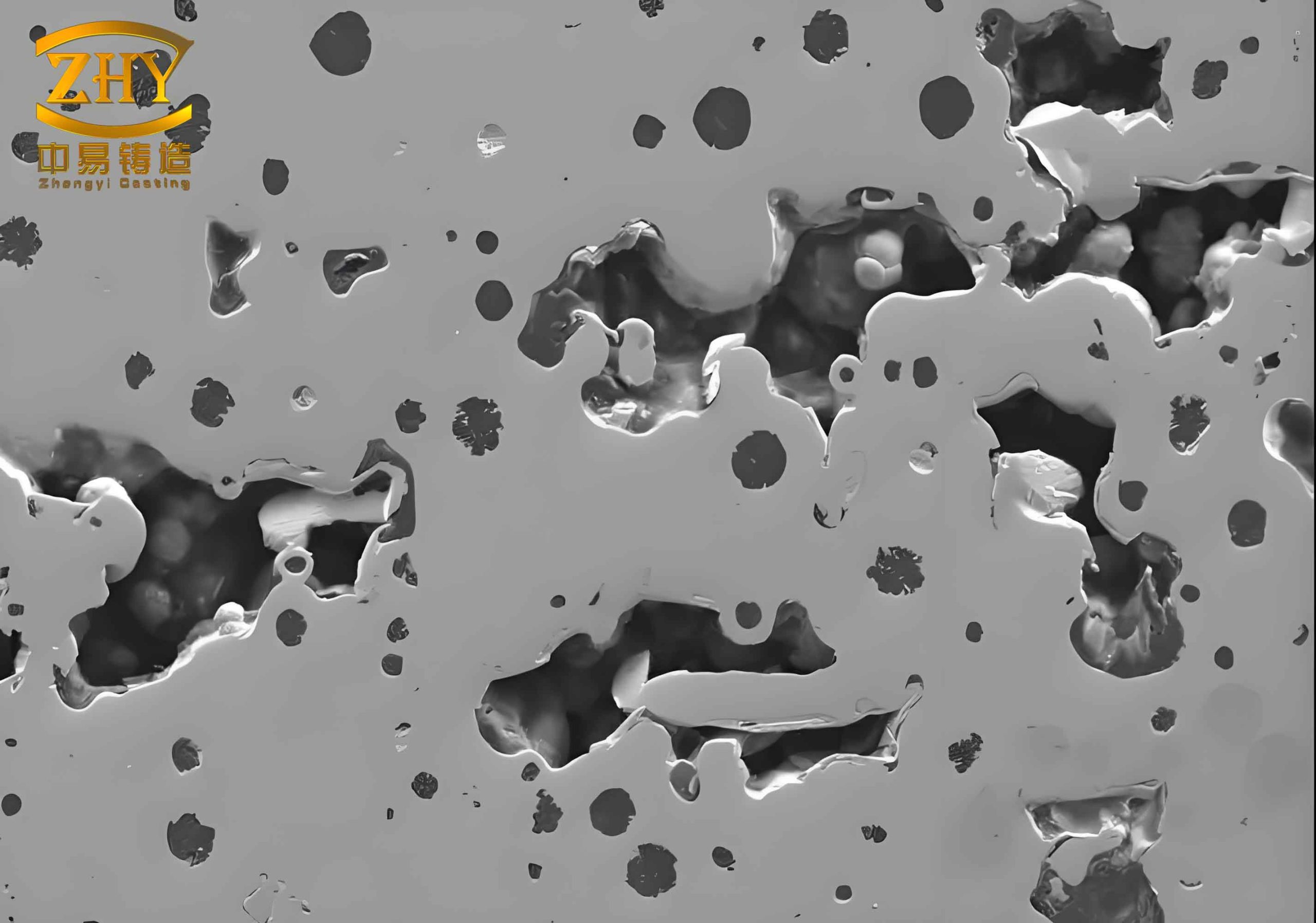
Chemical burn-on occurs when the high-temperature molten metal reacts with the silica sand, forming low-melting-point compounds such as fayalite (Fe₂SiO₄). This sand casting defect typically appears near gates and risers where thermal exposure is most intense. In bucket tooth production, we traditionally did not apply any coating to the shell mold to save cost. However, at pouring temperatures above 1580°C, the silica sand (with SiO₂ content ~95%) begins to melt and react.
The reaction can be simplified as:
$$2FeO + SiO_2 \rightarrow Fe_2SiO_4$$
Fayalite has a melting point of about 1205°C, well below the steel temperature, so it forms a liquid slag that bonds the sand grains to the casting.
Preventive measures I have implemented:
- Replace ordinary silica sand with zircon sand or cerabeads (hollow alumina-silicate spheres) for critical areas. The higher refractoriness of these materials reduces chemical reaction. For cost control, I established a closed-loop recycling system for cerabeads, achieving a recovery rate of over 90%.
- Apply a localized refractory coating (e.g., zircon wash) on the shell cavity in areas prone to burn-on, such as gate contact zones.
- Adjust the pouring temperature window to the low side: first stack at 1580°C (instead of 1610°C) and last stack at 1530°C. This minimizes the time during which the sand is exposed to extreme temperatures.
| Mold Material | SiO₂ Content (%) | Refractoriness (°C) | Burn-on Defect Rate (%) | Relative Cost Index |
|---|---|---|---|---|
| Silica sand (ordinary) | 95 | 1700 | 5.3 | 1.0 |
| Silica sand (high-purity) ≥98% | 98 | 1750 | 3.1 | 1.2 |
| Cerabeads (new) | ~55 | 1850 | 0.8 | 3.5 |
| Cerabeads (recycled 10 cycles) | ~55 | 1830 | 1.1 | 1.8 |
Comprehensive Process Control for Minimizing Sand Casting Defects
From my experience, a holistic approach is required to effectively reduce sand casting defect rates in shell mold casting of bucket teeth. The following table summarizes the critical process parameters and their target ranges that I have found effective:
| Process Variable | Target Range | Measurement Method | Impact on Sand Casting Defect |
|---|---|---|---|
| Blowing pressure (shell making) | ≥0.6 MPa | Pressure gauge on machine | Mechanical penetration |
| Shell thickness | 6–12 mm (uniform) | Caliper, ultrasonic gauge | Both penetration and gas porosity |
| Pouring temperature (first stack) | 1580–1600°C | Optical pyrometer or thermocouple | Gas porosity, penetration, burn-on |
| Pouring temperature (last stack) | ≥1530°C | Same | Misrun, cold shut, but also burn-on if too high |
| Pouring time per stack | 18 ± 2 s | Stopwatch | Intrusive gas porosity |
| Oxygen content in steel before pour | < 15 × 10⁻⁶ | Oxygen probe (e.g., Celox) | Precipitated gas porosity |
| Aluminum deoxidation addition | 0.05–0.10 wt% final Al | Spectrometer check | Precipitated gas porosity |
| Holding time after Al addition | 2–3 min | Timer | Reoxidation and gas pickup |
| Sand SiO₂ content (if silica) | ≥95% (preferably ≥98%) | Chemical analysis | Chemical burn-on |
| Coating application (local) | Zircon wash, 0.3–0.5 mm | Visual and thickness gauge | Chemical burn-on, mechanical penetration |
Additionally, I have developed a simple empirical model to predict the risk of mechanical sand penetration as a function of metal head and pouring temperature. Based on our production data, the critical penetration pressure \(P_{\text{crit}}\) for a given shell quality can be expressed as:
$$P_{\text{crit}} = 0.15 \cdot T – 220$$
where \(T\) is the pouring temperature in °C, and \(P_{\text{crit}}\) is in kPa. When the actual ferrostatic pressure exceeds \(P_{\text{crit}}\), penetration is likely. For example, at 1580°C, \(P_{\text{crit}}\) ≈ 17 kPa. In vertical stack pouring (84.7 kPa), the condition is easily exceeded; horizontal stack pouring (10.6 kPa) is below the threshold, confirming our practical observation.
Conclusion
Through systematic analysis of sand casting defect phenomena in shell mold casting of bucket tooth components, I have established that the most critical defects—gas porosity and sand adhesion—can be effectively controlled by close monitoring of process parameters, improvement in pouring techniques, selection of high-refractoriness mold materials, and proper deoxidation practice. The use of serial stack casting, either vertical or horizontal, should be chosen based on the trade-off between productivity and defect risk. Horizontal pouring significantly reduces the ferrostatic head and thus mechanical penetration, albeit with a slightly larger footprint. The introduction of high-purity silica sand or cerabeads, combined with localized refractory coating, has substantially reduced chemical burn-on. Moreover, the adoption of oxygen measurement and strict deoxidation protocol has nearly eliminated precipitated gas porosity.
In summary, shell mold casting remains a highly efficient and versatile process for producing precision bucket teeth and similar wear-resistant components. However, success hinges on a deep understanding of the underlying physics of sand casting defect formation and a disciplined adherence to optimized process windows. The data and formulas presented here serve as a practical guide for foundry engineers aiming to minimize scrap and improve casting quality. By sharing these insights, I hope to contribute to the broader adoption of shell mold casting in the production of demanding steel castings.