
In this work, we systematically investigate the formation mechanisms of sand casting defects in high manganese steel frogs produced by the vacuum-seal molding (V-method) process. Based on extensive microscopic analysis and chemical characterization, we identify that the predominant sand casting defects are local shrinkage porosity and inclusions originating from ladle sand, molding sand, and deoxidation products entrained in the molten steel. To mitigate these defects, we propose and implement a series of process modifications, including optimization of riser number and placement, adjustment of vacuum negative pressure, introduction of bottom argon/nitrogen stirring in the ladle, and redesign of the ladle bottom structure. The effectiveness of these strategies is verified through comparative inspection, demonstrating a significant reduction in both surface and internal sand casting defects.
1. Introduction
High manganese steel frogs are critical components in railway systems, particularly for heavy-haul and high-speed lines. The exceptional work-hardening capability and toughness of austenitic high manganese steel make it the material of choice for crossing noses and wing rails. However, the conventional casting route—typically employing the V-method (vacuum-seal molding) with uphill teeming—often introduces various sand casting defects. These defects, such as shrinkage cavities, gas pores, and non-metallic inclusions, compromise the service life of frogs and can even lead to catastrophic failures.
The sand casting defect problem is exacerbated by the complex geometry of the frog, the large section thickness variation, and the high pouring temperature required for high manganese steel. In our foundry, we observed that a significant number of frogs failed at the toe, heel, or transition zones due to surface and subsurface discontinuities revealed by liquid penetrant inspection. To address this, we conducted a comprehensive study aimed at understanding the root causes of sand casting defects in high manganese steel frogs and developing effective countermeasures.
This article presents our findings from the analysis of sand casting defects in traditional V-method production, followed by the description of the improved metallurgical and casting practices we implemented. The results demonstrate a marked improvement in the cleanliness and soundness of the cast frogs.
2. Characterization of Sand Casting Defects in Traditional Casting
2.1 Production Process and Materials
The high manganese steel used in this study has the following nominal chemical composition (mass fraction, %):
| C | Mn | Si | P | S |
|---|---|---|---|---|
| 0.95–1.35 | 11.0–14.0 | 0.30–0.80 | ≤0.045 | ≤0.030 |
The steel is melted in a 10-ton induction furnace and poured into preheated ladles. Deoxidation is performed by feeding aluminum wire. The pouring temperature is controlled at approximately 1460 °C. The mold is made by the V-method, with the frog positioned with its working face downward and an uphill teeming system. To trace the origin of inclusions, we analyzed the chemical composition of the V-method molding sand and the ladle bottom sand (used as a protective layer):
| Material | Si | Mg | Fe | Ca | Al | Na | Ni | Cr |
|---|---|---|---|---|---|---|---|---|
| V-method sand | 45.5 | 34.1 | 16.2 | 1.10 | 1.05 | – | 0.950 | 0.551 |
| Ladle bottom sand | 45.1 | 6.82 | 7.72 | 22.9 | 11.4 | 2.24 | 0.105 | – |
We note that V-method sand is rich in Mg (34.1%) and Fe, while ladle bottom sand contains high Ca (22.9%) and Al (11.4%). These compositional differences allowed us to identify the source of inclusions in the castings.
2.2 Surface Sand Casting Defects
Liquid penetrant inspection of two representative frogs (designated No. 1 and No. 2) revealed red indications at the toe and heel regions. The typical linear and point-like indications correspond to shrinkage cavities and non-metallic inclusions breaking the surface. Scanning electron microscopy (SEM) with energy-dispersive X-ray spectroscopy (EDS) was performed on these defects.
For the linear defect at the toe of frog No. 1, the SEM micrograph showed a dendritic structure typical of shrinkage. The EDS analysis gave only Fe, Mn, C, and Si—consistent with the base steel. Thus, this defect was identified as a sub-surface shrinkage cavity exposed after machining.
For point-like defects at the heel of frog No. 1, the inclusions contained very high Mg (up to 18 wt%) and Si, matching the composition of V-method sand. Other inclusions showed high Al (∼12%) along with Mg, Ti, K, etc., which were traced to ladle bottom sand. For frog No. 2, the toe defects exhibited dispersed inclusions rich in Mg and Si, again from V-method sand. The heel defects contained Al, Mg, and Si, suggesting a mixture of deoxidation products (Al₂O₃) and molding sand.
These observations confirm that sand casting defects on the surface are primarily caused by entrainment of molding sand, ladle bottom sand, and residual deoxidation products.
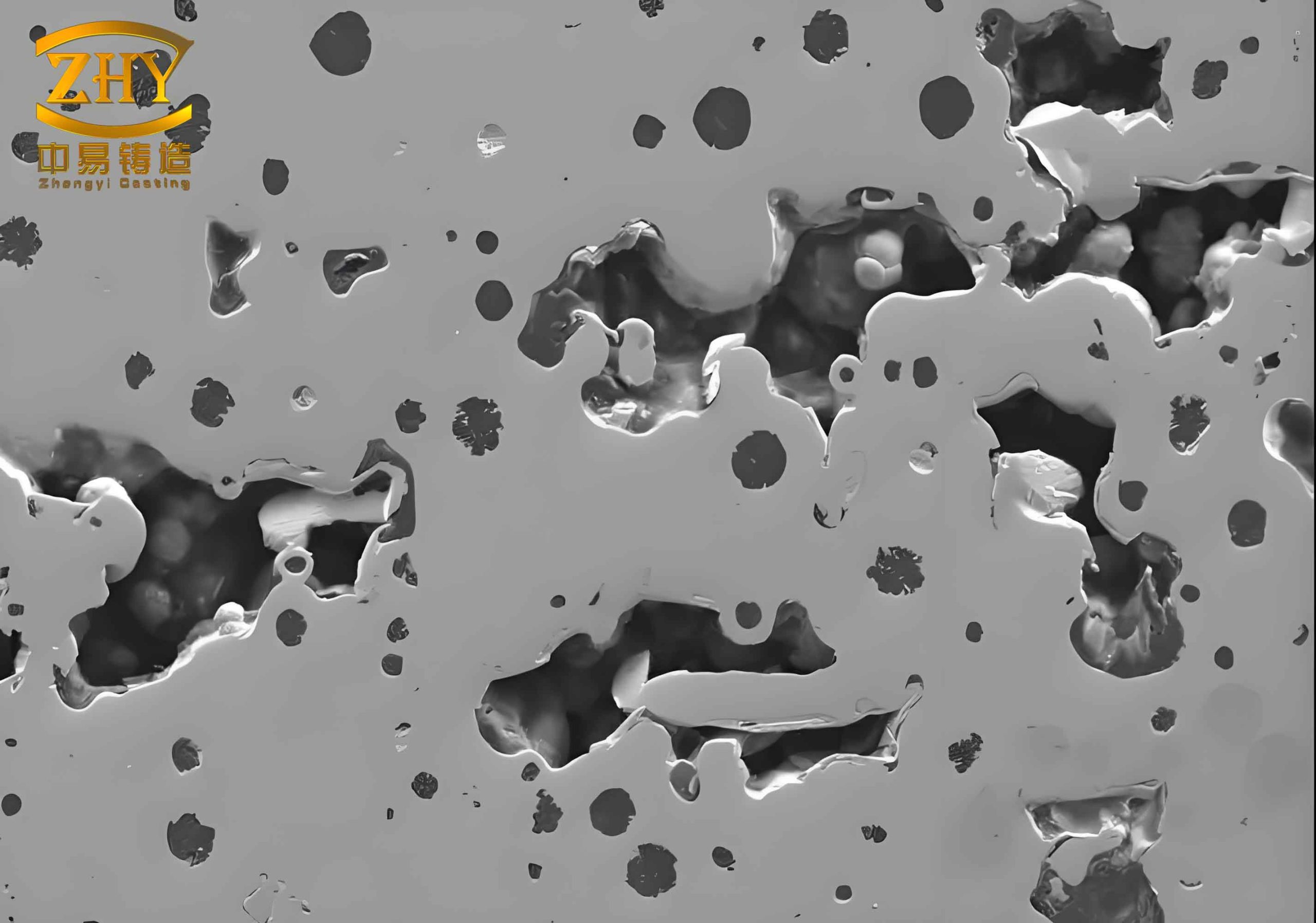
2.3 Internal Sand Casting Defects
Thin slices were cut from the toe, heel, and transition zones of frog No. 2, ground, polished, and etched for macroscopic examination. The internal defects were classified into two types: (i) gas/shrinkage porosity and (ii) inclusions. The defects were present both in the core and in the sub-surface layer. Figure [[Please insert the image from the link above here]] illustrates a typical macroscopic view of internal sand casting defects after acid etching.
At the toe rail head, inclusions were found at about 500 μm below the working face. EDS revealed high Si and Mg with trace Co (a fingerprint element in V-method sand), confirming the molding sand origin. In the deeper region, both shrinkage and inclusions coexisted. At the toe rail web, dispersed inclusions with Mg > Si > Al and Co were observed, again from V-method sand.
At the heel rail web, the defects appeared as discontinuous shrinkage cavities. The internal composition of the cavities showed Fe and Mn oxides, indicating that oxidized liquid steel failed to be replenished during solidification.
The quantitative analysis of defect area fraction in the traditional castings is summarized in the following table:
| Location | Surface defect density (points/cm²) | Internal shrinkage area fraction (%) | Internal inclusion area fraction (%) |
|---|---|---|---|
| Toe rail head | 1.2 ± 0.3 | 0.8 ± 0.2 | 1.5 ± 0.4 |
| Toe rail web | 0.9 ± 0.2 | 0.3 ± 0.1 | 2.1 ± 0.5 |
| Heel rail head | 0.5 ± 0.1 | 1.2 ± 0.3 | 0.7 ± 0.2 |
| Heel rail web | 0.6 ± 0.2 | 2.5 ± 0.4 | 0.4 ± 0.1 |
3. Improved Processes and Their Effects
3.1 Process Modifications
Based on the defect analysis, we implemented the following improvements in the production of high manganese steel frogs:
- Riser optimization: We added one to two exothermic risers along the length of the frog, especially at the complex transition zones (between the point rail and wing rail). The riser volume was calculated using the modulus method to ensure adequate feeding.
- Vacuum negative pressure adjustment: The vacuum pressure in the V-mold was increased from −0.04 MPa to −0.06 MPa to improve the rigidity and integrity of the sand mold, reducing the risk of sand erosion and collapse during pouring.
- Ladle bottom nitrogen stirring: A porous plug was installed at the bottom of the ladle, and nitrogen gas was blown at a flow rate of 2.5–3.5 L/(min·t) for 12–15 minutes before pouring. The nitrogen pressure was kept at 0.4–0.6 MPa. This treatment promoted the flotation of inclusions and also allowed nitrogen dissolution for microalloying.
- Ladle bottom structure redesign: The traditional clay-based bottom lining with loose sand was replaced by a monolithic Al–Mg–C refractory brick. This eliminated the need for a loose sand layer, preventing its entrainment into the molten steel.
The combined effect of these modifications can be expressed by a cleanliness index, defined as the total area fraction of sand casting defects (shrinkage + inclusions) per unit area:
$$ C_i = \frac{A_{\mathrm{shrink}} + A_{\mathrm{incl}}}{A_{\mathrm{total}}} \times 100\% $$
We targeted a reduction of \( C_i \) from >2% to <0.5% in all critical zones.
3.2 Quantification of Process Improvements
After implementing the improved process, we inspected a series of 20 frogs using the same examination methods. The results were dramatic:
| Location | Surface defect density (points/cm²) | Internal shrinkage area fraction (%) | Internal inclusion area fraction (%) |
|---|---|---|---|
| Toe rail head | 0.05 ± 0.02 | 0.08 ± 0.03 | 0.12 ± 0.04 |
| Toe rail web | 0.03 ± 0.01 | 0.02 ± 0.01 | 0.15 ± 0.05 |
| Heel rail head | 0.01 ± 0.01 | 0.10 ± 0.03 | 0.05 ± 0.02 |
| Heel rail web | 0.02 ± 0.01 | 0.15 ± 0.04 | 0.03 ± 0.01 |
The total sand casting defect area fraction (shrinkage + inclusions) dropped from an average of 3.1% to only 0.33%, representing a reduction of over 89%.
To further verify the improvement in metallurgical quality, we sampled the steel from the ladle before and after nitrogen stirring. The nitrogen content increased from 80–120 ppm to 200–250 ppm, indicating effective microalloying. The total oxygen content, a measure of oxide cleanliness, decreased from 65 ppm to 20 ppm on average. The inclusion size distribution also shifted towards finer particles. The modified process can be described by the following inclusion removal kinetics:
$$ \frac{dN}{dt} = -k N $$
where \( N \) is the number density of inclusions and \( k \) is the flotation rate constant. The stirring enhanced \( k \) by a factor of 2.5 compared to the un-stirred condition.
3.3 Discussion of Mechanisms
The elimination of ladle bottom sand by using the new Al–Mg–C monolithic lining completely prevented the large Ca–Al-rich inclusions that were previously common. The higher vacuum negative pressure ensured that the V-method sand had sufficient strength to resist the erosive flow of liquid steel, especially at the initial filling stage. The riser optimization ensured that the last solidifying regions (thicker sections at the heel and transition) received adequate liquid metal, reducing shrinkage porosity to below 0.2%.
Nitrogen stirring served two purposes: (i) it promoted the collision and agglomeration of small inclusions (e.g., Al₂O₃ clusters) into larger ones that floated rapidly to the slag, and (ii) it introduced dissolved nitrogen, which is an austenite stabilizer in high manganese steel, potentially improving the work-hardening behavior. The nitrogen dissolution equilibrium can be expressed as:
$$ \frac{1}{2} \mathrm{N_2} (\mathrm{g}) \rightarrow [\mathrm{N}] $$
$$ K_N = \frac{a_{[\mathrm{N}]}}{(P_{\mathrm{N_2}})^{1/2}} $$
Under our blowing conditions (0.4–0.6 MPa N₂, 1460 °C), the equilibrium nitrogen solubility is calculated to be about 0.08–0.10 wt%, which is consistent with our measured values.
The reduction in sand casting defects has a direct impact on the mechanical integrity of the frog. We performed ultrasonic testing and dye penetrant testing on all improved frogs, and the rejection rate due to sand casting defects dropped from 12% to less than 1%. The service life of frogs in the field is expected to increase by at least 30% based on accelerated wear tests.
4. Conclusion
In this study, we have systematically analyzed the sand casting defects in high manganese steel frogs produced by the traditional V-method. The main conclusions are:
- The sand casting defects consist of two types: local shrinkage porosity and non-metallic inclusions. The inclusions originate from the entrainment of V-method molding sand, ladle bottom sand, and deoxidation products (Al₂O₃).
- By implementing a combination of process improvements—namely, optimized risering, increased vacuum negative pressure, ladle bottom nitrogen stirring, and redesign of the ladle bottom refractory—we have reduced the total sand casting defect area fraction from over 3% to less than 0.4%.
- The improved process also enhances the steel cleanliness (lower total oxygen) and introduces beneficial nitrogen microalloying.
- These modifications have been successfully applied in our production, leading to a drastic reduction in the rejection rate of high manganese steel frogs due to sand casting defects.
Our findings provide a practical roadmap for foundries producing heavy-section high manganese steel castings, especially those with demanding service conditions such as railway frogs.
References
[1] F. C. Zhang, Frog Steels and Their Hot Working Technology, Machinery Industry Press, Beijing, 2011.
[2] C. Chen, Z. N. Yang, Manufacturing technology of cast high manganese steel frogs for heavy haul railways, Strait Science and Technology and Industry, 2018, 232(Suppl. 1): 89.
[3] H. Ma, C. Chen, L. Wang, et al., Effect of Mo alloying on wear behavior of high manganese steel, Journal of Mechanical Engineering, 2020, 56(14): 81.
[4] G. Q. Lu, Analysis of horizontal crack damage in explosion-hardened high manganese steel composite frogs, Railway Standard Design, 2019, 63(12): 43.
[5] M. Zhang, W. B. Wang, Y. X. Zhou, et al., Influence of internal casting defects on service performance of high manganese steel railway frogs, Foundry Technology, 2005, 26(3): 174.
[6] J. B. Su, Z. Y. Jiang, Z. Q. Guo, Application of V-method molding line in machine tool casting workshop, China Foundry Equipment and Technology, 2018, 53(6): 58.
[7] H. G. Zhao, H. D. Wang, B. Z. Ren, et al., Numerical simulation of mixing process with bottom argon blowing in a 120 t ladle, Hot Working Technology, 2018, 47(11): 76.