
In my years of working with metal mold casting for compressor cylinder components, I have encountered a wide spectrum of defects that threaten product quality and production yield. These components, primarily gray cast iron with controlled chemical compositions (C 3.2–3.6%, Si 2.4–2.6%, Mn 0.7–1.2%, S 0.06–0.12%, P 0.3–0.4%, Ti 0.06–0.12%, balance Fe), require stringent mechanical properties (HRA 83–96, σb ≥ 250 MPa) and specific microstructures (predominantly D-type graphite with minor E-type, pearlite 5–30% after heat treatment). Defects such as gas porosity, slag inclusions, shrinkage cavities, and cracks are strictly prohibited.
Unlike sand casting, where the mold offers high permeability and effective slag-trapping gating systems, metal mold casting presents unique challenges: low permeability, high thermal conductivity, and limited ability to implement slag-removal measures. Through systematic analysis, I have identified key defect types and developed effective preventive strategies. Drawing from my experience, I often compare these findings with common sand casting defects to highlight the distinct mechanisms at play. The following sections elaborate on each defect, supported by tables, equations, and practical recommendations.
1. Unqualified Graphite Morphology
In gray iron metal mold casting, D-type graphite is desirable for its superior mechanical properties and machinability compared to A-type graphite. To obtain D-type graphite, given a fixed chemical composition, three conditions must be met: sufficiently high cooling rate, low oxygen content, and appropriate titanium content.
I have observed that this defect frequently emerges when switching from electric furnace melting to cupola-electric furnace duplex melting, or when changing pig iron suppliers without adjusting process parameters (e.g., high-temperature holding time, inoculant addition). The residual coarse graphite from pig iron, insufficient superheat, or low holding time leaves unmelted graphite nuclei in the melt, promoting A-type graphite. This is analogous to certain sand casting defects where improper melt treatment leads to aberrant graphite forms, though the cooling rate in sand molds is generally slower.
To eliminate this defect, I implemented several measures:
- Use pig iron from the same supplier with consistent grade, or blend low-grade and high-grade pig iron.
- Ensure adequate superheat (≥1500°C) and holding time (≥15 min) in electric furnace to dissolve coarse graphite.
- In duplex melting, strictly control holding temperature and time, and reduce inoculant addition.
- For thick-walled castings (e.g., 111, 119 types), lower carbon equivalent (CE) and increase titanium content to the upper limit.
- Optimize mold mass-to-casting mass ratio (target ≥10–15, although literature suggests 24) to increase chilling effect.
The following table summarizes the critical parameters and their effects:
| Parameter | Effect on Graphite Type | Recommended Adjustment |
|---|---|---|
| Carbon Equivalent (CE) | Higher CE promotes A-type graphite | Reduce CE for thick walls |
| Inoculant addition | Excessive inoculant increases nuclei → A-type | Reduce inoculant amount |
| Holding temperature & time | Insufficient dissolution → residual graphite | ≥1500°C, ≥15 min |
| Cooling rate | Low cooling rate favors A-type | Increase mold thickness, water cooling |
| Titanium content | Ti promotes D-type (0.06–0.12%) | Use upper limit for thick sections |
By applying these controls, we eliminated batch scrap caused by A-type graphite, which had previously accounted for 3–7 furnace charges per shift.
2. Phosphorus Eutectic Band Segregation
In metal mold cast cylinder components, particularly the heavier types 185 and 111, I occasionally observed a banded segregation of phosphorus eutectic near the mid-thickness (up to 3 mm wide and 60 mm long). This defect creates a brittle layer that can lead to cracking during service.
Since the chemical specification requires high phosphorus (0.3–0.4%) to form dispersed phosphide eutectic for wear resistance, reducing P content is not an option. Furthermore, traditional grain refinement through increased cooling rate or enhanced inoculation is already near its limit in metal mold casting.
Through systematic comparison under identical production conditions, I discovered that heavier castings were prone to this segregation while lighter ones (143, 145, 119) were not. The root cause was the enrichment of phosphorus during solidification due to slower flow and longer solidification time. By enlarging the gating system to increase pouring speed and reduce residence time, I successfully eliminated the phosphorus band segregation.
The following equation describes the time-dependent enrichment of phosphorus in the liquid ahead of the solidification front, based on the Scheil equation (simplified):
$$ C_{L} = C_{0} (1 – f_{s})^{k – 1} $$
where \( C_{L} \) is the phosphorus concentration in the liquid, \( C_{0} \) is initial concentration, \( f_{s} \) is solid fraction, and \( k \) is partition coefficient (k < 1 for phosphorus in gray iron). Faster pouring reduces the time available for enrichment, thus mitigating segregation. This phenomenon is distinct from common sand casting defects like inverse segregation in aluminum alloys, but the principle of solute redistribution is analogous.
3. Surface Sweat (Surface Exudation)
Surface sweat appears as small globules or beads on the casting surface. I observed two types: localized sweat in areas of slow cooling (e.g., gas pockets, uneven coating) mainly in thin-walled castings (143, 145 types), and widespread sweat due to premature mold opening across all casting types.
The mechanism involves the graphite expansion during eutectic solidification exerting pressure on the remaining liquid, forcing low-melting-point liquid through dendrite interstices to the surface. In metal mold casting, the high cooling rate and early loss of mold constraint (if opened too early) exacerbate this.
Preventive measures I implemented include:
- Strictly control mold opening time based on thermal analysis.
- Enhance cooling (water flow rate, mold temperature management).
- Ensure uniform coating thickness (both base coat and working coat) to avoid local hot spots.
Unlike sand casting defects such as metal penetration or sand burn-on, surface sweat is unique to metal mold casting due to the lack of mold compressibility. However, the underlying cause—improper solidification timing—is a common theme in both processes.
4. Gas Porosity, Slag Porosity, and Slag Pinholes
Gas-related defects are the most challenging in metal mold casting. I have categorized them into three types:
4.1 Precipitation Porosity
Occurs at last-solidifying regions (e.g., riser/casting junction, ingate). Caused by high gas content in the melt due to low melting temperature, short holding time, or high humidity. I observed this mainly in thick castings (111, 119 types) but occasionally in thinner ones.
4.2 Entrapment Porosity & Slag Porosity
These appear together on the top surface of castings. Root causes: irrational gating system causing turbulence and entrainment of gas and slag; high pouring speed; insufficient riser area; secondary oxidation of inoculants containing RE, Ba, Ca, Al, Si. High ambient humidity aggravates the problem.
4.3 Slag Pinholes
Observed uniquely in metal mold casting of 111 and 119 types—small surface-smooth pinholes (1–2 mm diameter, 8–10 mm deep) located near the horizontal diameter on the upper half of the casting. Mechanism: slag or iron oxide adhered to mold surface reacts with acetylene carbon black coating or carbon in molten iron, generating gas that penetrates the solidifying shell. Due to high cooling rate, the gas bubble cannot expand laterally but only grows inward, forming deep, narrow pinholes.
To eliminate these defects, I redesigned the gating system and optimized process parameters:
- Adopt bottom-gated, open or semi-closed gating system to ensure tranquil filling.
- Increase riser area to ≥2× (even 3× for thick castings) the ingate area.
- Add slag traps at the end of runners or before ingates.
- Control pouring sequence: slow-fast-slow.
- Superheat melt to 1450–1500°C and hold before pouring.
- In humid seasons, dry all materials (charge, inoculant, filters, ladles) to minimize gas pickup.
- For slag pinholes, control acetylene carbon black spraying, clean residual carbon, reduce mold temperature, and accelerate cooling.
The following table summarizes the four types of gas/slag defects and their distinguishing features:
| Defect Type | Location | Appearance | Primary Cause |
|---|---|---|---|
| Precipitation porosity | Last-solidifying regions | Round, isolated, sometimes with shrinkage | High dissolved gas in melt |
| Entrapment porosity | Top surface, near risers | Large, irregular, often with slag | Turbulent filling, poor venting |
| Slag porosity | Same as above | Containing visible slag | Secondary oxidation, slag carryover |
| Slag pinholes | Upper side near horizontal diameter | Smooth, deep, narrow (1–2 mm dia) | Gas reaction at mold surface |
I would like to emphasize that while these defects have parallels with sand casting defects (e.g., gas porosity in sand molds due to moisture or poor venting), the severity and morphology differ due to the distinct heat transfer and gas evolution dynamics. In sand casting, mold permeability allows gas to escape, whereas in metal mold, gases are trapped, making prevention even more critical.
5. Surface Clips (Surface Laminations)
Surface clips resemble cold shuts but are different: a thin layer of metal partially separates from the casting, leaving a depression with a small fracture at the deepest point. I found this defect mainly on the upper surfaces of thinner castings (143, 145, 185) and occasionally on 109 type where wall thickness varies.
The mechanism: during solidification, graphite expansion pressure forces liquid metal through weak points in the solidified shell, between the shell and mold, forming a thin protruding layer. Contributing factors: uneven coating (accumulation of carbon black); fine inclusions adhering to mold surface; localized slow cooling due to gas entrapment; low carbon equivalent promoting dendritic structure (more interdendritic channels); high cooling rate in thin sections leading to fine dendrites and high permeability.
To eliminate surface clips, I:
- Ensure uniform mold cooling by cleaning residual carbon and controlling coating application.
- Purify melt to reduce inclusions.
- Adjust pouring speed to avoid gas entrapment.
- Optimize carbon equivalent and inoculant addition according to section thickness: higher CE for thin walls (143,145,185), lower CE for thick walls (111,119), strict control for variable-wall castings (109).
This defect has no direct analog in sand casting defects, though similar phenomena occur in die casting as “soldering” or “erosion”. However, the root cause—graphite expansion pressure—is unique to cast irons solidifying with graphite precipitation.
Comprehensive Comparison with Sand Casting Defects
Throughout my career, I have always found it instructive to contrast metal mold casting defects with the well-known sand casting defects. Sand casting defects such as sand inclusions, blows, scabs, and rattails are primarily related to sand properties (moisture, binder, grain size) and mold-metal reactions. In metal mold casting, those are absent, but new defects arise from the rigid, impermeable, and highly conductive mold.
The following table highlights key differences:
| Defect | Metal Mold Casting | Sand Casting |
|---|---|---|
| Gas porosity | Often large, deep pinholes; caused by dissolved gas + no escape; requires strict melt treatment | Often small, dispersed; caused by mold moisture, core gas; can be vented |
| Slag inclusions | Difficult to remove due to lack of slag traps; secondary oxidation severe | Can be trapped in gating system more easily |
| Graphite type | D-type desired; A-type due to slow cooling or improper melt | Mostly A-type; control via inoculation and cooling rate |
| Surface clips | Unique to iron metal mold casting due to graphite expansion pressure | Rare; similar to cold shuts but not lamination |
| Phosphorus band | Segregation due to slow solidification in thick sections | Not typical; slower cooling generally avoids banding |
| Sand burn-on, penetration | Not present | Common due to sand-metal reaction |
I hope this sharing of practical experience—rooted in years of troubleshooting and process optimization—will help others facing similar challenges in metal mold casting of gray iron components. By understanding the fundamental mechanisms, and learning from analogous sand casting defects, we can systematically eliminate defects and achieve high-quality castings.
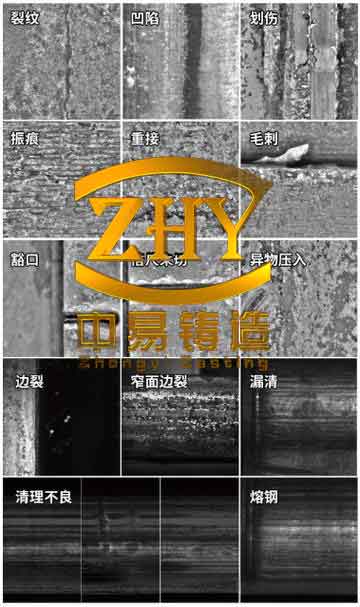
The image below illustrates typical sand casting defects for comparison, which shares some conceptual similarities with gas and slag defects in metal mold casting, though the physical manifestations differ:
Conclusion
In this article, I have shared my first-hand experience and systematic approach to identifying and preventing common defects in metal mold casting of gray iron cylinder components. The key to success lies in understanding the unique solidification and heat transfer characteristics of metal molds, and adapting melt handling, gating design, and process parameters accordingly. The comparison with sand casting defects provides valuable perspective, as many root causes—such as gas evolution, segregation, and inappropriate cooling rates—transcend casting processes. By implementing the remedies described above, I have consistently reduced defect rates and improved product reliability.