
Throughout my career in both mining engineering and foundry operations, I have observed that systematic problem-solving approaches yield the most robust solutions. For instance, in a coal mine ventilation system upgrade project I supervised in 2006, we systematically reduced total mine resistance from 1800 Pa to 1225 Pa by enlarging cross-sections and replacing the main fan. The after-modification resistance distribution is shown in Table 1 below. This experience taught me that sand casting defects, particularly endogenous reaction porosity, require similarly methodical diagnosis and targeted interventions.
| Section | Length (m) | Cross-section (m²) | Support type | Ventilation resistance (Pa) | Percentage of total mine resistance (%) |
|---|---|---|---|---|---|
| Return air rise | 1200 | 13.44 | Bolt-shotcrete | 80.57 | 6.58 |
| Main return airway | 958 | 13.44 | Bolt-shotcrete | 249.5 | 20.37 |
| Return air inclined shaft | 78 | 15.90 | Concrete lining | 34.02 | 2.78 |
| Total (mine) | — | — | — | 1225 | 100.00 |
Just as we identified high-resistance bottlenecks in the ventilation network and remedied them with cross-section enlargement, in the foundry I learned that sand casting defects such as endogenous reaction porosity arise from specific chemical and physical imbalances during solidification. The visual characteristics of these sand casting defects are distinctive: large, often irregularly shaped holes, up to several millimeters in diameter, distributed throughout the casting cross-section. The inner surfaces of these pores are typically smooth and metallic in color, and they are usually internal, only becoming visible after machining. This type of sand casting defects also exhibits a “pandemic” nature — if one casting in a melt batch shows these pores, nearly all castings from that batch will be affected, regardless of mold type.
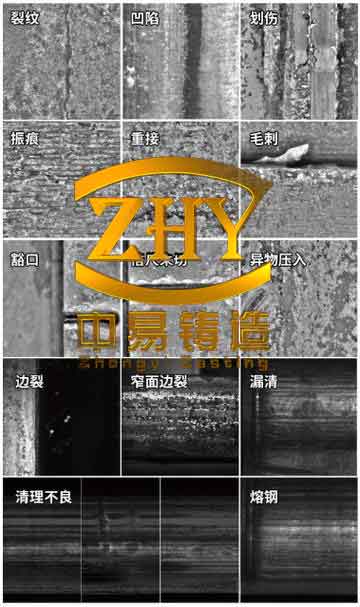
To properly address these sand casting defects, we must first distinguish between the two primary sub‑types: (1) endogenous CO reaction porosity and (2) endogenous H2O reaction porosity. Their formation mechanisms, though chemically distinct, share a common root — inadequate deoxidation or degassing of the molten metal. Below, I detail each category.
Endogenous CO Reaction Porosity
This defect is most prevalent in steel castings. The root cause is insufficient deoxidation during melting. When the dissolved oxygen concentration [O] in the molten steel is too high, the following reaction occurs at the solid‑liquid interface during solidification:
$$
[C] + [O] \rightarrow CO \uparrow
$$
The carbon monoxide gas is virtually insoluble in liquid steel. It nucleates on dendrite arm concavities or micro‑grooves at the solidification front, and hydrogen and nitrogen from the surrounding melt diffuse into the CO bubbles, causing them to grow. Because these bubbles form during the final stages of solidification, they cannot float out and instead become trapped as large, clustered pores. The high oxygen content in steel (30–300 ppm) compared to cast iron (3–45 ppm) explains why steel is more susceptible to this family of sand casting defects. Even white cast irons with very low carbon and silicon can suffer from CO reaction porosity.
Prevention strategies center on thorough deoxidation. Deoxidizers such as ferrosilicon, ferromanganese, and finally aluminum (to bring oxygen down to ~4 ppm) are essential. However, care must be taken because steel that is excessively deoxidized becomes highly susceptible to hydrogen pickup. Hence, from tapping to pouring, exposure to moisture must be minimized.
Endogenous H2O Reaction Porosity
Copper‑based alloys — especially pure copper, tin bronzes (e.g., ZCuSn10Zn2), and leaded tin bronzes (e.g., ZCuSn5Pb5Zn5) — are prone to this type of sand casting defects if deoxidation is inadequate. During melting, copper reacts with water vapor in the furnace atmosphere to form cuprous oxide (Cu2O) and atomic hydrogen [H]:
$$
2Cu + H_2O \rightarrow Cu_2O + 2[H]
$$
The Cu2O dissolves in the melt, while the hydrogen is also readily absorbed. If the melt is insufficiently deoxidized, the following reaction occurs during solidification:
$$
Cu_2O + 2[H] \xrightarrow{\text{in liquid}} 2Cu + H_2O \uparrow
$$
The water vapor (H2O) produced forms large, clustered pores, very similar in appearance to CO reaction porosity. Preventing these sand casting defects requires a two‑step process: first, “oxygen‑rich dehydrogenation” by using oxidizing fluxes (e.g., CuO or MnO2 with silica sand and soda ash) to combine dissolved hydrogen with oxygen, forming H2O that escapes; second, after removing the flux slag, thorough deoxidation with phosphorus‑copper (or similar) to eliminate the residual Cu2O. It is critical that no reactive elements (Al, Si, Mn) are present in the melt during the oxidizing stage, as they would be preferentially oxidized and increase slag inclusions.
Alternative methods include inert gas bubbling, vacuum melting, or vacuum degassing to remove hydrogen, followed by deoxidation — all effective for preventing water‑vapor‑related sand casting defects.
Comparative Summary of Endogenous Reaction Porosity
The following table contrasts the two main types of endogenous reaction sand casting defects:
| Feature | CO reaction porosity | H2O reaction porosity |
|---|---|---|
| Typical alloys affected | Steel, white cast iron, Ni‑Cu alloys | Pure copper, tin bronzes, leaded bronzes |
| Primary cause | Insufficient deoxidation → high [O] | Insufficient deoxidation → high Cu2O and [H] |
| Chemical reaction | [C] + [O] → CO | Cu2O + 2[H] → 2Cu + H2O |
| Pore appearance | Large (mm‑scale), spherical/irregular, clustered, internal | Large (mm‑scale), spherical/irregular, clustered, internal |
| Surface color | Metallic brightness | Metallic brightness |
| Pandemic nature | Yes — entire melt batch affected | Yes — entire melt batch affected |
| Primary prevention | Aluminum or deep deoxidation + hydrogen control | Oxygen‑rich dehydrogenation + subsequent deoxidation |
Lessons from Ventilation System Optimization Applied to Casting Defect Control
The parallel between mine ventilation resistance reduction and sand casting defects mitigation is instructive. In the ventilation project, we first measured the resistance distribution (Table 1), identified the high‑resistance bottlenecks (the return air rise and main return airway accounted for nearly 27 % of total resistance), and then implemented targeted remedies: expanding the cross‑sections from 13.44 m² to a larger area, changing support from bolt‑shotcrete to smoother concrete lining where feasible, and finally replacing the main fan with a more powerful axial‑flow model (FBCDZ‑10‑No28D, 2×280 kW). The result was a 31.94 % reduction in total resistance and a 13.72 % increase in air volume.
For sand casting defects, the analogous steps are: (1) diagnose the defect type through visual inspection and metallography; (2) identify the root cause — typically insufficient deoxidation, high hydrogen content, or improper melt treatment; (3) implement corrective actions such as modifying the deoxidation practice, adjusting flux composition, or changing pouring temperature. The success of the mine ventilation project hinged on a combination of infrastructure changes (enlarged cross‑sections) and equipment upgrades (new fan). Similarly, solving sand casting defects often requires both process adjustments (better deoxidation) and equipment improvements (e.g., using a vacuum degassing unit for copper alloys).
One critical factor that I have repeatedly observed is that sand casting defects are rarely caused by a single factor. For instance, even with proper deoxidation, if the mold moisture is too high, hydrogen can re‑enter the melt during pouring. Hence, a holistic view — encompassing melt quality, mold condition, pouring practice, and alloy chemistry — is essential.
Additional Formulas and Quantitative Relationships
The equilibrium relationship between carbon and oxygen in liquid steel at a given temperature can be expressed as:
$$
\log f_{[C]} f_{[O]} [\%C][\%O] = -\frac{1168}{T} – 2.07
$$
where \(f\) are activity coefficients, and \(T\) is in Kelvin. This relation underscores why insufficient deoxidation leads to [O] levels above the equilibrium value, driving CO formation as sand casting defects.
For copper‑based alloys, the solubility product of Cu2O in liquid copper at 1200 °C is around:
$$
[\%O]_{\text{eq}} \approx 0.01\% \quad \text{(for pure copper)}
$$
If the actual oxygen content exceeds this value, and hydrogen is present, the H2O reaction becomes thermodynamically favorable, leading to sand casting defects.
Practical Prevention Table for Sand Casting Defects
Based on my experience, I have compiled the following practical checklist to minimize endogenous reaction sand casting defects:
| Alloy system | Key prevention steps | Typical deoxidizer | Additional notes |
|---|---|---|---|
| Steel (carbon, low‑alloy) | 1. Use Al (0.05–0.10 %) for final deoxidation 2. Avoid prolonged holding after deoxidation 3. Keep pouring temperature within recommended range |
Al, Si‑Ca, Fe‑Mn, Fe‑Si | Monitor hydrogen with reduced pressure test |
| White cast iron (low C, Si) | Similar to steel; ensure sufficient Si or Al deoxidation | Fe‑Si, Al | Higher risk when recycled scrap is used |
| Pure copper | 1. Oxidizing flux (CuO + SiO₂ + Na₂CO₃) at 1150–1200 °C 2. Skim slag then add P‑Cu (0.02–0.04 % P) 3. Pour quickly to avoid re‑oxidation |
P‑Cu (15 % P) | Do not add Al, Si, or Mn before deoxidation |
| Tin bronzes (e.g., ZCuSn10Zn2) | 1. Melt under protecting flux 2. Deoxidize with P‑Cu after melting 3. Avoid highly oxidized scrap |
P‑Cu | Use nitrogen purging for additional degassing |
| Leaded tin bronzes (e.g., ZCuSn5Pb5Zn5) | 1. Cover melt with charcoal or borax 2. Add P‑Cu before pouring 3. Pour at lowest permissible temperature |
P‑Cu | Ensure lead is not oxidized; minimize stirring |
Conclusion
The fight against sand casting defects is a continuous battle that demands both scientific rigor and practical wisdom. My work in mine ventilation taught me the value of data‑driven bottleneck analysis and systematic intervention. Applying the same philosophy to the foundry floor, I have been able to significantly reduce the incidence of endogenous reaction porosity. The key is to recognize that sand casting defects such as CO and H₂O reaction porosity are not random — they have clear chemical drivers and distinct signatures. By measuring melt oxygen and hydrogen contents, controlling deoxidation practice, and adapting process parameters to the specific alloy, we can consistently produce sound castings. The tables and formulas presented here serve as a reference for any foundry engineer seeking to eliminate these troublesome sand casting defects from their production line.
In summary, whether one is optimizing a mine ventilation network or troubleshooting sand casting defects, the underlying principle remains the same: diagnose quantitatively, act on root causes, and verify the outcome. This approach has never failed me, and I am confident it will benefit others facing similar challenges.