
Since the 1970s, furan resin self‑setting sand technology has been widely studied and applied in China. In my own experience over more than a decade working with a furan resin sand production line introduced in 2002, I have encountered various sand casting defects such as gas porosity, metal penetration (sand burning), hot tearing, and mold‑surface sticking. These defects not only reduce the yield but also compromise the service life of pressure‑bearing steel castings. Through systematic investigation and process optimization, I have accumulated practical countermeasures to mitigate these sand casting defects. In this article, I share the key findings and solutions, with a focus on the selection of resin and hardener, reduction of binder consumption, control of sand‑to‑metal ratio, and management of process parameters.
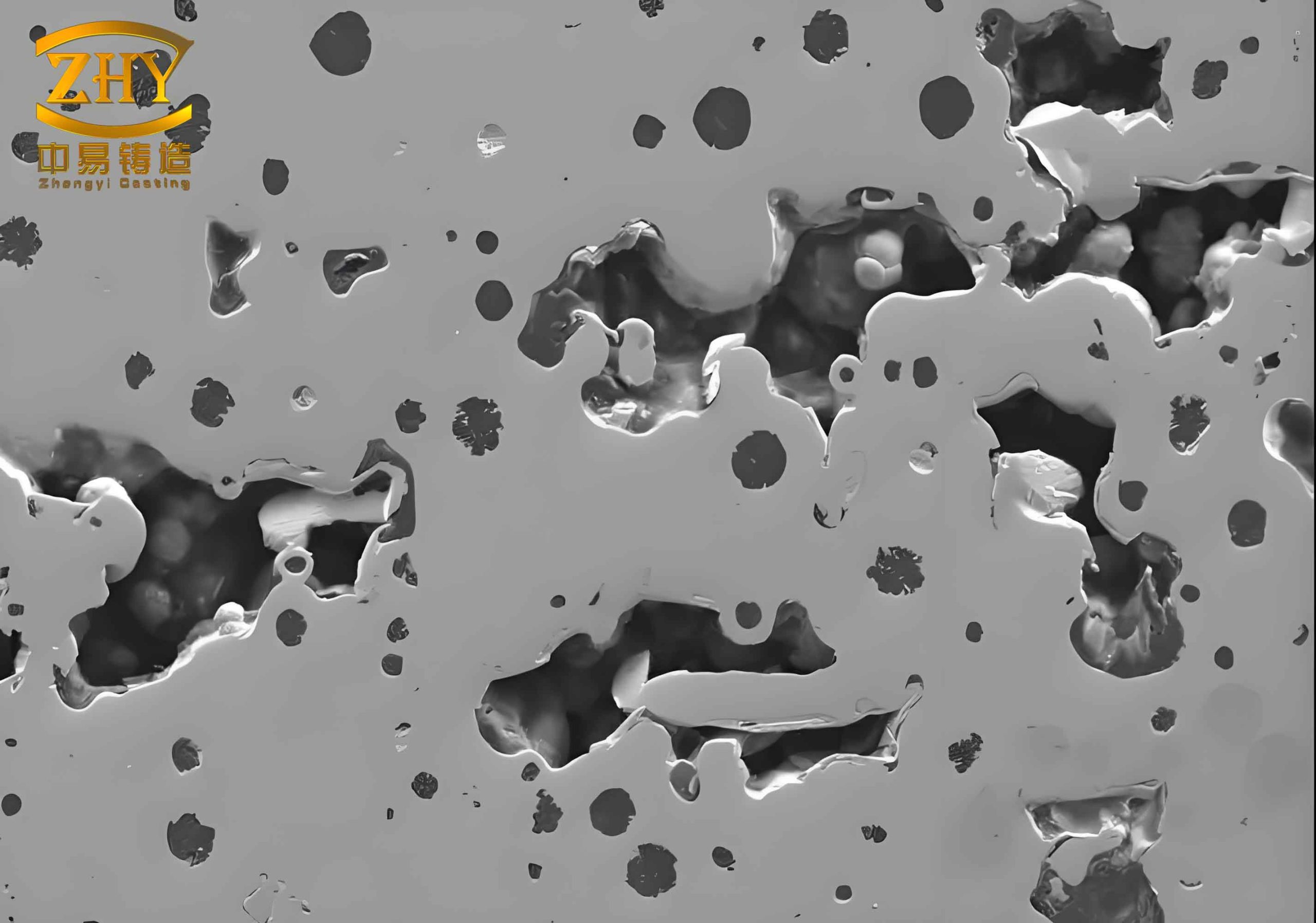
1. Gas Porosity (Blowholes) – Formation and Countermeasures
Gas porosity is one of the most troublesome sand casting defects in furan resin sand. Bubbles form when gases released during pouring are trapped in the solidifying metal. The primary sources of gas are the thermal decomposition of resin and hardener, moisture in sand, and entrapped air. I have identified six effective strategies:
- Choose appropriate resin and minimize addition – Excess resin or hardener raises the nitrogen content and gas evolution. I always use nitrogen‑free or low‑nitrogen resins (e.g., a commercial nitrogen‑free resin such as FL105 or XY90‑0) and keep the total binder addition as low as possible.
- Control fine dust content in reclaimed sand – High fines increase gas evolution and reduce permeability. I regularly monitor the fines content (target ≤0.8 %) and, if it exceeds the limit, add fresh sand while improving the reclamation system.
- Ensure thorough drying of cores and molds – Residual moisture in sand cores acts as a gas source. I strictly control the coating drying procedure and avoid applying wet coatings.
- Design proper venting channels – I align core prints and mold vents to prevent blockage. Increasing pouring height also helps gas escape. Pouring speed should not be too low to avoid premature solidification.
- Adjust base sand grain size – Coarser sand (e.g., 30/50 mesh for large castings) improves permeability without sacrificing surface finish.
- Control pouring temperature – A proper temperature range prevents both gas porosity and metal penetration. The exact temperature depends on casting wall thickness and alloy type.
The following table summarizes the causes and remedial actions for gas‑related sand casting defects:
| Root Cause | Indicator | Action |
|---|---|---|
| High resin/hardener addition | Increased nitrogen content | Use low‑N or N‑free resin; reduce addition rate |
| Excessive fines in reclaimed sand | Reduced permeability, high gas evolution | Add fresh sand; improve reclamation; keep fines ≤0.8 % |
| Moisture in cores/molds | Blowholes near core surface | Strict drying; use proper coating |
| Poor venting | Gas trapped in isolated pockets | Align vents and core prints; increase pouring height |
| Fine sand grains | Low permeability | Use coarser sand (30/50 or 40/70 mesh) |
| Incorrect pouring temperature | Simultaneous gas and sand burning | Adjust temperature to avoid cold shuts and gas |
2. Mechanical Sand Burning (Metal Penetration)
Mechanical sand burning occurs when liquid metal penetrates into the interstices of the mold under ferrostatic pressure and solidifies, creating a rough, fused layer on the casting surface. This is a common sand casting defect in steel castings produced with furan resin sand. I have implemented the following measures to eliminate it:
- Optimize sand grading – Using a multi‑sieve distribution (e.g., 30/50 or 40/70 mesh for medium‑large castings) increases packing density and thus resistance to metal penetration.
- Select and apply coatings properly – A coating with good penetration depth and thermal stability forms an effective barrier. For critical hot spots, I apply two coats to build sufficient thickness.
- Take advantage of reclaimed sand – After repeated thermal cycling, reclaimed sand exhibits better thermal stability and rounder grain shape, reducing penetration risk.
- Improve pattern surface and mold compaction – Smooth patterns and high ramming density (especially around undercuts, corners, and stepped sections) minimize surface irregularities that favor penetration.
- Control pouring temperature – Lowering the pouring temperature safely (without causing cold shuts) reduces fluidity and thus the driving force for penetration.
Table 2 lists the key parameters and their effects:
| Parameter | Target / Action | Effect on Defect |
|---|---|---|
| Sand grain distribution | Multi‑sieve; AFS number appropriate for casting size | Higher density → lower permeability to metal |
| Coating | Double coating on hot spots; good penetration into mold | Physical barrier |
| Reclaimed sand | Use >80 % reclaimed with low LOI (≤1.5 %) | Improved thermal stability |
| Pattern surface and compaction | Roughness ≤ Ra 3.2 µm; compaction pressure ≥ 0.6 MPa | Fewer capillaries for metal ingress |
| Pouring temperature | Reduce by 20–30 °C while avoiding cold shuts | Less fluidity → lower penetration force |
3. Mold Sticking (Adhesion of Sand to Pattern)
When sand sticks to the pattern or core box during stripping, it damages the mold surface and can render the casting a reject. This sand casting defect is caused by poor pattern surface finish, improper release agent, or premature stripping. My preferred solutions are:
- Maintain pattern and core box surface quality (polished or coated with wear‑resistant paint).
- Select the correct release agent based on ambient temperature – for cold weather use a quick‑drying type, for hot weather use a slower‑drying one.
- Wait for the sand to reach adequate strength before stripping; do not strip too early.
4. Control of Curing Time
I have observed that curing time significantly affects both productivity and casting quality. Too fast curing leads to brittle molds and short bench life; too slow curing reduces productivity and may cause distortion. The influencing factors and my recommended actions are:
| Problem | Common Season | Root Cause | Remedy |
|---|---|---|---|
| Too fast curing | Summer (high temperature) | Sand temperature >35 °C; excessive hardener | Cool sand to <35 °C; reduce hardener type or amount |
| Too slow curing | Winter (low temperature) | Sand temperature <10 °C; high clay or moisture in sand | Preheat mold boxes to ≥10 °C; increase hardener dosage or use stronger acid; ensure sand quality |
I emphasize that increasing hardener simply to accelerate curing is detrimental – it raises gas evolution and reduces mold strength. Instead, sand temperature control is the preferred method.
5. Selection of Resin and Hardener
The choice of resin and hardener depends on the alloy type and casting wall thickness. For steel castings (carbon steel and alloy steel), nitrogen‑free resins are mandatory to avoid pinhole porosity. I always match the hardener activity with the ambient temperature. Table 4 provides a simplified guide:
| Alloy Type | Resin Type | Recommended Hardener | Notes |
|---|---|---|---|
| Carbon steel, low‑alloy steel | Nitrogen‑free furan resin (e.g., FL105, XY90‑0) | Sulfonic acid type (fast, medium, slow grades) | Match hardener activity to sand temperature |
| High‑alloy steel, stainless steel | Nitrogen‑free resin with low free formaldehyde | Phosphoric acid or blended acid | Avoid sulfur contamination for sensitive alloys |
| Heavy sections (>100 mm) | High‑strength furan resin (low nitrogen still) | Slow hardener to allow uniform hardening | Prevent hot tearing |
6. Reducing Binder Consumption
Lower binder addition not only reduces cost but also minimizes gas evolution and the risk of sand casting defects. I follow these principles:
6.1 Proper Strength Specification
The tensile strength of furan resin sand is typically set between 0.8 and 1.0 MPa for molds and 1.6–2.0 MPa for complex cores. Exceeding these values wastes resin and can increase brittleness. The relationship between binder content and strength can be approximately expressed as:
$$ \sigma = \sigma_{\text{max}} \left(1 – e^{-k C}\right) $$
where \( \sigma \) is the tensile strength, \( C \) is the resin content (wt.%), \( \sigma_{\text{max}} \) is the maximum achievable strength, and \( k \) is a constant. Beyond a certain point, increasing \( C \) yields diminishing returns.
6.2 High‑Quality Base Sand
Using sand with low clay (<0.2 %), low fines (<0.8 %), low moisture (<0.2 %), and an angularity factor <1.35 reduces the binder demand. The recommended grain sizes for different casting masses are shown in Table 5.
| Casting Category | AFS Grain Fineness | Typical Mesh (USA) |
|---|---|---|
| Large castings (>500 kg) | 30–40 | 30/50 or 40/70 |
| Medium castings (50–500 kg) | 40–55 | 40/70 or 50/100 |
| Small castings (<50 kg) | 55–80 | 50/100 or 100/140 |
6.3 Benefits of Reclaimed Sand
Reclaimed sand has superior thermal stability because the silica grains undergo a phase transformation during repeated heating, reducing the volume expansion that can cause hot tearing. Additionally, the acid demand is lower due to removal of alkaline oxides, allowing a reduction in hardener addition. I maintain the following quality indexes for reclaimed sand:
- Fines content (mass fraction) ≤ 0.8 %
- Loss on ignition (LOI) for steel castings ≤ 1.5 %
- Acid demand ≤ 5 mL (0.1 N NaOH per 50 g sand)
6.4 Mixing Quality
Accurate metering of resin and hardener is crucial. I use a twin‑arm continuous mixer with a two‑stage mixing process: first add hardener, then resin, to ensure uniform coating. The mixing efficiency directly affects the minimum binder addition needed to achieve target strength.
6.5 Sand Temperature Control
The ideal sand temperature for furan resin sand is 20–30 °C. Deviations require adjustment of hardener type and amount. In winter, I preheat the sand to at least 10 °C; in summer, I cool it below 35 °C using a sand cooler.
6.6 Reduction of Sand‑to‑Metal Ratio
A lower sand‑to‑metal ratio reduces binder consumption and improves casting quality. I adopt the following measures:
- Use filler materials (e.g., lumps of refractory brick, stones, or wood blocks) in areas with large sand thickness.
- Design the sand mold with a minimum sand thickness of about 50 mm for shaped flasks; for non‑critical areas, the thickness can be reduced further.
The sand‑to‑metal ratio \( R_{s/m} \) is defined as:
$$ R_{s/m} = \frac{\text{mass of sand used}}{\text{mass of liquid metal poured}} $$
By reducing \( R_{s/m} \) from a typical value of 3–4 to 1.5–2.5, I have observed a 20–30 % reduction in binder consumption and a significant decrease in gas‑related sand casting defects.
7. Integrated Strategy for Defect‑Free Castings
Based on my practical experience, the most effective way to eliminate sand casting defects in furan resin sand is a holistic approach that combines:
- Selection of nitrogen‑free resin with minimal addition (typically 0.8–1.2 % based on sand mass).
- Use of high‑quality reclaimed sand with controlled LOI and fines.
- Proper mold and core design with adequate venting and controlled pouring temperature.
- Reduction of sand‑to‑metal ratio through intelligent flask design.
- Strict monitoring of sand temperature and curing time, adjusting hardener type accordingly.
I have compiled a summary formula for the probability of gas‑related sand casting defects as a function of key variables, which can be used for process optimization:
$$ P_{\text{gas}} \propto \frac{(N_{\text{resin}} + N_{\text{hardener}}) \cdot V_{\text{binder}} \cdot T_{\text{pour}}}{\text{Permeability} \cdot \text{Venting}_{\text{eff}} \cdot (T_{\text{solidus}} – T_{\text{pour}})} $$
where \( N \) represents nitrogen content, \( V_{\text{binder}} \) is the binder volume fraction, \( T_{\text{pour}} \) is pouring temperature, and \( T_{\text{solidus}} \) is the solidus temperature of the alloy. Although not exact, this expression guides me in balancing trade‑offs.
Conclusion
Over the years, I have systematically addressed the major sand casting defects encountered in furan resin sand production of steel castings. By focusing on raw material quality, binder reduction, process parameter control, and mold design, I have achieved a substantial improvement in casting soundness and productivity. The tables and formulas presented here serve as a practical reference for foundry engineers who face similar challenges. Continuous monitoring and adjustment remain essential, as the behavior of furan resin sand is sensitive to seasonal changes and batch variations. Through disciplined application of these principles, the occurrence of sand casting defects can be minimized, leading to higher yield and lower production costs.