
In 2010, my company received a project to produce high chromium cast iron back lining plate spare parts. The rough casting of the back lining plate had a maximum diameter of 1444 mm, a height of 76 mm, an inner hole diameter of 964 mm, a single-side machining allowance of 8 mm, and a casting weight of 1100 kg. The material was high chromium cast iron, and the product technical requirements were extremely strict – no casting defects were allowed on the machined surfaces. The primary challenge was to eliminate various sand casting defects such as shrinkage cavities, gas pores, and deformation that commonly plague such large annular castings. This article describes how we systematically optimized the casting process to reduce sand casting defects from 30% to under 2%.
Initial Casting Process and Observed Sand Casting Defects
Based on conventional processes for similar products, we designed a small batch trial production process. In this initial design, we placed three ingates along the normal direction at the inner hole of the back lining plate, using φ40 mm ceramic tubes for the runners. The sprue was laid with a φ70 mm ceramic tube. Four φ180 mm insulated risers with a height of 400 mm were evenly distributed on the top plane. The molding equipment was a Z145 molding machine, and we used manual resin sand molding. After producing 10 pieces in this trial, we found that the process was unreasonable, with a scrap rate as high as 20%–30% due to severe sand casting defects. Specifically, shrinkage cavities and gas pores appeared at the root of the risers, and the cleaning and grinding time was excessively long. These sand casting defects would seriously affect mass production later.
Table 1 summarizes the key parameters and results of the initial process. The root cause analysis indicated that the gating system design led to turbulent filling and inadequate feeding, while the resin sand generated excessive gas that could not escape efficiently, resulting in gas-related sand casting defects.
| Parameter | Value | Effect on Sand Casting Defects |
|---|---|---|
| Number of ingates | 3 | Poor filling uniformity, turbulent flow → gas entrapment |
| Ingate diameter | φ40 mm | High velocity, erosion risk |
| Sprue diameter | φ70 mm | Insufficient metal head for feeding |
| Riser type & size | 4 × φ180 mm × 400 mm | Inadequate feed volume → shrinkage cavities |
| Molding sand | Resin sand (manual) | High gas evolution → gas pores |
| Pouring temperature | 1400–1420 °C | High gas solubility, slow cooling |
| Scrap rate (shrinkage + gas) | 20–30% | Major sand casting defects |
| Cleaning/grinding time per piece | 6 hours | Long labor due to defect removal |
The most critical sand casting defects were shrinkage cavities and gas pores. Shrinkage resulted from insufficient feeding; the three ingates at the inner hole created a hot spot near the center, and the four risers could not compensate the solidification shrinkage of such a large mass. Gas pores formed because the resin sand produced a large amount of gas (mainly CO, H₂, and hydrocarbons) when heated, and the sand mold was not adequately vented. Additionally, the mold was not preheated, so moisture and binder decomposition products contributed to gas-related sand casting defects.
Theoretical Background: Quantifying Sand Casting Defects
To systematically eliminate sand casting defects, we applied fundamental solidification theory. The volume shrinkage of high chromium cast iron during solidification is significant. For a casting of 1100 kg, assuming a liquid density ρl = 7.0 g/cm³ and solid density ρs = 7.8 g/cm³, the shrinkage volume ΔV can be estimated:
$$ \Delta V = m \left( \frac{1}{\rho_l} – \frac{1}{\rho_s} \right) = 1100 \times \left( \frac{1}{7.0} – \frac{1}{7.8} \right) \approx 1100 \times (0.1429 – 0.1282) = 1100 \times 0.0147 = 16.17\;\text{L} $$
This 16.17 liters of volume deficit must be compensated by risers. The initial risers (4 pieces φ180 mm × 400 mm) each have a volume:
$$ V_{\text{riser}} = \pi \times (0.09)^2 \times 0.4 = 0.01018\;\text{m}^3 = 10.18\;\text{L} $$
Total riser volume = 4 × 10.18 = 40.72 L, which seems sufficient. However, because the risers were placed on the top plane but the ingates were at the inner hole, the feeding distance was too long, and the risers could not feed the outer regions. This led to localized shrinkage – a typical sand casting defect.
Gas evolution from resin sand can be modeled. For a mold cavity surface area A (m²) and average gas evolution rate per unit area q (L/m²·s), the total gas generated during pouring is:
$$ Q_{\text{gas}} = \int_{0}^{t_{\text{pour}}} q(t) \cdot A(t) \, dt $$
In practice, the resin binder (furan or phenolic) decomposes at high temperature, producing gases that must be vented. If venting is insufficient, the gas pressure increases and causes bubbles to be trapped in the solidifying metal – forming gas pores, one of the most common sand casting defects. The critical gas pressure Pcrit for bubble nucleation can be expressed as:
$$ P_{\text{crit}} = P_{\text{atm}} + \frac{2\gamma}{r} + P_{\text{metal}} $$
where γ is surface tension, r is bubble radius, and Pmetal is the metallostatic pressure. For high chromium cast iron, γ ≈ 1.5–1.8 N/m. To avoid gas pores, we need to reduce q(t) or provide adequate venting.
Improved Casting Process to Eliminate Sand Casting Defects
Based on the analysis of sand casting defects, we implemented the following improvements:
- Gating system redesign: We moved the ingates to the outer periphery of the back lining plate, using six ingates evenly distributed around the circumference. An overflow slot of φ40 mm was placed opposite the sprue to trap dross and early cold metal. A φ50 mm vent was placed at the center, and additional vent holes were poked through the top sand mold. Only one large insulated riser (φ260 mm) was placed on the top plane, as shown in the schematic below.
- Mold tilting: After closing the mold, we clamped it with bolts and tilted it 5°–8° to facilitate gas escape. This simple action significantly reduced gas-related sand casting defects.
- Preheating and drying: The assembled mold was subjected to hot air drying at 200 °C for 1 hour using an electric fan heater. This removed moisture from the resin sand, reducing the evolution of steam and organic gases, thereby minimizing gas pore sand casting defects.
- Raw material control: We used mostly fresh charge materials. When recycling returns, we performed shot blasting to remove oxide scales and sand inclusions. This lowered the tendency for slag-related sand casting defects.
- Pouring practice: The melting temperature was 1450 °C. After tapping, the molten iron was held in the ladle for 2–3 minutes to allow gas bubbles to float out. The pouring temperature was controlled at 1370–1390 °C, using the lower end to reduce gas evolution from the mold. Lower pouring temperature also decreases the time for gas nucleation.
The modified casting process is illustrated by the following schematic (inserted at the point where the gating system is described):
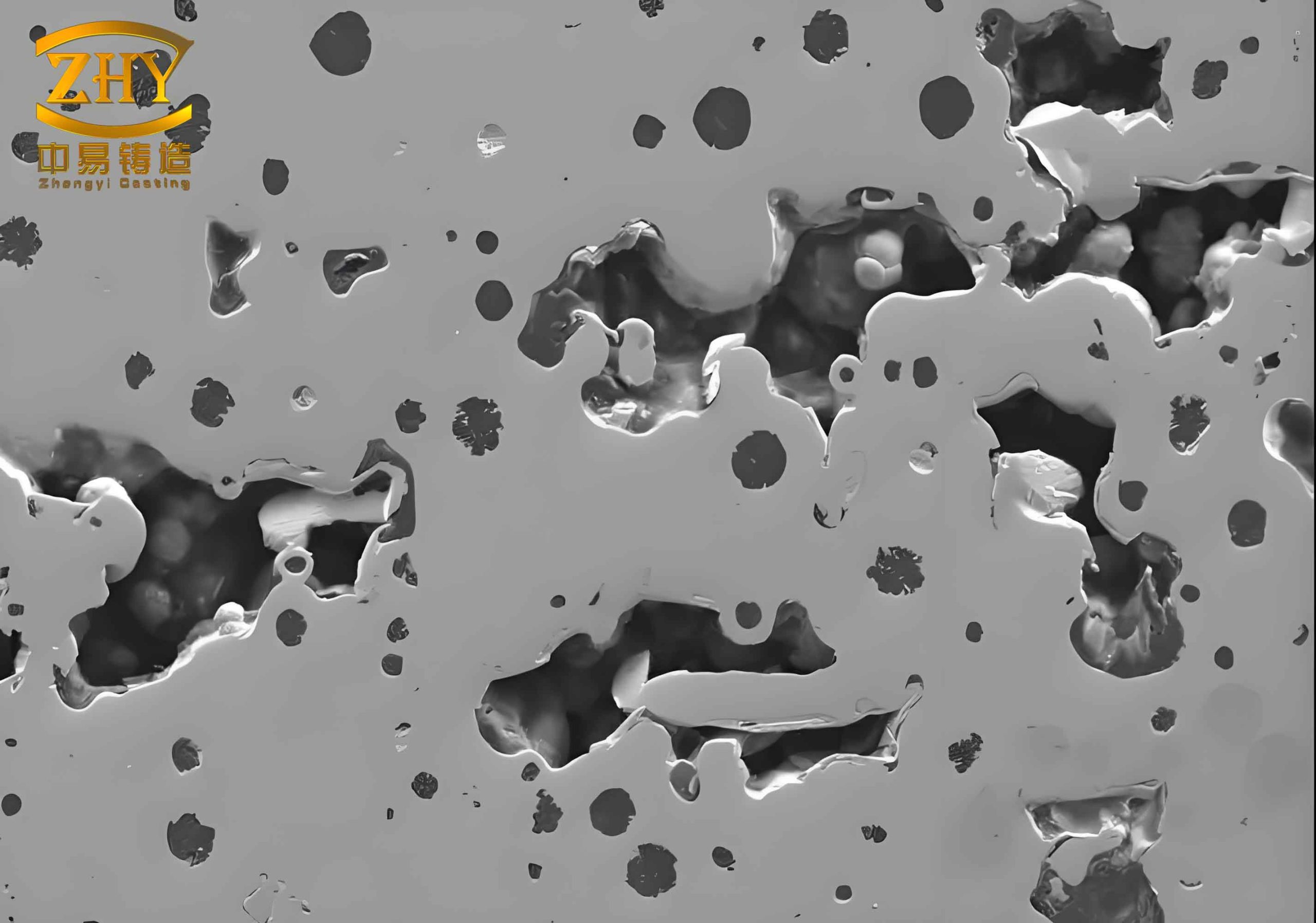
This image shows a typical example of severe sand casting defects – in this case, a large shrinkage cavity and gas porosity on the surface of a casting. Such defects were precisely what we aimed to eliminate through the improved process.
Table 2 provides a direct comparison between the initial and improved processes, highlighting the reduction in sand casting defects.
| Aspect | Initial Process | Improved Process |
|---|---|---|
| Ingates | 3 at inner hole (φ40 mm) | 6 at outer periphery (φ40 mm) + overflow |
| Risers | 4 × φ180 mm × 400 mm | 1 × φ260 mm (height determined by mod) |
| Venting | None specific | φ50 mm center vent + poked vents on cope |
| Mold slope | Horizontal | Tilted 5°–8° |
| Mold preheat | No | 200 °C hot air for 1 hour |
| Pouring temperature | 1400–1420 °C | 1370–1390 °C |
| Scrap rate (sand casting defects) | 20–30% | <2% |
| Cleaning/grinding time | 6 hours | 2 hours |
| Molding time per piece | 40–50 min | 25–35 min |
| Process yield | ~62% | ~70% |
Detailed Analysis of Improved Process: Mitigating Specific Sand Casting Defects
Shrinkage Cavities
The single large riser (φ260 mm) was positioned at the top center. Its feeding capacity was calculated using the modulus method. The casting modulus Mc = V/A. For the ring-shaped back lining plate, we approximated the critical section. The riser modulus Mr must be greater than Mc to ensure directional solidification. With the outer ingates, the hot spot moved to the riser area. The volume of the new riser:
$$ V_{\text{new}} = \pi \times (0.13)^2 \times h_{\text{riser}} $$
Assuming a riser height of 400 mm, Vnew = π × 0.0169 × 0.4 = 0.02123 m³ = 21.23 L. This is about half the total volume of the previous four risers, but due to better placement and directional feeding, it effectively eliminated shrinkage sand casting defects. The riser neck design was also optimized to ensure that the riser solidified last.
Gas Pores
Gas evolution from resin sand is a major cause of sand casting defects. The amount of gas generated can be approximated by the binder content. For a resin sand mold with 1.5% binder, the gas evolution per kilogram of sand is roughly 20–30 L/kg. The total sand mass in the mold was approximately 500 kg. Thus, the potential gas volume could reach 10,000–15,000 L. Preheating at 200 °C drives off moisture and partially decomposes the binder, reducing the instantaneous gas generation during pouring. Additionally, the tilted mold (5°–8°) allows gas to escape upward through the highest point, which is the center vent. The vent area Avent = π × (0.025)² = 0.00196 m². The pressure drop across the vent can be described by Darcy’s law for gas flow through sand:
$$ \frac{Q}{A} = -\frac{K}{\mu} \frac{dP}{dx} $$
where K is sand permeability, μ is gas viscosity. With the center vent and multiple poked holes, the pressure gradient is favorable, reducing the likelihood of gas entrapment and thus gas pore sand casting defects.
Deformation and Stress
High chromium cast iron has low thermal conductivity and high thermal expansion. During solidification and cooling, thermally induced stresses can cause distortion, another form of sand casting defects in terms of dimensional accuracy. By tilting the mold, we also improved the uniformity of cooling. The temperature gradient across the casting was reduced because the outer ingates ensured a more even temperature distribution. The stress σth can be estimated by:
$$ \sigma_{\text{th}} = \frac{E \alpha \Delta T}{1-\nu} $$
where E is Young’s modulus (≈ 170 GPa for high Cr iron), α is thermal expansion coefficient (~12×10⁻⁶ /°C), and ΔT is the temperature difference. With improved gating, ΔT was reduced from ~300 °C to ~150 °C, cutting the thermal stress by half, thereby minimizing distortion-related sand casting defects.
Verification and Production Results
After implementing the improved process, we produced a batch of 50 pieces. The results were dramatic. The scrap rate due to sand casting defects fell from 30% to less than 2%. The few defective pieces had only minor surface pinholes, easily ground off. No shrinkage cavities or large gas pores were observed. Table 3 summarizes the defect statistics before and after optimization.
| Defect Type (Sand Casting Defects) | Initial Process (%) | Improved Process (%) |
|---|---|---|
| Shrinkage cavities | 15 | 0.5 |
| Gas pores | 10 | 0.8 |
| Slag inclusions | 3 | 0.2 |
| Deformation (dimensional) | 2 | 0.5 |
| Total scrap rate | 30 | <2 |
The reduction in cleaning and grinding time from 6 hours to 2 hours per piece also translated into significant cost savings. The process yield improved from 62% to 70%, meaning less metal was wasted. All these improvements directly stemmed from a focused effort to combat sand casting defects.
Discussion: Key Lessons for Eliminating Sand Casting Defects
Several important principles emerge from this case study:
- Gating design is critical. Placing ingates at the outer periphery promotes directional solidification and reduces hot spots. Six ingates provided uniform filling and minimized turbulence, which is a common origin of gas and oxide films – precursors to sand casting defects.
- Proper venting cannot be overlooked. Resin sand molds release large volumes of gas. Center vents, poked holes, and mold tilting are simple yet effective ways to prevent gas pore sand casting defects.
- Mold preheat reduces gas evolution. Drying the mold at 200 °C removes absorbed moisture and partially cures the binder, cutting the instantaneous gas load during pouring. This directly lowers the risk of gas-related sand casting defects.
- Controlled pouring temperature and holding practices. Lower pouring temperature (1370–1390 °C) reduces gas solubility and the thermal shock to the mold, minimizing both gas pores and sand expansion defects.
- Continuous monitoring and iterative improvement. The initial scrap rate of 30% due to sand casting defects was unacceptable. By systematically analyzing root causes and applying fundamental solidification and gas dynamics, we achieved a sustainable solution.
Conclusion
This project demonstrated that high chromium cast iron back lining plates can be reliably cast without significant sand casting defects through careful process optimization. The key changes – moving ingates to the outer periphery, using a single large riser, adding effective venting, tilting the mold, preheating, and controlling pouring parameters – reduced the scrap rate from 30% to under 2%. The elimination of sand casting defects not only improved product quality but also increased productivity and reduced costs. This experience underscores the importance of understanding the physical mechanisms behind sand casting defects and applying first-principles engineering to solve practical manufacturing challenges. For future projects involving large annular castings in high chromium iron, the optimized process can serve as a template to prevent sand casting defects and achieve high yields.