
In the global wave of intelligent manufacturing transformation, our casting industry is confronted with the dual challenges of industrial structure adjustment and development mode transition. For decades, the industry has been plagued by excessive resource consumption, severe environmental pollution, and low production efficiency, which are fundamentally incompatible with the principles of sustainable development. Through systematic research and extensive practical validation, we have recognized that sand casting 3D printing technology serves as a representative intelligent manufacturing method, offering a transformative solution for the casting sector. Our collaborative innovation center has successfully established over ten digital demonstration production lines across multiple regions nationwide, and formulated corresponding technical specifications. These practices have provided solid technical evidence and support for the industry, steering production processes toward automation and refinement, while significantly enhancing both production efficiency and environmental performance. The work we have undertaken holds substantial practical significance for promoting the high-quality development of China’s casting industry.
1. Overall Architecture of the Intelligent Casting Factory
The overall system architecture of an intelligent casting factory is composed of four distinct layers: the Equipment Layer, the Unit Layer, the Workshop Layer, and the Enterprise Layer. This hierarchical structure ensures seamless integration and coordinated control from the physical hardware to the enterprise-level management systems. The key characteristics of each layer are as follows:
| Layer | Primary Components | Integration Method |
|---|---|---|
| Equipment Layer | Unit equipment, inspection devices, auxiliary equipment, and their control systems | Fieldbus (FB) communication with Unit Layer |
| Unit Layer | Sand mold 3D printing unit, melting & pouring unit, post-processing unit, etc. | Data interface integration with Workshop Layer |
| Workshop Layer | Planning management, process design management, quality management, equipment management, tooling management, energy management, etc. | System integration via data interfaces with Unit and Enterprise layers |
| Enterprise Layer | Warehouse management, supply chain management, customer relationship management, safety/environment/health management, etc. | Integrated information systems for cross-business data coordination |
The integration of these layers is accomplished through standardized data interfaces. At the unit level, the fieldbus (FB) protocol is used to connect control systems of individual equipment. Between the workshop layer, unit layer, and enterprise layer, system-to-system data interfaces are implemented, enabling real-time data exchange and collaborative decision-making. The core hardware layer (Equipment Layer) includes sand mold 3D printing machines, robotic handling systems, melting furnaces, pouring devices, shot blasting machines, and various inspection and auxiliary equipment. Each piece of equipment is equipped with a digital control system that supports industry-standard communication protocols and Ethernet connectivity, allowing direct access to the workshop local area network. This connectivity enables the collection of key operational parameters such as temperature, pressure, flow rate, position, and cycle times.
To visually represent the integration, we provide the following illustration of a typical intelligent foundry configuration:
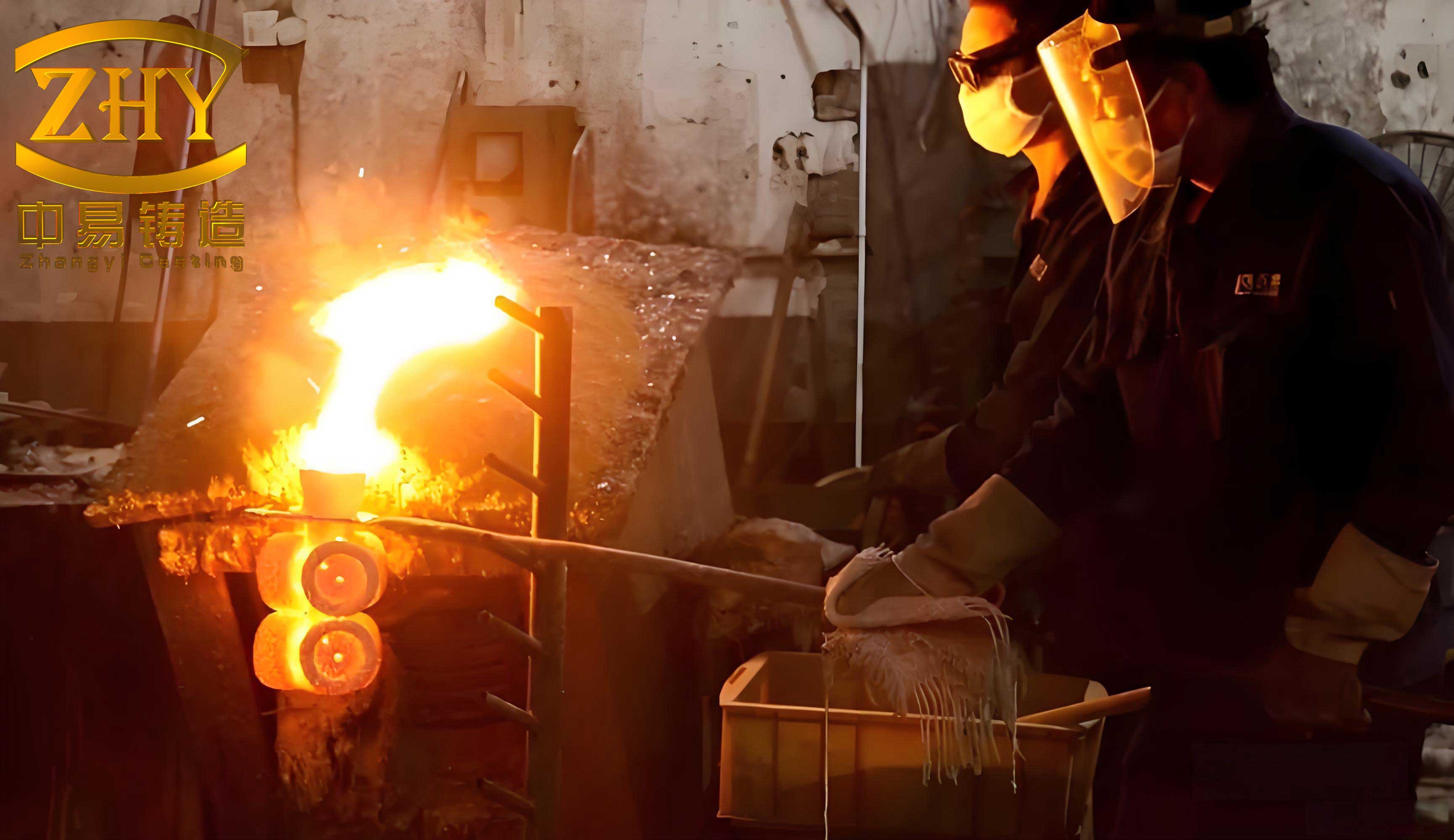
Figure: A representative image of precision investment castings manufactured using advanced sand casting and 3D printing techniques, illustrating the high-quality output achievable with intelligent factory systems.
2. General Requirements for Factory System Construction
2.1 Intelligent Equipment
Intelligent equipment is categorized by unit type: sand mold 3D printing unit equipment, melting and pouring unit equipment, post-processing unit equipment, inspection devices, and auxiliary equipment. Every control system must be equipped with multiple error-proofing and safety protection mechanisms, and must support numerical control (NC) and networked capabilities. The following table summarizes the key technical requirements for critical equipment:
| Equipment Category | Key Technical Requirements |
|---|---|
| Sand Mold 3D Printer | Modular line integration capability; job box/work platform with unique barcode; fluid temperature control; comply with GB/T 42156 |
| Sand Mixing & Supply Equipment | Mixing and supply rate meeting line demand; ability to blend reclaimed and new sand; mixing uniformity per GB/T 42156 |
| Sand Mold Gripping Robot | Sealed gripper to prevent sand and coating ingress; repeat positioning error ≤ 0.5 mm; safety system per GB/T 37415 |
| Charging & Batching Equipment | Automatic batching; receive material list; weighing display; batching error ≤ 0.2% of set value; exchange data with furnace and pit parameters |
| Melting Furnace | Comply with GB/T 10067.1 (technical); safety per GB/T 5959.1 |
| Transfer & Pouring Equipment | Pouring speed control; autonomous movement and positioning; exchange data on pouring time, duration, and mass |
| Shot Blasting Equipment | Adjustable cycle time/feed rate; manual touch-up station; exchange data on air pressure, impeller current, blade/lining usage; predictive replacement alerts |
Additionally, all equipment must support mainstream industrial communication protocols (e.g., PROFINET, EtherNet/IP, Modbus TCP) and provide open access permissions for integration with third-party systems. The digital twin capability is optionally recommended for predictive maintenance and performance optimization.
2.2 Unit Control Systems
The unit layer comprises three principal subsystems: the sand mold 3D printing unit system, the melting and pouring unit system, and the post-processing unit system. Each unit system must fulfill the following generic requirements:
| Unit System | Core Functional Requirements |
|---|---|
| Sand Mold 3D Printing Unit | Acquire sand mold production plan from workshop layer; generate core-making and core-assembly plans based on process design; develop pre-production checklists (materials, equipment status, personnel); integrate with intelligent equipment to send/receive key process data; record device parameters in real time; auto/manual report job completion and material consumption |
| Melting & Pouring Unit | Acquire casting production plan from workshop layer; determine melting and pouring schedule; generate material requirement plan; integrate with automatic charging, pouring, and furnace equipment to send batch specifications and pouring parameters; collect process data; integrate with chemical composition and temperature measurement devices; record quality data and compare with standards; provide recommended optimal charge composition; support auto/manual reporting and quality anomaly escalation; optionally optimize charge based on raw material composition, price, and customer requirements |
| Post-processing Unit | Acquire casting production plan; generate operation sequence based on process route; integrate with automatic transfer, shot blasting, heat treatment, and painting equipment; send blasting time, heat treatment curve, etc.; collect real-time equipment status and inspection data; compare with process standards and alert on deviations; auto/manual reporting; track material consumption for cost accounting |
2.3 Workshop Layer Information Systems
The workshop layer includes modules for planning management, process design management, quality management, equipment management, and tooling management. The general requirements for each key module are detailed below:
| Module | Functional Requirements |
|---|---|
| Planning Management | Finite capacity scheduling rule; auto-scheduling based on due date, workstation capacity, factory calendar, equipment status, tooling status; support monthly, weekly, daily multi-level scheduling and capacity evaluation; generate material and tooling requirement plans automatically; release plans to workshop and operation levels; optionally build data-driven scheduling models |
| Process Design Management | Full lifecycle management of design, release, execution, approval; parametric management of process parameters at each node; maintain material lists, process routes, key parameters, process cards, work instructions; version control; auto-match and recommend historical processes during design; optionally build knowledge bases (typical processes, defect library, expert system) to assist decision-making via knowledge reuse |
| Quality Management | Centralized management of inspection data for critical raw materials; support quality traceability and analysis; analyze production data and compare with process standards; generate alerts for non-conformance; implement three-level quality control workflow; support online application, review, and release of quality reports |
| Equipment Management | Equipment ledger and history management; classify by equipment type; create, release, review, and report maintenance and repair plans; support routine inspection and breakdown repair; real-time equipment status monitoring linked with production scheduling; optionally monitor service life of components and provide early warning |
| Tooling Management | Tooling and die ledger; maintain coding, service life, quality inspection data; track usage and return; auto-record usage count and pre-warn before end of life; manage repairs; initiate overhaul process automatically or manually |
2.4 Enterprise Layer Information Systems
The enterprise layer encompasses warehouse management, supply chain management, customer relationship management, and safety, environment, and health (EHS) management. The key requirements are:
| Module | Functional Requirements |
|---|---|
| Warehouse Management | Raw material receiving, production issue/return, finished product in/out; inter-warehouse transfer and physical inventory; safety stock alerts; virtual bin mapping to physical location |
| Supply Chain Management | Aggregate upstream and downstream resources for one-stop digital procurement; price index, supplier management, sourcing, order, and inventory management; generate optimal purchase plan via data models; support inquiry, quotation, and price comparison workflows |
| Customer Relationship Management | Contract, opportunity, lead, supplier evaluation, project progress management; record customer interaction behaviors and generate reliable leads via models; optionally establish supplier admission and evaluation system and select optimal suppliers through analysis |
| Safety Environment Health (EHS) | Environmental safety management; hazard identification, risk control, occupational health management, incident/accident management; environmental factor and hazard source identification with risk control checklist; manage emergency resources, support simulation drills and assessment; record employee health information for occupational disease management; incident reporting, investigation, corrective action, and statistical analysis; IoT monitoring of environmental indicators (e.g., dust, noise, air quality) with evaluation and alerts; optionally leverage AI vision recognition to identify hazards in critical areas |
3. Mathematical Models and Optimization in Intelligent Casting
To quantify the improvements brought by sand 3D printing-based intelligent factories, we employ several mathematical formulations. The overall efficiency gain can be expressed as a composite index:
$$ \eta = \frac{E_{\text{out}}}{E_{\text{in}}} \times 100\% $$
where \(E_{\text{out}}\) is the total value of qualified castings produced per unit time, and \(E_{\text{in}}\) is the total input of energy, raw materials, labor, and overhead costs. Our empirical studies indicate that adopting sand 3D printing and integrated automation leads to an efficiency improvement of at least 35–50% compared with traditional sand casting lines.
The defect rate reduction achieved in intelligent factories is modeled as:
$$ D_{\text{defect}} = D_0 \times (1 – \alpha \cdot \exp(-\beta \cdot t)) $$
where \(D_0\) is the initial defect rate before digital transformation, \(\alpha\) and \(\beta\) are empirical constants derived from machine learning algorithms, and \(t\) represents the number of production cycles after full deployment. Typically, \(\alpha = 0.85\) and \(\beta = 0.02\) per cycle, resulting in a stabilized defect reduction of over 70%.
The energy consumption per unit casting (in kWh/kg) is optimized through the following linear programming formulation for the melting process:
$$ \min \sum_{i=1}^{n} (c_i \cdot x_i + e_i \cdot y_i) $$
subject to constraints on final composition, temperature, and production rate. Here \(c_i\) is the cost coefficient for raw material \(i\), \(e_i\) is the energy coefficient, \(x_i\) is the mass of material used, and \(y_i\) is a binary variable indicating furnace operation. Implementation of this optimization in our smart foundries reduced energy intensity by 20–30%.
Material utilization improvement is described by:
$$ U = \frac{M_{\text{casting}}}{M_{\text{total}}} \times 100\% $$
where \(M_{\text{casting}}\) is the net mass of the final casting, and \(M_{\text{total}}\) includes the sand, binder, and metal used. With 3D printing’s near-net-shape capability, the material utilization for sand molds increases from about 60% in conventional processes to over 90%.
4. Conclusion
We have systematically presented the construction framework and general requirements for an intelligent casting factory based on sand 3D printing technology. Our research demonstrates that by building a four-layer architecture (Equipment, Unit, Workshop, Enterprise) and establishing standardized technical specifications for intelligent equipment, unit control systems, and information management modules, a clear and actionable blueprint for the planning and implementation of intelligent foundries can be provided. The core value of such intelligent factories lies in fundamentally reshaping traditional casting production. Sand 3D printing enables digital, mold-free fabrication of complex sand molds, serving as the source of intelligent production; subsequent automation and intelligent integration of melting, pouring, and post-processing units, together with the interconnection and deep coordination of information across the entire process, collectively form an efficient, lean, and green modern production system. The successful deployment of digital workshops in multiple regions by our innovation center fully validates the feasibility and advanced nature of this model, achieving not only significant improvements in production efficiency and product quality but also real reductions in energy consumption and environmental pollution.
In summary, driving the intelligent transformation of the casting industry is a profound industrial revolution. The construction model of an intelligent factory based on sand 3D printing provides a critical technical path and a practical paradigm for this revolution. By steadfastly advancing in the direction of digitalization, networking, and intelligence, we will surely help China’s casting industry break through development bottlenecks, move toward high-quality and sustainable progress, and ultimately achieve the historic leap from a large casting country to a strong casting country.