
In the field of modern casting, the integration of sand casting with 3D printing technologies has revolutionized the design and manufacturing of complex, thin-walled components. This study focuses on the optimization of the sand mold 3D printing forming process using a systematic response surface methodology to produce a high-quality thin-walled impeller for low-pressure die casting. The primary objective is to achieve a balance between mechanical strength and gas evolution while minimizing material consumption and improving production efficiency.
Our investigation began with the selection of three critical process parameters: resin inkjet content, activator addition, and printing layer thickness. These parameters directly influence the tensile strength and gas evolution of the printed sand molds, which are vital for defect-free casting. We employed a Box-Behnken design to efficiently explore the parameter space with fewer experimental runs compared to traditional full factorial designs. The independent variable ranges were defined based on preliminary equipment trials: resin inkjet content from 1.35% to 1.65%, activator addition from 0.20% to 0.40%, and printing layer thickness from 0.25 mm to 0.45 mm. The response variables were measured according to standard testing procedures for sand mold properties.
| Level | Resin inkjet content (A) / % | Activator addition (B) / % | Layer thickness (C) / mm |
|---|---|---|---|
| 1 | 1.35 | 0.20 | 0.25 |
| 2 | 1.50 | 0.30 | 0.35 |
| 3 | 1.65 | 0.40 | 0.45 |
Seventeen experiments were conducted, including five center points, to ensure reliability. The obtained data for tensile strength and gas evolution were used to fit quadratic regression models via analysis of variance. The ANOVA results for tensile strength are shown below:
| Source | Sum of squares | df | Mean square | F-value | p-value |
|---|---|---|---|---|---|
| Model | 1.47 | 9 | 0.1635 | 56.68 | <0.0001 |
| A | 1.02 | 1 | 1.02 | 351.93 | <0.0001 |
| B | 0.0001 | 1 | 0.0001 | 0.039 | 0.8491 |
| C | 0.3444 | 1 | 0.3444 | 119.39 | <0.0001 |
| AB | 0.0002 | 1 | 0.0002 | 0.078 | 0.7881 |
| AC | 0.0009 | 1 | 0.0009 | 0.312 | 0.5939 |
| BC | 0.0001 | 1 | 0.0001 | 0.0347 | 0.8576 |
| A² | 0.097 | 1 | 0.097 | 33.61 | 0.0007 |
| B² | 0.0057 | 1 | 0.0057 | 1.97 | 0.2031 |
| C² | 0.0025 | 1 | 0.0025 | 0.8583 | 0.3851 |
| Residual | 0.0202 | 7 | 0.0029 | ||
| Lack of fit | 0.0083 | 3 | 0.0028 | 0.9256 | 0.5055 |
| Pure error | 0.0119 | 4 | 0.0030 | ||
| Total | 1.49 | 16 |
The model for tensile strength is highly significant with a p-value less than 0.0001 and a non-significant lack-of-fit (p = 0.5055). The coefficient of determination R² = 0.9865 indicates excellent agreement between experimental and predicted values. The regression equation for tensile strength (Y₁) in terms of coded variables is:
$$Y_1 = 2.19 + 0.3563A – 0.0037B – 0.2075C + 0.0075AB – 0.015AC + 0.005BC – 0.1518A^2 – 0.0368B^2 – 0.0242C^2$$
Similarly, the ANOVA for gas evolution produced a significant model with R² = 0.9986, as shown in the table below.
| Source | Sum of squares | df | Mean square | F-value | p-value |
|---|---|---|---|---|---|
| Model | 35.81 | 9 | 3.98 | 564.2 | <0.0001 |
| A | 32.16 | 1 | 32.16 | 4559.88 | <0.0001 |
| B | 1.82 | 1 | 1.82 | 258.63 | <0.0001 |
| C | 0.076 | 1 | 0.076 | 10.78 | 0.0134 |
| AB | 0.0042 | 1 | 0.0042 | 0.599 | 0.4643 |
| AC | 0.0020 | 1 | 0.0020 | 0.2871 | 0.6087 |
| BC | 0.0012 | 1 | 0.0012 | 0.1737 | 0.6893 |
| A² | 1.68 | 1 | 1.68 | 238.27 | <0.0001 |
| B² | 0.0030 | 1 | 0.0030 | 0.4272 | 0.5342 |
| C² | 0.0217 | 1 | 0.0217 | 3.07 | 0.1230 |
| Residual | 0.0494 | 7 | 0.0071 | ||
| Lack of fit | 0.0269 | 3 | 0.0090 | 1.59 | 0.3245 |
| Pure error | 0.0225 | 4 | 0.0056 | ||
| Total | 35.86 | 16 |
The gas evolution model equation (Y₂) is:
$$Y_2 = 10.24 + 2.0A + 0.4775B – 0.0975C – 0.0325AB + 0.0225AC – 0.0175BC – 0.6317A^2 – 0.0268B^2 – 0.0718C^2$$
Through response surface and contour plot analysis, we identified that resin inkjet content is the most influential factor for both tensile strength and gas evolution. The interaction between resin content and layer thickness significantly affects tensile strength, while the interaction between resin content and activator addition most strongly influences gas evolution. Based on the optimization goal of achieving high strength with low gas evolution while reducing material usage and increasing layer thickness for efficiency, we used the numerical optimization tool within the design software. The optimal parameters predicted were: resin inkjet content 1.445%, activator addition 0.214%, and layer thickness 0.306 mm, yielding a tensile strength of 2.10 MPa and gas evolution of 9.00 mL/g. For practical implementation, we adjusted these to 1.44%, 0.21%, and 0.30 mm respectively. Verification tests on standard “8” shape specimens printed under these conditions gave a tensile strength of 2.14 MPa and gas evolution of 8.92 mL/g, which agree well with predictions.
Compared to the pre-optimization settings, the optimized process reduced resin consumption by 5.88%, activator by 30%, and increased layer thickness by 0.05 mm, thereby improving printing efficiency by about 16.7%. The optimized sand mold exhibited adequate strength and low outgassing, making it suitable for the low-pressure casting of thin-walled impellers.
To validate the optimized 3D printing sand mold forming process, we applied it to an actual thin-walled impeller casting made of ZL101A aluminum alloy. The impeller has an overall size of 318 mm × 318 mm × 124 mm, with wall thicknesses ranging from 1.2 mm to 44.5 mm. The sand core was printed in one piece with dimensional accuracy ±0.015%. The mold assembly included a riser system with a central sprue of 40 mm diameter, step gates, and chill blocks to promote directional solidification. A filter was placed at the bottom of the sprue to stabilize the melt flow. The casting was produced via low-pressure die casting at a pouring temperature of 745°C and a holding pressure of 38 kPa.
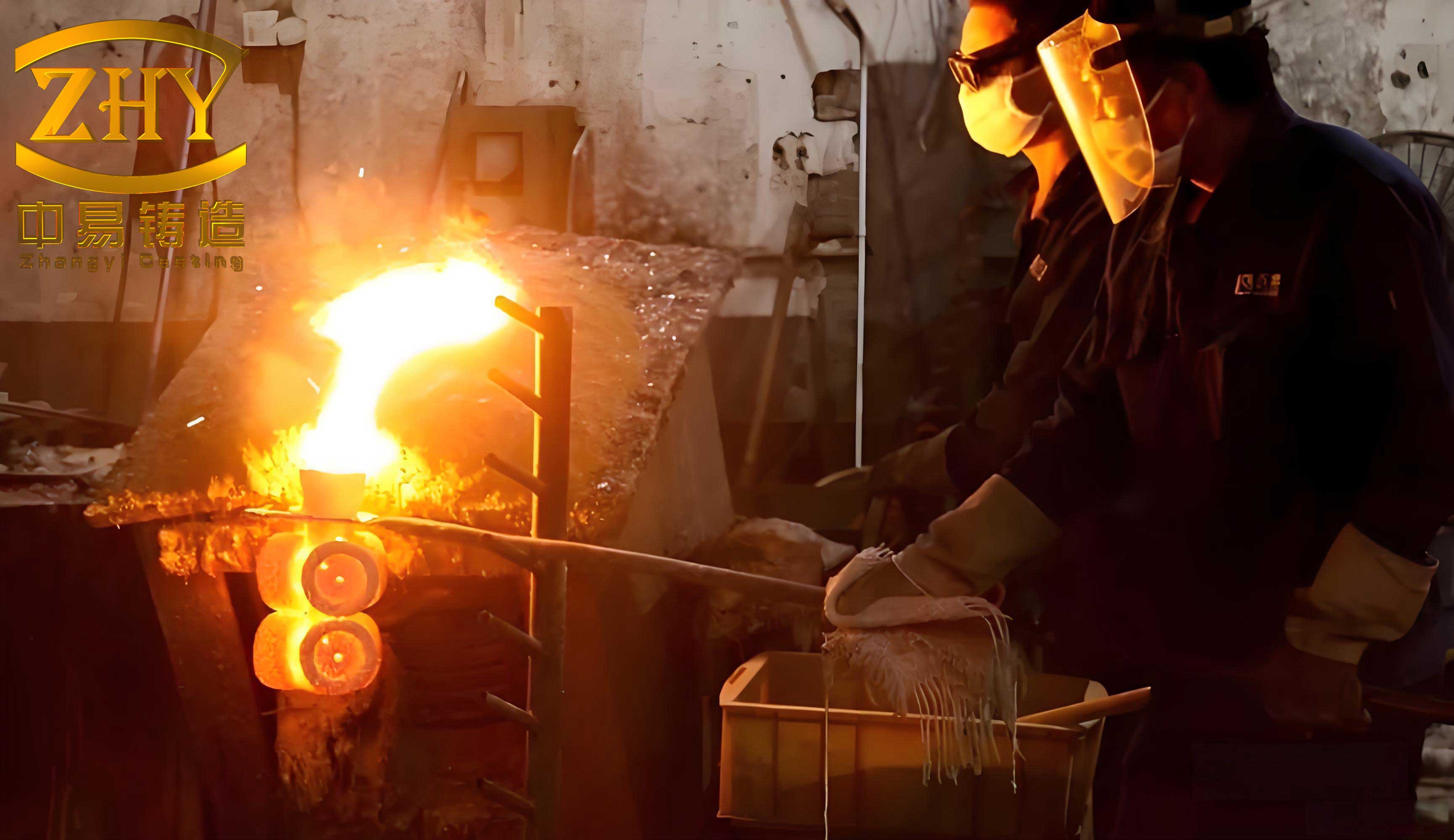
The resulting impeller casting exhibited a clean surface with well-defined blade contours. X-ray inspection confirmed the absence of porosity or shrinkage defects in critical regions. Dimensional accuracy on non-machined surfaces remained within ±0.9 mm, meeting DCTG6 tolerance requirements. The success of this trial demonstrates that the Box-Behnken response surface methodology is a robust approach for optimizing the 3D printing sand mold forming process in sand casting applications, particularly for complex thin-walled components.
In conclusion, the systematic optimization of resin inkjet content, activator addition, and printing layer thickness using response surface methodology enabled the production of sand molds with an excellent combination of high tensile strength (2.14 MPa) and low gas evolution (8.92 mL/g). The optimized process not only reduces material consumption and increases printing efficiency but also ensures the quality of the final casting. This work provides a practical reference for integrating 3D printing with sand casting for demanding industrial applications such as impeller manufacturing.