
In this work, we systematically investigated the influence of carbon equivalent on the microstructure and mechanical properties of high-strength and high-toughness austempered ductile iron (ADI). The carbon equivalent values were designed as 4.2%, 4.3%, 4.4%, and 4.5% by mass fraction. All specimens were subjected to an identical austempering treatment: austenitizing at 900 °C for 90 min followed by isothermal holding at 340 °C for 60 min in a salt bath. We observed the as-cast and heat-treated microstructures using optical microscopy and scanning electron microscopy, and we measured hardness, tensile properties, impact absorbed energy, and fracture morphology. Our results indicate that as the carbon equivalent increases, the graphite nodules in the as-cast state become progressively refined while the matrix constituents remain essentially unchanged. After austempering, the microstructure consists of acicular ferrite and retained austenite. With increasing carbon equivalent, the acicular ferrite becomes finer and more abundant, whereas the retained austenite content decreases. Consequently, the hardness, ultimate tensile strength, and yield strength increase continuously, while the elongation and impact toughness decrease. At a carbon equivalent of 4.5%, the ADI exhibits an excellent combination of strength and toughness, with a Brinell hardness of 374 HBW, ultimate tensile strength of 1196 MPa, yield strength of 997 MPa, and elongation of 9.2%. These findings provide valuable guidance for optimizing the chemical composition of high-performance ductile iron castings.
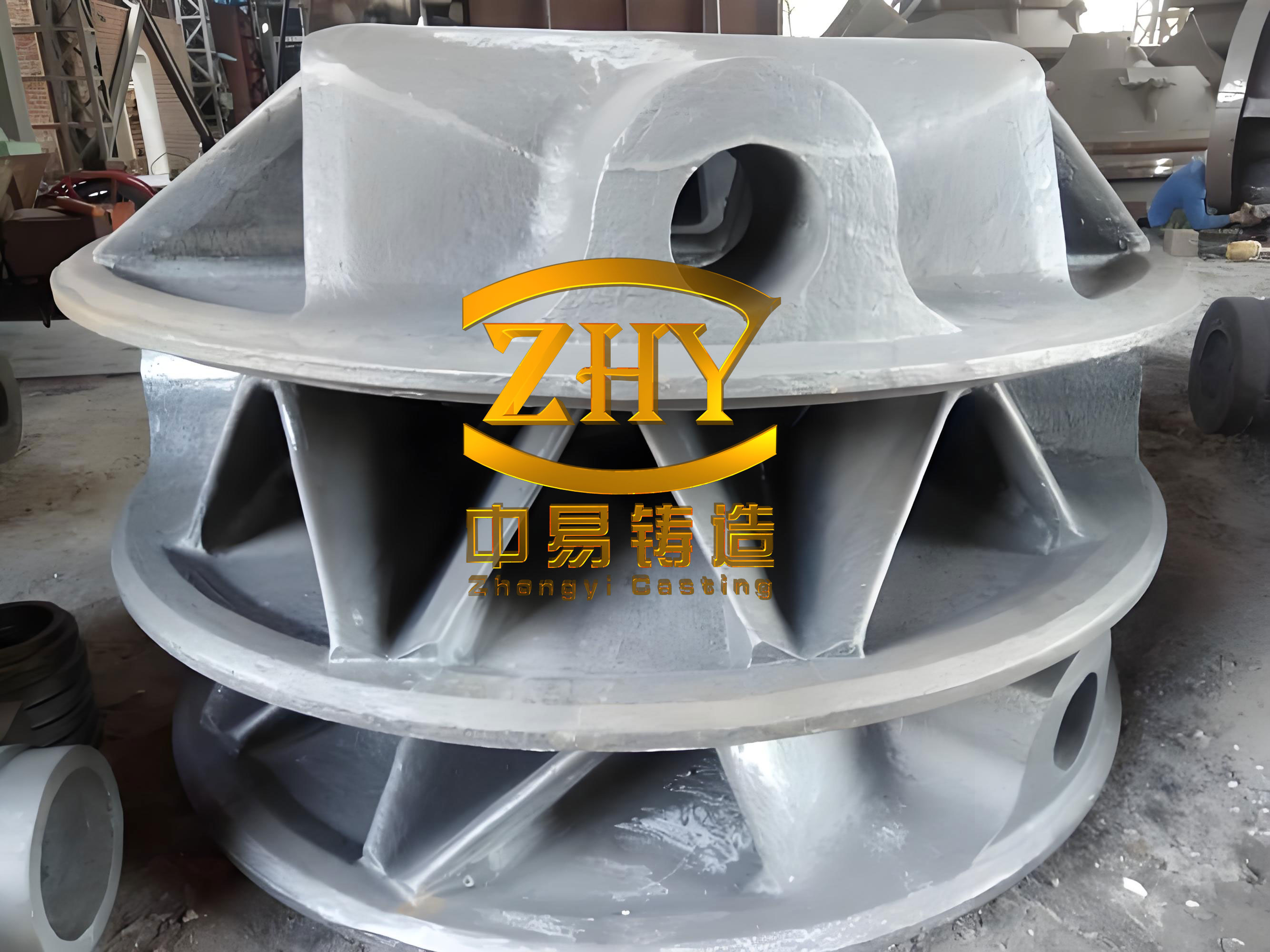
A typical ductile iron casting produced in our laboratory is illustrated below. The spherical graphite morphology, which is essential for achieving superior mechanical properties, can be clearly observed in such castings.
Introduction
Austempered ductile iron has attracted considerable attention in the automotive, railway, and heavy machinery industries because of its excellent combination of strength, ductility, fatigue resistance, and wear resistance. ADI is produced by a specialized heat treatment of ductile iron castings, which transforms the as-cast pearlitic/ferritic matrix into a mixture of acicular ferrite and carbon-enriched retained austenite. This unique microstructure yields mechanical properties that are often superior to those of conventional ductile iron, cast steel, and even some forged steels. In particular, high-strength and high-toughness ADI grades, such as those with a tensile strength above 1050 MPa and an elongation greater than 8%, are increasingly used for critical components like heavy-duty truck gears, crankshafts, railway brake brackets, and engineering machinery parts.
The mechanical behavior of ADI depends strongly on its chemical composition, processing parameters, and the resulting microstructural constituents. Among the compositional variables, the carbon equivalent is a fundamental parameter that controls the solidification behavior, graphite morphology, and matrix characteristics of ductile iron castings. The carbon equivalent is commonly expressed as:
$$C_{eq} = C + \frac{1}{3}Si$$
where C and Si are the mass fractions of carbon and silicon, respectively. This parameter influences the eutectic composition, the degree of graphitization, and the carbon activity in austenite during heat treatment. Although many studies have examined the effects of alloying elements such as silicon, manganese, copper, nickel, and molybdenum on the properties of ADI, the specific role of the carbon equivalent in achieving a high-strength and high-toughness balance has not been fully clarified. Therefore, in this study, we aimed to elucidate the relationship between carbon equivalent and the microstructure and properties of high-strength and high-toughness ADI. We designed four different carbon equivalents, performed a controlled austempering treatment, and evaluated the resulting microstructures and mechanical properties. Our ultimate goal is to identify the optimal carbon equivalent for producing ductile iron castings with outstanding strength and toughness.
Experimental Procedure
Materials and Melting
The raw materials consisted of pig iron, steel scrap, foundry returns, ferromolybdenum, electrolytic copper, and electrolytic nickel. The melts were prepared in a 0.5-ton medium-frequency induction furnace. The melting temperature was maintained between 1520 and 1525 °C. During melting, the composition was adjusted iteratively to achieve the target carbon equivalents of 4.2%, 4.3%, 4.4%, and 4.5%. After spheroidization and inoculation, the molten metal was poured at 1360–1380 °C into standard Y-block molds, with six test blocks per mold. The chemical composition of each casting was verified using a DF-100E direct-reading spectrometer. The measured compositions are listed in Table 1.
| Specimen | C | Si | Mn | S | P | Ni | Mo | Cu | Ceq / % |
|---|---|---|---|---|---|---|---|---|---|
| 1 | 3.61 | 1.83 | 0.15 | 0.014 | 0.026 | 0.47 | 0.15 | 0.68 | 4.22 |
| 2 | 3.49 | 2.42 | 0.17 | 0.016 | 0.024 | 0.48 | 0.16 | 0.67 | 4.29 |
| 3 | 3.60 | 2.41 | 0.15 | 0.017 | 0.025 | 0.50 | 0.17 | 0.71 | 4.40 |
| 4 | 3.63 | 2.68 | 0.16 | 0.015 | 0.023 | 0.49 | 0.16 | 0.69 | 4.52 |
The measured carbon equivalents were slightly higher than the design values, with deviations within 0.02–0.04%. This is acceptable for practical foundry operations. The contents of manganese, sulfur, phosphorus, nickel, molybdenum, and copper remained essentially constant across the four specimens, ensuring that any observed differences in properties could be attributed primarily to the variation in carbon equivalent.
Heat Treatment
The austempering treatment was carried out in two stages. First, the Y-block coupons were austenitized in a box resistance furnace at 900 °C for 90 min. This step fully homogenizes the austenite and dissolves carbon into solid solution. Subsequently, the specimens were rapidly transferred to a salt bath consisting of 50% KNO3 and 50% NaNO3 maintained at 340 °C. The specimens were held at this isothermal temperature for 60 min, followed by air cooling to room temperature. This isothermal step allows the transformation of undercooled austenite into a mixture of acicular ferrite and stable retained austenite. The duration of 60 min was chosen to complete the first stage of the reaction while avoiding the second stage, which would lead to the formation of brittle carbides. The complete heat treatment cycle is summarized in Table 2.
| Process step | Temperature / °C | Time / min | Medium |
|---|---|---|---|
| Austenitizing | 900 | 90 | Air furnace |
| Austempering | 340 | 60 | 50%KNO3 + 50%NaNO3 salt bath |
| Cooling | Air | — | Ambient air |
Microstructural Characterization
Specimens for metallographic examination were sectioned from the heat-treated Y-blocks. For as-cast observation, the samples were ground, polished, and examined without etching to reveal the graphite morphology. To observe the matrix, the polished samples were etched with 4% nitric acid in ethanol for 10 s. The graphite nodule count, nodularity, and size grades were evaluated according to the Chinese standard GB/T 9441—2009. Optical microscopy was performed using an MD4000M microscope, while scanning electron microscopy was carried out using a QUANTA200 SEM for detailed observations of the acicular ferrite and retained austenite, as well as the tensile fracture surfaces.
Mechanical Testing
Brinell hardness was measured with a TH600 hardness tester using a tungsten carbide ball indenter and a load duration of 30 s. Five measurements were taken at randomly selected locations on each specimen, and the average value was reported. Tensile tests were conducted at room temperature using a ZUAG-I250KV electronic universal testing machine. The ultimate tensile strength (UTS), yield strength (0.2% offset), and elongation to fracture were determined. Five tensile specimens were tested for each condition, and the average values were calculated. Impact tests were performed using a JB-30 pendulum impact tester on un-notched specimens with dimensions of 10 mm × 10 mm × 55 mm. Five specimens were tested for each condition, and the average impact absorbed energy was recorded.
Results and Discussion
As-Cast Microstructure
The unetched as-cast specimens were examined under the optical microscope to evaluate the graphite characteristics. Figure 1 shows the graphite morphology of the four specimens with different carbon equivalents. All specimens exhibited well-spheroidized graphite with uniform distribution. As the carbon equivalent increased, the graphite nodules became noticeably finer and more numerous. The quantitative evaluations, including nodularity, graphite size grade, and nodule count, are summarized in Table 3.
| Ceq / % | Nodularity / % | Spheroidization grade | Graphite size grade | Nodule count / mm−2 |
|---|---|---|---|---|
| 4.2 | 90 | 2 | 6 | ~120 |
| 4.3 | ≥95 | 1–2 | 6 | ~145 |
| 4.4 | ≥95 | 1–2 | 7–8 | ~170 |
| 4.5 | ≥95 | 1–2 | 7–8 | ~195 |
The nodule count increases with increasing carbon equivalent, which is primarily attributed to the higher silicon content accompanying the higher carbon equivalent. Silicon is a strong graphitizing element that promotes nucleation of graphite during solidification. A higher silicon content increases the degree of undercooling and provides more nucleation sites, thereby refining the graphite nodules. Finer and more numerous graphite nodules are beneficial for the mechanical properties of ductile iron castings because they reduce the effective stress concentration and improve the load-bearing cross-section.
The etched as-cast microstructures are shown in a separate set of images (not reproduced here for brevity). The matrix in all specimens consisted of pearlite and ferrite, with approximately 55% pearlite and the remainder ferrite. The relative amounts of these constituents did not change significantly with carbon equivalent. This indicates that in the as-cast condition, the carbon equivalent mainly affects the graphite morphology rather than the matrix phase fractions. The uniform distribution of pearlite and ferrite is important for achieving consistent response to subsequent austempering.
Austempered Microstructure
After the full austempering treatment, the microstructures were examined by SEM. In all specimens, the matrix was composed of acicular ferrite (dark regions) and retained austenite (light regions). The distribution of these phases was uniform. Figure 3 in the original article clearly shows the evolution of the microstructure with carbon equivalent. When the carbon equivalent increased from 4.2% to 4.4%, the acicular ferrite became progressively finer and more abundant. This can be explained by the effect of carbon equivalent on the stability of undercooled austenite. During the first stage of the austempering reaction, austenite transforms into acicular ferrite and carbon-enriched retained austenite. A higher carbon equivalent, especially with higher silicon content, reduces the carbon concentration in the austenite available for stabilization, thereby accelerating the transformation. The increased driving force for nucleation results in more numerous ferrite needles and a finer microstructure. At a carbon equivalent of 4.5%, the acicular ferrite exhibited a very fine needle-like morphology with a dense distribution. Silicon also plays a role in suppressing the formation of carbides, which is essential for preserving the beneficial ausferritic structure. Therefore, increasing the carbon equivalent within the investigated range refines the acicular ferrite and increases its volume fraction.
Simultaneously, the retained austenite content decreased with increasing carbon equivalent. The stability of retained austenite depends largely on its carbon content. With a higher carbon equivalent, the carbon partitioning between ferrite and austenite is altered, leading to a lower carbon concentration in the retained austenite. As a result, the retained austenite is less stable and may partially transform during cooling or under mechanical loading. This trend is consistent with the observed mechanical behavior, as described below.
Hardness
The Brinell hardness values of the austempered specimens are plotted in Figure 4 of the original article. We observed a monotonic increase in hardness with increasing carbon equivalent. The hardness values at the lowest and highest carbon equivalents are listed in Table 4, together with other mechanical properties.
| Property | Ceq = 4.2% | Ceq = 4.5% | Change / % |
|---|---|---|---|
| Hardness / HBW | 323 | 374 | +15.9 |
| Ultimate tensile strength / MPa | 1092 | 1196 | +9.5 |
| Yield strength / MPa | 910 | 997 | +9.6 |
| Elongation / % | 12.7 | 9.2 | −27.6 |
| Impact absorbed energy / J | 136 | 92 | −32.3 |
The increase in hardness can be attributed to two factors: the reduction in retained austenite content and the refinement of acicular ferrite. Retained austenite is relatively soft and ductile compared with ferrite, so its reduced fraction increases the overall hardness. Finer acicular ferrite provides a larger number of grain boundaries, which impede dislocation motion and thus enhance hardness. The hardness increased by 15.9% as the carbon equivalent rose from 4.2% to 4.5%, reaching 374 HBW, which is considered excellent for high-strength ADI.
Tensile Properties
The tensile test results are presented in Figure 5 of the original article. The ultimate tensile strength and yield strength both increased with increasing carbon equivalent, while the elongation decreased. At a carbon equivalent of 4.5%, the ultimate tensile strength reached 1196 MPa, which is 9.5% higher than that at 4.2% (1092 MPa). The yield strength increased from 910 MPa to 997 MPa (a 9.6% increase). The elongation decreased from 12.7% to 9.2%, representing a reduction of 27.6%. Despite this decrease, the elongation of 9.2% at 4.5% carbon equivalent still meets the requirement for high-strength and high-toughness ductile iron castings (e.g., QTD1050-8 grade, which requires a minimum elongation of 8%).
The observed trends can be rationalized by the microstructural evolution described earlier. The refinement of acicular ferrite increases the density of ferrite/austenite interfaces, which act as barriers to dislocation slip. This leads to an increase in both yield strength and ultimate tensile strength according to the Hall-Petch relationship. The size of the acicular ferrite needles, d, is related to the yield strength via:
$$\sigma_y = \sigma_0 + k_y d^{-1/2}$$
where σ0 is the lattice friction stress and ky is the Hall-Petch coefficient. As d decreases due to the higher carbon equivalent, σy increases. At the same time, the reduced amount of retained austenite lowers the work-hardening capacity and the uniform elongation. Retained austenite can transform into martensite during plastic deformation, contributing to the transformation-induced plasticity effect that enhances ductility. A lower retained austenite content reduces this beneficial effect, thereby decreasing elongation.
Within the carbon equivalent range studied, we obtained linear approximations for the tensile properties as functions of carbon equivalent. These relationships are useful for composition design of ductile iron castings. Using the data at the two extreme carbon equivalents, the following linear equations were established:
$$\sigma_b = 345.67 \cdot C_{eq} – 359.5 \quad \text{(MPa)}$$
$$\sigma_y = 291.0 \cdot C_{eq} – 312.5 \quad \text{(MPa)}$$
$$\delta = -11.7 \cdot C_{eq} + 61.85 \quad \text{(%)}$$
where Ceq is expressed in percent by mass. These equations provide a simple means to predict the tensile behavior of ADI within the range of 4.2%–4.5% carbon equivalent. However, one must remember that they are empirical fits and may only be valid for the specific alloy system and heat treatment conditions used in this work.
Fracture Surface Analysis
The tensile fracture surfaces of the specimens were examined by SEM, as shown in Figure 6 of the original article. At carbon equivalents of 4.2% and 4.3%, the fracture surfaces exhibited a large number of dimples and some tear ridges, typical of ductile fracture with significant plastic deformation. This is consistent with the relatively high elongation and impact toughness observed for these specimens. As the carbon equivalent increased to 4.4% and 4.5%, the number of dimples decreased, and cleavage facets and river patterns became more evident around the graphite nodules. This transition indicates a mixed mode of ductile and quasi-cleavage fracture, moving toward a more brittle behavior. Nevertheless, the 4.5% specimen still displayed some dimples, reflecting the 9.2% elongation that was measured. The presence of graphite nodules acts as stress concentrators and crack initiation sites, but the fine and well-distributed nodules in the high-carbon-equivalent material help to disperse the stress and maintain a reasonable level of plasticity.
Impact Toughness
The impact absorbed energy values are shown in Figure 7 of the original article. The impact energy decreased monotonically with increasing carbon equivalent. At 4.2%, the impact energy was approximately 136 J, whereas at 4.5%, it dropped to 92 J, corresponding to a reduction of 32.3%. This decrease is directly related to the reduced retained austenite content and the finer ferritic structure. Retained austenite is known to enhance toughness by undergoing strain-induced transformation to martensite, which absorbs energy and blunts crack tips. A lower content of retained austenite reduces this toughening mechanism. Additionally, the refined acicular ferrite creates more interfaces, which can facilitate crack propagation despite increasing strength. For many practical applications, an impact energy of 92 J is still considered excellent for ductile iron castings, especially when combined with the high strength levels achieved at 4.5% carbon equivalent.
Optimization of Carbon Equivalent
Based on our results, the carbon equivalent significantly influences the balance of strength and toughness in high-strength and high-toughness ADI. A lower carbon equivalent (e.g., 4.2%) provides higher ductility and impact toughness, but lower strength and hardness. A higher carbon equivalent (e.g., 4.5%) enhances strength and hardness while sacrificing some ductility and toughness. For components that require a combination of high strength and good toughness, such as heavy-duty gears and crankshafts, the 4.5% carbon equivalent appears to be the most favorable among the tested conditions. The resulting mechanical properties—hardness of 374 HBW, ultimate tensile strength of 1196 MPa, yield strength of 997 MPa, and elongation of 9.2%—satisfy the demanding requirements of high-performance ductile iron castings. The impact energy of 92 J is also adequate for many structural applications.
It is worth noting that the carbon equivalent was varied primarily by adjusting silicon and carbon contents. The additional silicon contributed to better graphitization and refinement of graphite nodules, which is beneficial for both mechanical properties and machinability. However, excessive silicon can promote the formation of ferrite and reduce hardenability, so the optimal carbon equivalent must be selected with careful consideration of section size and heat treatment response. In our study, the 4.5% carbon equivalent produced the best overall properties without any adverse effects such as carbide formation or microstructural inhomogeneity.
Conclusions
In this investigation, we studied the effect of carbon equivalent on the microstructure and mechanical properties of high-strength and high-toughness austempered ductile iron. The following conclusions can be drawn:
- The as-cast microstructure of ductile iron castings with carbon equivalents ranging from 4.2% to 4.5% consists of pearlite and ferrite, with approximately 55% pearlite. The carbon equivalent does not noticeably alter the phase fractions, but it significantly affects the graphite morphology. As the carbon equivalent increases, the graphite nodules become finer and more numerous, with the nodule count increasing from about 120 to 195 per square millimeter.
- After austempering at 900 °C for 90 min and then 340 °C for 60 min, the microstructure of all specimens is composed of acicular ferrite and retained austenite. Increasing the carbon equivalent promotes the formation of finer acicular ferrite and reduces the amount of retained austenite. At 4.5% carbon equivalent, the ferrite needles are extremely fine and densely packed.
- The mechanical properties are strongly dependent on the carbon equivalent. With increasing carbon equivalent, the hardness, ultimate tensile strength, and yield strength increase, while the elongation and impact absorbed energy decrease. The tensile fracture mode transitions from ductile to quasi-cleavage.
- At a carbon equivalent of 4.5%, the ADI achieves an excellent combination of strength and toughness: hardness of 374 HBW, ultimate tensile strength of 1196 MPa, yield strength of 997 MPa, and elongation of 9.2%. This makes it a promising candidate for manufacturing high-stress components from ductile iron castings, where both high strength and adequate ductility are required.
- Empirical linear relationships between the tensile properties and carbon equivalent were established for the range of 4.2%–4.5%. These equations can be used as a guide for designing the composition of high-strength and high-toughness ductile iron castings.
In summary, the carbon equivalent is a key parameter for tailoring the microstructure and mechanical properties of austempered ductile iron. Our study demonstrates that a carbon equivalent of 4.5% is optimal for achieving a high strength–toughness balance in this alloy system. The findings provide a valuable reference for foundry engineers and materials scientists working with ductile iron castings and may contribute to the wider application of ADI in advanced engineering components.