
In the context of the new round of technological revolution and industrial upgrading, accelerating the construction of a manufacturing power has become an important national development strategy. Intelligent manufacturing, as the core technical path to promote the transformation and upgrading of the manufacturing industry, is also the main direction for advancing the construction of a manufacturing power. As an important force in the global casting industry, China is in a critical stage from a “big casting country” to a “strong casting country”. In this process, the casting industry has shown a profound transformation trend of digitalization, intelligence, and greening. In recent years, the intelligent development of casting is reflected in the widespread application of robots, sensors, and digital manufacturing technologies on casting production lines. For example, Germany’s Honttinger company applies the Core-Vision sand core quality inspection technology, using cameras to collect up to five images of each sand core under light sources in different directions, and then the computer compares these images with standard images of qualified sand cores to identify obvious differences indicating defects on the sand core. In China, Ningxia Shared Group independently developed 3D printing technology, forming a transformation and upgrading path of “casting 3D printing, robots and other innovative technologies + green intelligent factory”, and became the world’s first enterprise to complete a comprehensive “3D+” overall transformation.
Under this background, the casting industry has put forward higher requirements for the ability structure of engineering and technical personnel. Higher education urgently needs to strengthen students’ engineering practice ability and innovation ability. The traditional engineering training curriculum system has been unable to fully adapt to the development needs of the new manufacturing mode. The “Engineering Training” course is a key platform for cultivating students’ comprehensive engineering practice ability and innovation ability, and it is also an important way for universities to cultivate outstanding engineering talents. Under the background of new engineering, it is necessary to introduce digital design, process simulation, and advanced manufacturing content into the “Engineering Training” course to enhance the frontier and adaptability of the teaching system.
In view of the shortcomings of traditional casting engineering training in technology integration and teaching system, this reform introduces 3D sand printing technology into casting engineering training teaching. By upgrading practical teaching facilities, updating practical teaching content, improving practical teaching methods, and perfecting evaluation mechanisms, a new casting engineering training course system is established, and a casting engineering training teaching mode oriented to the background of digitalization and intelligence is explored.
1. Overview of 3D Sand Printing Technology
Traditional sand casting, as the basic technology of the casting industry, has the advantages of wide application range, good material compatibility, controllable cost, and flexible process. It can produce castings of different weights and complex shapes, is compatible with a variety of metal alloys, requires low equipment investment, and the sand can be recycled. It can meet the needs of single-piece trial production and small-to-medium batch production. At present, more than 60% of metal castings are produced by sand casting processes. However, traditional sand casting also has significant shortcomings: it is highly dependent on manual operation. The core making, molding, shakeout, and cleaning links of sand casting often require skilled workers to operate manually, resulting in low production efficiency; the precision and surface quality are limited. Compared with investment casting, the dimensional accuracy and surface roughness of sand castings are usually poor, and problems such as roughness, sand sticking, and defects are prone to occur; the production cycle is long and labor intensity is high. There are many steps such as making sand molds, sand cores, and subsequent pouring and solidification, and the labor intensity of workers is high; the environmental impact is relatively large. During the production process, dust, waste sand, and waste gas are generated, and corresponding protection and environmental protection measures need to be taken. To solve these problems, researchers are actively exploring new technologies and methods, and 3D sand printing technology is one of the directions.
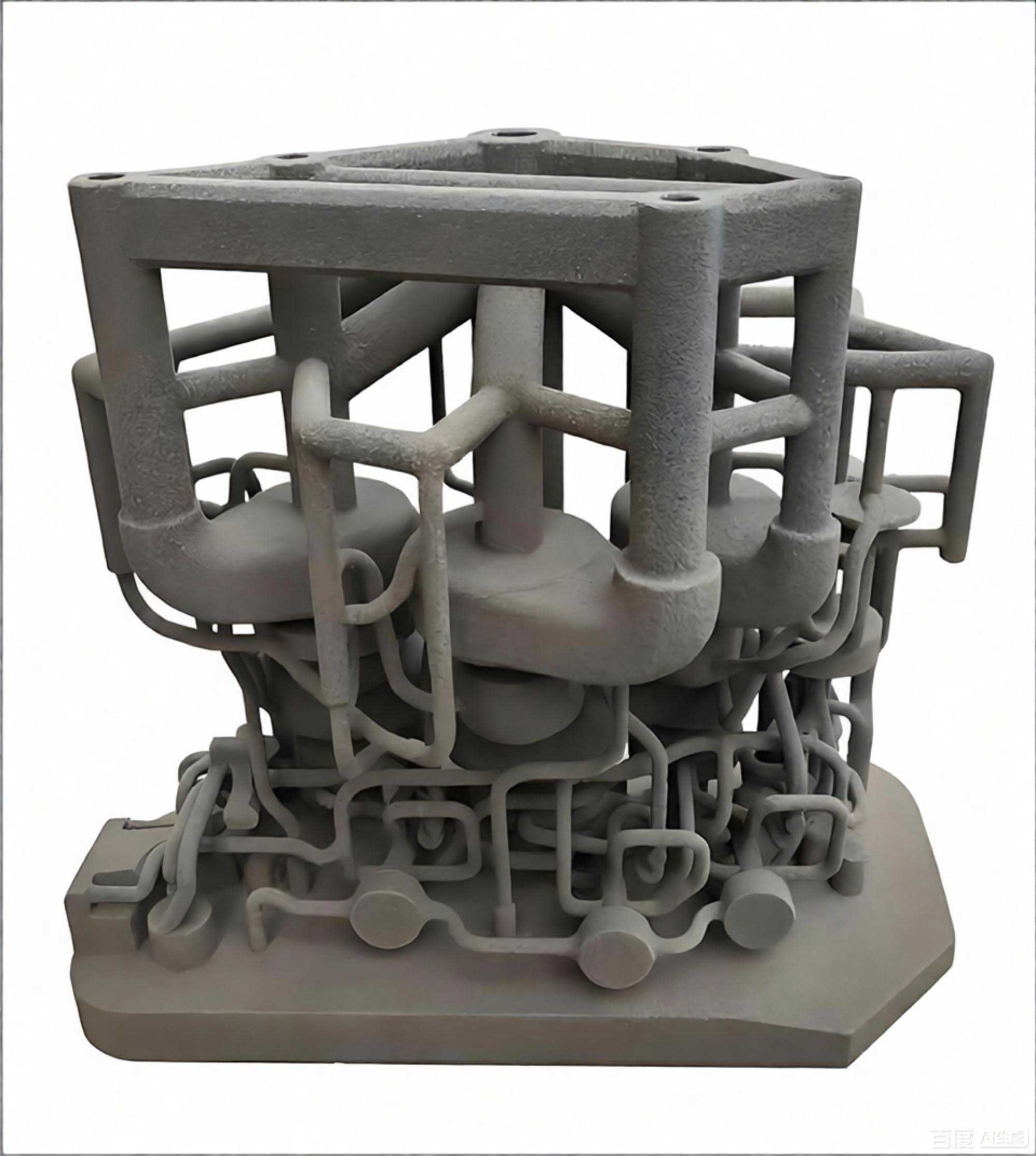
3D sand printing mainly includes Binder Jetting Three Dimension Printing (BJ 3DP), Patternless Casting Manufacturing (PCM), and Selective Laser Sintering (SLS). Among them, 3DP and PCM technologies are based on the principle of powder discrete accumulation and droplet jetting. The process is to first screen the casting original sand, add hardener, and mix the sand. After pretreatment, the treated molding sand is spread on the sand bed by a sand spreader. The binder is sprayed from the printing nozzle to the surface of the sand bed to form a solidified bonding area. The sand bed descends one layer, the sand spreader spreads sand again, and the nozzle sprays binder again at the designated position, accumulating layer by layer to form a three-dimensional sand mold (core). SLS technology uses a high-power laser to selectively scan and sinter the pre-coated sand layer by layer, so that the resin melts and bonds the pre-coated sand, thereby realizing the layer-by-layer forming of the sand mold (core). Compared with traditional sand casting, 3D sand printing technology has the advantages of design freedom, short production cycle, high dimensional accuracy, good internal quality, high material utilization rate, and low labor cost in the casting field.
The traditional sand casting and 3D sand printing casting processes can be compared. In the traditional process flow, the steps of pattern making, core making, and molding in the dashed box can be directly replaced by the precise and rapid forming of sand molds (cores) by 3D printing, thereby eliminating the pattern making stage and significantly shortening the sand casting cycle. With the help of 3D printing, the mold does not need to consider the traditional parting and draft design requirements, and complex internal cavity structures can also be accurately printed in one step. At the design source, sand mold manufacturing based on the principle of 3D printing introduces a completely new design concept, breaking the traditional design limitations in the mold or product structure caused by process conditions. The sand mold generated by 3D printing technology can abandon the traditional tedious processes such as flask assembly and core setting, greatly simplifying the process flow. Compared with traditional sand casting, which is highly dependent on the experience of process personnel, 3D sand printing technology reduces the operation threshold and makes production more standardized, convenient, and efficient. The effective integration of 3D printing technology and sand casting process has changed the traditional casting process route.
2. Analysis of the Current Teaching Situation of Traditional Casting Engineering Training
At present, the casting engineering training in most universities is still based on the traditional sand casting knowledge system. Students make sand molds by manual molding and pour them to complete casting production, achieving the practical teaching purpose of sand casting. Traditional manual molding casting has its own advantages: it has a profound heritage and strong technical foundation. As the most basic casting process, it has a long history and accumulation. Learning manual molding process can enable students to deeply understand and experience the development history and technical essence of this process from ancient times to the present. It has natural advantages in integrating ideological and political elements, such as guiding students to understand history and cultivating their craftsmanship spirit, labor spirit, and model worker spirit. It is flexible in operation and widely used in teaching. It can produce a variety of shaped products and is suitable as an important content carrier for engineering training casting teaching. Students can personally participate in the whole process from sand mold making to metal product forming in practice. The cost is low, materials are easy to obtain, and teaching conditions are easy to meet. The required equipment and tools are relatively simple, and it is easy to build a manual molding environment. However, in the current engineering training teaching system, the traditional manual molding casting practice is insufficiently integrated with the frontier technology in the contemporary casting field. Students rarely come into contact with advanced technologies such as digital modeling, simulation technology, and 3D sand printing during the learning process. The teaching content cannot reflect the development trend of intelligent casting, and it is also difficult to meet the requirements of cultivating outstanding engineers. For the traditional manual molding process, if there is a lack of intensive and efficient energy management, the energy consumption per unit product is usually high. In contrast, 3D sand printing has significant advantages in greenness and economy: most of the original sand in 3D sand printing is not solidified, and the cleaned loose sand and the unsolidified original sand can continue to be used, saving original sand and hardener. The solidified sand molds and cores can also be regenerated. After pouring, the castings are separated from the sand molds. The sand molds (cores) are magnetically separated, large metal blocks are screened out, and then they enter a crusher, followed by high-temperature roasting, and pure regenerated sand can be obtained after screening. In response to these problems, it is necessary to introduce advanced casting technology into the casting teaching of engineering training, comprehensively optimize teaching quality, and cultivate outstanding engineers who can adapt to future development.
3. Teaching Reform of Casting Engineering Training Based on 3D Sand Printing
3D sand printing technology has brought disruptive innovation to the traditional sand casting process. Its core advantages in material forming efficiency, realization of complex structures, and optimization of production processes have put forward new era requirements for talent cultivation in the casting engineering field. Therefore, it is urgent to systematically reform and upgrade the existing casting engineering training course system, scientifically integrate the core content of 3D sand printing technology such as principles, equipment operation, process optimization, and engineering application into the course teaching framework and practical training links, and build a new teaching mode that deeply integrates theory and practice. This will cultivate outstanding engineering and technical talents with the ability to apply advanced manufacturing technology and meet the needs of industrial development.
3.1 Upgrading Teaching Environment and Equipment
To enhance teaching quality, guided by the goal of cultivating outstanding engineering and scientific talents who can adapt to and lead the new round of technological revolution and industrial change, our center has comprehensively upgraded the original casting environment and equipment. We have newly built a CAD design classroom, equipped with three 3D sand printers, one sand screening device, one sand mixing device, and three medium-frequency induction furnaces. The intelligent casting workshop now has the following functional areas: the casting design classroom, the 3D sand printer area, and the manual molding area. The layout of these areas is carefully planned to ensure a smooth teaching flow from design to printing to casting.
| Item | Before reform | After reform |
|---|---|---|
| Design classroom | None | 1 classroom with 30 CAD workstations |
| 3D sand printer | None | 3 units |
| Sand processing equipment | Manual sand handling | 1 sand screening machine and 1 sand mixer |
| Melting equipment | 1 resistance furnace | 3 medium-frequency induction furnaces |
| Manual molding area | Basic benches and tools | Upgraded workbenches, modern dust extraction |
3.2 Updating Teaching Content
With the introduction of 3D sand printing teaching and the current development of intelligent casting, the teaching objectives have been expanded from originally only requiring students to understand casting processes and methods. The new objectives are as follows:
(1) Understand the principle of 3D sand printers and the current status of intelligent casting.
(2) Master the skills of using 3D sand printers to manufacture sand molds and cores.
(3) Master the core design, gating system design, and 3D modeling methods for simple sand casting castings.
(4) Understand casting production safety technology, environmental protection knowledge, and be able to conduct simple economic benefit analysis.
Before the curriculum reform, the casting engineering training process mainly consisted of six parts: the teacher explained casting process principles and key points, the teacher demonstrated the sand casting process and introduced steps and tools, the students performed manual molding practice (with a specified pattern) to make sand molds according to the teacher’s explanation, the students poured under the teacher’s guidance, the students performed post-processing of the product, and the students watched videos to understand other special casting processes.
After the curriculum reform, the casting engineering training is mainly composed of six parts: principle explanation, mold (core) CAD design, 3D sand printer operation, sand mold assembly and product pouring, product post-processing, and students watching videos to understand other special casting processes. The teaching flow is shown in the following table.
| Step | Before reform | After reform |
|---|---|---|
| 1 | Teacher explains casting principles | Teacher explains casting principles and 3D sand printing principles |
| 2 | Teacher demonstrates manual molding | Students perform mold (core) CAD design |
| 3 | Students do manual molding with a given pattern | Students run casting process CAE simulation |
| 4 | Students pour under supervision | Students operate 3D sand printers |
| 5 | Students perform post-processing | Students assemble sand molds and pour |
| 6 | Students watch videos of special processes | Students perform post-processing and watch videos |
3.2.1 Principle Explanation
The teacher explains the principle, process, and development history of casting, while giving a brief introduction to the principle of 3D sand printing. Then the teacher focuses on the development, characteristics, and applications of 3D sand printing. Finally, the teacher introduces the practical 3D sand printer and its operation steps.
3.2.2 Mold CAD Design
The teacher guides students to adapt to the structural design ideas of 3D sand printed parts by explaining the technology. Students use CAD software to directly design the sand mold based on the characteristics of 3D sand printing. The designed sand mold CAD data is then imported into the 3D sand printer for printing. For example, the CAD design process of a bent pipe product’s sand mold (core) includes creating the casting model, designing the parting surface, adding the gating system, and generating the core box with the core. This process enables students to understand the importance of design for additive manufacturing.
3.2.3 Casting Process CAE Simulation
The bent pipe product material is ZAlSi12 cast aluminum alloy. Considering the low temperature and fast cooling characteristics of aluminum alloy, and that the entire pouring process needs to be completed in a limited time, the course content did not set up a core venting structure design. After completing the design of the bent pipe shape and the sand mold/core, the independently developed HuaZhu CAE software is used for casting process simulation analysis. The three-dimensional geometric models of the casting, sand mold, and core are first imported into the HuaZhu CAE software, and pre-processing work such as mesh division, material selection, initial condition setting, and boundary condition setting is carried out. Then simulation calculation is performed. Finally, the simulation results are used to analyze the locations where defects such as shrinkage porosity and shrinkage cavities are likely to occur in the casting. According to the defect concentration positions given by the simulation software, the feeding system and exhaust channel are optimized: risers are added at both ends of the bent pipe, and the risers serve the dual functions of feeding and exhausting, effectively suppressing the generation of shrinkage porosity and shrinkage cavities. The optimized simulation results show that the defect areas are significantly reduced.
To quantitatively evaluate the effect of optimization, we define the defect volume fraction ratio as follows:
$$R_{defect}=\frac{V_{defect}}{V_{total}} \times 100\%$$
where \(V_{defect}\) is the total volume of micro-porosity and shrinkage cavities in the casting, and \(V_{total}\) is the total volume of the casting. Based on simulation results, the defect volume fraction was reduced from 4.8% in the initial design to 0.6% after adding risers, representing an 87.5% reduction.
3.2.4 3D Sand Printer Operation
The original sand is placed into the sand screening machine to select fine sand with relatively consistent particle sizes. The hardener is added to the fine sand, and the mixture is stirred evenly with a sand mixer to prepare pre-mixed sand, which is then added to the hopper of the 3D sand printer. The printer’s built-in slicing software is used to slice the CAD model. Then the 3D sand printer is started to print the sand mold (core). After printing is completed, the sand mold is allowed to cure. The sand mold (core) printing process is as follows: pre-mixed sand is added from the hopper to the sand spreader, which uniformly spreads a layer of pre-mixed sand of 0.2–0.3 mm thickness on the worktable. The nozzle sprays binder at specified positions according to the slicing cross-section data. The binder undergoes a cross-linking reaction with the hardener pre-mixed in the original sand, causing the sand particles in specific areas to solidify and form. The platform descends one layer, and the sand spreading and binder spraying are repeated, accumulating layer by layer until the entire sand mold or core is completed. The areas where no binder is sprayed remain loose, and are cleaned later. After the sand mold (core) is cured for an appropriate time, surface cleaning can be performed to obtain the separated sand mold (core) components that can be used for molding.
3.2.5 Sand Mold Assembly and Pouring
The cured sand molds (cores) are taken out of the 3D sand printer, cleaned with tools, and after sand removal, the molds are assembled. Under the condition of ensuring safety, the pouring of molten metal is guided or operated by the teacher. After cooling, the casting before post-processing is obtained.
3.2.6 Casting Post-Processing
Students remove the gating system and grind burrs to obtain the final casting, which is then submitted to the teacher for evaluation. During the entire 3D sand printing practical training course, while the 3D sand printer is working, the teacher can still demonstrate the manual molding process to the students and allow them to practice manual molding to understand the traditional sand casting process.
3.3 Improving Teaching Methods
In traditional sand casting training, the teaching method is mainly lecturing and demonstration, and students lack initiative. The practice mode is imitation and hands-on experience. After the introduction of 3D sand printing into the casting training course, a CAD design classroom was added, and the casting principle and 3D sand printing can be explained more clearly through multimedia means. At the same time, the entire teaching method was changed to project-based teaching. The ultimate goal is to complete the manufacture of a bent pipe casting. Through sand mold (core) design, casting process simulation, 3D printing of sand molds and cores, mold assembly and pouring, and post-processing, the cast blank product is obtained. Compared with the previous teaching situation, the entire teaching process is more proactive for students, more modern advanced technologies are connected, and the real casting process is simulated. This can improve students’ ability to deal with problems and their innovation ability, realizing student-centered practical teaching.
To better illustrate the teaching method innovation, we can express the learning activity distribution with the following formula:
$$A_{active}=A_{traditional}+A_{simulation}+A_{printing}+A_{teamwork}$$
where \(A_{traditional}\) is the time spent on traditional manual molding practice, \(A_{simulation}\) is the time spent on CAE simulation, \(A_{printing}\) is the time spent on operating 3D sand printers, and \(A_{teamwork}\) is the time spent on collaborative problem-solving. In the reformed course, the share of active and constructivist learning increased substantially compared to the traditional course.
The project-based teaching mode is implemented in stages. In the first stage, students receive the project task and learn the relevant theoretical knowledge. In the second stage, they complete the CAD design and simulation. In the third stage, they print and clean the sand molds. In the fourth stage, they assemble and pour. In the fifth stage, they post-process and evaluate. This staged mode allows students to gradually master the complete workflow of modern casting production.
3.4 Improving Teaching Evaluation
In traditional sand casting training, the evaluation of students’ practice is often based on the quantity and quality of the final product, which is only a “result evaluation”. After the introduction of 3D sand printing, the entire teaching process is project-based, and evaluation can run through every link, such as sand mold design, CAE simulation, sand mold printing, pouring, and post-processing. This diversified and process-oriented evaluation can truly and comprehensively measure students’ practical effects. Combining “process evaluation” and “result evaluation” makes the evaluation more accurate.
The reformed casting engineering training evaluation system consists of four parts: students’ practice process and final deliverable quality each account for 40%, organization and neatness account for 10%, and classroom discipline accounts for 10%. The whole teaching process is divided into principle explanation, CAD design, 3D sand printing operation, manual molding, pouring, and post-processing links. In CAD design, students independently complete the 3D design of the sand mold and core. Based on the standardization degree and completion time of the students’ independent completion of the sand mold and core 3D design, their ability to combine theory with practice and their ability to analyze problems are quantitatively evaluated. Other links are carried out in the form of team cooperation. Through the completion degree of 3D sand printing operation and sand cleaning treatment, manual molding, pouring, and post-processing links, and according to the scoring standards, quantitative evaluation is carried out on whether the 3D printer operation is correct, whether the sand cleaning is clean, whether the manual molding is reasonable, whether more molds are made and more qualified products are poured per unit time, and whether the division of labor is reasonable. Combined with the process evaluation of each link and the product quality evaluation, a comprehensive evaluation of students’ practical performance is made.
| Evaluation aspect | Before reform | After reform |
|---|---|---|
| Final product quality | 80% | 40% |
| Process design and simulation | Not included | 20% |
| 3D printing operation | Not included | 10% |
| Manual molding practice | 10% | 10% |
| Teamwork and communication | Not evaluated | 10% |
| Safety and discipline | 10% | 10% |
3.5 Reform Effects
Since the introduction of 3D sand printing technology into the casting engineering training course (2020–2025), the course has benefited more than 20,000 students, covering students with science and engineering backgrounds from the whole university, including students from the schools of mechanical, materials, energy, ship and ocean, and life sciences. It has significantly improved teaching quality and students’ practical ability. Taking the winning situation of the “College Student Mechanical Engineering Innovation and Creativity Competition: Casting Process Design Competition” (referred to as the Casting Competition) as an example, our university won 6 national first prizes in the five years from 2015 to 2019, and 11 national first prizes in the five years from 2020 to 2024. Among them, two national first prizes were won in 2022. The student teams were both from the Class of 2020 materials forming and control engineering major, and all had participated in the reformed casting engineering training course. During the competition preparation process, the two student teams used 3D sand printing technology many times to print sand molds and cores, continuously adjusted the process plan, and carried out actual pouring, finally obtaining the optimal process design plan to participate in the national finals. The participating students were exposed to 3D sand printing in the reformed casting engineering training course. When they later participated in the competition, they returned to the casting training classroom for the competition topic design and printing practice, which deepened their digital design level and understanding of the casting process, and finally won the national first prize. One of the teams was guided by this paper’s author. Since the reform of casting engineering training, the number of national first prizes won by our university in the Casting Competition has nearly doubled, which reflects the effectiveness of the reform to a certain extent.
After the reform of casting engineering training, hundreds of universities came to visit, and the reform results were highly recognized by peers in higher education. Among them, the Industrial Training Center of Central South University and the Engineering Practice Innovation Center of Sun Yat-sen University have borrowed and referenced in the construction of new era casting engineering training courses. The reformed casting workshop has received hundreds of visits from primary and secondary schools, universities, and enterprises, achieving a good effect of science popularization and dissemination of new technologies. At the same time, in the classroom student feedback evaluation forms, students reported that the training effect was good. Through the teaching combined with 3D sand printing technology, students not only deeply understood the basic principles and challenges of traditional sand casting, but also came into contact with the development trend of the casting industry in today’s era. Students’ interest in casting engineering training teaching content significantly increased.
3D sand printing casting engineering training allows students to personally experience the whole process from sand mold CAD design to casting manufacturing, realizing the integration of theory and practice. With the help of advanced 3D printing technology, the rapid and precise manufacturing of sand molds and cores with complex geometric shapes breaks through the limitations of traditional manual molding or wood pattern making, significantly shortening the casting process design and optimization cycle, and is conducive to the development of students’ independent innovation. The reformed casting engineering training gives students greater autonomy and innovation space, enabling them to flexibly use their learned CAD skills to design personalized products, and directly transform product design into physical models. In practice, students consolidate theoretical knowledge and improve their ability to use professional knowledge for actual project innovation.
4. Discussion
The reform of casting engineering training based on 3D sand printing is not merely an equipment upgrade but a systematic pedagogical transformation. In this section, we analyze the key factors that contributed to the success of the reform and the challenges that remain.
4.1 Key Success Factors
First, the integration of 3D sand printing with traditional manual molding creates a complementary teaching environment. Students first learn the basic principles of sand casting through hands-on manual molding, which gives them an appreciation of the difficulties and constraints of traditional processes. Then, they use 3D sand printing to design and manufacture molds that would be impossible or extremely difficult to make manually. This comparative approach deepens their understanding of both technologies.
Second, the use of CAE simulation before printing and pouring helps students understand the importance of virtual design in modern manufacturing. The ability to predict defects and optimize the feeding system before any physical work is done saves time, material, and energy. This experience directly mirrors what students will encounter in industrial practice.
Third, the project-based format with a concrete product (a bent pipe casting) provides a clear goal and motivation. Students are not just doing isolated exercises; they are working toward a functional product. This creates a sense of ownership and accomplishment.
Fourth, the revised evaluation system rewards both process and product, encouraging students to pay attention to every step from design to post-processing. The evaluation criteria are transparent and quantitative, allowing students to understand what is expected of them.
4.2 Quantified Effects
To further demonstrate the impact of the reform, we can examine several quantitative indicators. The following table summarizes the main improvements observed over the five-year period from 2020 to 2025.
| Indicator | Before reform (2015-2019) | After reform (2020-2024) | Improvement |
|---|---|---|---|
| Number of national first prizes in casting competition | 6 | 11 | +83.3% |
| Number of students trained per year | ~3,000 | ~4,000 | +33.3% |
| Average student satisfaction score (out of 100) | 78.5 | 92.3 | +17.6% |
| Average time to complete a casting project (hours) | 16 | 12 | -25% |
| Material utilization rate of sand | ~60% | ~92% | +32 percentage points |
The improvement in material utilization can be expressed as:
$$\eta_{utilization}=\frac{m_{usable\_sand}}{m_{total\_sand}} \times 100\%$$
In the traditional manual molding process, a significant amount of sand is discarded due to inconsistencies in mixing and compaction. In contrast, 3D sand printing only consolidates the sand in the targeted regions, and the loose sand can be easily reused after sieving. Therefore, the material efficiency increases dramatically, leading to both economic and environmental benefits.
4.3 Challenges and Limitations
Despite the positive outcomes, there are challenges that need to be addressed. The initial investment in 3D sand printers, sand processing equipment, and the CAD design classroom is substantial. Not all universities may have the budget for such an upgrade. However, the cost of 3D sand printing technology has been decreasing steadily, and the long-term benefits in teaching quality and student capability justify the investment.
Another challenge is the need for instructors to be proficient in both traditional casting techniques and modern digital tools. Faculty development is essential. We organized training workshops and collaborated with industry partners to ensure that our teaching staff are comfortable with the new equipment and software.
Furthermore, the printing process itself takes time. For a typical class of 30 students, printing all the sand molds and cores can take several hours. To manage this, we schedule the printing activities in parallel with other teaching modules, such as manual molding practice or video presentations. This ensures that students are always engaged in meaningful activities while the printer is running.
5. Conclusion
This paper has explored the teaching reform of casting engineering training based on 3D sand printing technology. By introducing 3D sand printing into the casting engineering training, advanced manufacturing processes have been successfully incorporated into the traditional engineering training system, deeply innovating the casting engineering training. The reformed casting engineering training not only teaches students the principles of casting but also allows them to deeply learn 3D sand printing technology, exercise their structural design thinking ability, enhance their ability to solve practical problems, and gradually establish an engineering view, quality view, and system view.
3D sand printing technology endows the traditional casting process with digital and intelligent characteristics. Nevertheless, the essence of this technology is still based on the principles of casting processes. Therefore, when students deeply understand and apply 3D sand printing technology, they must first firmly grasp the basic casting theoretical knowledge. Integrating 3D sand printing into the casting training course does not mean creating a completely new teaching content; rather, it means retaining and inheriting the core concepts of traditional sand casting, while introducing advanced technology in a forward-looking manner, thereby reforming casting engineering training and deepening the cultivation of students’ practical innovation ability and engineering ability.
Through this reform, we have established a casting engineering training teaching system that reflects the characteristics of the times and the development trend of casting. The reform has achieved obvious results, and the reformed casting engineering training has significantly improved students’ engineering practice ability and innovation ability. The exploration and practice presented here can serve as a useful reference for other universities and training centers that aim to modernize their engineering training curricula in the context of intelligent manufacturing.