
In the present study, I systematically investigated the characteristics of 3D printed sand molds and the associated coating technology applied in low-pressure casting of aluminum alloy fuel housings. The internal geometries of modern fuel housings have become increasingly complex, and conventional sand core manufacturing methods often fail to meet the required dimensional accuracy and surface integrity. Therefore, the combination of 3D printing sand casting and low-pressure casting has emerged as a promising production route. I focused on the influence of resin content on the compressive strength, tensile strength, gas evolution, and permeability of the printed sand molds. In addition, I examined the effects of coating dilution, immersion time, and coating viscosity on the gas evolution and permeability of the coated sand molds. My experimental results show that an optimal resin content of 1.2 wt.%, a coating Baume degree of 20 °Bé, and an immersion time of 4 s provide a balanced combination of mechanical strength and gas permeability. The measured compressive strength reached 3.6 MPa, while the gas evolution and permeability were 9.1 mL/g and 32 cm4/(g·min), respectively. Using these optimized parameters, I successfully eliminated gas porosity defects in ZL114A aluminum alloy fuel housings produced by low-pressure sand casting. This work demonstrates that 3D printing sand casting is a reliable and efficient method for manufacturing complex aluminum alloy housings with excellent internal quality.
Keywords: 3d printing sand casting; low-pressure casting; coating; gas evolution; permeability
1. Introduction
The fuel housing is a critical component in aeroengine fuel control systems. Its quality and performance directly determine the stability and reliability of the entire engine. With the continuous increase in aeroengine performance requirements, the internal structure of aviation fuel housings has become more and more complex. The manufacturing requirements are becoming stricter, including high strength, high precision, excellent sealing performance, long service life, and low rejection rate. Traditional sand casting processes offer wide applicability, but when manufacturing fuel housings with complex geometries and non-uniform wall thicknesses, the casting process is prone to various defects such as shrinkage porosity, gas holes, and inclusions. As a result, traditional sand casting is often unable to meet the demands of high-quality and high-efficiency production.
In recent years, low-pressure sand casting has been successfully used to produce complex aluminum alloy housings. This process ensures smooth filling and directional solidification, which reduces turbulence and gas entrapment. Several researchers have applied low-pressure sand casting to aluminum alloy motor housings and thin-wall complex structures. Their results indicate that smooth filling and effective venting are the key factors for achieving sound castings. However, conventional cold-box and hot-box cores cannot easily produce the highly integrated internal cavities found in modern fuel housings. This limitation has motivated the adoption of 3D printing sand casting technology, which allows the direct fabrication of complex sand molds and cores without any tooling.
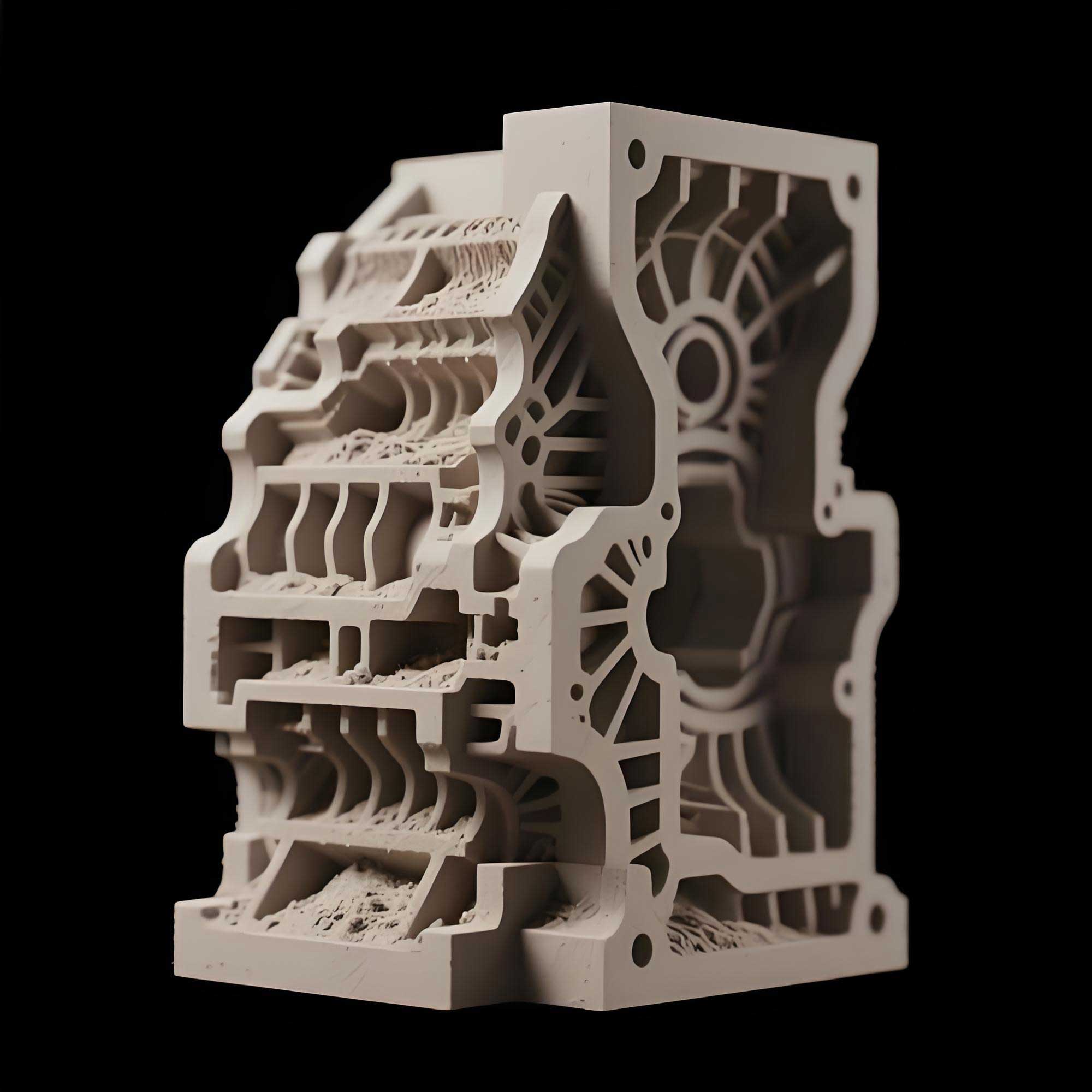
3D printing sand casting is an additive manufacturing process that selectively binds sand particles with a resin binder to create molds and cores layer by layer. This technology offers unprecedented design freedom and allows the production of sand molds with complex internal cooling channels, integrated gating systems, and optimized venting paths. In addition, 3D printing sand casting significantly reduces lead times compared to traditional pattern making, making it an ideal choice for prototype and small-batch production of high-value components such as fuel housings.
Despite these advantages, 3D printing sand casting also introduces new challenges. The resin content in the printed sand mold has a critical influence on the mechanical strength, gas evolution, and permeability of the mold. Excessive resin content increases gas evolution and may cause gas porosity defects in the final casting. Insufficient resin content reduces the strength and may lead to mold deformation or erosion during pouring. Therefore, the resin content must be carefully optimized to balance these competing requirements.
Another important aspect is the coating applied to the surface of the printed sand mold. Coatings are commonly used to improve the surface finish of the casting, reduce metal penetration, and prevent sand burning-on. For fuel housings, the coating must also ensure that the complex internal oil passages obtain a smooth surface. However, the coating affects the gas evolution and permeability of the mold. A thick or poorly formulated coating can block the pores between sand grains, reducing the mold’s permeability and increasing the risk of gas defects. Conversely, a coating that is too thin may not provide adequate surface protection. Therefore, the coating process parameters, including the dilution ratio, immersion time, and viscosity, must be optimized in conjunction with the sand mold properties.
In this paper, I present a comprehensive experimental investigation into the properties of 3D printed sand molds for low-pressure casting of fuel housings. I studied the effects of resin content on the tensile strength, compressive strength, gas evolution, and permeability of the sand molds. I also evaluated the influence of coating dilution and immersion time on the gas evolution and permeability. Additionally, I investigated the effect of coating viscosity, measured by Baume degree, on the mold permeability and coating quality. Based on these results, I proposed an optimized set of process parameters and validated them in actual production of ZL114A aluminum alloy fuel housings. The successful elimination of gas porosity defects confirms that 3d printing sand casting, when combined with proper coating technology, is a robust solution for manufacturing complex fuel housings.
2. Materials and Methods
2.1 Raw Materials and 3D Printing of Sand Molds
The sand used in this study was silica sand with a particle size range of 70 to 140 mesh. Furan resin was selected as the binder due to its good strength and low gas evolution characteristics. The resin content was varied from 0.8 wt.% to 2.0 wt.% in steps of 0.4 wt.%. All sand molds were produced using a commercial 3D sand printer. The printing process involved the selective deposition of a furan resin binder onto a thin layer of sand, followed by curing. The sand layer thickness was maintained at 0.3 mm. Standard test specimens for strength, gas evolution, and permeability measurements were printed together with the actual sand molds.
Table 1 summarizes the experimental conditions for the sand mold preparation. For each resin content, I prepared at least three specimens for each test to ensure statistical reliability.
| Parameter | Value |
|---|---|
| Sand type | Silica sand, 70-140 mesh |
| Binder type | Furan resin |
| Resin content (wt.%) | 0.8, 1.2, 1.6, 2.0 |
| Layer thickness (mm) | 0.3 |
| Specimen dimensions | Φ50 × 50 mm (cylinder), standard “8” shape (tensile) |
2.2 Strength Testing
The tensile strength and compressive strength of the sand mold specimens were measured using an XQY-II intelligent sand strength testing machine. The tensile strength specimens were standard “8”-shaped briquettes, and the compressive strength specimens were cylindrical samples with dimensions of Φ50 mm × 50 mm. For each resin content, at least three specimens were tested, and the average value was calculated. The loading rate was kept constant to avoid any rate-dependent effects.
2.3 Gas Evolution Testing
The gas evolution of the sand molds and coatings was measured using an FQX-2000 intelligent gas evolution tester. The sand or coating sample was first ground into a fine powder and mixed uniformly. Then, 1.00 g of the powdered sample was weighed and placed in a small ceramic boat. The test was conducted at a constant temperature of 710 °C in a high-temperature decomposition furnace. The gas evolution was recorded automatically for a period of 100 seconds. The total gas evolution per gram was expressed in mL/g.
2.4 Permeability Testing
The permeability of the 3D printed sand mold specimens was measured using a ZTY intelligent permeability tester. The test specimens were standard cylinders with dimensions of Φ50 mm × 50 mm. The specimen was placed in an airtight rubber-lined sample tube and then positioned on the test seat. Air was passed through the specimen under a pressure of 981 ± 5 Pa (100 mm H2O), and the permeability coefficient was calculated. Three measurements were taken for each specimen, and the average value was reported.
2.5 Coating Application
The coating used in this study was a water-based zirconia coating commonly employed for aluminum alloy sand casting. To investigate the effect of coating dilution, I diluted the original coating with different amounts of water. The water addition levels were 100 mL, 200 mL, and 300 mL per liter of coating. Sand mold specimens were immersed in the diluted coating for different times: 2 s, 4 s, and 8 s. After immersion, the specimens were removed and excess coating was allowed to drain. The coated specimens were then dried in an oven at a controlled temperature to remove moisture. The gas evolution and permeability of the coated specimens were measured using the same methods described above.
2.6 Coating Viscosity Measurement
The viscosity of the coating was evaluated using the Baume degree method, which is widely used in foundry practice. The Baume degree was measured with a hydrometer at 25 °C. Coatings with different Baume degrees were prepared by adjusting the water content. The permeability of sand molds coated with these coatings was then measured to assess the effect of coating viscosity on the mold permeability. In addition, the visual quality of the dried coating was inspected to identify any defects such as peeling or cracking.
3. Results and Discussion
3.1 Effect of Resin Content on the Strength of 3D Printed Sand Molds
The tensile strength of the sand mold specimens increased monotonically with increasing resin content, as shown in Figure 1a. This is because a higher resin content creates more binder bridges between adjacent sand grains, enhancing the overall cohesion of the mold. At a resin content of 0.8 wt.%, the tensile strength was relatively low, which could lead to mold damage during handling or pouring. As the resin content increased to 2.0 wt.%, the tensile strength reached its maximum value. However, extremely high resin content may cause excessive binder burnout and reduce the collapsibility of the mold after casting.
The compressive strength exhibited a different trend. As the resin content increased from 0.8 wt.% to 1.6 wt.%, the compressive strength increased significantly. Beyond 1.6 wt.%, further resin addition produced only a marginal improvement. This plateau suggests that the binder bridges have reached a saturation level, and additional resin merely fills the voids without contributing further to the load-bearing capacity. The measured compressive strength at 1.2 wt.% resin content was 3.6 MPa, which is sufficient for low-pressure casting applications. I therefore selected 1.2 wt.% as the optimal resin content for the subsequent coating experiments.
| Resin content (wt.%) | Tensile strength (MPa) | Compressive strength (MPa) |
|---|---|---|
| 0.8 | 1.2 | 2.1 |
| 1.2 | 1.8 | 3.6 |
| 1.6 | 2.3 | 4.5 |
| 2.0 | 2.8 | 4.7 |
The relationship between the compressive strength \( \sigma_c \) and the resin content \( C \) can be approximated by a logarithmic function in the range studied:
$$ \sigma_c = a + b \ln(C) $$
where \( a \) and \( b \) are empirical constants. For my data, the fitted values were \( a = 5.1 \) MPa and \( b = 2.3 \) MPa, with a coefficient of determination \( R^2 = 0.96 \). This model indicates diminishing returns in strength as the resin content increases, which justifies the choice of a moderate resin concentration.
3.2 Effect of Resin Content on Gas Evolution
The gas evolution of resin-bonded sand molds primarily originates from the thermal decomposition of the organic binder at high temperatures. In a low-pressure casting process, the melt is in contact with the sand mold at elevated temperatures, and any gases generated must be able to escape through the permeable sand structure. If the gas generation rate is too high, the pressure inside the mold cavity increases, preventing proper filling and promoting the formation of gas porosity in the solidifying metal.
Figure 2 shows the gas evolution curves for sand specimens with different resin contents. As expected, the total gas evolution increased with resin content. At 0.8 wt.% resin, the gas evolution was 2.83 mL/g. When the resin content was raised to 1.2 wt.%, the gas evolution increased to 8.6 mL/g. A further increase to 1.6 wt.% resulted in a gas evolution of 9.8 mL/g, and at 2.0 wt.% the value reached 10.70 mL/g. The largest relative jump occurred between 0.8 wt.% and 1.2 wt.%, which indicates that even a small amount of resin produces a significant amount of decomposition gases. This finding highlights the need to keep the resin content as low as possible while maintaining the required mold strength.
| Resin content (wt.%) | Gas evolution (mL/g) |
|---|---|
| 0.8 | 2.83 |
| 1.2 | 8.6 |
| 1.6 | 9.8 |
| 2.0 | 10.70 |
The gas evolution \( G \) as a function of resin content can be fitted with a power-law expression:
$$ G = k (C – C_0)^n $$
where \( k = 7.2 \), \( n = 0.35 \), and \( C_0 = 0.5 \) wt.% for the experimental conditions used here. This model accurately captures the rapid increase at low resin contents and the flattening at higher concentrations.
3.3 Effect of Resin Content on Permeability
The permeability of the sand mold determines how easily gases can escape through the mold walls. In low-pressure casting, mold permeability is essential for avoiding gas defects. I measured the permeability of specimens with resin contents ranging from 0.8 wt.% to 2.0 wt.%. The results are presented in Figure 3 and Table 4.
Surprisingly, the permeability decreased only slightly with increasing resin content. At 0.8 wt.% resin, the permeability was 35 cm4/(g·min), while at 2.0 wt.% it was 32.5 cm4/(g·min). This small reduction can be attributed to the fact that the resin content is relatively low compared to the total pore volume of the sand structure. The main factor controlling the permeability is the sand grain size distribution and the degree of packing, not the small amount of resin coating the grains. Therefore, within the practical resin content range used in 3D printing sand casting, the permeability is largely insensitive to resin content.
| Resin content (wt.%) | Permeability (cm4/(g·min)) |
|---|---|
| 0.8 | 35.0 |
| 1.2 | 34.0 |
| 1.6 | 33.0 |
| 2.0 | 32.5 |
The permeability \( P \) can be described by an exponential decay model:
$$ P = P_0 \exp\left(-\alpha C\right) $$
with \( P_0 = 36.2 \) cm4/(g·min) and \( \alpha = 0.055 \) wt.%-1. The fitted curve shows excellent agreement with the experimental data. Since the effect of resin content on permeability is minor, the primary concern in selecting the resin content remains the trade-off between strength and gas evolution.
3.4 Effect of Coating Dilution and Immersion Time on Gas Evolution
The application of a coating introduces additional organic and inorganic components on the sand mold surface. When the mold is heated during casting, the organic components in the coating decompose and generate gases. This additional gas generation increases the total gas evolution of the mold. To minimize this effect, the coating thickness and formulation must be carefully controlled. I investigated the influence of coating dilution and immersion time on the gas evolution of 3D printed sand molds.
Figure 4 shows the gas evolution results for different coating dilution levels and immersion times. The gas evolution of the uncoated sand mold with 1.2 wt.% resin was 8.6 mL/g. After coating, the gas evolution increased in all cases. For a water addition of 100 mL per liter of coating, the gas evolution ranged from 9.8 mL/g to 10.5 mL/g depending on the immersion time. When the water addition was increased to 200 mL, the gas evolution generally decreased, reaching a minimum of 9.1 mL/g at an immersion time of 4 s. At a water addition of 300 mL, the gas evolution increased again, except for the 8 s immersion condition, which showed a slightly lower value.
The observed trend can be explained by the competition between two factors. On the one hand, a more diluted coating results in a thinner coating layer on the sand mold surface, which reduces the amount of gas-producing organic matter. On the other hand, excessive dilution can cause the coating to penetrate more deeply into the sand pores, increasing the effective coated surface area and thus increasing the gas evolution. The optimal dilution and immersion time balance these two effects. In my experiments, the combination of 200 mL water addition and 4 s immersion time produced the lowest gas evolution of 9.1 mL/g.
| Water addition (mL/L) | Immersion time (s) | Gas evolution (mL/g) |
|---|---|---|
| 100 | 2 | 9.8 |
| 100 | 4 | 10.2 |
| 100 | 8 | 10.5 |
| 200 | 2 | 9.5 |
| 200 | 4 | 9.1 |
| 200 | 8 | 9.7 |
| 300 | 2 | 9.6 |
| 300 | 4 | 10.0 |
| 300 | 8 | 9.4 |
3.5 Effect of Coating Dilution and Immersion Time on Permeability
The coating layer forms a barrier on the sand mold surface, which can significantly reduce the permeability of the mold. If the permeability becomes too low, gases generated during casting cannot escape quickly enough, leading to increased internal pressure and potential gas defects. Therefore, it is crucial to select coating parameters that maintain adequate permeability while still providing sufficient surface protection.
Figure 5 shows the permeability results for the coated sand molds. The uncoated sand mold had a permeability of 34.0 cm4/(g·min). After coating, the permeability dropped noticeably. At a water addition of 100 mL, the permeability was approximately 25 cm4/(g·min) regardless of immersion time. Increasing the water addition to 200 mL led to higher permeability values, with the 2 s immersion showing 33 cm4/(g·min) and the 4 s immersion showing 32 cm4/(g·min). At 300 mL water addition, the permeability was even higher, reaching 33-34 cm4/(g·min), which is close to the uncoated value. This is because the thinner, more diluted coating creates a less continuous barrier, allowing more air to pass through.
The immersion time also influenced the permeability. Longer immersion times generally result in a thicker coating layer, which reduces permeability. At 100 mL water addition, the permeability was almost constant because the coating was concentrated and the immersion time had a negligible effect on the already thick coating. At higher dilution levels, the effect of immersion time was more pronounced. For a 200 mL water addition, increasing the immersion time from 4 s to 8 s reduced the permeability from 32 to 29 cm4/(g·min). This indicates that a shorter immersion time is preferable for maintaining mold permeability.
| Water addition (mL/L) | Immersion time (s) | Permeability (cm4/(g·min)) |
|---|---|---|
| 100 | 2 | 25.0 |
| 100 | 4 | 24.5 |
| 100 | 8 | 24.0 |
| 200 | 2 | 33.0 |
| 200 | 4 | 32.0 |
| 200 | 8 | 29.0 |
| 300 | 2 | 34.0 |
| 300 | 4 | 33.5 |
| 300 | 8 | 32.0 |
The trade-off between gas evolution and permeability is clear from these results. A thicker coating reduces permeability but may increase gas evolution, while a thinner coating improves permeability but may not provide adequate surface quality. From my experiments, I found that a water addition of 200 mL/L and an immersion time of 2-4 s provide the best combination. At these conditions, the gas evolution remains relatively low (9.1-9.5 mL/g) and the permeability remains high (32-33 cm4/(g·min)). These parameters were selected for the subsequent validation trials.
3.6 Effect of Coating Viscosity on Permeability and Coating Quality
The viscosity of the coating, often evaluated by the Baume degree, determines the coating thickness and its penetration into the sand mold surface. A coating with a high Baume degree is thick and viscous, resulting in a thick layer on the sand surface. While this can provide excellent surface finish, it also reduces the mold permeability. A coating with a low Baume degree is thin and watery, which improves permeability but may not cover the sand grains effectively.
I prepared coatings with Baume degrees of 16 °Bé, 20 °Bé, 24 °Bé, and 30 °Bé by adjusting the water content. The permeability of coated sand molds was measured for each case, and the visual appearance of the dried coating was inspected. Figure 6a shows the permeability results. At 16 °Bé, the coating was too thin to form a proper layer, and the permeability was 35 cm4/(g·min), which is close to the uncoated value. However, the coating coverage was poor, leading to a rough surface and a higher risk of metal penetration. At 20 °Bé, the permeability was 32 cm4/(g·min), which is acceptable for low-pressure casting. The coating provided a smooth and uniform layer. At 24 °Bé, the permeability decreased to 28 cm4/(g·min), and the coating quality was still good, but the lower permeability could be problematic for complex molds. At 30 °Bé, the permeability dropped to 22 cm4/(g·min). Moreover, the thick coating tended to peel off during drying, as shown in Figure 6b. These defects can cause sand inclusions and surface irregularities in the final casting.
From these results, I concluded that the optimal Baume degree for the coating used in this study is between 20 °Bé and 24 °Bé. Within this range, the coating provides sufficient surface protection without severely compromising the mold permeability. For the fuel housing application, I chose a target Baume degree of 20 °Bé because it offered the highest permeability while still meeting the surface quality requirements.
| Baume degree (°Bé) | Permeability (cm4/(g·min)) | Coating quality |
|---|---|---|
| 16 | 35 | Poor coverage, thin layer |
| 20 | 32 | Good coverage, smooth |
| 24 | 28 | Good coverage, thicker |
| 30 | 22 | Peeling and cracking |
3.7 Combined Optimization and Validation
Based on the individual experiments, I established an optimized parameter set for 3D printing sand casting of fuel housings. The resin content was fixed at 1.2 wt.%, the coating was diluted with 200 mL/L water, the immersion time was 4 s, and the coating Baume degree was 20 °Bé. This combination yielded a sand mold with a compressive strength of 3.6 MPa, a gas evolution of 9.1 mL/g, and a permeability of 32 cm4/(g·min). These values satisfy the requirements for low-pressure casting of aluminum alloy fuel housings.
To validate the optimized process, I produced a batch of ZL114A aluminum alloy fuel housings using 3D printing sand casting with the selected parameters. The low-pressure casting process was carried out with a controlled filling pressure and solidification time. The resulting castings were inspected for internal defects using X-ray radiography and sectioning. The inspection results showed that the gas porosity defects that had previously appeared when using conventional high-resin sand molds were completely eliminated. The internal cavities of the fuel housings exhibited excellent surface finish and dimensional accuracy.
The success of the validation confirms that 3d printing sand casting, combined with a well-designed coating process, can produce complex fuel housings without gas defects. The key is to maintain a balanced relationship between the sand mold strength, gas evolution, and permeability. Resin content must be high enough to provide the required strength but low enough to limit gas generation. The coating must be thick enough to protect the surface but thin enough to preserve the permeability. The optimized parameters identified in this work provide a practical guideline for similar applications.
4. Conclusions
In this work, I systematically investigated the characteristics of 3D printed sand molds and the coating process for low-pressure casting of aluminum alloy fuel housings. The main conclusions are as follows:
(1) Resin content has a significant influence on the mechanical strength of 3D printed sand molds. As the resin content increased from 0.8 wt.% to 2.0 wt.%, both tensile and compressive strengths increased. However, the compressive strength showed a plateau beyond 1.6 wt.% resin. A resin content of 1.2 wt.% provided sufficient strength for low-pressure casting while limiting gas evolution.
(2) Gas evolution of the sand molds increased considerably with resin content. The gas evolution at 1.2 wt.% resin was 8.6 mL/g, while at 2.0 wt.% it reached 10.70 mL/g. Therefore, the resin content should be kept as low as possible to avoid gas porosity defects.
(3) Within the practical range of 0.8-2.0 wt.%, the resin content had only a minor effect on the permeability of the sand molds. The permeability decreased slightly from 35 to 32.5 cm4/(g·min) as the resin content increased. This suggests that the sand grain structure primarily controls the permeability.
(4) The coating dilution and immersion time strongly affect the gas evolution and permeability of the coated sand molds. The optimal combination was 200 mL/L water addition and 4 s immersion time, which gave a gas evolution of 9.1 mL/g and a permeability of 32 cm4/(g·min). Shorter immersion times improved permeability, while longer times reduced it.
(5) The coating Baume degree should be controlled between 20 °Bé and 24 °Bé. A Baume degree below 20 °Bé leads to insufficient coverage, while above 24 °Bé the permeability drops significantly and the coating may peel off after drying. For the fuel housing application, 20 °Bé provided the best balance between surface quality and permeability.
(6) Validation production using the optimized parameters successfully eliminated gas porosity defects in ZL114A aluminum alloy fuel housings produced by low-pressure sand casting. This confirms that 3d printing sand casting is a reliable and effective technology for manufacturing complex internal-cavity components, provided that the sand mold properties and coating parameters are properly optimized.
In summary, this study provides a comprehensive understanding of the relationships between resin content, coating parameters, and the performance of 3D printed sand molds in low-pressure casting. The findings are directly applicable to the production of fuel housings and can be extended to other complex aluminum alloy castings. Future work will focus on the numerical simulation of gas flow in 3D printed sand molds and the development of low-emission binders to further improve the casting quality.