
Lost foam castings depend heavily on the quality of the expandable foam pattern. The pattern must have correct density, controlled surface quality, adequate strength, and low moisture content. If the pattern is defective, the final casting will almost certainly reveal defects such as misruns, surface roughness, gas porosity, slag entrapment, or dimensional errors. For this reason, the production of the foam board that becomes the pattern is one of the most important steps in the manufacturing chain of lost foam castings.
In this article I describe a systematic research program that I carried out on the board production line. I tracked every production phase from raw bead inspection to pre-foaming, bead aging, and final board forming. I recorded process parameters, identified abnormal conditions, and compared those abnormalities with board quality indicators such as fusion degree, density, strength, moisture, and surface condition. From the collected data I established process specifications that stabilize the quality of the foam board and therefore improve the reliability of lost foam castings.
Lost foam castings require patterns made of EPS, EPMMA, or STMMA beads. These beads contain a liquid blowing agent, normally pentane. The manufacturing route for the board can be summarized as material inspection, pre-foaming, bead aging, and board forming. Each of these stages must be carefully controlled because every stage influences the bead structure, the available blowing agent, the final fusion degree, and the mechanical properties of the board.
1. Why Board Quality Matters for Lost Foam Castings
The pattern used in lost foam castings remains inside the mold during pouring. When molten metal is introduced, the foam pattern vaporizes and the metal takes its place. If the board contains internal voids, poor bead fusion, or residual moisture, the behavior during pouring can become unstable. Poorly fused beads can create surface cavities on the pattern, which then become coated and replicated on the casting. High moisture content increases gas evolution during pouring, which may lead to porosity or slag defects in the final component.
The most important board characteristics for lost foam castings are:
1. Fusion degree, which controls the surface quality after machining and the resistance to bead pull-out during pattern handling.
2. Density, which controls pattern strength, rigidity, and gas evolution per unit volume.
3. Moisture content, which must be low to avoid casting defects.
4. Dimensional stability, which ensures that the pattern maintains its shape during storage, coating, and molding.
5. Gas evolution and combustion residue, which directly affect the cleanliness of lost foam castings.
A board may have the correct average density but still be unusable if the bead fusion is poor. Therefore, the central focus of this research was to understand how process parameters affect fusion degree, and to establish practical control rules.
2. Materials and Test Conditions
In this study I used expandable polystyrene beads, commonly known as EPS beads. The properties of the beads were checked before production. Table 1 summarizes the raw material parameters.
| Property | Value |
|---|---|
| Color | Semi-transparent |
| Volatile content | 6.26% |
| Sieving efficiency | 98.78% |
| Particle size | 0.7–1.1 mm |
| Moisture content | 0.4% |
The target board density for the experiments was set at approximately 20 g/L, which is common for pattern boards used in lost foam castings. The production environment was kept in a relatively dry state because humidity has a strong influence on bead aging and moisture pickup.
During the research I followed every batch through the production line. For each batch I recorded the pre-foaming steam pressure, the pre-foaming time, the aging temperature, the aging humidity, the aging time, the one-shot forming steam pressure, the secondary forming steam pressure, the heating time, the cooling time, and the final board quality. Whenever a defect appeared, I analyzed the cause and applied corrective measures. In this way I was able to convert experience into a formal process specification.
3. Production Process Overview
The complete production process for foam board used in lost foam castings includes the following steps:
1. Incoming material inspection.
2. Pre-foaming of the raw expandable beads.
3. Aging of the pre-foamed beads in a ventilated silo.
4. Board forming by steam heating in a plate mold.
5. Drying and conditioning of the board after demolding.
6. Machining, bonding, coating, and final assembly of the pattern for lost foam castings.
Although the later machining and coating steps are also important, the board quality cannot be corrected later. A poor board will always produce a poor pattern, regardless of how carefully it is machined. Therefore, the focus must be on the early stages of production.
4. Pre-Foaming Control
Pre-foaming is the stage in which raw beads are heated by steam. The heat vaporizes the liquid blowing agent inside the beads. As the blowing agent expands, it creates internal pressure and causes the beads to grow. The volume of the beads increases and the bulk density decreases.
The density of pre-foamed beads can be described by the simple relationship:
$$ \rho_{\text{pre}} = \frac{m_{\text{beads}}}{V_{\text{pre}}} $$
where \( \rho_{\text{pre}} \) is the pre-foamed bulk density, \( m_{\text{beads}} \) is the mass of the beads, and \( V_{\text{pre}} \) is the volume occupied by the expanded beads. In a quantitative pre-foaming machine, the outlet height and the barrel volume are fixed. Therefore, for a desired density, I can calculate the mass of raw beads that must be charged:
$$ m_{\text{beads}} = \rho_{\text{target}} \times V_{\text{chamber}} $$
The volume expansion ratio is also useful for process control. It can be written as:
$$ R = \frac{\rho_{\text{raw}}}{\rho_{\text{pre}}} $$
where \( \rho_{\text{raw}} \) is the bulk density of the unexpanded beads. The expansion ratio tells the operator how much the beads have grown. If the ratio is too high, the beads become too light and too fragile. If the ratio is too low, the final board will be too dense and will have excessive gas evolution during pouring. Both extremes are harmful to lost foam castings.
The driving force for expansion is the vapor pressure of the blowing agent inside the beads. The saturation pressure of the blowing agent increases with temperature. This can be represented by the Clausius–Clapeyron relationship:
$$ \frac{d\ln P}{dT} = \frac{\Delta H_v}{RT^2} $$
where \( P \) is the vapor pressure, \( T \) is the absolute temperature, \( \Delta H_v \) is the latent heat of vaporization, and \( R \) is the universal gas constant. In practical terms, the steam pressure in the pre-foamer determines the maximum temperature that the beads reach. Therefore, steam pressure is the primary control variable for pre-foaming density.
During the experiments I observed several common problems in the pre-foaming stage. These problems are listed in Table 2, together with their root causes and corrective actions.
| Problem | Root Cause | Corrective Action |
|---|---|---|
| Pre-foaming lump formation | Excess coating agent on the beads; raw material stored too long; excessive water in the pre-foaming tank; poor drainage | Re-coat the beads with the proper amount of coating agent; replace the beads or reduce the expansion ratio; install steam traps and clean the drain lines |
| Pre-foamed beads are wet | Steam contains too much water; water remains in the pre-foaming tank | Insulate the steam line and add a steam trap; clean the condensate drain |
| Pre-foamed beads shrink | Ambient temperature is too low; material remains in the pre-foaming tank too long | Increase the workshop temperature; adjust the discharge air pressure to remove the beads promptly |
| Unstable expansion ratio | Uneven feed rate; steam pressure fluctuations; different bead batches mixed together | Dry the raw material and clean the feeder; stabilize the steam pressure; use the same batch of beads |
| Dead or unexpanded bead lumps | Pre-foaming machine rotation speed too high; feed speed too high; foaming temperature too low | Reduce the rotation speed; optimize the feed speed; increase the foaming temperature |
The density of the pre-foamed beads directly influences the fusion degree in the final board. If the beads are not expanded uniformly, some areas of the board will be denser than others. This density difference causes inconsistent mechanical properties and creates stress points in the pattern. For lost foam castings, even small density variations can lead to variations in coating absorption and dimensional stability.
I also found that the pre-foaming step must be performed with dry saturated steam. Wet steam contains fine water droplets, which cool the bead surface and prevent uniform expansion. The steam line should be insulated and fitted with a separator or steam trap. The pre-foaming tank must be drained regularly to prevent water accumulation.
5. Aging of Pre-Foamed Beads
After pre-foaming, the beads are hot and contain both condensed blowing agent and steam vapor. When the beads cool, the internal pressure becomes negative because the steam condenses. This internal vacuum is not desirable for board forming. The beads must be allowed to age in a ventilated environment so that air can diffuse into the beads and the internal pressure can approach atmospheric pressure.
The aging process also removes some moisture from the beads. At the same time, the blowing agent slowly diffuses toward the bead surface and is lost to the atmosphere. If aging is too short, the beads remain damp and internally under pressure. If aging is too long, too much blowing agent is lost and the beads cannot expand properly during board forming. Both conditions reduce the fusion degree of the final board and therefore harm the quality of lost foam castings.
The aging time can be expressed as a function of several variables:
$$ t_a = f\left(\rho_{\text{pre}}, d_p, T, RH\right) $$
where \( t_a \) is the aging time, \( \rho_{\text{pre}} \) is the pre-foamed bead density, \( d_p \) is the bead diameter, \( T \) is the aging temperature, and \( RH \) is the relative humidity. In general, larger beads and denser beads require a longer aging time. Lower temperatures also require a longer aging time because the diffusion of air into the beads is slower.
During my trials, I measured the fusion degree of boards made from beads aged for different lengths of time. The relationship was clear: the fusion degree first increased with aging time, reached an optimum range, and then decreased as the blowing agent was gradually lost. This behavior confirms that aging time is a critical control point for lost foam castings.
The main aging problems observed during production are shown in Table 3.
| Problem | Root Cause | Corrective Action |
|---|---|---|
| Poor aging effect, pressure not balanced, or humidity too high | Aging environment temperature too low | Improve ventilation and increase the aging room temperature |
| Excessive static electricity in the aging silo | Non-conductive silo material | Use conductive materials for the silo and ground all conveying lines |
| Beads cannot be completely discharged from the aging silo | Silo bottom angle too small | Increase the silo bottom angle so that beads flow freely |
| Static charge causes bridging | Static electricity in the conveying system | Ground the silo and pipes; use anti-static materials |
| Blowing agent content too low | Unreasonable aging time | Set aging time based on bead size, density, temperature, and humidity |
A critical observation is that the optimum aging time is not a fixed number. It changes with the season, the temperature of the workshop, and the density of the pre-foamed beads. For this reason, I established a rule that the aging silo must be monitored and that samples must be taken before every board-forming campaign. The operator must verify that the beads are dry, free-flowing, and still contain sufficient blowing agent.
For a target density of 20 g/L, the measured optimum aging window in my trials was approximately one to two days under controlled conditions. At lower temperatures, the aging time had to be extended. At higher humidity, the beads absorbed moisture and the fusion degree decreased. Therefore, the aging room should be kept below 30% relative humidity whenever possible.
If the aging time is too short, the beads still have a negative internal pressure. During board forming, steam heating causes the residual moisture to evaporate, but the internal pressure may not develop sufficiently to fuse the beads together. The resulting board is weak and has a granular fracture surface. If the aging time is too long, the blowing agent concentration becomes too low. During board forming, the beads cannot expand enough to close the gaps between them, and the fusion degree again becomes poor.
The fusion degree of the board is the most visible indicator of aging quality. A simple measurement method is to cut a thin strip from the board and bend it. If the fracture surface shows many intact spherical beads, fusion is poor. If the fracture surface shows a white, fibrous, broken-cell structure, fusion is good. This quick test should be used for every production batch intended for lost foam castings.
6. Board Forming
Board forming is the final step in producing the foam plate. In this step, aged beads are filled into a rectangular mold cavity by vacuum or compressed air. The mold is then heated with steam. The steam softens the bead surfaces and causes the residual blowing agent to expand again. The expanded beads press against each other and weld together at their contact points. After cooling, the welded structure becomes a solid foam board.
The board-forming process can be divided into mold preheating, bead filling, steam heating, cooling, and demolding. The heating method has a strong effect on the quality of the board.
In the first heating method, steam is introduced through the two large surfaces of the board. The air and condensate leave through the four small surfaces. In the second heating method, steam is introduced through the four small surfaces while the two large surfaces are used for drainage. The two methods are often combined in production. The first heating method builds a fused shell on the two large surfaces, while the second heating method improves the fusion near the four small surfaces.
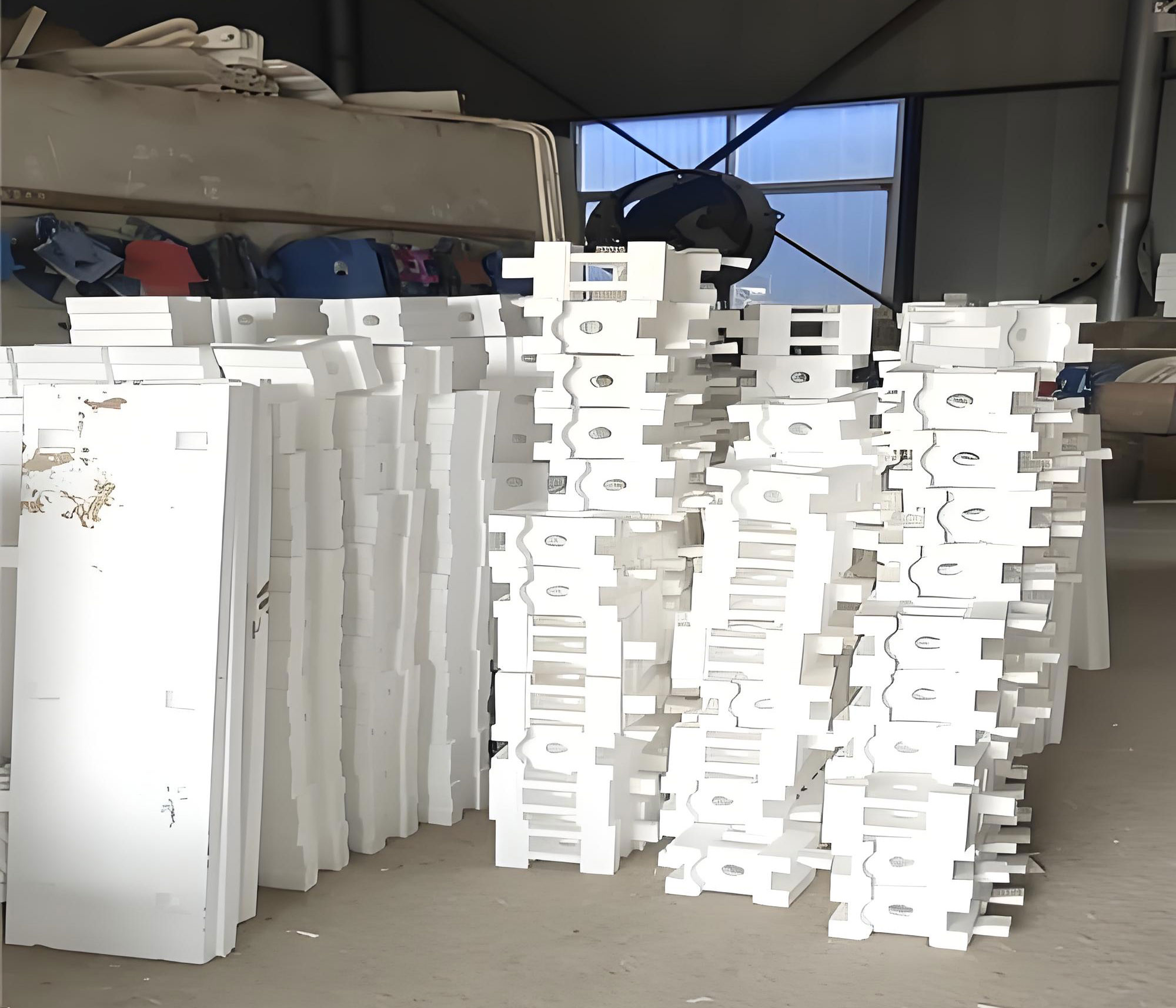
The heat input during board forming can be written as:
$$ Q_{\text{in}} = \dot{m}_s h_{fg} t_h $$
where \( \dot{m}_s \) is the mass flow rate of steam, \( h_{fg} \) is the latent heat of vaporization, and \( t_h \) is the heating time. The steam flow rate is related to the pressure difference between the steam manifold and the mold cavity. For an orifice-like steam vent, the flow rate can be approximated by:
$$ \dot{m}_s = C_d A_v \sqrt{2 \rho_s \left(P_s – P_c\right)} $$
where \( C_d \) is the discharge coefficient, \( A_v \) is the open area of the steam vents, \( \rho_s \) is the steam density, \( P_s \) is the steam supply pressure, and \( P_c \) is the cavity pressure. This equation explains why the principle of “low pressure and high flow rate” is important. If the pressure is too high, the bead surfaces at the cavity wall melt quickly and form a dense skin. This skin prevents steam from penetrating into the center of the board. As a result, the core of the board remains poorly fused even though the surface appears over-burned.
The cooling stage is equally important. Cooling can be accomplished with water cooling or vacuum cooling. In water cooling, water flows through the cooling channels in the mold and removes heat from the board. The heat removed can be estimated as:
$$ Q_{\text{out}} = \dot{m}_w c_p \left(T_{\text{out}} – T_{\text{in}}\right) t_c $$
where \( \dot{m}_w \) is the cooling water flow rate, \( c_p \) is the specific heat of water, \( T_{\text{out}} \) and \( T_{\text{in}} \) are the outlet and inlet water temperatures, and \( t_c \) is the cooling time. In vacuum cooling, a vacuum pump draws the remaining steam and blowing agent vapor out of the mold. This method removes heat by evaporation and also helps to dry the board before demolding.
Cooling must be continued until the board has enough strength to be removed without deformation. If the board is removed too early, the residual heat inside the foam can cause continued expansion. This leads to warpage and dimensional instability. Warped boards are difficult to machine and create poor patterns for lost foam castings.
7. Effect of One-Shot Steam Pressure on Fusion Degree
During the board-forming trials, I focused on the relationship between steam pressure and fusion degree. In my first series of tests, I varied the one-shot steam pressure while keeping the secondary heating pressure at 0.08 MPa and the heating time at 5 seconds. I also ran a second series with a heating time of 10 seconds.
The results showed a consistent pattern. As the one-shot steam pressure increased from a low value, the fusion degree first increased. It reached a maximum in a moderate pressure range. When the pressure became too high, the fusion degree decreased again.
This behavior can be represented by a simple parabolic model around the optimum pressure:
$$ F = F_{\max} – k \left(P_1 – P_{\text{opt}}\right)^2 $$
where \( F \) is the fusion degree, \( F_{\max} \) is the maximum fusion degree achievable for a given board thickness and bead type, \( P_1 \) is the one-shot steam pressure, \( P_{\text{opt}} \) is the optimum pressure, and \( k \) is a curvature coefficient. This model is useful for process optimization because it directly shows that both low pressure and high pressure are harmful.
Table 4 summarizes the observed effect of one-shot steam pressure on the fusion degree.
| One-Shot Pressure | Observed Effect on Board Quality |
|---|---|
| Too low | Steam cannot penetrate deeply into the board; beads remain separated; fusion degree is low; board is friable and may break during machining |
| Optimum | Steam penetrates completely before the surface skin closes; beads weld uniformly; fracture surface is fibrous and strong |
| Too high | The surface fuses quickly and blocks steam entry; the core remains under-fused; the surface may become over-burned, brown, or sticky; demolding becomes difficult |
I also observed that the one-shot heating time had only a minor effect on fusion degree. When the pressure was low, a longer heating time provided a slight improvement because it allowed more steam to reach the interior. When the pressure was high, a longer heating time did not improve fusion and only increased the risk of over-burning. This confirms that pressure is more important than time in the one-shot heating stage.
For the tested board density, the optimum one-shot pressure was in the range of about 0.08 to 0.12 MPa. below this range, the fusion degree was poor. Above this range, the board quality deteriorated rapidly. However, the exact optimum depends on the board thickness, the bead grade, the pre-foamed density, and the steam vent density in the mold. Therefore, the process specification should be verified with a simple fusion test at the beginning of each production campaign.
8. Effect of Secondary Steam Pressure on Fusion Degree
In the second series of forming tests, I kept the one-shot pressure at 0.12 MPa and varied the secondary heating pressure. The secondary heating time was also varied between 5 and 10 seconds.
The result was different from the one-shot heating result. The secondary pressure had a smaller effect on the overall fusion degree. As the secondary pressure increased, the fusion degree increased only slightly. This is because the board has already formed a fused surface layer during the one-shot heating stage. The secondary steam cannot easily enter the interior of the board. Its main contribution is to improve the fusion near the four small surfaces, which are drained during the one-shot heating stage and therefore receive less steam.
The relationship can be expressed as:
$$ F_{\text{final}} = F_{\text{core}} + \beta P_2 t_2 $$
where \( F_{\text{core}} \) is the fusion degree established by the one-shot heating, \( P_2 \) is the secondary steam pressure, \( t_2 \) is the secondary heating time, and \( \beta \) is a positive coefficient. The equation shows that the secondary heating has a linear, corrective effect on fusion degree, but the magnitude is limited.
Table 5 summarizes the observed effect of secondary steam pressure.
| Secondary Pressure | Observed Effect |
|---|---|
| Low | Very little improvement in edge fusion; the four small faces may be weaker than the two large faces |
| Moderate | Good repair of edge fusion; board surfaces remain smooth; no sticking |
| High | Overheating at the surface; risk of burning, discoloration, and sticking to the mold; no significant gain in internal fusion |
Because secondary heating has little effect on the interior, it cannot correct a poor one-shot heating cycle. Operators must not rely on secondary heating to repair a board that was under-fused during the first heating stage. Instead, the one-shot pressure must be set correctly for the board thickness and density.
9. Effect of Aging Time on Fusion Degree
In addition to the steam pressure tests, I studied the effect of aging time. I prepared beads at a constant pre-foamed density and divided them into several batches. Each batch was aged for a different time before board forming. The boards were then measured for fusion degree.
The general trend is illustrated in Table 6.
| Aging Condition | Fusion Degree Trend |
|---|---|
| Too short | Beads are damp and internally under vacuum; expansion during forming is insufficient; fusion degree is low |
| Optimum | Internal pressure is balanced; moisture is low; blowing agent content is still sufficient; fusion degree is high |
| Too long | Blowing agent has diffused out of the beads; expansion power is lost; fusion degree decreases |
I also found that the temperature during aging had an important influence. At a lower aging temperature, the diffusion processes were slower. Therefore, the optimum aging time was longer. At a higher aging temperature, the optimum was shorter, but the risk of losing blowing agent was also greater. Humidity played an equally important role. If the relative humidity was high, the beads absorbed moisture from the air. Moisture in the beads reduced the fusion quality and increased the moisture content of the final board. Since moisture in the pattern is harmful to lost foam castings, the aging environment must be kept dry.
10. Common Board-Forming Problems and Solutions
Throughout the production study, I encountered a number of common board-forming defects. Each defect was traced back to a process condition. The main problems and their solutions are summarized in Table 7.
| Problem | Root Cause | Corrective Action |
|---|---|---|
| Poor fusion degree | Aging time too long; aging time too short; steam pressure too high; steam pressure too low; blocked steam vents; steam vent density too low; mold leakage; insufficient bead filling | Optimize aging time; extend aging time if below 12 hours; lower or raise steam pressure as needed; add steam vents; clean blocked vents; replace mold seals; clean filling lines and ensure complete filling |
| Difficult demolding | Overheating causing bead fusion to the mold surface; insufficient cooling; incorrect ejector pin position; low ejection pressure; pressure sensor reading error | Reduce heating time; increase cooling water flow or cooling time; reposition ejector pins; adjust ejection air pressure; calibrate pressure sensor |
| Board deformation | Poor aging; excessive expansion ratio; local overheating; insufficient cooling | Extend aging time; reduce the pre-foamed expansion ratio; improve steam vent distribution; increase cooling time |
| Non-uniform board density | Different bead grades mixed; non-uniform pre-foaming; non-uniform raw bead particle size | Use the same bead grade and same batch; adjust pre-foaming for uniform expansion; use sieved beads with a narrow particle size range |
| Surface burning or discoloration | Steam pressure too high; heating time too long; blocked steam vents creating hot spots | Reduce pressure; shorten heating time; clean steam vents and check their distribution |
| Moisture content too high | High humidity in the aging silo; insufficient drying after forming; wet steam line | Control aging room humidity; extend drying time; use dry saturated steam and install steam traps |
I also studied the effect of cooling on deformation. The board expands slightly after demolding if the internal temperature is still high. This expansion is not uniform because the surface cools faster than the core. As a result, the board can develop a bow or warp. To reduce this risk, the board must be cooled to the recommended demolding temperature before the ejector pins are activated. In addition, the boards should be stacked flat on a smooth, level surface after demolding so that they can finish cooling without distortion.
11. Density and Moisture Control
For lost foam castings, the density of the foam pattern is directly related to the amount of gas generated during pouring. A denser pattern contains more polymer mass per unit volume. When the metal is poured, this polymer must be decomposed and removed from the mold cavity. If the density is too high, the gas generation rate can exceed the permeability of the coating and the sand, causing back-pressure defects. If the density is too low, the pattern may not have enough strength to resist the pressure of the sand during compaction.
The average density of a finished board can be calculated as:
$$ \rho_{\text{plate}} = \frac{m_{\text{plate}}}{V_{\text{plate}}} $$
where \( m_{\text{plate}} \) is the mass of a cut sample and \( V_{\text{plate}} \) is its volume. The uniformity of density can be quantified by the sample standard deviation:
$$ \sigma_{\rho} = \sqrt{\frac{1}{n-1} \sum_{i=1}^{n} \left(\rho_i – \bar{\rho}\right)^2} $$
where \( n \) is the number of samples cut from different positions of the board, \( \rho_i \) is the density of sample \( i \), and \( \bar{\rho} \) is the average density. A low standard deviation means that the board is uniform. I used this method to check boards produced before and after process adjustments. The results showed that density uniformity improved significantly when the pre-foaming and aging conditions were properly controlled.
Moisture content is also critical for lost foam castings. The moisture content can be determined by weighing a sample before and after drying:
$$ MC = \frac{m_{\text{wet}} – m_{\text{dry}}}{m_{\text{dry}}} \times 100\% $$
where \( m_{\text{wet}} \) is the mass of the wet sample and \( m_{\text{dry}} \) is the mass after drying. Boards with high moisture content should not be used for lost foam castings. During pouring, the water vaporizes and increases the gas volume in the mold. This can cause bubbles in the coating, erosion of the sand mold, and gas porosity in the casting.
12. Fusion Degree and Pattern Surface Quality
Fusion degree is probably the most direct measure of board quality for lost foam castings. The fusion degree can be defined as the percentage of the fracture surface that fails through the cell walls rather than along intact bead surfaces:
$$ F = \frac{A_{\text{welded}}}{A_{\text{total}}} \times 100\% $$
where \( A_{\text{welded}} \) is the area that shows torn cell walls and \( A_{\text{total}} \) is the total fracture area. A board with high fusion degree has a fracture surface that looks white and fibrous. A board with low fusion degree has a fracture surface that shows many separate, rounded beads.
During machining of the board into pattern segments, a low fusion degree leads to bead pull-out. The cutter dislodges whole beads from the surface instead of cutting smoothly through the foam. This leaves a rough, pitted surface. The rough surface cannot be removed by coating. In fact, the coating tends to accumulate in the pits, and after pouring the casting may show rough surface areas or defects.
In the lost foam casting process, the pattern surface is directly replicated on the casting surface. Therefore, high fusion degree is essential for high-quality lost foam castings.
13. Process Specification for Stable Production
Based on the experimental results and the production observations, I developed a process specification for the tested EPS bead grade and a target density of 20 g/L. The specification includes the key control points shown in Table 8.
| Process Stage | Control Point | Recommended Practice |
|---|---|---|
| Incoming material | Bead grade and batch | Use one batch for each production campaign; check volatile content and sieve analysis before use |
| Pre-foaming | Steam quality | Use dry, saturated steam; insulate the steam line; fit steam traps and drain condensate regularly |
| Pre-foaming | Target density | Set the pre-foaming density according to the board density specification; measure bead density frequently |
| Pre-foaming | Uniform expansion | Maintain stable steam pressure; avoid mixing different batches; clean the raw material feeder |
| Aging | Environment | Maintain 20–25 °C temperature and relative humidity below 30% |
| Aging | Aging time | Use the optimized aging time for the measured bead density; verify the blowing agent content before forming |
| Board forming | One-shot steam pressure | Set the pressure in the optimum range; do not exceed the pressure that causes surface sealing before core penetration |
| Board forming | Secondary steam pressure | Use a moderate pressure to repair edge fusion; avoid over-burning the surface |
| Board forming | Cooling | Cool to the required demolding temperature; use water or vacuum cooling as defined in the process sheet |
| Board forming | Mold condition | Keep steam vents open and clean; replace worn seals; balance ejector pin forces |
| Finished board | Quality testing | Measure density, fusion degree, moisture, and visual appearance on every batch |
This specification is not a universal recipe. The optimum values depend on the bead type, the bead size, the mold design, and the desired board density. However, the methodology is universal. By tracking parameters and comparing them with board quality, any production line can find its own optimum window. Once the window is known, the process can be controlled tightly to produce stable boards for lost foam castings.
14. Discussion
One of the most important conclusions from this study is that the pre-foaming and aging stages deserve at least as much attention as the board-forming stage. Many operators believe that the steam pressure in the forming mold is the only important parameter. In reality, the quality of the pre-foamed beads determines what the forming stage can achieve. If the beads have the wrong density, excessive moisture, or insufficient blowing agent, no amount of forming pressure can produce a well-fused board.
Another key conclusion is that the board-forming process should follow the principle of quick steam penetration. The steam must enter the bead mass fast enough to heat the entire cross-section before the outer layers collapse into a dense skin. This is the reason why low pressure with high flow rate is preferred over high pressure with low flow rate. The steam vents, the mold seals, and the condensate drainage all play a role in maintaining the necessary flow rate.
For thicker boards, the challenge is greater because steam has to travel further from the large surfaces to the center. The optimum steam pressure will be different for different board thicknesses. A process specification must therefore include a range of pressures for each board thickness and density. The operator should confirm the correct setting by running a test board and checking the fracture surface before starting a full production batch.
The effect of secondary heating is often misunderstood. Some operators increase the secondary pressure to improve overall fusion. My tests show that this is not effective. The secondary heating only repairs the small-surface regions. It cannot rescue an under-fused core. Therefore, the one-shot heating stage must be the primary focus of quality control.
Cooling is another critical but sometimes ignored parameter. In my study, several boards that had correct fusion degree and density were rejected because of deformation. In every case, the deformation was caused by insufficient cooling or by removing the board from the mold too early. The solution was to extend the cooling time and to use a flat storage rack after demolding. This simple change reduced warpage dramatically and improved the dimensional consistency of patterns used for lost foam castings.
I also observed that the moisture content of the finished board is influenced by the aging environment. If the aging silo is located near a source of humidity, the beads can pick up moisture even after they have been dried in the pre-foaming stream. Moisture in the beads becomes moisture in the board. For lost foam castings, this moisture is a source of potential defects. Therefore, the aging area should be ventilated and, if necessary, dehumidified.
The use of a standardized process specification has another benefit. It makes training easier and reduces dependence on individual operator judgment. When the process variables are written down and the acceptable ranges are clear, new operators can produce good boards more quickly. At the same time, the quality data from each batch provides a basis for continuous improvement. If a batch falls outside the normal range, the cause can be identified by examining the recorded parameters.
15. Relationship Between Process Control and Downstream Pattern Quality
The link between board production and final lost foam castings can be understood as a chain of quality transfer. The raw bead quality is transferred to the pre-foamed bead quality. The pre-foamed bead quality is transferred to the aged bead quality. The aged bead quality is transferred to the formed board quality. Finally, the board quality is transferred to the machined pattern quality. If any link in the chain is weak, the final casting suffers.
In particular, the fusion degree of the board affects the pattern in these ways:
1. Machining appearance. A well-fused board has a smooth machined surface with small closed cells. A poorly fused board has a rough, pitted surface with open spaces between beads.
2. Coating behavior. The surface of a poorly fused board absorbs coating unevenly. Some areas receive more coating, while other areas receive less. This can cause coating cracking or poor permeability.
3. Handling strength. Thin pattern sections, such as ribs and flanges, break easily if the board has low fusion degree. This leads to scrap and rework.
4. Dimensional stability. Boards with uneven fusion often contain internal stresses. When the board is machined, the stress is released and the pattern may distort.
5. Gas evolution. If the board contains voids caused by poor fusion, the voids can fill with sand or coating during subsequent processing. During pouring, these voids may release gas or allow metal penetration, causing defects in lost foam castings.
Therefore, the process control measures described in this article are not just about making attractive foam boards. They are directly connected to the success of lost foam castings.
16. Quality Testing Methods
I used several testing methods to evaluate the finished boards. These methods are simple enough to be used by production personnel on every shift.
The density test is performed by cutting a sample of known volume and weighing it. The density is calculated with the formula:
$$ \rho = \frac{m}{V} $$
where \( m \) is the mass in grams and \( V \) is the volume in liters. For a 20 g/L board, a sample with dimensions 100 mm × 100 mm × 50 mm has a volume of 0.5 L and should weigh approximately 10 g.
The fusion test is performed by cutting a strip from the board. The strip is bent between the hands, and the fracture surface is examined. The classification is qualitative:
Good fusion: the fracture surface is white, fibrous, and difficult to pull apart by hand.
Poor fusion: the fracture surface shows many whole, round beads that fall out easily.
This test is fast and reliable. I used it to make routine decisions about whether to accept or reject a board production run.
The moisture test is performed by weighing a sample, drying it in an oven at about 60 °C for several hours, and then weighing it again. The moisture content is:
$$ MC = \frac{m_{\text{wet}} – m_{\text{dry}}}{m_{\text{dry}}} \times 100\% $$
Boards with a moisture content above the specification limit should be dried again before machining. For lost foam castings, the moisture content should be as low as practically possible.
The surface quality test is performed by visual inspection. The board surface should be smooth, without local sunken areas, burn marks, or discoloration. The corners and edges should be sharp and complete. A surface with visible gaps between beads indicates poor fusion or insufficient expansion.
17. Optimization Strategy
To optimize the production process for lost foam castings, I recommend the following strategy.
First, define the required board quality. This includes density, minimum fusion degree, maximum moisture, and allowable deformation.
Second, establish a stable raw material supply. The bead grade, particle size, and volatile content should be consistent from batch to batch.
Third, map the pre-foaming process. For the chosen bead grade, determine the relationship between pre-foaming steam pressure, heating time, and bulk density.
Fourth, study the aging behavior. Measure the blowing agent content and moisture content of the beads at different aging times. Choose an aging window that preserves enough blowing agent while allowing pressure equalization.
Fifth, optimize the board-forming cycle. Vary the one-shot steam pressure, the secondary steam pressure, and the heating time. Use the fusion test and density test to identify the optimum settings.
Sixth, document the process. Write the acceptable ranges for every parameter. Train operators to check these ranges before every batch.
Finally, monitor the results. Record quality test data and compare it with process data. When a problem appears, look for the process step that changed.
This strategy is iterative. In my research, I repeated it several times. Each cycle brought the process closer to a stable and reliable condition. The result was a visible improvement in board quality and a reduction in defects in the final lost foam castings.
18. Practical Considerations for Production
In a production environment, the theoretical optimum is not always easy to achieve. There are practical constraints such as steam pressure fluctuations, differences between molds, and changes in ambient weather. I therefore introduced several practical safeguards in the process specification.
First, the steam line must be checked before production. The steam trap must be working, and the pipe insulation must be intact. Wet steam is one of the most common causes of poor fusion and high moisture content.
Second, the steam vents in the board mold must be inspected regularly. Blocked vents create uneven steam flow. This can cause local hot spots and local under-fusion in the same board. Both conditions are damaging to lost foam castings.
Third, the mold seals must be in good condition. Leakage reduces the pressure available for steam penetration and allows steam to escape through unwanted paths. The operator should check the seals before every production shift.
Fourth, the ejector pins must be adjusted carefully. If the pins are out of balance, the board can be damaged during demolding. A small indentation from an ejector pin is not always visible on the board surface, but it will appear as a defect on the machined pattern and may be replicated in the casting.
Fifth, the workshop environment should be as clean and dry as possible. Dust and moisture in the beads can cause density variations. Clean handling also reduces the number of defects caused by foreign material.
19. Effect of Raw Bead Volatile Content
The volatile content of the raw EPS beads determines the expansion potential of each bead. In Table 1, the volatile content was 6.26%. This value is within the typical range for beads used in lost foam castings.
If the volatile content is too low, the beads cannot expand sufficiently during pre-foaming. They also cannot supply enough blowing agent during board forming. The result is a dense, poorly fused board with high density and rough surface.
If the volatile content is too high, the beads expand very quickly. This may cause uncontrolled expansion and a very low density. The board may be too weak to handle. In addition, high volatile content increases the gas evolution during pouring, which can overload the coating permeability.
Therefore, the incoming bead quality should be checked carefully. I used a simple loss-on-heating test to verify the volatile content. This test should be repeated whenever a new batch of beads arrives.
20. Summary of Observations
I have organized the main observations from this research into the following list:
1. The fusion degree of the board is the most important quality indicator for pattern surface quality and therefore for lost foam castings.
2. Pre-foaming must produce beads with the correct target density and a narrow density distribution.
3. Aging must balance internal pressure and moisture removal against blowing agent retention.
4. One-shot steam pressure must be high enough to penetrate the bead mass, but not so high that it seals the surface before the interior is heated.
5. Heating time has less influence than steam pressure under normal conditions.
6. Secondary heating is useful only for repairing edge fusion and must not be used to compensate for poor one-shot heating.
7. Cooling time and demolding temperature are critical for dimensional stability.
8. Moisture control in the aging room is essential for reducing both board moisture and casting defects.
9. Mold maintenance, including steam vent cleaning and seal replacement, is a necessary part of producing consistent boards.
10. A written process specification and routine quality testing are the best tools for stabilizing board quality.
Each of these observations has a direct impact on the performance of the pattern during the production of lost foam castings.
21. Conclusion
This research was carried out to understand how the production parameters of the foam board affect the quality of lost foam castings. I tracked the entire board production process, analyzed abnormal conditions, and developed corrective actions. Through process experiments I found that the fusion degree of the board is controlled primarily by the pre-foamed bead quality, the aging condition, and the steam pressure during board forming.
The relationship between one-shot steam pressure and fusion degree follows a curve that rises to a maximum and then falls. This means that both under-pressurization and over-pressurization must be avoided. The secondary heating pressure has a much smaller effect and should be used only for edge repair. Heating time has only a minor influence, especially at high pressure.
Aging time must be set carefully. Too little aging leaves the beads moist and unbalanced. Too much aging depletes the blowing agent. The aging temperature and humidity should be controlled to ensure consistent results.
By converting these findings into a formal process specification, I was able to improve the consistency of the board production line. The quality of the patterns produced from these boards became more stable. Scrap caused by surface defects, low strength, and dimensional distortion was reduced. Most importantly, the stability of the final lost foam castings improved because the pattern behavior during pouring became more predictable.
The methods described in this article can be applied to other bead grades and other board densities. The key is to measure the process, understand the relationships, and control the variables within their optimum windows. In this way, the production of foam board can be made reliable enough to support high-quality lost foam castings at an industrial scale.