
In the production of heavy-duty marine diesel engines, the cylinder block stands as the most critical and challenging casting component. Its quality requirements are exceptionally stringent, with key areas such as cylinder bores, bearing journals, and camshaft bores mandating rigorous ultrasonic inspection. The specific series of blocks discussed here, with casting weights reaching up to 20 tons and manufactured from QT400-15 ductile iron, fall into the category of heavy-section nodular castings. During the initial production trials, a persistent and detrimental quality issue emerged: the presence of slag inclusion defects in multiple locations of the cast block. These defects, severely compromising the mechanical integrity of the component, manifested as gray-brown discolorations, appearing either as large patches or localized spots, predominantly on the upper surfaces of the casting or at the underside of cores.
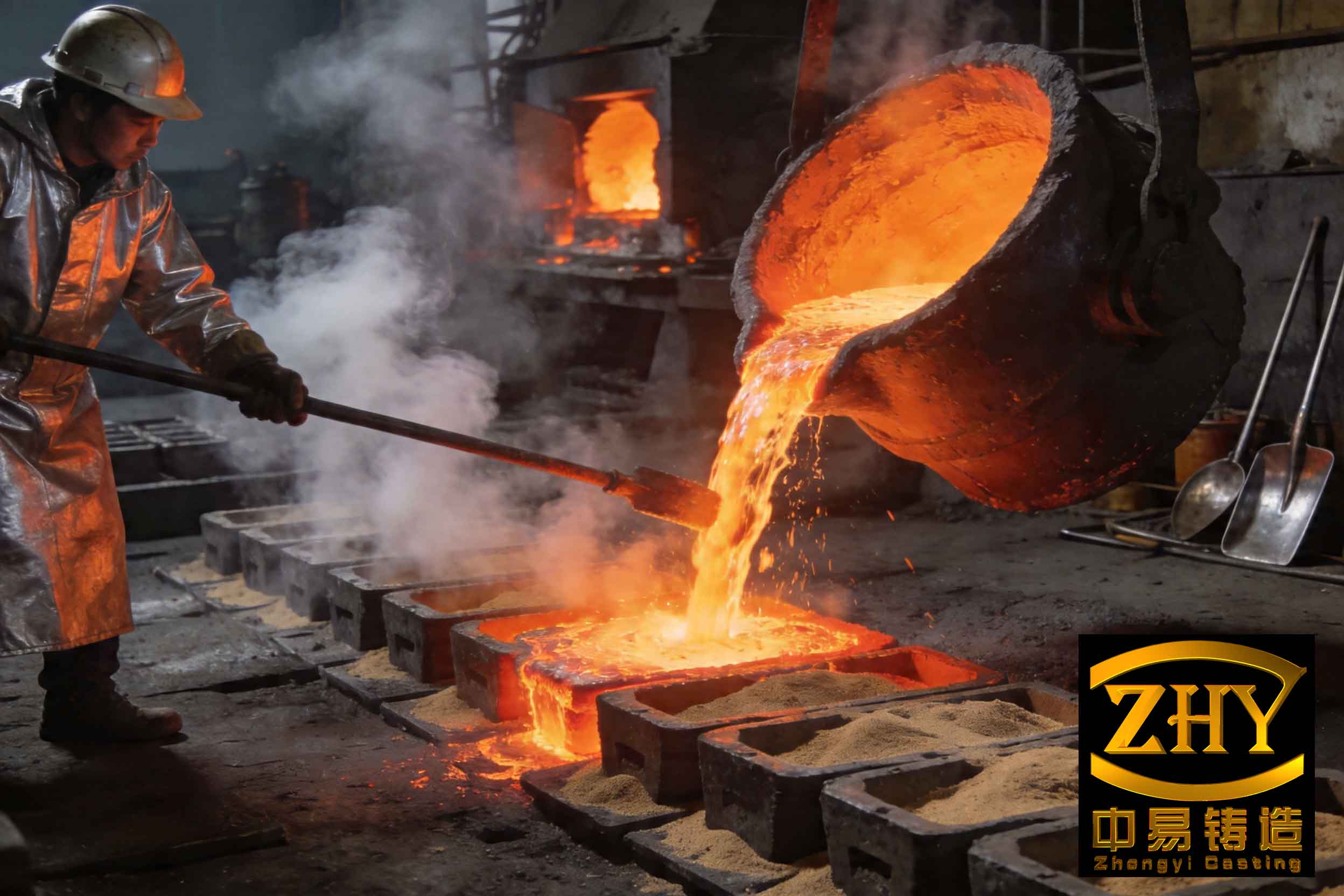
Slag inclusion defects in ductile iron, commonly referred to as “black dross,” represent one of the most prevalent and troublesome casting imperfections. They fundamentally degrade mechanical properties, particularly elongation and impact toughness, posing a significant risk of component failure under operational loads. These inclusions are generally classified into two categories: primary and secondary slag. Primary slag originates from oxides, sulfides, and other non-metallic compounds formed during melting or improper furnace treatment, which are then carried into the mold cavity with the metal stream. Secondary slag, conversely, forms during the mold-filling process due to the re-oxidation of the liquid metal. The tendency for these defects to settle at the top surfaces or in stagnant flow zones makes them a critical concern for complex, heavy castings like engine blocks.
Faced with this significant production hurdle, I led an investigation to pinpoint the root cause of these slag inclusion defects. Traditional trial-and-error methods on such a massive and expensive casting were prohibitively costly and time-consuming. Therefore, we employed advanced numerical simulation technology, specifically using MAGMA software, to virtually analyze the original gating and feeding design. This approach allowed us to visualize the filling and solidification processes in detail, providing invaluable insights into the fluid dynamics and thermal conditions that were fostering defect formation.
Root Cause Analysis Through Numerical Simulation
The original casting process utilized a single-side gating system where metal entered the mold cavity from one lateral position. Our MAGMA simulation of this initial design revealed several critical flow pathologies directly contributing to the formation of slag inclusion defects.
First, the analysis of the velocity field during the early stages of filling showed an excessively high instantaneous flow rate through the gating channels. This high velocity induced severe splashing and air entrainment within the gating system itself, particularly near the ingates. The entrained air bubbles act as nuclei for oxide film formation, directly promoting slag generation. More critically, the positioning of the ingates was such that the metal stream impinged directly onto the bottom prints of large sand cores. This impingement created intense turbulence, further aggravating metal splash, re-oxidation, and the fragmentation of any existing oxide films into discrete particles that could become trapped as slag inclusion defects.
Second, the simulation of the temperature field painted a clear picture of thermal imbalance. The side of the mold opposite the single gating inlet exhibited significantly lower temperatures throughout the filling sequence. This thermal gradient is detrimental for two reasons: 1) cooler metal has higher viscosity, which drastically reduces the buoyancy-driven ascent velocity of any slag particles, making them more likely to be trapped, and 2) it creates “cold zones” or dead areas in the lower regions of the block opposite the ingates. Early metal entering these zones remains stagnant and cools rapidly, preventing the agglomeration and flotation of oxides, thereby localizing slag inclusion defects in these areas.
The flotation of slag particles is governed by Stokes’ law, which can be simplified for this context as:
$$ v = \frac{2 g r^2 (\rho_m – \rho_s)}{9 \eta} $$
where \( v \) is the terminal flotation velocity, \( g \) is gravitational acceleration, \( r \) is the radius of the slag particle, \( \rho_m \) and \( \rho_s \) are the densities of the molten metal and slag, respectively, and \( \eta \) is the dynamic viscosity of the metal. A lower temperature significantly increases \( \eta \), causing \( v \) to drop. If the solidification time \( t_s \) in a particular region is too short, a particle needs a minimum velocity \( v_{min} = h / t_s \) (where \( h \) is the distance to the top surface) to escape. A slag inclusion defect forms when \( v < v_{min} \). The cold zone created by the original design ensured this condition was met.
Based on the simulation findings, the root causes for the persistent slag inclusion defects were conclusively identified as:
1. Excessively high pouring velocity leading to severe splashing and air entrainment.
2. Poor ingate positioning causing direct impingement and turbulent flow.
3. Thermally unbalanced filling, resulting in cold zones with poor slag flotation capacity.
4. Sub-optimal pouring temperature, further reducing slag buoyancy.
| Cause Category | Specific Mechanism | Effect on Slag Formation |
|---|---|---|
| Fluid Dynamics | High velocity at ingates | Splashing, air entrainment, oxide film fragmentation. |
| Flow Path | Ingate impinging on core prints | Increased turbulence and re-oxidation. |
| Thermal Management | Single-side gating creating thermal imbalance | Formation of cold zones with high metal viscosity. |
| Process Parameter | Low pouring temperature (1330-1340°C) | Reduced slag particle flotation velocity (\(v \downarrow\)). |
Design and Implementation of Corrective Measures
Armed with this diagnostic understanding, I formulated a comprehensive set of corrective actions focused on achieving quiescent, balanced, and thermally uniform filling to mitigate slag inclusion defects.
1. Redesign of the Gating System: The single-side gating was completely abandoned in favor of a symmetrical, two-side gating system. This fundamental change ensured that metal entered the mold cavity from opposite sides simultaneously, promoting balanced filling and eliminating the large stagnant cold zone. Furthermore, the total cross-sectional area of the sprue, runners, and ingates was systematically increased to transition from a pressurized (choke-controlled) system to a more open, unpressurized one. The relationship between flow rate \( Q \), cross-sectional area \( A \), and velocity \( v \) is given by:
$$ Q = A \cdot v $$
For a constant flow rate \( Q \) (determined by the pouring basin), increasing the choke area \( A \) directly reduces the metal velocity \( v \) at that point. Lower velocity is the primary defense against turbulence and splash-induced slag inclusion defects.
2. Strategic Repositioning of Ingates: The location of each ingate was carefully offset to ensure the metal stream entered the mold cavity parallel to core surfaces or into open volumes, rather than impinging directly on core prints or mold walls. This minimized flow disruption and turbulence at the point of entry.
3. Optimization of Pouring Parameters: The target pouring temperature was raised from 1330-1340°C to 1360-1370°C. This increase directly lowers the dynamic viscosity \( \eta \) of the iron, which, according to the Stokes’ law equation, increases the flotation velocity \( v \) of slag particles, giving them a much better chance to rise to the cope surfaces or into the feeder heads before the metal solidifies. The temperature dependence of viscosity can be approximated by an Arrhenius-type relation:
$$ \eta = \eta_0 \exp\left(\frac{E_a}{RT}\right) $$
where \( E_a \) is the activation energy for viscous flow, \( R \) is the gas constant, and \( T \) is the absolute temperature. A small increase in \( T \) causes a significant decrease in \( \eta \).
4. Enhanced Pouring Practice: The pouring sequence was modified to incorporate a “two-stage stopper rod” technique. An initial, slower pour was initiated to gently fill the sprue and bottom runners, after which the stopper was fully opened for the main pour. This practice further controlled the initial rush of metal, dampening turbulence.
A new simulation was run on the optimized design. The results confirmed a dramatic improvement. The velocity field showed a calm, progressive filling front without splashing or impingement. Most importantly, the temperature field displayed remarkable symmetry and uniformity; the previously cold zone was eliminated, with both sides of the block heating up evenly during filling. This uniform thermal profile ensured consistent viscosity across the casting, promoting efficient slag flotation everywhere and leaving no low-temperature traps for slag inclusion defects.
| Parameter / Outcome | Original Process | Optimized Process |
|---|---|---|
| Gating Configuration | Single-side, pressurized | Two-side, unpressurized |
| Ingate Position | Impinging on core prints | Offset, non-impinging |
| Pouring Temperature | 1330 – 1340 °C | 1360 – 1370 °C |
| Simulated Max. Flow Velocity | High (Critical) | Low (Safe) |
| Simulated Thermal Balance | Poor (ΔT > 50°C) | Excellent (ΔT < 15°C) |
| Predicted Slag Tendency | Severe | Negligible |
Production Validation and Results
The optimized process derived from numerical simulation analysis was implemented in full-scale production trials. A batch of 20 cylinder blocks was produced following the new specifications: the redesigned two-side gating molds, higher pouring temperatures, and controlled pouring practices.
The results were unequivocal. Non-destructive testing (NDT) and subsequent machining of these trial castings revealed a near-total elimination of slag inclusion defects. The defects that had previously plagued the upper deck surfaces and core underside regions were absent. All 20 blocks passed the rigorous quality inspections, including the critical ultrasonic testing of key bores and journals. The castings successfully proceeded through machining, engine assembly, and final performance testing without any issues related to slag. The process capability was established, enabling stable, batch production of high-quality cylinder blocks.
This successful resolution underscores several critical learnings. First, slag inclusion defects are often a symptom of poor fluid dynamics and thermal management during mold filling, not just melting quality. Second, numerical simulation is an indispensable tool for diagnosing the root causes of such defects in complex castings, moving problem-solving from empirical guesswork to a science-based methodology. It allows for the visualization of parameters like velocity, temperature, and even oxide formation potential that are impossible to see in real-time during an actual pour. The quantitative insights from simulation, such as the analysis of flow velocity against critical thresholds for splash or the calculation of temperature-dependent viscosity, provide a solid foundation for effective corrective action.
Furthermore, our experience highlights that controlling slag inclusion defects requires a holistic approach. While simulation guided the macro-design changes (gating, temperatures), its success was contingent on parallel improvements in foundry practices—meticulous drying of ladles and pouring basins, strict control of sand core and mold hardness to resist erosion, and careful execution of the pouring sequence. It is also noteworthy that defects like slag and gas porosity often share common root causes in turbulent flow and oxide formation; therefore, a solution targeting slag inclusion defects frequently improves overall casting soundness.
| Control Pillar | Specific Actions | Targeted Mechanism |
|---|---|---|
| Process Design (Simulation-Guided) | Unpressurized, balanced gating; Non-impinging ingates; Increased pouring temperature. | Minimizes turbulence & re-oxidation; Maximizes slag flotation velocity (\(v \uparrow\)). |
| Melting & Metallurgy | Effective desulfurization; Clean, calm transfer; Proper inoculation & treatment. | Reduces primary slag sources (sulfides, oxides). |
| Mold & Core Quality | Adequate hardness & permeability; Use of protective coatings (e.g., alumina-based). | Prevents sand erosion; Creates barrier to metal-mold reaction. |
| Pouring Practice | Two-stage pouring; Fast, consistent pour after initial fill; Full ladles/basins. | Prevents initial turbulence; Avoids re-oxidation from slag carryover. |
In conclusion, the challenge of slag inclusion defects in large, heavy-section ductile iron castings is formidable but manageable. By leveraging numerical simulation to understand the intimate details of the filling process, we were able to diagnose the precise hydrodynamic and thermal deficiencies causing the problem. The implementation of a balanced, quiescent filling system coupled with optimized thermal parameters proved to be the definitive solution. This case stands as a testament to the power of integrating virtual prototyping tools like MAGMA into the foundry problem-solving workflow, transforming the production of critical components like marine engine blocks from a high-risk endeavor into a reliable, repeatable manufacturing process. The principles established—controlling velocity, ensuring thermal symmetry, and maximizing slag buoyancy—form a universal framework applicable to combating slag inclusion defects across a wide range of cast iron and cast steel applications.