
In modern foundry practice, the pursuit of high-quality shell castings for complex components like diesel engine cylinder blocks and differential drive housings has driven innovation in casting processes. As a foundry engineer, I have extensively worked with both lost foam casting and V-process (vacuum sealed molding) techniques, which offer significant advantages over traditional sand casting methods. These processes not only enhance the dimensional accuracy and surface finish of shell castings but also reduce environmental impact and production costs. In this article, I will delve into the design optimizations, process controls, and theoretical foundations that make these methods viable for producing robust shell castings. The focus will be on how these technologies unify product requirements, solidification principles, and production efficiency, with particular emphasis on shell castings—a term that encapsulates the critical outer and inner structures of cast components. Throughout, I will use tables and formulas to summarize key data and relationships, aiming to provide a comprehensive resource for practitioners.
The lost foam casting process, also known as full mold casting, involves creating a foam pattern of the desired shell casting, coating it with a refractory material, and embedding it in unbonded sand under vacuum. This method is especially suited for intricate shell castings like diesel engine cylinder blocks, where internal passages and thin walls demand precision. In my experience, the design of the gating system and the pre-placement of cores are crucial. For instance, in dry liner diesel engine blocks, sand cores for the liner areas can be made using self-hardening or hot box processes, pre-filled during foam pattern assembly to prevent defects such as sand adhesion and scabbing. The foam pattern is typically made from expandable polystyrene beads, assembled into a cluster with the pouring system, dipped in coating, and dried before being placed in a sand-filled flask with a vacuum system. The molten metal is then poured under vacuum, causing the foam to vaporize and the metal to take its shape, resulting in a precise shell casting.
To quantify the benefits, consider the solidification dynamics in lost foam casting. The heat transfer during metal replacement can be modeled using Fourier’s law of heat conduction. For a shell casting with thickness $L$, the solidification time $t_s$ can be approximated by Chvorinov’s rule:
$$ t_s = k \cdot \left( \frac{V}{A} \right)^n $$
where $V$ is the volume of the casting, $A$ is the surface area, $k$ is a mold constant dependent on material properties, and $n$ is an exponent typically around 2 for many alloys. In lost foam casting, the vacuum environment and foam decomposition alter $k$, often reducing solidification time and improving shell casting integrity. For a diesel engine cylinder block, with complex geometries, optimizing the $V/A$ ratio through pattern design is key to minimizing shrinkage defects. Below is a table summarizing typical process parameters for lost foam casting of shell castings like cylinder blocks:
| Parameter | Value Range | Impact on Shell Castings |
|---|---|---|
| Foam Density | 20-25 kg/m³ | Affects pattern strength and gas evolution during pour |
| Coating Thickness | 0.5-1.0 mm | Controls metal penetration and surface finish of shell castings |
| Vacuum Pressure | -0.04 to -0.06 MPa | Ensures mold stability and reduces porosity in shell castings |
| Pouring Temperature | 1350-1400°C for iron | Influences fluidity and defect formation in shell castings |
| Sand Grain Size | 70-140 mesh | Affects surface detail and compaction for shell castings |
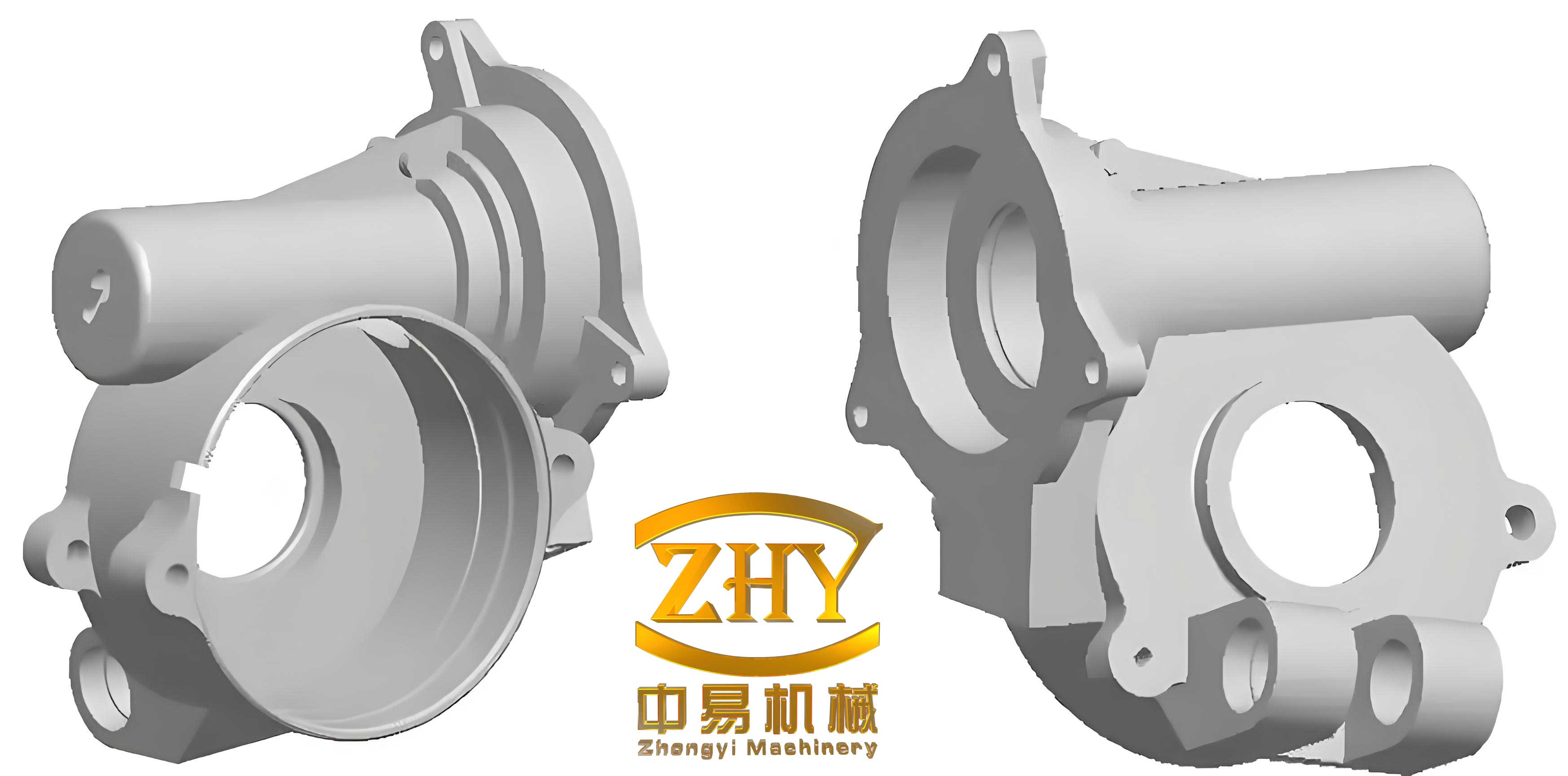
Transitioning to V-process casting, this method uses a thin plastic film heated and draped over a pattern, with dry sand vacuum-compacted around it. The film seals the mold, and vacuum is maintained during pouring, resulting in shell castings with excellent surface detail and minimal draft angles. In my work with differential drive hulls—a type of shell casting for automotive applications—V-process has proven effective in reducing costs and improving quality compared to resin sand methods. The process begins with pattern making, often from hardwood or CNC-machined materials, to ensure accuracy for the shell casting. For the differential housing, the parting line is set at the flange, and an open gating system is designed to ensure smooth metal flow. The gating ratio, critical for shell casting quality, is typically set as $F_{\text{直}}:F_{\text{横}}:F_{\text{内}} = 1.0:1.25:1.35$, where $F$ represents cross-sectional areas of sprue, runner, and ingate, respectively. This ratio minimizes turbulence and erosion in the mold cavity, preserving the integrity of the shell casting.
The fluid dynamics in V-process casting can be described using Bernoulli’s principle for incompressible flow. The metal velocity $v$ at the ingate is given by:
$$ v = \sqrt{2gh + \frac{2(P_v – P_a)}{\rho}} $$
where $g$ is gravity, $h$ is the effective head height, $P_v$ is the vacuum pressure, $P_a$ is atmospheric pressure, and $\rho$ is the metal density. For shell castings, maintaining $v$ below a critical threshold prevents mold collapse and sand inclusion. In practice, for a differential housing shell casting, the pouring temperature is kept at 1320-1360°C, with vacuum levels of -0.05 to -0.06 MPa. The chemical composition of the iron, tailored for shell castings, includes elements like copper and molybdenum to enhance strength and wear resistance. Below is a table comparing V-process and resin sand methods for producing shell castings like differential housings:
| Aspect | V-Process Casting | Resin Sand Casting |
|---|---|---|
| Surface Finish | High gloss, minimal roughness | Moderate, prone to veining |
| Dimensional Accuracy | CT6-9 grade for shell castings | CT8-10 grade |
| Environmental Impact | Low, no binder emissions | High, organic vapors |
| Production Cost per Ton | Lower by approximately 1000 units | Higher due to resin use |
| Defect Rate in Shell Castings | Reduced porosity and shrinkage | Higher incidence of gas holes |
In both processes, the design of cores is vital for shell castings. In lost foam, cores are pre-embedded and coated with graphite to prevent reactions, while in V-process, shell cores made from coated sand are used to form internal cavities. The core-making process itself can be optimized using equations for sand compaction. For example, the permeability $K$ of the sand affects gas escape during pouring and is given by:
$$ K = \frac{d^2 \phi^3}{180(1-\phi)^2} $$
where $d$ is the sand grain diameter and $\phi$ is porosity. For shell castings, high permeability reduces back-pressure and defect formation. Additionally, the coating applied to patterns or cores in both processes serves as a barrier, and its effectiveness can be modeled via heat transfer coefficients. The thermal conductivity $\lambda_c$ of the coating influences the cooling rate of the shell casting, impacting microstructure. Empirical data shows that for iron shell castings, $\lambda_c$ should range from 0.5 to 1.0 W/m·K to balance cooling and avoid cracks.
To further illustrate the practical outcomes, consider the metallurgical aspects of shell castings. In ductile iron differential housings, the nodule count and matrix structure determine mechanical properties. The solidification sequence can be controlled by chilling, as seen in V-process where graphite chills are placed at hot spots. The cooling rate $T’$ affects nodule formation and is approximated by:
$$ T’ = \frac{T_p – T_s}{t_s} $$
where $T_p$ is pouring temperature, $T_s$ is solidus temperature, and $t_s$ is solidification time. For shell castings, a moderate $T’$ ensures fine graphite and ferritic-pearlitic matrices. Below is a table detailing typical chemical compositions for shell castings produced via these methods, highlighting alloying elements that enhance performance:
| Element | Range for Lost Foam Shell Castings (%) | Range for V-Process Shell Castings (%) | Role in Shell Castings |
|---|---|---|---|
| Carbon | 3.2-3.6 | 3.0-3.8 | Provides fluidity and strength |
| Silicon | 1.8-2.4 | 2.0-2.6 | Promotes graphitization in iron shell castings |
| Manganese | 0.6-0.9 | 0.5-1.0 | Increases hardness and wear resistance |
| Copper | 0.2-0.5 | 0.3-0.7 | Enhances tensile strength of shell castings |
| Molybdenum | 0.1-0.3 | 0.35-0.50 | Improves toughness and high-temperature properties |
The integration of these processes into production lines has revolutionized shell casting manufacturing. For instance, in lost foam casting, the use of robotic dipping and automated sand filling systems increases consistency for shell castings. The vacuum level, a critical parameter, is monitored in real-time using sensors, and data analysis can predict shell casting quality. I have developed empirical models linking vacuum stability to defect rates, expressed as:
$$ D = \alpha e^{-\beta P_v} + \gamma $$
where $D$ is defect density in shell castings, $P_v$ is vacuum pressure, and $\alpha, \beta, \gamma$ are material-specific constants. This shows that maintaining a steady vacuum below -0.04 MPa reduces defects like sand erosion in shell castings. Similarly, in V-process, the film heating temperature and time affect mold replication. Optimal heating ensures the film elongates uniformly, conforming to the pattern and producing sharp details on shell castings. The relationship between film temperature $T_f$ and stretchability $\epsilon$ can be linearized as $\epsilon = m T_f + c$, where $m$ and $c$ are constants derived from polymer properties.
In terms of economic and environmental benefits, both processes significantly reduce raw material consumption for shell castings. Lost foam eliminates binders and reduces sand waste, while V-process uses dry sand that can be recycled extensively. The energy consumption per ton of shell castings is lower due to shorter cooling times and reduced post-processing. For example, the pouring weight for a differential housing shell casting in V-process is about 35.6 kg for a yield of 92.1%, compared to higher losses in traditional methods. This efficiency stems from optimized gating designs, which minimize metallostatic pressure and turbulence. The gating system dimensions can be calculated using continuity equations:
$$ A_i v_i = \text{constant} $$
where $A_i$ and $v_i$ are cross-sectional area and velocity at different sections. For shell castings, this ensures uniform filling and reduces oxide formation.
Looking at quality assurance, non-destructive testing methods like ultrasonics are employed to verify the internal soundness of shell castings. In my practice, the wave velocity $c$ through a shell casting relates to density $\rho$ and elastic modulus $E$ via $c = \sqrt{E/\rho}$. Deviations indicate porosity or inclusions. For premium shell castings, such as those for automotive differentials, velocities above 5000 m/s are typical for ductile iron. Additionally, dimensional checks using coordinate measuring machines confirm that shell castings meet CT6-8 tolerances for length and width, as seen in V-process productions. This precision reduces machining allowances, further lowering costs for shell castings.
The future directions for shell casting technologies involve hybrid approaches and digital simulations. Finite element analysis (FEA) models can predict thermal stresses during solidification, using equations like the heat conduction equation:
$$ \rho C_p \frac{\partial T}{\partial t} = \nabla \cdot (\lambda \nabla T) + Q $$
where $C_p$ is specific heat, $\lambda$ is thermal conductivity, and $Q$ is heat source from phase change. For shell castings, this helps optimize riser placement and cooling rates. Moreover, additive manufacturing is being explored to create complex foam patterns or sand molds directly, pushing the boundaries of shell casting design. In all cases, the goal is to produce lightweight, high-strength shell castings with minimal environmental footprint.
In conclusion, the lost foam and V-process casting methods represent significant advancements for producing high-integrity shell castings. Through careful design of gating systems, control of process parameters, and application of theoretical principles, these technologies achieve superior surface finish, dimensional accuracy, and internal quality in shell castings. The use of vacuum assistance, dry sand, and advanced coatings mitigates traditional defects, while economic and environmental benefits make them sustainable choices. As foundry practices evolve, continuous optimization and integration of digital tools will further enhance the capabilities for manufacturing complex shell castings, ensuring their role in critical applications from automotive to machinery. The repeated emphasis on shell castings throughout this discussion underscores their importance in modern metallurgy, and I am confident that these processes will continue to drive innovation in the field.