
My extensive involvement in the foundry and engine components sector, particularly with spheroidal graphite iron (SGI), has provided me with a deep, first-hand perspective on the evolution of manufacturing technologies. Over the past decades, the quest for higher performance, durability, and production efficiency has driven significant innovation in the casting processes for spheroidal graphite iron piston rings. These components are critical in modern internal combustion engines for automotive, agricultural machinery, and motorcycle applications, where their unique combination of strength, wear resistance, and thermal stability is paramount. The microstructure of the material, characterized by its spherical graphite nodules embedded in a ferritic or pearlitic matrix, is fundamental to its properties. This structure is effectively visualized in the following micrograph.
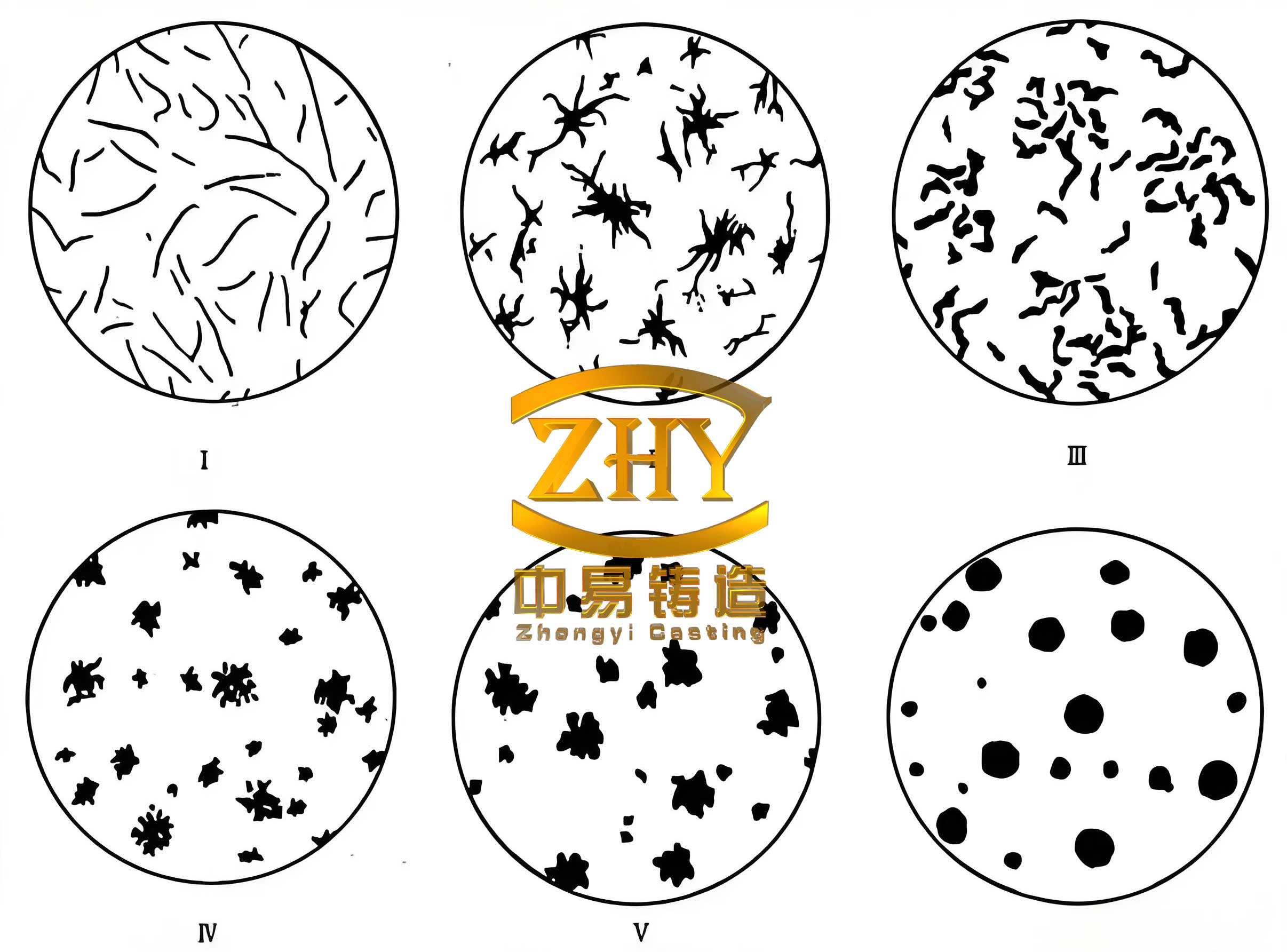
The casting process itself plays a decisive role in achieving this optimal microstructure, making the choice of technique a cornerstone of manufacturing quality.
Globally, several dominant casting methodologies have been developed and refined, primarily originating from European and Asian technological hubs. The most prevalent and historically significant process is the two-piece elliptical casting method. This technique was pioneered and perfected in Germany and subsequently disseminated worldwide. Its core principle involves casting two elliptical rings together as a single unit, which are later separated. This approach offers exceptional control over the solidification process, which is crucial for the integrity of the spheroidal graphite iron matrix. The dimensional relationships for a typical two-piece pattern can be described by the following parameters governing the mold cavity:
$$ A_c = \pi \cdot \left(\frac{D_{maj}}{2} \cdot \frac{D_{min}}{2}\right) – \pi \cdot \left(\frac{d_{maj}}{2} \cdot \frac{d_{min}}{2}\right) $$
Where \( A_c \) is the cross-sectional area of the ring cavity, \( D_{maj} \) and \( D_{min} \) are the major and minor diameters of the outer ellipse, and \( d_{maj} \) and \( d_{min} \) are the major and minor diameters of the inner ellipse. The elliptical shape is engineered to transform into a perfect circle under the operational stresses within the engine cylinder, ensuring an ideal seal. A companion method, the four-piece elliptical casting, represents a direct evolution of this concept. It increases productivity by stacking two sets of two-piece rings vertically within the same mold flask height, effectively doubling the output per molding cycle using identical automated flask lines. The key difference is the increased height (H) of the pattern and the subsequent need for multi-stage slicing, as shown in the conceptual diagram below.
| Process Parameter | Two-Piece Casting | Four-Piece Casting |
|---|---|---|
| Pattern Height per Set (H) | ~35 mm | ~70 mm |
| Rings per Mold (Standard Flask) | Numerous sets (e.g., 20-40 rings) | Twice the number of two-piece sets |
| Material Utilization (Iron Yield) | ~40-50% | ~45-55% |
| Primary Slicing Operation | Single cut to separate the pair | Three cuts: one to create two cylinders, then each cylinder into two rings |
| Core Technological Challenge | Minimizing gates/risers, mold filling | Uniform solidification through taller section; specialized slicing machinery |
The third major advanced process is the elliptical barrel or short-sleeve casting method, prominently adopted in Japan. This technique utilizes high-efficiency, vertically parted flaskless molding lines (e.g., Disa or Koyo styles). Instead of discrete ring pairs, it produces a continuous elliptical barrel (sleeve) of spheroidal graphite iron. Each barrel, when sliced, yields multiple individual rings—often between 10 and 30, depending on the ring’s axial height and barrel length. The productivity metric for such a line is formidable, often exceeding 500 molds per hour. The slicing operation, however, becomes exponentially more complex and requires dedicated, high-precision, multi-blade automatic lathes or grinding machines. The economic viability of this process is heavily dependent on achieving a very high volume for a specific ring size. The relationship for productivity can be approximated as:
$$ P_{rings/hour} = M_{hour} \times (B_{mold} \times R_{barrel}) $$
Where \( P \) is rings produced per hour, \( M_{hour} \) is molds per hour, \( B_{mold} \) is barrels per mold, and \( R_{barrel} \) is rings yielded per barrel.
Other processes exist but have significant limitations. Single-piece casting, where each ring is individually molded with its own risering system, suffers from extremely poor metal yield, often below 20%, due to the disproportionately large feeder heads required for sound solidification of the small spheroidal graphite iron casting. While simple for prototyping or very small series, it is economically unsustainable for mass production. Similarly, lost-foam casting (EPC) has been trialed, particularly for smaller rings. It offers simplicity and design flexibility but has been associated with challenges in consistently achieving the dense, shrinkage-free microstructure required for high-performance spheroidal graphite iron rings, often necessitating costly process controls to mitigate internal porosity.
The metallurgical success of any of these processes hinges on controlling the solidification parameters to promote the formation of the desired graphite spheroids and matrix. The cooling rate \( \dot{T} \) during the critical solidification interval must be managed to avoid undesirable graphite shapes like vermicular or flake forms, which compromise ductility. This is governed by the heat transfer equation relevant to the mold:
$$ \dot{T} = \frac{(T_{pour} – T_{eutectic})}{\Delta t_{solid}} \propto \frac{k_{mold} \cdot A \cdot \Delta T}{V \cdot \rho \cdot C_p} $$
Where \( k_{mold} \) is the thermal conductivity of the molding sand, \( A \) and \( V \) are the surface area and volume of the casting, \( \Delta T \) is the temperature gradient, \( \rho \) is density, and \( C_p \) is specific heat. The two-piece and four-piece methods, using high-density green sand molds in steel flasks, offer a reproducible and controllable cooling environment. The barrel casting process, using specialized sand in a flaskless line, also provides excellent and consistent cooling, though some comparative analyses have suggested subtle differences in the resulting pearlite/ferrite ratio or nodule count in the spheroidal graphite iron microstructure, potentially due to differences in thermal mass and solidification gradients along the barrel length.
A critical comparative analysis of these mainstream processes reveals their distinct operational and economic profiles. The following table synthesizes the key characteristics, advantages, and challenges from a production engineering standpoint.
| Feature | Two-Piece Elliptical | Four-Piece Elliptical | Elliptical Barrel/Sleeve |
|---|---|---|---|
| Process Maturity | Very High. Global standard for decades. | High. Direct derivative of two-piece technology. | High. Well-established in dedicated high-volume lines. |
| Equipment & Tooling | Semi or fully automatic horizontal flask molding lines. Relatively simple slicing machines. | Requires fully automatic lines. Complex, high-precision multi-stage slicing machines are critical. | Requires vertical flaskless automatic molding lines. Extremely complex and expensive automatic multi-blade slicers. |
| Productivity (Output Rate) | High and reliable. | Very High. ~100% increase over two-piece using same molding line. | Extremely High. Suited for ultra-high volume single parts. |
| Material & Resource Efficiency | Moderate metal yield. Standard sand consumption per ring. | Higher metal yield. Significant reduction in sand consumption and cleaning labor per ton of castings. | High metal yield. Very low sand consumption per ring due to flaskless design. |
| Flexibility & Changeover | Excellent. Quick pattern change for wide range of diameters and heights. | Good. Changeover is similar to two-piece but slicing program must also change. | Poor to Moderate. Best for long runs. Changeover of slicing setup is complex and time-consuming. |
| Primary Economic Driver | Versatility, reliability, lower initial machine investment for slicing. | Maximizing output from existing automated flask-based foundry infrastructure. | Ultimate low-cost per part at astronomically high volumes, justifying huge capital investment. |
| Key Technical Risk | Managing micro-shrinkage in the web between rings. | Ensuring uniform metallurgy through the taller casting section; absolute dependability of slicers. | Consistent barrel straightness and wall thickness; slicing yield and precision; potential microstructural variance. |
From my professional assessment, the technological trajectory is clear. The two-piece casting of spheroidal graphite iron rings remains the versatile backbone of the global industry, perfectly balancing quality, flexibility, and cost for a mixed-production environment. It is the process I have seen implemented most successfully across diverse manufacturing settings. However, for foundries dedicated to producing a limited range of components in massive quantities, the push towards higher consolidation—from two-piece to four-piece, or to full barrel casting—is a powerful economic imperative. The equation for the economic advantage (EA) of consolidation can be framed as a reduction in fully allocated cost per piece:
$$ EA = \frac{(C_{mold} + C_{sand} + C_{labour})_{original} – (C_{mold} + C_{sand} + C_{labour})_{consolidated}}{P_{consolidated}} $$
Where \( C \) represents costs per batch and \( P \) is the number of rings per batch in the consolidated process. The four-piece process leverages existing capital investment in automatic molding lines to drive down costs. The barrel process achieves radical efficiency but requires a completely specialized and capital-intensive production cell.
The principal barrier to adopting the more productive four-piece and barrel methods is not the molding process itself, but the subsequent machining operation: slicing. Developing or sourcing robust, high-uptime, precision slicing machinery that can handle the harder and more abrasive spheroidal graphite iron material is the pivotal challenge. Innovations in slicing technology—whether using high-speed diamond or CBN grinding wheels, advanced fixturing, or novel cutting mechanisms—will be the key enabler for the wider adoption of these advanced casting formats. Furthermore, ongoing research into the precise influence of the barrel casting’s solidification dynamics on the final spheroidal graphite iron microstructure (nodule count, matrix homogeneity) is warranted to ensure no compromise in the material’s in-service performance.
In conclusion, the landscape of spheroidal graphite iron piston ring casting is defined by a hierarchy of processes tailored to production scale and flexibility. The two-piece method stands as the universal and robust workhorse. The four-piece method represents a logical and powerful upgrade path for maximizing existing high-volume foundry assets. The barrel casting process is the apex of mass-production efficiency for dedicated applications. The future advancement of the industry will depend on parallel progress in both casting science—to further refine the quality of spheroidal graphite iron—and in transformative slicing and machining technologies that unlock the full economic potential of these highly consolidated casting geometries.