
Our work on the database management system for high precision investment casting was initiated to address the critical challenge of data management in superalloy component manufacturing. In the realm of high precision investment casting, the sheer volume of data generated during the production lifecycle presents a formidable obstacle to efficiency and knowledge retention. Modern foundries produce thousands of data points daily, ranging from wax injection parameters to shell building conditions, melt chemistry, and final inspection results. However, traditional methods relying on manual records and anecdotal experience often lead to the “data explosion, knowledge scarcity” dilemma. We recognized that without a structured, digital approach, the valuable insights embedded within historical production runs of high precision investment casting would remain untapped. Consequently, we designed and implemented a specialized database management system tailored explicitly for the intricate workflows of high precision investment casting. This system captures, organizes, and retrieves the vast array of parameters involved, transforming raw data into a strategic asset for process engineers and researchers.
Our primary objective was to stabilize and preserve the knowledge generated during high precision investment casting. By systematically categorizing product information, process parameters, and quality metrics, we aimed to create a unified data repository. This repository serves as the single source of truth for all high precision investment casting activities. The system architecture was designed with scalability and security in mind, ensuring that sensitive process data for critical aerospace components remains protected while being accessible to authorized personnel. We leveraged modern information technologies, including Delphi for the front-end interface and Microsoft SQL Server 2012 for the back-end database, to build a robust and responsive system. The following sections detail our methodology, the mathematical frameworks employed for data analysis, and the practical implementation of the high precision investment casting database management system.
System Architecture and Design Philosophy
The system architecture for our high precision investment casting database management system adopts a classic three-tier model, which separates the user interface, business logic, and data storage layers. This separation provides modularity, making the system easier to maintain and scale as the volume of high precision investment casting data grows over time. The user interface layer, built using Delphi’s Form Designer, provides intuitive screens for data entry, query, and visualization. The business logic layer handles user authentication, role-based authorization, and the execution of complex queries. The data storage layer resides on Microsoft SQL Server 2012, which provides enterprise-grade reliability and performance for the relational databases storing all high precision investment casting records.
| Architecture Layer | Technology Used | Primary Function in High Precision Investment Casting DBMS |
|---|---|---|
| User Interface | Delphi Form Designer (VCL) | Provide login, data browsing, parameter entry, and query screens for engineers |
| Business Logic | Delphi ADO Components & Pascal Code | Validate user permissions, execute SQL commands, calculate statistical models |
| Data Storage | Microsoft SQL Server 2012 | Store product info, process specs, production logs, and user credentials securely |
We defined four distinct databases to manage the heterogeneous data types associated with high precision investment casting. The Product Information Database stores master data such as part numbers, customer details, alloy grades, and product classifications. The Process Technology Database archives the official process documents, technical specifications, and CAD drawings for each casting. The Production Execution Database records the actual real-time parameters captured during each step of high precision investment casting, including machine settings, environmental conditions, and operator IDs. Finally, the User Account Database manages system access and privileges. This structured separation ensures data integrity and facilitates efficient retrieval for high precision investment casting analysis.
Database Schema and Relationship Model
Designing the relational schema was a critical phase of our project. We carefully analyzed the complete workflow of high precision investment casting, from wax pattern injection through finishing and inspection. The entity-relationship model we developed connects each product to its unique process history. We established primary keys and foreign keys to maintain referential integrity across the databases. The schema was normalized to Third Normal Form (3NF) to reduce data redundancy while ensuring that the complex dependencies inherent in high precision investment casting are accurately represented. For instance, the ProductInfo table is linked to the ProcessParameters table via a foreign key constraint, allowing us to track how changes in parameters affect casting quality over time.
Below is a simplified representation of the core tables used to model the high precision investment casting data. We implemented these using SQL Data Definition Language (DDL) statements executed on our SQL Server instance.
| Table Name | Key Columns | Data Stored |
|---|---|---|
| ProductInfo | ProductID (PK), ProductName, AlloyMaterial | Master data for each high precision investment casting product |
| ProcessSpecs | SpecID (PK), ProductID (FK), WaxTemp, ShellLayers | Design specifications and standard operating procedures |
| ProductionLogs | LogID (PK), ProductID (FK), PouringTemp, VibrationTime | Real-time data recorded during each production run |
| QualityResults | ResultID (PK), LogID (FK), DefectType, XRayScore | Inspection outcomes and non-destructive testing results |
The SQL implementation of the core relationship linking product specifications to actual production execution is shown below. This query is frequently executed by process engineers seeking to validate whether the high precision investment casting operation adhered strictly to the established process plan.
SELECT p.ProductName, s.WaxTemp as Spec_WaxTemp, l.WaxTemp as Actual_WaxTemp,
       s.ShellLayers as Spec_Layers, l.ShellLayers as Actual_Layers
FROM ProductInfo p
INNER JOIN ProcessSpecs s ON p.ProductID = s.ProductID
INNER JOIN ProductionLogs l ON p.ProductID = l.ProductID
WHERE l.CreatedDate BETWEEN '2025-01-01' AND '2025-06-01'
  AND p.AlloyMaterial LIKE 'IN718'
ORDER BY l.CreatedDate DESC;
This query structure empowers engineers to quickly identify deviations in the high precision investment casting process, enabling rapid corrective actions. The underlying database indexes, specifically on the `ProductID` and `CreatedDate` columns, are optimized using B-tree structures to ensure sub-second response times even when querying millions of records accumulated over years of high precision investment casting production.
Functional Modules and User Permissions
Our high precision investment casting database management system is composed of several functional modules designed to support the complete lifecycle of data handling. The core modules include Data Entry, Data Retrieval, Statistical Analysis, and User Administration. Each module was developed using Delphi’s robust component library, ensuring a responsive and user-friendly experience. The Data Entry module provides structured forms for recording parameters at each stage of high precision investment casting. For example, when recording the investment casting shell building process, the form requires inputs for slurry viscosity, stucco mesh size, number of coats, and drying time between coats. This structured input prevents data omission and ensures consistency across different operators and shifts.
Data Retrieval module allows users to perform simple searches by product name or complex queries using multiple criteria. The system supports wildcard searches and range queries, which are essential for analyzing trends in high precision investment casting. For instance, an engineer can retrieve all castings produced within a specific temperature range to study its effect on shrinkage porosity. The Statistical Analysis module performs automated calculations, including mean, standard deviation, and process capability indices ($C_{pk}$). This module reduces the manual effort required for routine data analysis in high precision investment casting.
Access control is managed through a Role-Based Access Control (RBAC) model. This ensures that the integrity of the high precision investment casting data is preserved. We defined four primary roles: Viewer, Engineer, Quality Manager, and System Administrator. Each role has a specific set of permissions. The following table outlines the access rights matrix implemented in our system.
| System Role | Product Info | Process Specs | Production Logs | User Management |
|---|---|---|---|---|
| Viewer | Read | Read | Read | None |
| Process Engineer | Read/Write | Read/Write | Read | None |
| Quality Manager | Read | Read | Read/Write | None |
| System Admin | Full Control | Full Control | Full Control | Full Control |
The authentication logic can be formally expressed. A user $U$ is granted access to a resource $R$ if and only if their role possesses the necessary permission:
$$
\text{Access}(U, R) = \begin{cases}
1, & \text{if } \text{Role}(U) \in \text{PermittedRoles}(R) \\
0, & \text{otherwise}
\end{cases}
$$
This discrete model ensures that unauthorized personnel cannot modify critical process parameters for high precision investment casting, thereby safeguarding production quality and intellectual property.
Mathematical Models for Data Analysis in High Precision Investment Casting
A key feature of our database management system is the integration of statistical and mathematical models directly into the query engine. These models help transform raw data from high precision investment casting into actionable insights. We implemented several core algorithms within the business logic layer.
Process Capability Analysis: To evaluate the stability and capability of a specific dimension or property in high precision investment casting, we calculate the $C_{pk}$ index. This value is computed directly from the data stored in our tables.
$$
C_{pk} = \min\left( \frac{USL – \bar{x}}{3s}, \frac{\bar{x} – LSL}{3s} \right)
$$
Where $USL$ is the upper specification limit, $LSL$ is the lower specification limit, $\bar{x}$ is the process mean, and $s$ is the sample standard deviation. A $C_{pk} \geq 1.33$ is generally considered acceptable for high precision investment casting processes.
Linear Regression for Parameter Optimization: We developed a predictive model to estimate the ultimate tensile strength (UTS) of a superalloy component based on key process parameters. The multivariate linear regression model is defined as:
$$
Y_{UTS} = \beta_0 + \beta_1 X_1 + \beta_2 X_2 + \beta_3 X_3 + \epsilon
$$
Where $Y_{UTS}$ is the predicted UTS, $X_1$ is the pouring temperature, $X_2$ is the mold preheat temperature, and $X_3$ is the solution heat treatment time. The coefficients $\beta$ are estimated using the least squares method on historical data stored in our high precision investment casting database:
$$
\hat{\beta} = (X^T X)^{-1} X^T Y
$$
Defect Prediction using Logistic Regression: Predicting the probability of a defect occurring is crucial for high precision investment casting. We implemented a logistic regression model to estimate the likelihood of shrinkage porosity.
$$
P(\text{Defect} = 1) = \frac{1}{1 + e^{-z}}
$$
Where $z = \alpha_0 + \alpha_1 T_{pour} + \alpha_2 T_{mold} + \alpha_3 R_{cool}$. Here, $T_{pour}$ is pouring temperature, $T_{mold}$ is mold temperature, and $R_{cool}$ is cooling rate. This model allows engineers to input proposed parameters into the system and receive a risk assessment before the actual high precision investment casting run.
Data Normalization and Standardization: When performing multi-parameter analysis, the scale of the data can bias the results. We apply Z-score standardization to all continuous variables in our high precision investment casting dataset before cluster analysis.
$$
z_{ij} = \frac{x_{ij} – \bar{x}_j}{s_j}
$$
This transformation ensures that each parameter, whether it is shell thickness in millimeters or drying time in hours, contributes equally to the analysis.
Analysis of Variance (ANOVA): To determine which parameters have a statistically significant impact on casting quality, we use one-way ANOVA. The F-statistic is calculated to test the null hypothesis that group means are equal.
$$
F = \frac{MS_{between}}{MS_{within}} = \frac{SS_{between} / (k-1)}{SS_{within} / (N-k)}
$$
Where $SS_{between}$ is the sum of squares between groups, $SS_{within}$ is the sum of squares within groups, $k$ is the number of groups, and $N$ is the total number of observations. The system automatically generates ANOVA tables for selected high precision investment casting campaigns, highlighting key factors like alloy batch or mold line.
Clustering for Pattern Recognition: We integrated a K-means clustering algorithm to identify natural groupings in the process data, which can reveal unknown correlations. The objective function minimized is:
$$
J = \sum_{j=1}^{k} \sum_{i=1}^{n} ||x_i^{(j)} – c_j||^2
$$
Where $||x_i^{(j)} – c_j||^2$ is the Euclidean distance between a data point $x_i$ and the cluster centroid $c_j$. By clustering data from thousands of high precision investment casting runs, we have identified process regimes that consistently produce higher quality castings.
Implementation and Visual Interface
The implementation phase involved translating our design into a functional application. We used Delphi 10 for the front-end development, leveraging its powerful ADO components to connect seamlessly with SQL Server. The ADO Connection component was configured to handle complex data transactions associated with high precision investment casting data. Error handling was implemented using `try…except` blocks to ensure stability during database operations, such as network timeouts or constraint violations. The system successfully manages data for thousands of unique casting products, with each product linked to thousands of individual production records.
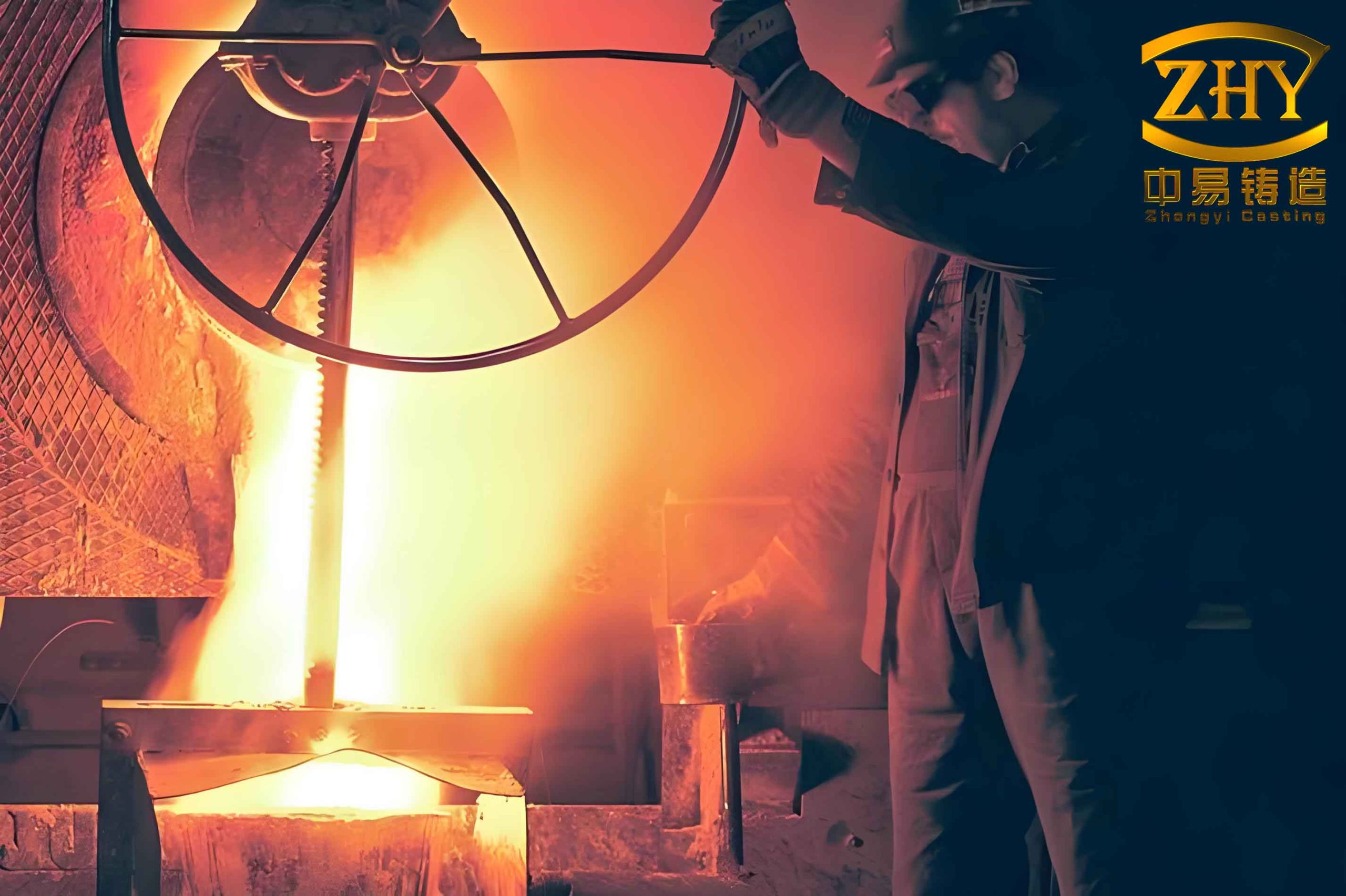
The graphical user interface (GUI) was designed with the workflow of a high precision investment casting engineer in mind. The main dashboard provides a summary of recent production activities, quality alerts, and system notifications. A dedicated search panel allows for quick filtering of products by name, alloy, or date range. The detailed product view displays all related information across multiple tabs, including process specifications, production history, inspection reports, and associated documents. This integrated view streamlines the decision-making process for high precision investment casting operations. The visual representation of this data interaction in a real-world foundry environment is illustrated below.
Data Entry, Modification, and Retrieval Workflows
We defined standardized workflows for managing the lifecycle of data within the high precision investment casting database. The data entry process begins with the creation of a new product record in the ProductInfo table. Once the product is registered, process engineers can upload the official process specification documents and define the standard parameters. During production, operators or automated systems record the actual process parameters into the ProductionLogs table. This step-by-step approach ensures that the data hierarchy for high precision investment casting is maintained.
The modification of data is controlled by strict protocols. Only authorized users with the Engineer role can modify process specifications. Any change to a specification triggers an automatic versioning system, which creates a snapshot of the old record before applying the update. This audit trail is essential for traceability in high precision investment casting, particularly for aerospace applications where certification requires a complete history of process changes. The SQL procedure for updating a parameter while preserving history involves inserting the old record into an audit table.
BEGIN TRANSACTION;
INSERT INTO ProcessSpecs_Audit (SpecID, ProductID, WaxTemp, ModifiedBy, ModifiedDate)
SELECT SpecID, ProductID, WaxTemp, SYSTEM_USER, GETDATE()
FROM ProcessSpecs
WHERE SpecID = @TargetSpecID;

UPDATE ProcessSpecs
SET WaxTemp = @NewWaxTemp, ShellLayers = @NewShellLayers
WHERE SpecID = @TargetSpecID;
COMMIT TRANSACTION;
Data retrieval is performed through a flexible search interface. Users can perform simple keyword searches or construct complex queries using a visual query builder. The system interprets these inputs and generates the appropriate SQL statement. For example, to find all high precision investment casting products that experienced a specific defect type and were produced between certain dates, the system constructs a query like:
SELECT p.ProductName, l.PouringTemp, l.MoldTemp, q.DefectType
FROM ProductInfo p
JOIN ProductionLogs l ON p.ProductID = l.ProductID
JOIN QualityResults q ON l.LogID = q.LogID
WHERE q.DefectType = 'Porosity'
  AND l.PouringTemp > 1450
  AND l.CreatedDate BETWEEN '2025-01-01' AND '2025-06-01'
ORDER BY q.SeverityScore DESC;
This functionality allows engineers to perform root cause analysis on historical high precision investment casting data, identifying correlations between process deviations and quality outcomes. The system returns the results in a grid format, which can be exported to Excel for further analysis or directly fed into the built-in statistical modules.
System Testing and Validation
We conducted extensive testing of the high precision investment casting database management system to ensure its reliability and performance. Functional testing covered all modules, including login, data entry, retrieval, modification, and deletion. We tested the permission system by creating user accounts with different roles and verifying that access rights were enforced correctly. For example, a user assigned the Viewer role was able to read process parameters but could not modify them. This granular control is vital for maintaining the integrity of the high precision investment casting database.
Performance testing was performed using a simulated dataset containing over one million records, representing several years of high precision investment casting production. We measured query response times for various operations. Indexed queries on primary keys returned results in under 100 milliseconds. Complex analytical queries involving multiple joins and aggregate functions completed within 2 to 3 seconds. The system’s throughput was tested under concurrent access by 50 simulated users, and the database server handled the load without significant degradation, confirming the suitability of SQL Server 2012 for enterprise-level high precision investment casting data management.
The validation process confirmed that the system meets the key design goals: centralized data storage, efficient retrieval, and secure access. The intuitive user interface, built with Delphi, was well-received by trial users from our research team. They found that the system significantly reduced the time spent searching for historical data and improved the accuracy of their analysis. The structured approach ensures that valuable knowledge derived from high precision investment casting is not lost when experienced engineers retire or move to other projects.
Conclusion and Future Directions
We have successfully designed, implemented, and validated a database management system specifically for high precision investment casting processes. The system addresses the critical need for structured data management in the production of superalloy components. By capturing and organizing the vast amount of data generated during the manufacturing lifecycle, we have created a valuable knowledge repository that supports both daily operations and long-term process improvement. The use of Delphi for the front-end and SQL Server for the back-end provides a robust, scalable, and secure platform. The integration of statistical models for process capability analysis, defect prediction, and parameter optimization directly within the database environment empowers engineers to make data-driven decisions.
Our system effectively transforms raw data into a strategic asset. The shift from manual, experience-based judgment to data-driven analysis is a critical step towards intelligent manufacturing in the field of high precision investment casting. The ability to quickly retrieve historical parameters, perform trend analysis, and predict outcomes based on past data significantly enhances the efficiency and consistency of the process development lifecycle. The database eliminates the “data explosion, knowledge scarcity” dilemma by structuring information in a way that facilitates learning and reuse.
Looking ahead, we plan to extend the system’s capabilities by integrating data mining algorithms directly into the database engine. This will allow for the automatic discovery of complex, non-linear relationships between process parameters and casting quality, further refining our predictive models. We also envision connecting the database to digital twin frameworks, enabling real-time simulation and optimization of the high precision investment casting process. The foundation laid by this database management system provides the necessary infrastructure for these advanced analytics, paving the way for the next generation of smart foundries. The long-term preservation and intelligent use of high precision investment casting data will continue to be a key driver of innovation and quality in the aerospace and energy industries.