
In this work, I investigated the abrasive wear characteristics of a series of manganese alloyed white cast iron, focusing on the effects of chemical composition, microstructure, hardness, and dynamic fracture toughness. White cast iron is widely used as a wear-resistant material in industrial applications, and manganese white cast iron offers a cost-effective alternative due to its lack of expensive elements like nickel, chromium, and molybdenum. My study aims to analyze how manganese, carbon, and silicon contents influence the microstructural features, such as carbide volume fraction, and subsequently the abrasive wear resistance under low-stress conditions. I also explored the wear mechanisms through scanning electron microscopy observations and correlated them with dynamic fracture toughness measurements. The findings provide insights into optimizing the composition of manganese white cast iron for enhanced耐磨性.
The experimental materials were prepared by melting ordinary pig iron, scrap steel, and ferroalloys in a medium-frequency induction furnace under atmospheric conditions. I cast the alloys into sand molds (Y-shaped blocks) and precision casting shell molds to study the effect of solidification cooling rates. The cooling curves were recorded using thermocouples and an X-Y function recorder, revealing that the precision-cast samples cooled significantly faster than the sand-cast ones, leading to finer microstructures. The chemical compositions of the manganese white cast iron samples are summarized in Table 1. All samples were tested in the as-cast state for abrasive wear and dynamic fracture toughness.
| Sample Series | C | Si | Mn | Microstructure (As-cast) | Carbide Volume Fraction (%) |
|---|---|---|---|---|---|
| Series A (Sand-cast) | 2.0-3.5 | 0.5-2.0 | 2.0-8.0 | Primary/eutectic carbides + pearlite/martensite/austenite | 15-40 |
| Series B (Precision-cast) | 2.0-3.5 | 0.5-2.0 | 2.0-8.0 | Finer carbides + matrix phases | 20-45 |
The abrasive wear tests were conducted using a wet sand rubber wheel abrasion tester under low-stress conditions. I applied loads of 22 N or 130 N on samples pressed against a rotating rubber wheel (diameter 228 mm, speed 240 rpm) in a slurry of water and quartz sand (50-70 mesh). The rubber wheel hardness was 60-65 Shore A. The weight loss of the white cast iron samples was measured to assess wear resistance, as shown in Table 2. The dynamic fracture toughness (KID) was determined using an impact testing machine with notched specimens, and the load-displacement curves were recorded oscilloscopically to calculate KID based on maximum load.
| Sample ID | Mn Content (%) | C Content (%) | Si Content (%) | Weight Loss (mg) at 22 N | Weight Loss (mg) at 130 N |
|---|---|---|---|---|---|
| A-1 | 2.0 | 2.5 | 1.0 | 120 | 350 |
| A-2 | 4.0 | 2.5 | 1.0 | 95 | 280 |
| A-3 | 6.0 | 2.5 | 1.0 | 70 | 220 |
| A-4 | 8.0 | 2.5 | 1.0 | 60 | 200 |
| B-1 | 2.0 | 2.5 | 1.0 | 80 | 250 |
| B-2 | 4.0 | 2.5 | 1.0 | 55 | 180 |
The microstructure of manganese white cast iron typically consists of primary or eutectic carbides (M3C type) in a matrix of pearlite, martensite, or retained austenite. I used metallographic methods to measure the carbide volume fraction, which increased with manganese content. The hardness of the white cast iron also rose with higher manganese levels, as described by the empirical relation: $$ H_v = 500 + 25 \cdot \text{Mn} $$ where H_v is the Vickers hardness in kg/mm² and Mn is the manganese content in wt.%. This increase in hardness contributes to improved abrasive wear resistance, as harder carbides (with microhardness around 1100-1300 HV) resist quartz sand abrasion better.
The effect of carbon content on manganese white cast iron was significant. For a fixed manganese level of 4%, increasing carbon from 2.0% to 3.5% raised the carbide volume fraction from 20% to 35%, leading to higher hardness and lower wear loss. I expressed this trend using a linear approximation: $$ V_c = 5 \cdot \text{C} + 10 $$ where V_c is the carbide volume fraction in % and C is the carbon content in wt.%. However, when carbon exceeded 3.0%, graphite formation occurred in some samples, degrading wear resistance. Silicon, as a graphitizing element, reduced hardness and wear resistance when increased beyond 1.5%, especially in white cast iron with约 4% Mn. The optimal silicon content for maintaining carbide stability is below 1.5%.
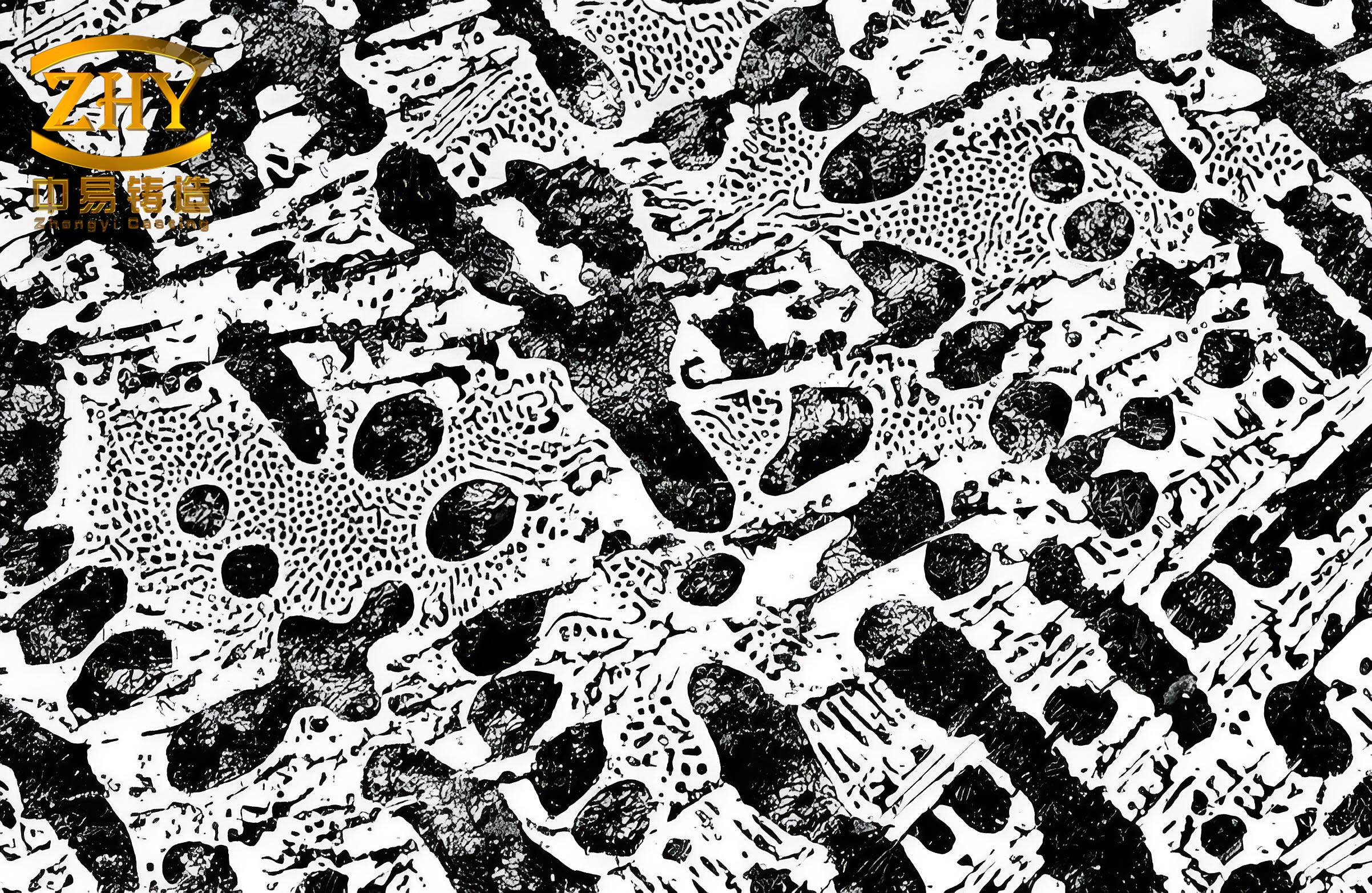
The solidification cooling rate profoundly influenced the microstructure and wear properties of manganese white cast iron. Precision-cast samples, with faster cooling, exhibited finer carbides and higher carbide volume fractions compared to sand-cast samples. This resulted in superior abrasive wear resistance, as evidenced by lower weight loss in Table 2. The relationship between cooling rate (R in °C/s) and carbide size (d in μm) can be approximated by: $$ d = \frac{100}{R} $$ indicating that rapid cooling refines the microstructure. Thus, for applications requiring high耐磨性, controlling the casting process to achieve fast cooling is beneficial for white cast iron.
Dynamic fracture toughness tests revealed that manganese white cast iron with higher manganese content (e.g., 6-8%) showed improved toughness due to the presence of retained austenite in the matrix. The KID values ranged from 20 to 35 MPa·m¹/², as summarized in Table 3. In contrast, a nickel-chromium white cast iron reference sample had higher toughness but lower carbide volume. The wear mechanisms differed between these materials: for manganese white cast iron, abrasive wear involved micro-cracking and spalling of carbides, while for the nickel-chromium alloy, micro-cutting and ploughing dominated. I observed through SEM that in white cast iron, the softer matrix wears first, leaving hard carbides protruding; subsequent abrasive actions cause cracks in carbides, leading to剥落.
| Sample Type | Mn Content (%) | C Content (%) | KID (MPa·m¹/²) |
|---|---|---|---|
| Manganese White Cast Iron | 4.0 | 2.5 | 22 |
| Manganese White Cast Iron | 6.0 | 2.5 | 28 |
| Manganese White Cast Iron | 8.0 | 2.5 | 35 |
| Nickel-Chromium White Cast Iron | 0.5 | 3.0 | 40 |
Based on my analysis, the wear resistance of manganese white cast iron is primarily controlled by the carbide volume fraction and hardness. The abrasive wear mechanism involves a crack-spalling process for carbides, which is influenced by the dynamic fracture toughness. To optimize the composition for耐磨性, I recommend a manganese content of 6-8%, carbon content of 2.5-3.0%, and silicon content below 1.5%. This combination ensures high carbide volume, adequate hardness, and reasonable toughness. Furthermore, rapid solidification through precision casting can enhance these properties by refining the microstructure. White cast iron with these characteristics shows promise for industrial applications where cost-effective wear resistance is needed.
In conclusion, my study on manganese white cast iron demonstrates that alloying elements significantly affect its abrasive wear behavior. The integration of experimental data with microstructural analysis provides a comprehensive understanding of how to tailor white cast iron for specific耐磨 requirements. Future work could explore heat treatment effects or other alloying additions to further improve the performance of white cast iron in harsh environments.