
In my extensive experience within the foundry industry, the production of complex, thin-walled box-type components from high-grade grey iron remains a formidable challenge. These grey iron castings, particularly those serving as structural housings in heavy machinery, demand exceptional mechanical properties, dimensional accuracy, and pressure tightness. The journey to perfect such castings is often iterative, involving meticulous process design, robust simulation, and adaptive problem-solving. This article delves deep into a comprehensive case study involving a critical front-end housing, a quintessential example of intricate grey iron castings. Through a first-person narrative, I will detail the initial hurdles, the root-cause analyses leveraging advanced simulation, and the multifaceted engineering solutions that led to a significant elevation in quality and yield. The recurring theme will be the nuanced behavior of grey iron castings under varying solidification and molding conditions.
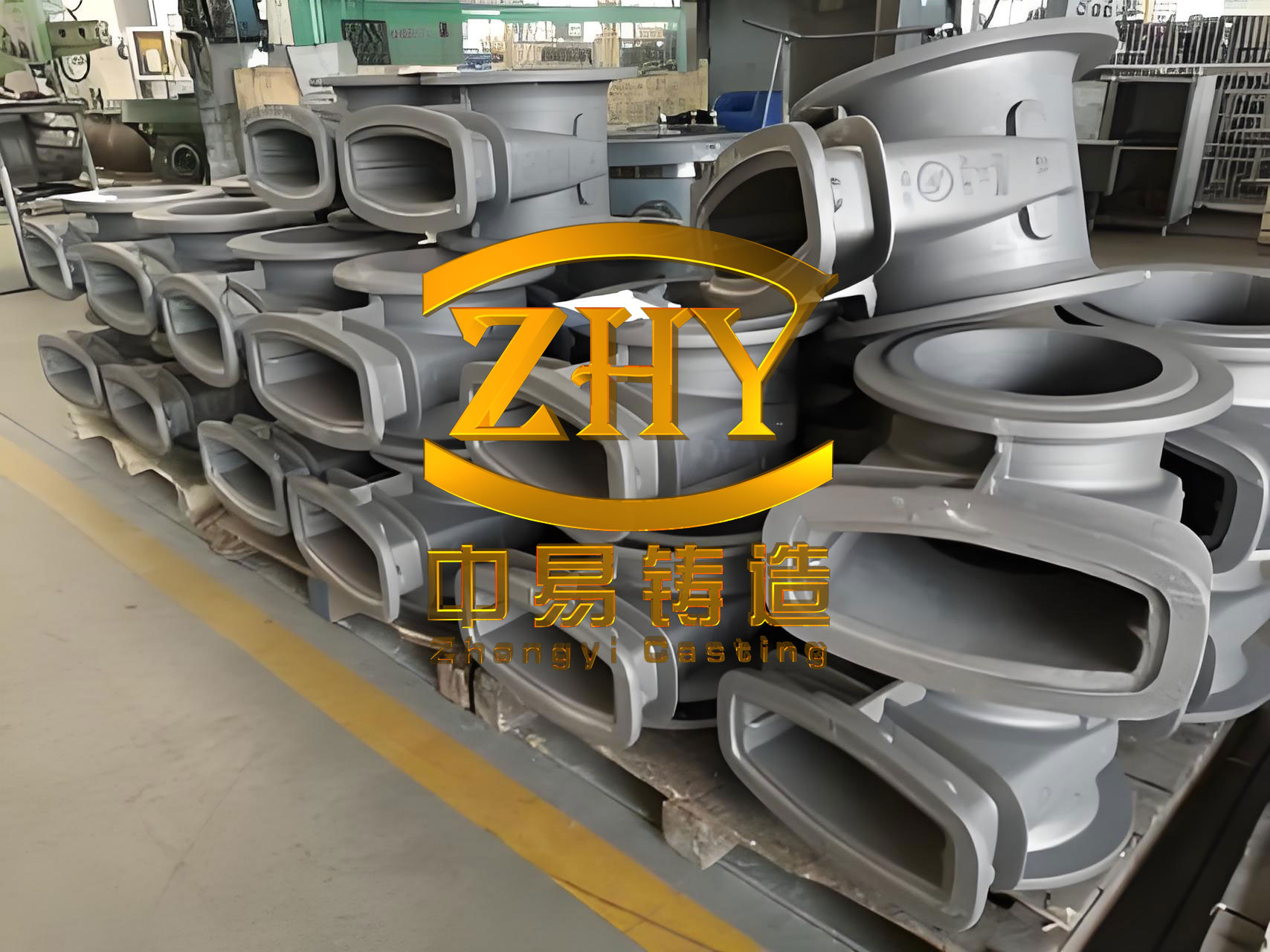
The subject component was a strategically sourced front-end box for a diesel engine series. This part exemplifies the complexity often encountered in premium grey iron castings. Its external envelope measured approximately 1800mm x 1100mm x 990mm, with a rough casting weight nearing 2000 kg. The wall design was heterogeneous, featuring critical sections as thin as 11mm juxtaposed with local thick masses up to 60mm. The material specification was high-strength grey iron, equivalent to HT300, a grade known for its sensitivity to composition and cooling rates, making the production of sound grey iron castings particularly demanding. Furthermore, the component had to withstand post-machining hydrostatic pressure tests, imposing stringent quality requirements on its structural integrity and absence of leaks.
The initial manufacturing process was built upon existing shop-floor capabilities. Molding was conducted using alkaline phenolic resin no-bake sand, while cores—numbering over 40 in varied shapes to form layered water and oil galleries—were produced manually. A bottom-gating, top-riser feeding system was employed. A summary of the initial process parameters and the resultant defect spectrum is presented in Table 1.
| Process Parameter | Specification | Major Defects Observed | Approximate Defect Rate (Initial Trials) |
|---|---|---|---|
| Molding Method | Alkaline Phenolic Resin No-Bake Sand | Cracking, Core Fracture, Blowholes | ~35% Scrap Rate |
| Coring Method | Manual, 40+ Cores | ||
| Gating System | Bottom Gating, Top Risers | ||
| Pouring Temperature | 1380-1400°C | Blowholes (most prominent) | ~25% incidence |
| Metal Grade | High-Strength Grey Iron (HT300) | Cracking at internal corners | ~15% incidence |
| Shakeout Temperature | > 200°C | Core fracture leading to wall loss | ~10% incidence |
The trial production phase revealed three persistent issues that severely compromised the integrity of these grey iron castings. Firstly, cracks manifested at the internal re-entrant corners of the charge air cooler cavity after shakeout. Secondly, the fracture of specific “L”-shaped cores led to a complete loss of wall thickness in corresponding areas, causing irreparable scrap. Thirdly, and most pervasively, blowholes appeared on the top casting surface and beneath large core assemblies. The prevalence of gas-related defects pointed towards systemic issues in both core gas evolution and metal flow dynamics.
Root Cause Analysis and Engineering Corrections
A fundamental principle in producing defect-free grey iron castings is understanding the interplay between thermal stresses, mold/core restraint, and gas generation. We employed a combination of metallurgical analysis, process audit, and sophisticated simulation software, MAGMA, to dissect each failure mode.
1. Combating Cracking: Stress and Restraint Management
Cracks in grey iron castings typically originate when the thermally induced tensile stress during cooling exceeds the material’s high-temperature strength. The stress ($\sigma_s$) can be conceptually modeled as a function of restraint:
$$ \sigma_s \propto E(T) \cdot \alpha(T) \cdot \Delta T \cdot R $$
where $E(T)$ is the temperature-dependent elastic modulus of the grey iron, $\alpha(T)$ is the thermal expansion coefficient, $\Delta T$ is the critical temperature drop across a section, and $R$ is a restraint factor (0 to 1) imposed by the mold and cores. For the problematic corner, $R$ was very high due to the massive, unyielding sand core and a sharp design fillet. The MAGMA thermal stress analysis highlighted this area as a peak stress concentration zone.
The corrective actions were two-pronged. Firstly, the core box was modified to include printed sand buildups, effectively increasing the internal fillet radius of the casting from a mere 2-3mm to over 8mm. This geometrically reduced the stress concentration factor ($K_t$). Secondly, to drastically lower the core restraint factor $R$, we innovated a “sacrificial void” technique within the large core. A large-diameter ceramic tube was placed in the core box, wound densely with a vent rope. After core hardening and stripping, the rope was pulled out, allowing the ceramic tube to be removed easily, leaving a deliberate hollow cavity within the core. This cavity significantly improved the core’s collapsibility during the crucial cooling phase of the grey iron casting. The effectiveness of these changes is summarized in Table 2.
| Parameter | Initial State | Improved State | Impact on Stress Factor |
|---|---|---|---|
| Internal Fillet Radius | ~2 mm | >8 mm | Reduced $K_t$ by ~60% (estimated) |
| Core Restraint (R) | High (Solid Core) | Low (Cored-Out Cavity) | Reduced $R$ by ~40-50% |
| Shakeout Temperature | 200-250°C | 150-180°C | Lowered $\Delta T$ during vulnerable phase |
| Cracking Incidence | ~15% | 0% | Eliminated |
2. Eliminating Core Fracture: Enhancing Structural Integrity
Core fracture is a catastrophic event for complex grey iron castings, often resulting from inadequate core strength or poor mechanical support during metal filling. The bending stress ($\sigma_b$) on a core cantilever can be approximated by:
$$ \sigma_b = \frac{M \cdot y}{I} \approx \frac{F_{metal} \cdot L \cdot y}{I} $$
where $M$ is the bending moment, $y$ is the distance from the neutral axis, $I$ is the area moment of inertia of the core section, $F_{metal}$ is the dynamic pressure force from the molten iron, and $L$ is the unsupported length. The original “L”-shaped core had a disjointed two-piece core print (chill) that created a weak plane at the bend. The core’s center of gravity was also offset, exacerbating the tilting moment.
Our solution focused on integral reinforcement. We designed an interlocking core print system where the two segments of the core print were connected via a robust, retrievable steel alignment block. This transformed the core print from two weak cantilevers into a single, rigid, box-section support, dramatically increasing the effective $I$ in the formula above. Furthermore, we optimized the resin curing cycle, ensuring full cross-linking and strength development before handling. This holistic approach to core engineering is vital for the reliable production of grey iron castings with deep internal cavities.
3. Solving the Blowhole Enigma: Gas Evolution and Flow Dynamics
Blowholes, especially the subsurface ones plaguing our grey iron castings, are predominantly invasive. They form when gas pressure in the mold cavity ($P_{gas}$) exceeds the local metallostatic pressure ($P_{metal}$) plus the ferrostatic pressure required for bubble nucleation ($P_{nuc}$). The condition for gas invasion is:
$$ P_{gas} > P_{metal} + P_{nuc} $$
$$ P_{metal} = \rho_{iron} \cdot g \cdot h(t) $$
Here, $h(t)$ is the changing height of metal above the point in question, and $P_{gas}$ builds from core/mold binder decomposition. The original process had two flaws: choked gas venting and turbulent filling that entrained air.
Venting Revolution: The practice of embedding combustible vent ropes in cores was flawed, as the ropes would collapse under ramming pressure, sealing the gas escape paths. We replaced them entirely with flexible, crush-resistant metallic tubes. These tubes, integrated into the core during fabrication, provided a permanent, open channel from the core interior to the core print. During mold assembly, these tubes were connected and routed outside the mold cavity, creating a positive venting system. This drastically reduced the resident gas pressure $P_{gas}$ within the core envelopes of the grey iron casting.
Gating System Redesign via Simulation: The MAGMA filling simulation of the original system was revelatory. It showed severe imbalance and reverse flow. The early-ingating gates received ~85% of the flow, while the last two ingates saw metal flowing backwards into them, indicating a non-pressurized, aspirating system. This turbulence is a prime source of air entrainment. The velocity fields and free surface fragmentation were clear indicators.
We redesigned the gating system based on simulated flow physics. The new design was a balanced, bottom-fed “fountain” style with an extended runner acting as a dirt trap. The key was to ensure a rapid, quiet fill of the runner to establish a pressurized flow before metal enters the cavity. The governing equation for a pressurized system is derived from Bernoulli’s principle with a loss factor:
$$ \frac{P_1}{\rho g} + \frac{v_1^2}{2g} + z_1 = \frac{P_2}{\rho g} + \frac{v_2^2}{2g} + z_2 + h_{L} $$
where $h_{L}$ represents head losses. The design goal was to minimize $v_1$ (gate entry velocity) and $h_{L}$ due to turbulence. The new simulation, as shown conceptually by tracer particle analysis, confirmed a quiescent initial fill where metal steadily rose from the bottom gates without splashing. The comparative analysis is quantified in Table 3.
| Gating Characteristic | Original Design | Optimized Design | Simulated Outcome |
|---|---|---|---|
| Flow Distribution | Highly uneven, ~85/15 split | Balanced, within ±10% | Eliminated reverse flow |
| Initial Ingate Velocity | ~1.8 m/s | ~0.7 m/s | Reduced kinetic energy by ~85% |
| Flow Regime in Cavity | Highly turbulent, free surface breakup | Laminar, progressive front | Minimized air entrainment |
| Pressure State | Non-pressurized, aspirating | Pressurized, choke at ingates | Prevented air aspiration |
The synergistic effect of the metallic vent tubes and the redesigned gating system was transformative. The incidence of blowholes on the critical top surfaces of these grey iron castings dropped from over 25% to less than 2%. The internal soundness, verified by radiographic inspection, showed remarkable improvement.
Comprehensive Quality Metrics and Future Perspectives
The implementation of these integrated solutions led to a dramatic turnaround in the production viability of these high-strength grey iron castings. A final summary of the quality leap is presented in Table 4, encompassing the key performance indicators for such demanding components.
| Quality Metric | Pre-Improvement Baseline | Post-Improvement Result | Percentage Improvement |
|---|---|---|---|
| Overall Casting Yield | ~65% | >95% | +46% |
| Hydrostatic Test Pass Rate | ~70% | >98% | +40% |
| Incidence of Cracking | 15% | 0% | 100% |
| Incidence of Core-Related Wall Loss | 10% | 0% | 100% |
| Incidence of Blowholes (Major) | 25% | <2% | >92% |
| Dimensional Consistency (CMM) | 85% within tolerance | 99% within tolerance | +16% |
This case study underscores several universal lessons for producers of complex grey iron castings. Firstly, the mechanical design of the casting and the cores must be symbiotic; generous fillets and strategic core collapsibility are not luxuries but necessities. Secondly, core venting must be treated as a critical, non-compressible engineering channel, where robust materials like metallic tubes outperform traditional fibers. Thirdly, the filling system is the conductor of the solidification symphony—its design cannot be heuristic but must be validated through modern simulation tools that visualize flow, temperature, and stress fields. The formula for success in premium grey iron castings is therefore a composite one:
$$ Q_{casting} = f\left(D_{design}, P_{process}, V_{venting}, S_{simulation}\right) $$
where $Q_{casting}$ is the final casting quality, a function of intelligent Design, controlled Process parameters, effective Venting, and predictive Simulation.
Looking ahead, the principles established here—particularly the use of simulation-driven gating design and active core venting—are being ported to other families of grey iron castings within our portfolio. The pursuit of zero-defect manufacturing for grey iron castings continues to drive innovation in binder systems, real-time process monitoring, and even more integrated digital twin technologies that can predict microstructure and final mechanical properties. The journey with this front-end box has reaffirmed that even the most challenging grey iron castings can be mastered through a disciplined, analytical, and holistic engineering approach.