
In recent years, the rapid development of China’s socio-economic landscape has led to a surging demand for high-precision machine tools. As a key component in manufacturing, machine tool castings play a pivotal role in ensuring the performance and longevity of equipment. Historically, high-end machine tool castings relied heavily on imports, with advanced technologies often restricted by foreign entities. To address this, numerous enterprises have embarked on innovation and reform, leveraging structural adjustments and high-tech applications to promote brand strategies. This paper, from my perspective as a researcher in materials engineering, delves into the casting processes for large and medium-sized machine tool castings, emphasizing the importance of process optimization and defect mitigation. The focus is on enhancing the quality and efficiency of machine tool casting production, which is critical for achieving self-reliance in this sector.
Machine tool castings are essential for providing毛坯s for mechanical parts, and in some cases, they serve as direct components in machinery. In industries like tractors, agricultural machinery, and internal combustion engines, machine tool castings account for 40% to 90% of the total weight, highlighting their significance. The diversity in machine tool castings includes complex shapes and high usage rates, making up approximately 60% of total casting output. Other applications include steel ingot molds for metallurgy and pipelines for engineering purposes. Key characteristics of these castings involve high strength, precision, wear resistance, and stringent requirements for dimensional accuracy, surface roughness, and internal cleanliness. For instance, the use of resin sand molds offers excellent rigidity and strength during the initial pouring phase, enabling the elimination of defects like shrinkage cavities and porosity through graphite expansion during solidification. This is particularly beneficial for gray and ductile iron castings, allowing for minimal or no riser designs.
In full mold casting, polystyrene foam patterns are employed with furan resin self-hardening sand, where the pattern vaporizes upon contact with molten metal, resulting in castings that mirror the pattern’s shape. This method outperforms traditional sand casting in producing single or small-batch items, such as automotive covers or machine tool beds, by reducing wood pattern costs, simplifying operations, and improving surface quality and dimensional accuracy. However, challenges like phosphorus content in steel and iron can reduce impact toughness and increase brittleness, leading to cold cracking. Similarly, hot cracking occurs near the solidus temperature due to factors like improper casting structure or alloy shrinkage. To prevent these issues, it is crucial to control alloy composition, adjust sulfur and phosphorus levels, optimize casting design, and enhance sand mold yield.
The wear resistance of machine tool castings is enhanced by graphite’s oil storage and lubrication properties, while the high carbon content in gray iron接近共晶成分, lowers the melting point and improves fluidity, making it suitable for complex or thin-walled castings. In this context, I will explore the casting processes, technical parameters, and common defects associated with large and medium-sized machine tool castings, providing insights into effective control strategies.
Characteristics of Machine Tool Castings
Machine tool castings exhibit several distinctive features that influence their manufacturing processes. Firstly, the rigidity of resin sand molds ensures high initial strength during pouring, leveraging graphite expansion in iron solidification to mitigate defects. This allows for riser-less or minimal-riser casting in灰铸铁 and球墨铸铁. The full mold casting process, utilizing polystyrene patterns, facilitates efficient production with advantages such as reduced costs, shorter cycles, and superior surface finish. For example, in applications like machine tool beds, this method significantly cuts down on machining allowances and enhances precision.
Secondly, the versatility of machine tool castings spans various mechanical components, with complex geometries demanding high integrity. The high phosphorus content in alloys can exacerbate brittleness, necessitating strict control during melting. Hot cracking, characterized by wide, short, and曲折 cracks, often arises from inadequate design or process parameters. To counter this, adjustments in alloy composition and mold yield are essential. Additionally, the inherent properties of cast iron, such as good fluidity and low melting points, make it ideal for intricate castings, but they require careful handling to avoid defects like shrinkage and deformation.
A key aspect is the dimensional stability and internal quality of machine tool castings, which are paramount for high-performance applications. The following table summarizes the typical properties and requirements for large and medium-sized machine tool castings:
| Property | Requirement | Common Issues |
|---|---|---|
| Dimensional Accuracy | High precision, minimal tolerance | Deformation, geometric deviations |
| Surface Roughness | Low Ra value (e.g., Ra ≤ 3.2 μm) | Poor finish due to molding defects |
| Internal Cleanliness | Minimal inclusions and porosity | Shrinkage cavities, slag entrapment |
| Material Strength | High tensile and impact strength | Brittleness from phosphorus content |
Moreover, the casting process must account for factors like carbon equivalent (CE), which influences fluidity and shrinkage. The carbon equivalent can be calculated using the formula: $$ CE = C + \frac{Si}{3} + \frac{P}{3} $$ where C, Si, and P represent the percentages of carbon, silicon, and phosphorus, respectively. Optimizing CE is critical for reducing casting defects and improving the overall quality of machine tool castings.
Casting Processes and Technical Parameters
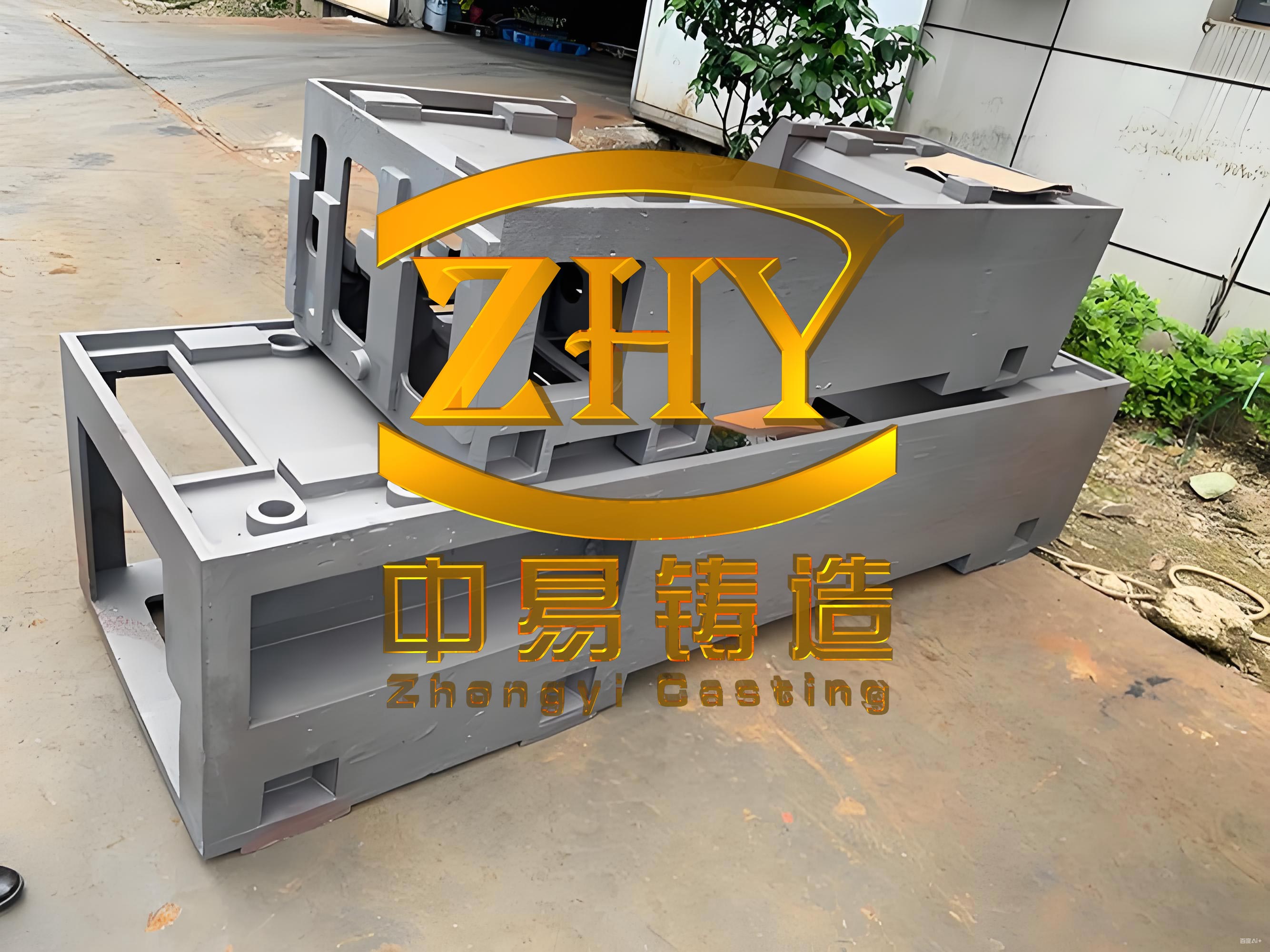
The casting of large and medium-sized machine tool castings involves meticulous process design to achieve desired outcomes. One fundamental aspect is the selection of the parting surface, which typically positions the guide rail downward and other parts upward. This alignment ensures proper mold filling and reduces defects. For instance, in the case of a bed casting with dimensions of 12m × 2m × 0.71m, the choice between sandbox molding and pit molding depends on cost and time considerations. Sandbox molding might require a box size of 13m × 2.6m, with upper and lower boxes of 0.2m and 1m thickness, respectively, leading to high costs and extended cycles. In contrast, pit molding offers a more economical alternative for single or small-batch production.
Pit molding, a traditional method, is particularly suitable for large machine tool castings due to its cost-effectiveness. However, it requires careful handling of gas venting. During pouring, the decomposition of foam patterns generates gases like carbon monoxide and hydrogen, which must be efficiently expelled through bottom layers of straw rope or coke, aided by vent pipes. Reducing pouring speed helps minimize lift force and prevents issues like “running fire” or “box swelling.” It is important to note that pit molding is not ideal for flat-structured castings, such as tailstock bodies, where sandbox molding is preferred.
Technical parameter adjustment is crucial for optimizing the casting process. Key parameters include pouring temperature, mold hardness, and cooling rates. For example, the pouring temperature for gray iron castings typically ranges from 1350°C to 1450°C, affecting fluidity and defect formation. The following equation models the solidification time (t) based on Chvorinov’s rule: $$ t = k \cdot V^2 / A^2 $$ where V is the volume of the casting, A is the surface area, and k is a constant dependent on mold material. This helps in predicting and controlling shrinkage defects.
In full mold casting, the use of internal and external chills is common to address thick sections prone to shrinkage. For instance, placing chills of appropriate thickness in large areas ensures directional solidification. The table below outlines recommended technical parameters for large machine tool castings:
| Parameter | Typical Range | Influence on Casting Quality |
|---|---|---|
| Pouring Temperature | 1350 – 1450°C | Affects fluidity and gas evolution |
| Mold Hardness | 80 – 90 (B scale) | Ensures dimensional stability |
| Cooling Rate | 0.5 – 2°C/s | Controls microstructure and defects |
| Carbon Equivalent | 3.8 – 4.2 | Optimizes strength and castability |
Furthermore, the design of gating systems plays a vital role in ensuring proper metal flow and feeding. For thick sections, internal gates are positioned to supply hot metal for effective feeding. In cases where risers are minimized, the use of chills and controlled cooling rates becomes imperative. It is essential to avoid over-reliance on large risers, as this can increase costs without significant benefits. Instead, focusing on process optimization, such as adjusting the carbon equivalent within strength limits, can yield better results. For example, increasing carbon equivalent improves fluidity but must be balanced against mechanical properties.
Casting Defects and Solutions
In the production of large and medium-sized machine tool castings, several defects commonly arise, impacting quality and yield. Shrinkage cavities and porosity in thick upper sections are frequent issues, often resulting from inadequate feeding. To address this, internal gates should be designed to deliver sufficient hot metal to these areas. Additionally, external chills or internal chills can be strategically placed to promote directional solidification. For instance, in a bed casting, chills of 20-30mm thickness on the sides and bottom of thick zones can effectively reduce shrinkage. Moreover, increasing the carbon equivalent within allowable limits enhances fluidity and feeding, but it requires careful monitoring to maintain strength and hardness.
Another prevalent problem is geometric deformation, where castings warp beyond tolerances, leading to rejection. In wooden pattern processes, anti-deflection measures can be applied, but in full mold casting, alternative approaches are needed. For guide rails formed by cores, manual grinding of anti-deflection curves on the cores is effective. If pit molding is used, similar curves can be crafted in the pit bottom to match the pattern. Post-pouring, allowing the casting to remain in the mold for an extended period—based on weight and size—helps relieve stresses and minimize deformation. The holding time t_hold can be estimated using: $$ t_{\text{hold}} = k_d \cdot W $$ where W is the casting weight and k_d is a empirical factor, typically ranging from 0.5 to 2 hours per ton for large machine tool castings.
Core floating, or “漂芯,” occurs in castings with enclosed structures and side holes, causing wall thickness variations and upper defects. This is mitigated by ensuring adequate “core iron” strength and stiffness to prevent upward movement. In non-machined upper surfaces, using “clamps” can secure the core, maintaining dimensional consistency. The following table summarizes common defects and their solutions in machine tool castings:
| Defect Type | Causes | Solutions |
|---|---|---|
| Shrinkage Cavities | Inadequate feeding, thick sections | Use of chills, optimized gating, increase CE |
| Geometric Deformation | Residual stresses, improper cooling | Anti-deflection designs, extended mold time |
| Core Floating | Weak core support, gas pressure | Reinforce cores, apply clamps, control pouring |
| Hot Cracking | High stress at solidus, poor design | Adjust alloy, improve mold yield |
Furthermore, the control of phosphorus and sulfur levels is critical to prevent embrittlement. The maximum allowable phosphorus content in high-quality machine tool castings is often below 0.05%, as higher levels increase cold cracking susceptibility. For hot cracking, which occurs at high temperatures, solutions include optimizing the casting structure to reduce stress concentrations and employing sands with better yield. The use of simulation software for process modeling can predict defect formation, allowing for preemptive adjustments. For example, finite element analysis (FEA) can simulate thermal stresses during solidification, helping to identify potential crack sites.
In practice, the integration of advanced technologies like TRIZ theory has shown promise in solving complex casting problems, such as improving surface roughness and eliminating burrs in precision components. However, for large machine tool castings, traditional methods combined with systematic parameter control remain effective. Regular monitoring and adjustment of process variables, such as pouring speed and mold composition, are essential for consistent quality. By addressing these defects proactively, manufacturers can enhance the reliability and performance of machine tool castings, supporting the broader goal of technological self-sufficiency.
Conclusion
In summary, the casting of large and medium-sized machine tool castings is a complex process that demands careful attention to design, parameters, and defect management. The evolution of casting techniques, such as full mold and pit molding, has significantly improved efficiency and quality, enabling domestic production to meet growing demands. Key to success is the optimization of technical parameters like carbon equivalent, pouring temperature, and cooling rates, which directly influence the integrity of machine tool castings. Common defects, including shrinkage, deformation, and core floating, can be effectively mitigated through strategic use of chills, anti-deflection measures, and core reinforcement.
Looking ahead, the machine tool casting industry must continue to innovate, leveraging digital tools and material science advancements to further enhance precision and sustainability. As global competition intensifies, a focus on research and development will be crucial for maintaining momentum. By addressing current challenges and embracing new technologies, the sector can achieve greater autonomy and contribute to the overall advancement of manufacturing. Ultimately, the continuous improvement in machine tool casting processes will support the production of high-performance equipment, driving economic growth and technological progress.
Through this exploration, I have highlighted the critical aspects of machine tool casting, emphasizing the need for integrated approaches that balance traditional wisdom with modern innovations. The repeated emphasis on machine tool casting and machine tool castings throughout this paper underscores their centrality in industrial applications, and I am confident that ongoing efforts will yield even more robust and efficient solutions for the future.