
In the manufacturing of multi-cylinder diesel engines, the cylinder head stands as a critical component whose quality directly influences key performance metrics such as fuel efficiency, power output, and exhaust temperature. Over the years, I have extensively studied and implemented various casting methodologies to produce these complex parts, with a particular focus on sand castings and full mold casting. This article delves into the intricate details of both techniques, drawing from practical experiences and technical analyses to provide a comprehensive guide. The goal is to explore how each method can achieve an optimal balance between quality and cost, while addressing their unique advantages and challenges. Throughout this discussion, I will emphasize the role of sand castings, as they remain a cornerstone in foundry operations, and incorporate mathematical models and comparative tables to elucidate key points.
The foundation of any casting process lies in the accurate creation of a model that represents the final part. For diesel engine cylinder heads, such as the N490 model, this begins with computer-aided design (CAD). By analyzing two-dimensional drawings and physical prototypes, I developed a three-dimensional product model using advanced CAD software. The process involves strategic selection of primary and secondary modules, along with careful Boolean operations to ensure precision. For instance, the intake port—a complex curved structure—was modeled by capturing feature points from an epoxy resin prototype via a coordinate measuring machine. Using free-form surface modeling, I constructed cloud surfaces with deviations under 0.05 mm, then generated cross-sectional contours to guide the creation of a solid entity. This approach segmented the port into straight sections, swirl generation zones, and transitional areas, each modeled with mesh surfaces and integrated through Boolean subtraction to form the final product model. The cylinder head model measures 488 mm × 178 mm × 90 mm, with an effective volume of 3.433 dm³, made from HT250 material, and weighs approximately 25 kg. This digital model serves as the blueprint for both sand castings and full mold casting processes.
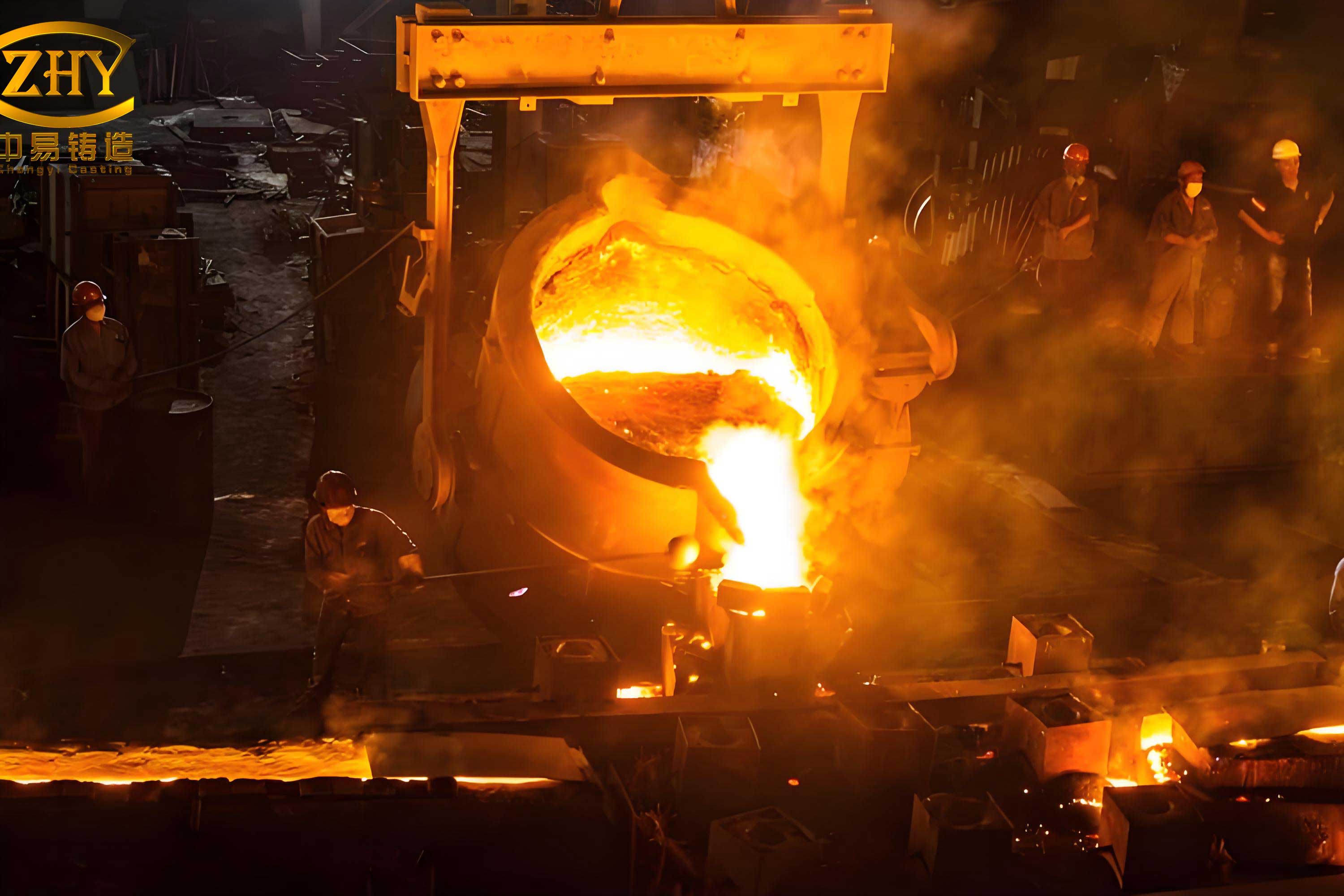
In sand castings, the product model is scaled up by a factor of 1.01 to account for shrinkage during solidification. This scaled model is then used to create patterns for molds and cores. The core assembly typically includes a main body core, intake port core, and exhaust port core, all designed with CAD tools. Draft angles are added after finalizing the pattern and core models to facilitate mold release. The manufacturing process for sand castings can vary from manual to automated methods. For low-volume production or prototyping, I have employed hand molding and core-making with wooden patterns coated in epoxy resin plastic, using green sand for molding. This approach offers flexibility and low initial costs, making it suitable for small-scale operations. However, it demands high skill levels from workers, involves significant labor intensity, and can lead to inconsistent quality due to human variability. To address these limitations, I transitioned to mechanized systems for larger batches. This includes pneumatic jolt-squeeze molding machines and combined hot box and shell core-making techniques. These automated sand castings processes enhance productivity, reduce labor dependency, and ensure better quality control through standardized parameters. For example, the molding sand composition is critical; a typical mixture might include silica sand, bentonite clay, and water, with properties defined by equations like the green strength formula: $$ \sigma_g = k \cdot \frac{C}{S} $$ where $\sigma_g$ is the green strength, $k$ is a constant, $C$ is the clay content, and $S$ is the sand grain size. Such formulas help optimize the sand castings process for durability and surface finish.
Full mold casting, also known as lost foam casting, presents an alternative to traditional sand castings. Here, the product model is scaled by 1.013 and segmented into multiple foam patterns based on structural and molding requirements. For the N490 cylinder head, I divided the model into four foam slices, as illustrated in a decomposition diagram. Each slice is equipped with reinforcement ribs in weak areas, and draft angles are applied post-segmentation. After gluing the slices, excess material is trimmed to form the complete foam pattern. The molding involves compacting dry, single-grade quartz sand (e.g., 0.6 mm/0.3 mm) around the foam pattern using a one-dimensional vibration table. Due to the high rigidity of the mold, risers used in sand castings can be eliminated; instead, the molten metal is poured under a negative pressure environment, causing the foam to vaporize and be replaced by metal. This method yields castings with superior surface quality and dimensional accuracy. In my trials, full mold cast cylinder heads weighed 3 kg less than sand castings counterparts, exhibited more uniform wall thickness, and had increased cooling water capacity. Hardness tests revealed a 15–35 HB increase over sand castings, attributed to faster cooling rates. The absence of parting lines and cores reduces post-processing needs, but the reliance on imported foam materials and high mold development costs pose economic challenges. The process can be modeled with equations like the vaporization rate of foam: $$ \frac{dm}{dt} = -A \cdot P \cdot \sqrt{\frac{M}{2\pi RT}} $$ where $dm/dt$ is the mass loss rate, $A$ is the surface area, $P$ is the vapor pressure, $M$ is the molar mass, $R$ is the gas constant, and $T$ is the temperature. This highlights the thermal dynamics distinct from sand castings.
To thoroughly compare sand castings and full mold casting, I have compiled detailed analyses using tables and formulas. Below is a table summarizing key aspects of both techniques:
| Aspect | Sand Castings | Full Mold Casting |
|---|---|---|
| Process Flexibility | High; adaptable to manual or machine methods | Moderate; requires precise foam pattern design |
| Production Volume | Ideal for both low and high volumes | Best for medium to high volumes |
| Tooling Cost | Relatively low for manual; higher for automated | High due to complex foam molds |
| Labor Intensity | High in manual mode; low in automated | Low; reduced handling and finishing |
| Surface Quality | Good, but may require machining | Excellent; minimal post-processing |
| Material Utilization | Moderate; includes risers and gates | High; near-net shape casting |
| Environmental Impact | Higher dust and emissions | Lower waste; foam decomposes |
| Typical Defects | Sand inclusions, porosity, shifts | Foam residue, gas porosity |
From a metallurgical perspective, the solidification behavior differs significantly between sand castings and full mold casting. In sand castings, the mold’s thermal conductivity affects cooling rates, which can be described by the Chvorinov’s rule: $$ t = B \cdot \left( \frac{V}{A} \right)^n $$ where $t$ is the solidification time, $B$ is a mold constant, $V$ is the casting volume, $A$ is the surface area, and $n$ is an exponent (typically around 2). For sand castings, $B$ is higher due to the insulating properties of sand, leading to slower cooling. In contrast, full mold casting uses dry sand with better permeability, and the vaporization of foam creates a protective gas layer, altering the heat transfer dynamics. This can be modeled with modified equations accounting for latent heat of vaporization: $$ Q = m_f \cdot L_f + \int \rho c_p dT $$ where $Q$ is the total heat, $m_f$ is the foam mass, $L_f$ is the latent heat, $\rho$ is density, $c_p$ is specific heat, and $T$ is temperature. Such models help optimize pouring parameters in both processes.
In terms of economic analysis, the cost-effectiveness of sand castings versus full mold casting depends on production scale and part complexity. I have derived a cost function to evaluate this: $$ C_{total} = C_{material} + C_{labor} + C_{tooling} + C_{energy} $$ For sand castings, $C_{tooling}$ is lower for manual setups but rises with automation, while $C_{labor}$ decreases. In full mold casting, $C_{material}$ is higher due to specialized foam, but $C_{labor}$ and $C_{energy}$ are reduced. A break-even analysis can be performed by setting the total costs equal and solving for production quantity $Q$: $$ Q_{break-even} = \frac{C_{tooling, FM} – C_{tooling, SC}}{(C_{unit, SC} – C_{unit, FM})} $$ where $FM$ denotes full mold, $SC$ denotes sand castings, and $C_{unit}$ is the per-unit cost excluding tooling. This highlights that for large batches, full mold casting may become advantageous despite higher upfront costs, whereas sand castings remain versatile for variable volumes.
Quality control in sand castings involves rigorous inspection of mold hardness, sand composition, and metal purity. I employ statistical process control (SPC) charts to monitor parameters like green strength and moisture content. For instance, the optimal moisture for green sand in sand castings is around 3–5%, calculated via: $$ M = \frac{W_{water}}{W_{sand}} \times 100\% $$ where $M$ is moisture percentage, $W_{water}$ is water weight, and $W_{sand}$ is sand weight. Defects such as blowholes or shrinkage in sand castings are mitigated by optimizing riser design using modulus methods: $$ M = \frac{V}{A} $$ where $M$ is the geometric modulus, ensuring risers solidify last. In full mold casting, quality hinges on foam density and pattern integrity. The foam expansion ratio, given by $$ R = \frac{\rho_{polymer}}{\rho_{foam}} $$ where $R$ is the expansion ratio, $\rho_{polymer}$ is the polymer density, and $\rho_{foam}$ is the foam density, typically ranges from 20 to 80 for casting patterns. Higher ratios improve gas evolution but may weaken the pattern. Non-destructive testing techniques, such as X-ray radiography, are used in both methods to detect internal flaws, but sand castings often require more extensive testing due to inherent variability.
The environmental and safety aspects further differentiate these techniques. Sand castings generate significant amounts of used sand, which can be recycled through reclamation systems, reducing waste. However, the process emits particulates and volatile organic compounds (VOCs) from binders, necessitating dust collection and ventilation. The energy consumption in sand castings is influenced by melting and molding operations, approximated by: $$ E = P_{melt} \cdot t_{melt} + P_{mold} \cdot t_{mold} $$ where $E$ is energy, $P$ is power, and $t$ is time. Full mold casting, while cleaner in terms of particulate emissions, involves polystyrene foam that decomposes into gases during pouring, requiring controlled ventilation to manage styrene emissions. The sand in full mold casting is reusable after cooling and screening, similar to sand castings, but with less degradation due to the absence of binders. From a worker safety perspective, full mold casting reduces exposure to silica dust common in sand castings, aligning with modern occupational health standards.
Looking ahead, advancements in both sand castings and full mold casting are driven by digital technologies. Simulation software now allows virtual testing of mold filling and solidification, reducing trial-and-error in sand castings. For example, fluid flow in sand castings can be simulated using Navier-Stokes equations: $$ \rho \left( \frac{\partial \mathbf{v}}{\partial t} + \mathbf{v} \cdot \nabla \mathbf{v} \right) = -\nabla p + \mu \nabla^2 \mathbf{v} + \mathbf{f} $$ where $\rho$ is density, $\mathbf{v}$ is velocity, $p$ is pressure, $\mu$ is viscosity, and $\mathbf{f}$ is body force. In full mold casting, models incorporate foam degradation kinetics to predict gas pressure and metal flow. Additive manufacturing is also revolutionizing pattern-making for both processes; 3D-printed sand molds enable rapid prototyping for sand castings, while printed foam patterns streamline full mold casting. These innovations enhance the competitiveness of sand castings in low-volume scenarios and expand the applicability of full mold casting to complex geometries.
In conclusion, both sand castings and full mold casting offer viable pathways for producing high-quality diesel engine cylinder heads. My experience underscores that sand castings, with their adaptability and cost-efficiency, remain indispensable for diverse production scales. Full mold casting excels in surface finish and precision, though it requires careful economic justification. By leveraging CAD modeling, process optimization, and continuous improvement, manufacturers can harness the strengths of each method. The future lies in hybrid approaches, where elements of sand castings are integrated with advanced materials and digital tools to achieve superior results. As the industry evolves, a deep understanding of these casting technologies will continue to drive innovation and efficiency in engine component manufacturing.