
In my extensive engineering experience focused on abrasion-resistant materials, I have dedicated significant effort to developing and optimizing high-chromium white cast iron for critical slurry pump applications. The relentless wear experienced by pump overflow components in mining and mineral processing operations presents a major economic and operational challenge. My work began with the objective of creating a domestically producible, cost-effective alternative to imported nickel-hard cast iron parts, which were standard in certain imported slurry pump systems. Through systematic research and industrial trials, I have established that a properly formulated and processed high-chromium white cast iron not only matches but often surpasses the performance of its nickel-based counterparts, offering a superior balance of hardness, wear resistance, and cost.
The core of my investigation revolves around a specific grade of white cast iron, meticulously alloyed to achieve optimal service life. The fundamental principle guiding this development was to engineer a material whose in-service cost-per-hour is lower, achieved by extending operational lifespan while maintaining material costs comparable to nickel-hard iron. The success of this white cast iron hinges on a deeply interconnected triad: precise chemical composition design, controlled solidification during casting, and a tailored heat treatment regimen.
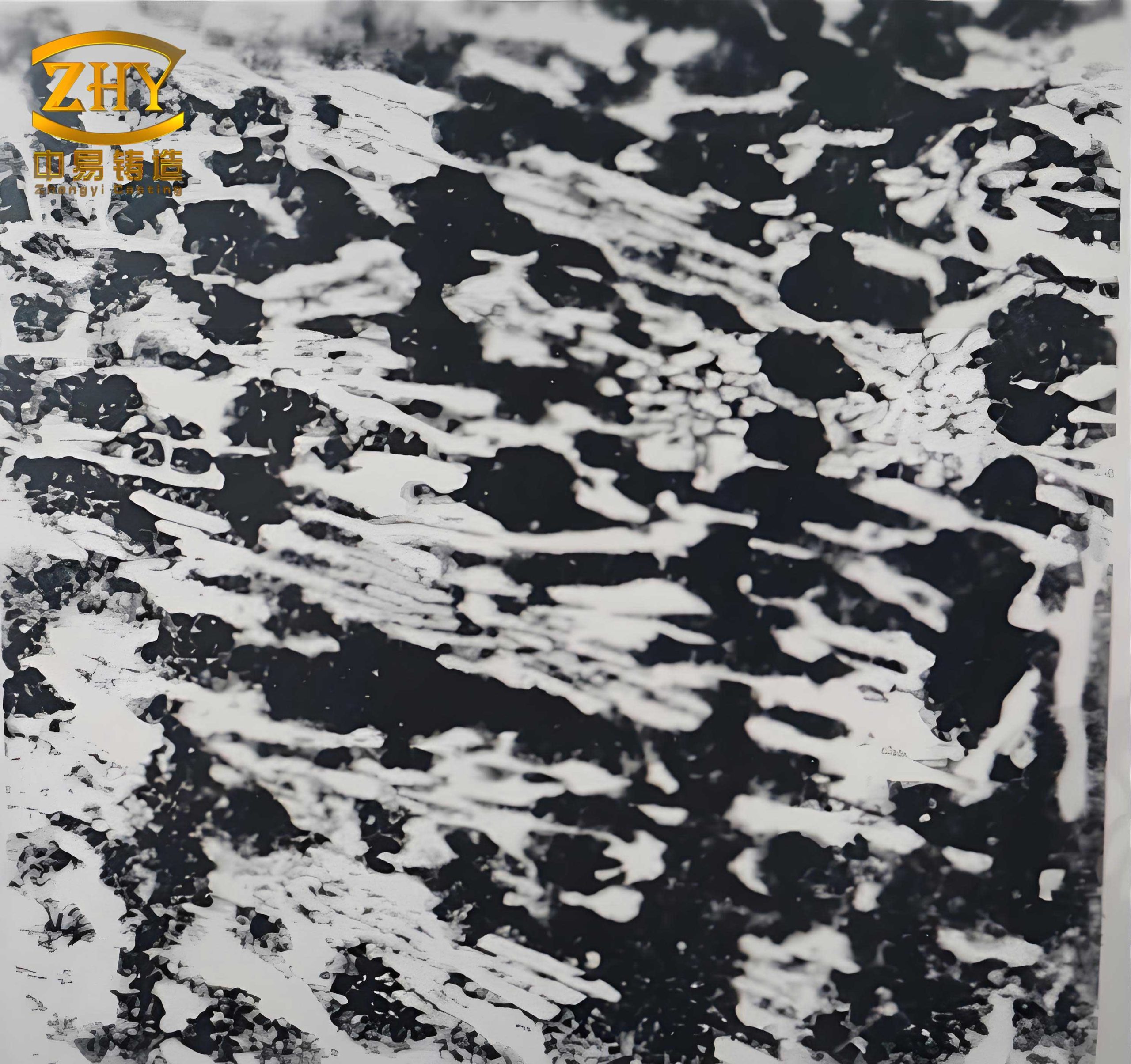
The chemical design of this high-chromium white cast iron is the first critical step. Each element plays a synergistic role in defining the final microstructure and properties. Carbon is paramount, as it directly influences the volume fraction and morphology of hard carbides and the hardness of the metallic matrix. In my formulation, carbon acts as the primary strengthener, but its level must be carefully balanced. Excessive carbon can lead to excessive carbide formation and embrittlement. I determined the optimal equilibrium point for carbon content through iterative testing, aiming for a range that maximizes hardness without compromising integrity. Chromium is the defining alloying element in this white cast iron, serving a dual purpose. It is crucial for forming hard, complex (Cr, Fe)₇C₃ carbides, which are significantly harder and more resistant to fracture than the cementite found in plain white cast irons. Furthermore, chromium enhances the material’s ability to form a protective passive layer in slurry environments, mitigating corrosive wear components. Molybdenum and copper are added in controlled amounts primarily to enhance hardenability, ensuring that the desired martensitic matrix can be achieved throughout the section thickness of typical pump parts, even under moderate cooling rates. The targeted chemical composition range I developed is summarized in the table below.
| Element | Target Composition (wt.%) | Primary Function |
|---|---|---|
| C | 2.8 – 3.2 | Controls carbide volume & matrix hardness |
| Cr | 14.0 – 16.0 | Forms (Cr,Fe)₇C₃ carbides; promotes passivation |
| Mo | 0.8 – 1.2 | Increases hardenability |
| Cu | 0.8 – 1.2 | Increases hardenability; aids corrosion resistance |
| Si | ≤ 0.8 | Deoxidizer; kept low to avoid graphitization |
| Mn | 0.5 – 1.0 | Stabilizes austenite; aids deoxidation |
| Fe | Balance | Matrix |
The relationship between carbon content and theoretical carbide volume fraction can be approximated for this type of white cast iron. For high-chromium alloys where most carbides are M₇C₃, the volume fraction of carbides (V_c) is strongly influenced by the carbon (C) and chromium (Cr) content. A simplified empirical relationship I often reference is:
$$ V_c \approx k_1 \cdot C + k_2 \cdot Cr – k_3 $$
where $k_1$, $k_2$, and $k_3$ are constants derived from phase diagram data. For our composition, targeting a V_c between 25% and 35% provides an excellent blend of abrasion resistance and toughness.
Casting this alloy is an exercise in controlling solidification to refine microstructure and prevent defects. I employ a medium-frequency induction furnace with an acidic lining for melting, using a charge of steel scrap, carbon-chromium ferroalloys, and low-alloy pig iron. Melt superheat is controlled precisely. A key innovation in my practice is the implementation of a simultaneous solidification strategy, as opposed to directional feeding, for these relatively thin-walled pump components. This is achieved through a judicious combination of internal and external chills, and a carefully designed gating system. The gating employs multiple, wide, thin-section ingates placed away from thermal centers to prevent “hot spots” and associated shrinkage porosity. External chills, typically made of gray iron, are strategically placed to accelerate cooling at critical wear surfaces. This rapid cooling refines the as-cast structure, leading to smaller eutectic carbide colonies and a finer dendritic arm spacing (DAS). The refinement of DAS significantly improves toughness and macro-hardness. I have observed that the cooling rate (Ṫ) during solidification has a power-law relationship with the resulting carbide size (d):
$$ d \propto Ṫ^{-n} $$
where $n$ is a positive exponent typically between 0.3 and 0.5 for white cast iron systems. Faster cooling yields finer carbides. The use of chills is instrumental in achieving this. Furthermore, the chilling effect can promote a desirable orientation of carbide fibers perpendicular to the wearing surface, enhancing abrasion resistance. After pouring, the molds are allowed to cool slowly in the flask to relieve casting stresses before shakeout.
However, the as-cast high-chromium white cast iron structure is not optimal for service. It typically consists of austenite (which may partially transform to martensite), massive carbides, and some pearlite, depending on the section size and cooling rate. To unlock the full potential of this white cast iron, a two-stage heat treatment is absolutely essential. The first stage is an austenitization or “hardening” treatment. The castings are heated into the austenite-plus-carbide phase field. The temperature and time are critical variables I have optimized. Higher temperatures promote greater dissolution of chromium and carbon into the austenite, increasing its alloy content and, consequently, the hardenability and the final martensite hardness (after quenching). However, excessive temperature or time can lead to carbide coarsening and grain growth. The optimal austenitizing temperature ($T_a$) I determined lies between 950°C and 1050°C, with the holding time ($t_a$) following a rule of thumb:
$$ t_a (hours) \approx \frac{\text{Section Thickness (mm)}}{25} $$
After sufficient soaking to achieve homogeneity, the components are quenched in air or oil, depending on section thickness, to transform the supersaturated austenite into martensite.
The second, equally vital stage is tempering. The as-quenched structure contains high-carbon martensite, which is very hard but also highly stressed and prone to micro-cracking. A low-temperature temper, typically between 200°C and 250°C, is employed to relieve these internal stresses, improve toughness slightly, and precipitate fine secondary carbides from the martensite, further increasing its hardness. The final microstructure I achieve is a composite of hard, primary (Cr,Fe)₇C₃ carbides embedded in a tempered martensite matrix containing a controlled amount of retained austenite (typically 5-15%). This retained austenite is beneficial as it can undergo strain-induced transformation to martensite during service, providing a degree of toughness and work-hardening capability. The effect of heat treatment parameters on hardness can be modeled. The as-quenched hardness ($H_{q}$) is a function of austenitizing conditions and alloy content. An approximate relationship is:
$$ H_{q} \approx A + B \cdot (C_{eq}) – C \cdot \exp(-E_a / RT_a) $$
where $C_{eq}$ is a carbon equivalent accounting for other alloying elements, $E_a$ is an activation energy, $R$ is the gas constant, $T_a$ is the austenitizing temperature, and A, B, C are constants. The data from my heat treatment trials is consolidated in the following table.
| Austenitizing Temperature (°C) | Holding Time (hours) | As-Quenched Hardness (HRC) | Estimated Retained Austenite, Ar (%) |
|---|---|---|---|
| 950 | 2.0 | 58 – 60 | 15 – 20 |
| 980 | 2.0 | 60 – 62 | 10 – 15 |
| 1020 | 1.5 | 62 – 65 | 5 – 10 |
| 1050 | 1.5 | 63 – 66 | 3 – 8 |
The performance of this engineered white cast iron was rigorously validated under industrial conditions. Field trials were conducted on vertical slurry pumps handling abrasive ore slurries in tin and iron ore processing plants. The key metric was service life—the operational hours until wear necessitated component replacement. The results, compared directly against the original nickel-hard cast iron parts, were compelling and are summarized below. The cost analysis confirmed that the total material cost for producing the high-chromium white cast iron parts was essentially equivalent to that of the nickel-hard iron, making the lifespan extension a pure economic gain.
| Test Site & Slurry Conditions | Material of Part | Average Particle Hardness (Mohs) | Slurry Density (%) | Service Life (hours) | Relative Life (Index) |
|---|---|---|---|---|---|
| Tin Mine, abrasive silica-based slurry | Nickel-Hard Cast Iron (Baseline) | ~7 | 30-40 | ~500 | 1.0 |
| Tin Mine, abrasive silica-based slurry | High-Cr White Cast Iron | ~7 | 30-40 | 750 – 800 | 1.5 – 1.6 |
| Iron Ore Plant, hard iron oxides | High-Cr White Cast Iron | ~6.5 | 40-50 | >1000 | >2.0* |
*Baseline life for nickel-hard iron at this site was also approximately 500 hours.
The superior performance of this white cast iron prompts a deeper discussion on the underlying wear mechanisms and material response. Slurry pump wear is a complex process involving low-stress abrasion, higher-stress impact/erosion, and potential corrosion. The relative wear resistance (W_r) of a material in such conditions is often correlated with its hardness (H), but not linearly. For metallic materials with hard phases, a relationship like the following is often observed:
$$ W_r \propto H^m $$
where the exponent $m$ is typically greater than 1 for abrasive wear, indicating that incremental increases in hardness yield disproportional gains in wear life. The high macroscopic hardness of my treated white cast iron, consistently above 60 HRC, provides a primary defense. However, the microstructure is equally important. The (Cr,Fe)₇C₃ carbides in this white cast iron have a hardness in excess of 1500 HV, providing the primary abrasion-resistant phase. The tempered martensite matrix, with a hardness of ~700-800 HV, provides strong support for these carbides, preventing them from being plucked out. The controlled amount of retained austenite adds fracture toughness to the composite, absorbing impact energy and reducing the propensity for catastrophic cracking.
A critical aspect of my processing methodology is the use of melt inoculation or modification treatments. After final deoxidation, I introduce a two-stage treatment. First, minor additions of vanadium and titanium are made via a plunging technique. These elements form their own hard, refractory carbides and nitrides (e.g., VC, TiC) which act as potent heterogeneous nucleation sites during solidification. This refines the overall grain structure and the carbide morphology. The effect on grain size (D) can be described by a classical nucleation model:
$$ D = \frac{k}{Q^{1/3}} $$
where $k$ is a constant and $Q$ is the number of effective nuclei per unit volume, which is increased by the inoculant. Subsequently, a proprietary rare-earth-based inoculant is added in the ladle. This further refines the structure, modifies the morphology of non-metallic inclusions (making them more spherical and less detrimental), and appears to enhance the interfacial bonding strength between the carbides and the metallic matrix. This stronger interface is crucial for preventing carbide pull-out during service, a common failure mode in poorly bonded white cast iron composites.
The discussion on solidification rate warrants further elaboration. The use of chills to achieve a simultaneous solidification pattern is particularly effective for this white cast iron. By rapidly extracting heat, the chill not only refines the microstructure at the surface but also creates a favorable thermal gradient. In some cases, this can lead to a directional solidification effect at the microscale, aligning the long axes of the eutectic carbide clusters more perpendicular to the chill surface (i.e., the future wear surface). This alignment can improve wear resistance as the abrasive particles encounter the hard carbide fibers edge-on rather than sliding along their length. The cooling rate ($\dot{T}$) near the chill surface can be estimated from heat transfer principles:
$$ \dot{T} = \frac{(T_{pour} – T_{chill})}{\sqrt{\pi \alpha t}} \cdot \frac{k_{mold}}{\rho c_p \delta} $$
where $\alpha$ is thermal diffusivity, $k_{mold}$ is mold conductivity, $\rho c_p$ is volumetric heat capacity, and $\delta$ is a characteristic depth. Achieving a high $\dot{T}$ is key to microstructural refinement in white cast iron.
Furthermore, the choice of heat treatment cycle directly addresses the stability of the austenite phase. The martensite start temperature ($M_s$) for this high-chromium white cast iron is depressed by the high carbon and alloy content. It can be estimated using an empirical formula:
$$ M_s (°C) \approx 539 – 423C – 30.4Cr – 12.1Mo – 7.5Cu + … $$
For our composition, the $M_s$ is typically below 200°C. The amount of retained austenite after quenching ($V_{γ}$) is inversely related to the difference between the $M_s$ and the quench-stop temperature. By controlling the austenitizing parameters, I effectively control the carbon and alloy content in solution, thus tuning the $M_s$ and consequently $V_{γ}$. This delicate balance ensures the matrix has high hardness from martensite but sufficient ductility from the retained phase.
The economic implication of adopting this high-chromium white cast iron is substantial. By eliminating the need for expensive nickel and achieving longer service life, the total cost of ownership for slurry pump wear parts is significantly reduced. The formula for cost-per-operating-hour ($C_{hour}$) clearly demonstrates this:
$$ C_{hour} = \frac{C_{material} + C_{manufacturing}}{L} $$
where $C_{material}$ and $C_{manufacturing}$ are the fixed costs per part, and $L$ is the service life. Since the numerator is similar for both materials (as designed), but $L$ is 1.5 to 2 times greater for the high-chromium white cast iron, the $C_{hour}$ is proportionally lower. This makes the case for this advanced white cast iron compelling not just on technical grounds, but on firm economic logic.
In conclusion, my research and practical application have firmly established that a scientifically designed and meticulously processed high-chromium white cast iron is an outstanding material for slurry pump overflow components. The synergy of a balanced chemical composition promoting the formation of hard M₇C₃ carbides, a casting practice emphasizing rapid solidification for microstructural refinement, and a dual-stage heat treatment to produce a tough martensitic matrix with controlled retained austenite, results in a material with exceptional abrasion and erosion resistance. This engineered white cast iron delivers a service life that reliably exceeds that of traditional nickel-hard cast iron while maintaining equivalent production costs. The success of this material hinges on understanding and controlling the complex interrelationships between composition, processing, microstructure, and properties—a principle at the heart of all advanced metallurgy. The continued optimization and adoption of such high-performance white cast iron alloys represent a significant step forward in reducing maintenance costs and improving efficiency in harsh industrial environments like mineral processing.