
In the development of high-performance crusher liners, we focused on optimizing high manganese steel casting to enhance durability and efficiency in demanding industrial applications. High manganese steel casting is renowned for its exceptional work-hardening capability and impact resistance, making it ideal for components subjected to heavy wear and shock loads. However, under non-intensive impact conditions, conventional high manganese steel casting may not fully exploit its hardening potential, leading to suboptimal mechanical properties. Our research aimed to address this by refining the alloy composition, employing advanced lost foam casting techniques, and implementing precise heat treatment protocols. Through extensive experimentation, we achieved significant improvements in microstructure, hardness, and wear resistance, establishing a robust framework for producing superior high manganese steel casting components.
The foundation of our approach lies in the meticulous design of the high manganese steel alloy composition. Traditional high manganese steel casting typically relies on a standard Mn-C balance, but we introduced strategic alloying elements to enhance carbide formation and matrix strengthening. The optimized chemical composition for our high manganese steel casting is detailed in Table 1. Elements such as Chromium (Cr) and Molybdenum (Mo) were incorporated to improve hardenability and refine grain structure, while Copper (Cu) and rare earth additions facilitated grain boundary strengthening and impurity removal. This composition not only boosts strength but also maintains ductility, crucial for withstanding cyclic impacts in crusher operations.
| Element | Range | Role in High Manganese Steel Casting |
|---|---|---|
| C | 0.90–1.35 | Enhances hardness and carbide formation |
| Mn | 11–14 | Promotes austenite stability and work-hardening |
| Cr | 1.5–2.5 | Improves corrosion resistance and hardenability |
| Si | 0.3–0.8 | Acts as deoxidizer and strengthens ferrite |
| Mo | 0.3–1.5 | Refines carbides and enhances high-temperature strength |
| Cu | 0.8–1.2 | Increases precipitation hardening and toughness |
| P | < 0.07 | Minimized to prevent embrittlement |
| S | < 0.035 | Reduced to avoid hot tearing |
| Fe | Balance | Base matrix for high manganese steel casting |
To quantify the effects of alloying, we applied thermodynamic calculations using equations such as the carbon equivalent (CE) for high manganese steel casting, which influences hardenability and phase transformations. The carbon equivalent can be expressed as:
$$ CE = C + \frac{Mn}{6} + \frac{Cr + Mo + V}{5} + \frac{Si}{24} $$
where each element’s contribution is weighted based on its impact on the microstructure. For our high manganese steel casting, this formula helped predict the formation of carbides and austenite retention, ensuring optimal balance between hardness and toughness. Additionally, the role of modifiers in high manganese steel casting was critical; we developed a proprietary modifier containing Mo-Cu and V-Ti compounds to induce fine, dispersed carbides. The reaction kinetics during solidification can be modeled as:
$$ \frac{dC}{dt} = -k C^n $$
where \( C \) is the concentration of alloying elements, \( k \) is the rate constant, and \( n \) is the reaction order, illustrating how modifier additions control carbide precipitation in high manganese steel casting.
The melting process for high manganese steel casting was conducted in a basic medium-frequency induction furnace to minimize oxidation and ensure homogeneity. We adhered to a strict sequence: charging scrap steel and pig iron first, followed by nickel, chromium, and molybdenum alloys, then ferromanganese and ferrosilicon, and finally rare earth silicides for modification. Aluminum was used for final deoxidation, and the melt was treated with our custom modifiers to achieve a uniform distribution of secondary phases. Temperature control was paramount, with pouring temperatures maintained between 1500°C and 1540°C to prevent defects like hot tearing, common in high manganese steel casting due to its high shrinkage rate of 2.4–3.6%. The solidification behavior was analyzed using the Chvorinov’s rule for casting solidification time:
$$ t = B \left( \frac{V}{A} \right)^2 $$
where \( t \) is solidification time, \( B \) is a mold constant, \( V \) is volume, and \( A \) is surface area, ensuring that our high manganese steel casting design minimized thermal stresses.
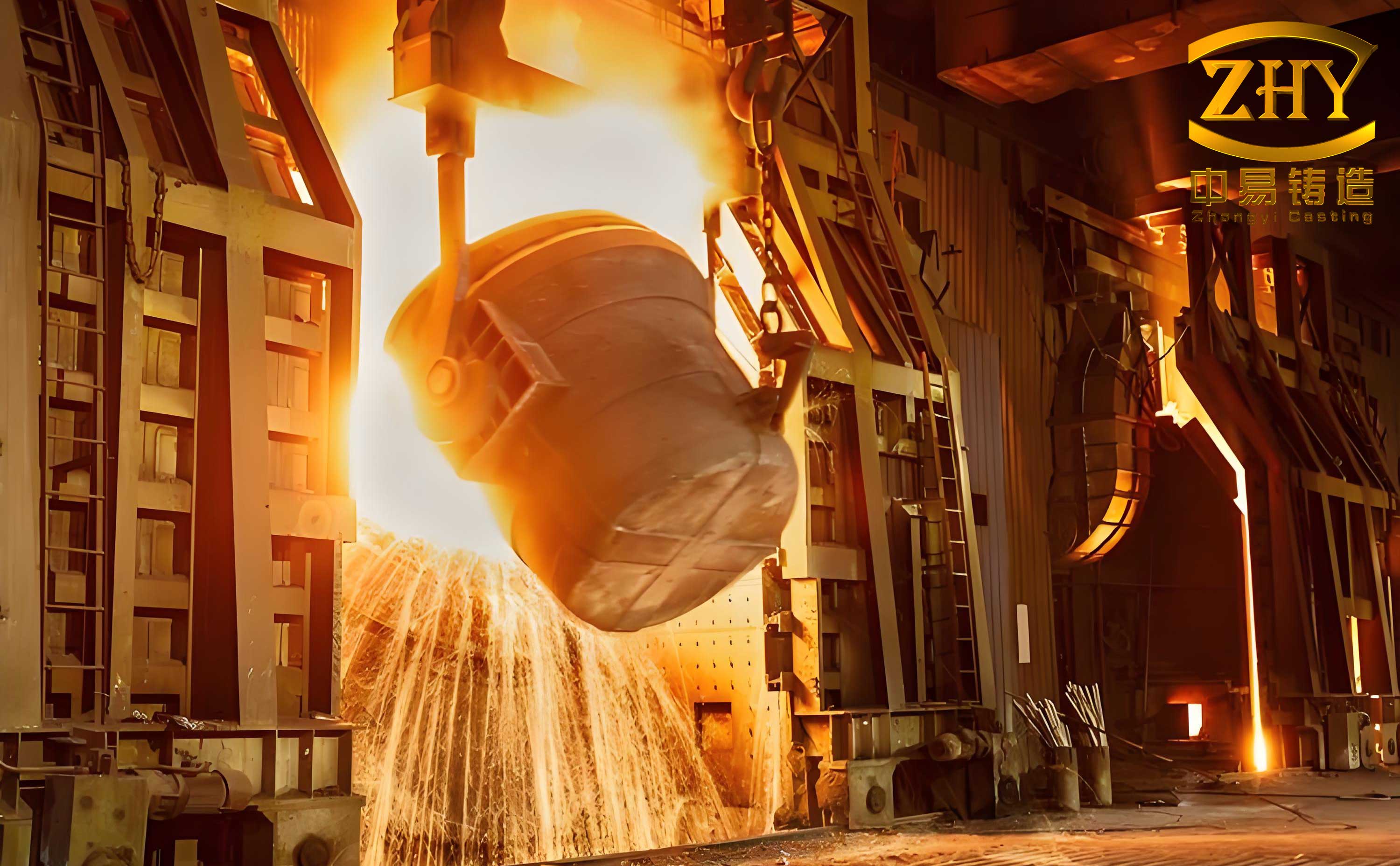
Our high manganese steel casting utilized the lost foam process, which involves creating foam patterns, coating them with refractory material, and casting under negative pressure to achieve precise dimensional accuracy and reduce inclusions. The gating system was designed as semi-closed with multiple flat horn-shaped ingates and insulating risers with knock-off heads to facilitate smooth metal flow and shrinkage compensation. This setup is particularly beneficial for high manganese steel casting, as it mitigates turbulence and oxidation. The fluid dynamics of molten metal in such systems can be described by Bernoulli’s equation for incompressible flow:
$$ P + \frac{1}{2} \rho v^2 + \rho g h = \text{constant} $$
where \( P \) is pressure, \( \rho \) is density, \( v \) is velocity, and \( h \) is height, ensuring that the high manganese steel casting fills the mold efficiently without defects. We positioned the sandbox at a 5°–10° angle during pouring to enhance feeding and reduce porosity. After casting, the components were cooled in the mold for 8–16 hours to below 200°C to prevent cracking, a key consideration in high manganese steel casting due to its low thermal conductivity, approximately one-fifth that of carbon steel.
Heat treatment is a cornerstone of enhancing the properties of high manganese steel casting. We implemented a “quenching and tempering” process tailored to our alloy composition. The thermal cycle involved slow heating at rates below 100°C/h to 700°C for 1–1.5 hours, followed by austenitizing at 30–50°C above Ac3 for 2–4 hours, forced air quenching to about 400°C, and gradual cooling to below 150°C. Tempering was conducted at 250–400°C for 2–4 hours to relieve stresses and stabilize the microstructure. The phase transformations during heat treatment of high manganese steel casting can be modeled using the Avrami equation for nucleation and growth:
$$ X = 1 – \exp(-k t^n) $$
where \( X \) is the fraction transformed, \( k \) is a rate constant, and \( n \) is the Avrami exponent, describing the kinetics of carbide precipitation and austenite decomposition. This controlled process ensured a fine dispersion of carbides and reduced retained austenite, critical for achieving high hardness and impact toughness in high manganese steel casting.
The mechanical performance and wear resistance of our high manganese steel casting were evaluated through standardized tests, with results compared to conventional liners in Table 2. Our optimized high manganese steel casting exhibited superior tensile strength, elongation, and impact toughness, attributable to the refined microstructure and effective modifier application. The wear mechanism in high manganese steel casting involves a combination of abrasion and impact, which can be analyzed using Archard’s wear equation:
$$ V = K \frac{F L}{H} $$
where \( V \) is wear volume, \( K \) is a wear coefficient, \( F \) is load, \( L \) is sliding distance, and \( H \) is hardness. Our high manganese steel casting demonstrated a lower wear rate due to the enhanced work-hardening capability and homogeneous carbide distribution.
| Property | Optimized High Manganese Steel Casting | Conventional High Manganese Steel Casting |
|---|---|---|
| Tensile Strength (MPa) | 900 | 735 |
| Elongation (%) | 32 | 30 |
| Impact Toughness (J/cm²) | 150 | 147 |
| Relative Wear Resistance | 1.25 (normalized) | 1.00 (baseline) |
Microstructural analysis revealed that our high manganese steel casting possessed a denser and more uniform grain structure with finely distributed carbides and minimal retained austenite. This contrasts with conventional high manganese steel casting, which often shows coarse carbides and uneven phases. The Hall-Petch relationship explains the strength enhancement in our high manganese steel casting due to grain refinement:
$$ \sigma_y = \sigma_0 + \frac{k_y}{\sqrt{d}} $$
where \( \sigma_y \) is yield strength, \( \sigma_0 \) is friction stress, \( k_y \) is a constant, and \( d \) is grain diameter. The finer grains in our high manganese steel casting contributed to higher strength without compromising ductility. Furthermore, the role of dislocations in work-hardening for high manganese steel casting can be described by the Taylor equation:
$$ \tau = \alpha G b \sqrt{\rho} $$
where \( \tau \) is shear stress, \( \alpha \) is a constant, \( G \) is shear modulus, \( b \) is Burgers vector, and \( \rho \) is dislocation density, highlighting how our processing parameters optimized strain hardening in service.
In conclusion, our comprehensive approach to high manganese steel casting—through alloy design, lost foam casting, and tailored heat treatment—has resulted in crusher liners with exceptional mechanical properties and wear resistance. The integration of advanced modifiers and precise process control in high manganese steel casting not only improves performance but also offers cost efficiencies by eliminating nickel and reducing material waste. Future work will focus on further optimizing the high manganese steel casting parameters for even greater sustainability and application range, solidifying its role in industrial耐磨 components.