
In my extensive experience with foundry engineering, the production of high-performance railway components, particularly frogs or crossings, represents one of the most demanding applications of high manganese steel casting. This austenitic steel, renowned for its exceptional work-hardening capability, impact toughness, and wear resistance, is indispensable for parts subjected to extreme mechanical stress, such as rail frogs. The successful implementation of high manganese steel casting requires meticulous control over every stage—from metallurgical composition and melt treatment to intricate mold design and precise pouring practices. Through this detailed account, I will share the comprehensive methodology and technical insights developed for manufacturing complex, export-grade KS60 rail frogs, which exemplify the pinnacle of high manganese steel casting technology. The process underscores the critical balance between achieving superior internal soundness, dimensional accuracy, and the stringent mechanical properties mandated for heavy-haul railway operations.
The fundamental requirement for any high manganese steel casting begins with its chemical composition. The grade commonly designated as ZGMn13 must adhere to a precise elemental range to guarantee the formation of a stable, single-phase austenitic matrix upon heat treatment (water toughening). This matrix is responsible for the steel’s unique properties. The chemical specifications, derived from both international standards and specific project requirements, are best summarized in the following table.
| Element | Required Composition (wt%) | Critical Function |
|---|---|---|
| Carbon (C) | 0.90 – 1.20 | Primary strengthener; ensures adequate hardness and strength. |
| Manganese (Mn) | 11.0 – 14.0 | Stabilizes austenite; prevents pearlite or martensite formation. |
| Silicon (Si) | 0.30 – 0.80 | Deoxidizer; improves fluidity of the molten metal. |
| Phosphorus (P) | ≤ 0.050 | Harmful impurity; kept low to prevent hot brittleness. |
| Sulfur (S) | ≤ 0.035 | Harmful impurity; kept low to prevent sulfide inclusions. |
A paramount relationship in high manganese steel casting is the manganese-to-carbon ratio. To ensure optimal austenite stability and mechanical performance, the ratio must satisfy the condition: $$ \frac{Mn}{C} \geq 10 $$ where Mn and C represent their weight percentages. This ratio is a cornerstone of metallurgical control. For instance, with a carbon content of 1.10%, the manganese content must be at least 11.0%. Deviation below this ratio can lead to the precipitation of carbides at grain boundaries, severely embrittling the casting. The target mechanical properties for the finished high manganese steel casting are equally rigorous: tensile strength (σ_b) ≥ 740 MPa, and elongation (δ) ≥ 35%. In practice, well-processed castings often achieve significantly higher values, such as σ_b = 850–970 MPa and δ = 55–60%, demonstrating the potential of optimized high manganese steel casting processes.
The journey of a high manganese steel casting like the KS60 frog begins with a thorough casting process analysis. The component’s geometry is inherently complex. It is a long, slender casting (ranging from 4012 mm to 6705 mm) with a height of approximately 179 mm and wall thickness varying between 25 mm and 45 mm. The section modulus changes continuously along its length, creating numerous isolated thermal centers and junctions. A network of longitudinal and transverse ribs intersects with the main body and base plate, forming multiple hot spots. This complexity makes the casting highly susceptible to defects like shrinkage porosity, hot tears, and sand fusion if the solidification pattern is not rigorously controlled. Furthermore, the quality standards are exceptionally strict. Critical zones, such as the weldable ends (DEFG zone), the transition areas of the nose rail (N zone) and wing rail (W zone), and the throat (T zone), require internal soundness classified as Level A1B1C1 according to radiographic inspection standards for gas pores (A), sand/slag inclusions (B), and shrinkage (C). This demands a casting process that promotes directional solidification and provides effective feeding to these remote and thermally dense regions.
The core of successful high manganese steel casting lies in the foundry’s ability to manipulate heat extraction. The adopted casting process for the KS60 frog is a split-pattern, horizontally molded, but tilted pouring technique. The mold is inclined at a height of 550–600 mm. This simple yet effective approach utilizes gravity to establish a strong thermal gradient, ensuring that solidification progresses sequentially from the lower, thinner sections towards the higher, thicker sections and finally into the strategically placed feeders. The entire top working surface of the frog (the rail head) is lined with numerous shaped open chills. The function of these chills is governed by the fundamental principle of heat transfer, described by Fourier’s law. The intense local cooling they provide accelerates solidification at the surface, refining the grain structure and creating a steep temperature gradient that directs the solidification front toward the risers. The heat extraction rate (q) from a chill can be approximated by: $$ q = h \cdot A \cdot (T_{melt} – T_{chill}) $$ where \( h \) is the heat transfer coefficient, \( A \) is the contact area, \( T_{melt} \) is the metal temperature, and \( T_{chill} \) is the initial chill temperature. By rapidly freezing a strong shell, these chills also enhance the casting’s resistance to geometric distortion.
Feeding system design is the complementary half of the solidification control strategy in high manganese steel casting. Blind risers alone are insufficient for the complex thermal geometry. The design incorporates insulating sleeve risers at key locations. A central riser is placed on the base plate to feed the massive body of the frog. Additional risers are positioned at the intersections of three walls (the P zone) and at the center of large reinforcement ribs. To address the specific challenge of the weldable ends (DEFG zones), which require flawless internal quality for subsequent rail welding, a combination of enhanced chilling and specialized exothermic risers was developed. The rail head at these ends is fitted with thicker, custom-made chills. Side chills are applied from the end face up to the triple-wall junction. Most importantly, exothermic feeding heads are used over the rail base, with added feed metal pads (or “padding”) on the rail web to ensure a continuous feeding path from the riser through the web and into the critical rail head region. This multi-pronged approach ensures that liquid metal补给 lasts long enough to compensate for volumetric shrinkage in these vulnerable zones, a critical achievement in high manganese steel casting for high-integrity components.
The mold and core materials play a subtle but vital role. The molds are produced using resin-bonded sand, which offers excellent dimensional stability, good collapsibility to avoid hot tearing, and the ability to produce complex shapes with high accuracy. The cores, which form the internal cavities and undercuts, are made from sodium silicate (water glass) sand. This choice is often driven by its higher strength and better resistance to metal penetration at the high pouring temperatures associated with high manganese steel casting. The entire mold cavity surface is coated with an alcohol-based, fast-drying magnesite refractory paint. This coating serves multiple purposes: it prevents metal penetration and burn-on, improves surface finish, and provides a thermal barrier that can help moderate the cooling rate, complementing the action of the chills. After drying, the cavity is meticulously brushed to remove any loose sand grains or coating debris, a crucial step to prevent mechanical inclusions—a common defect category in demanding high manganese steel casting projects.
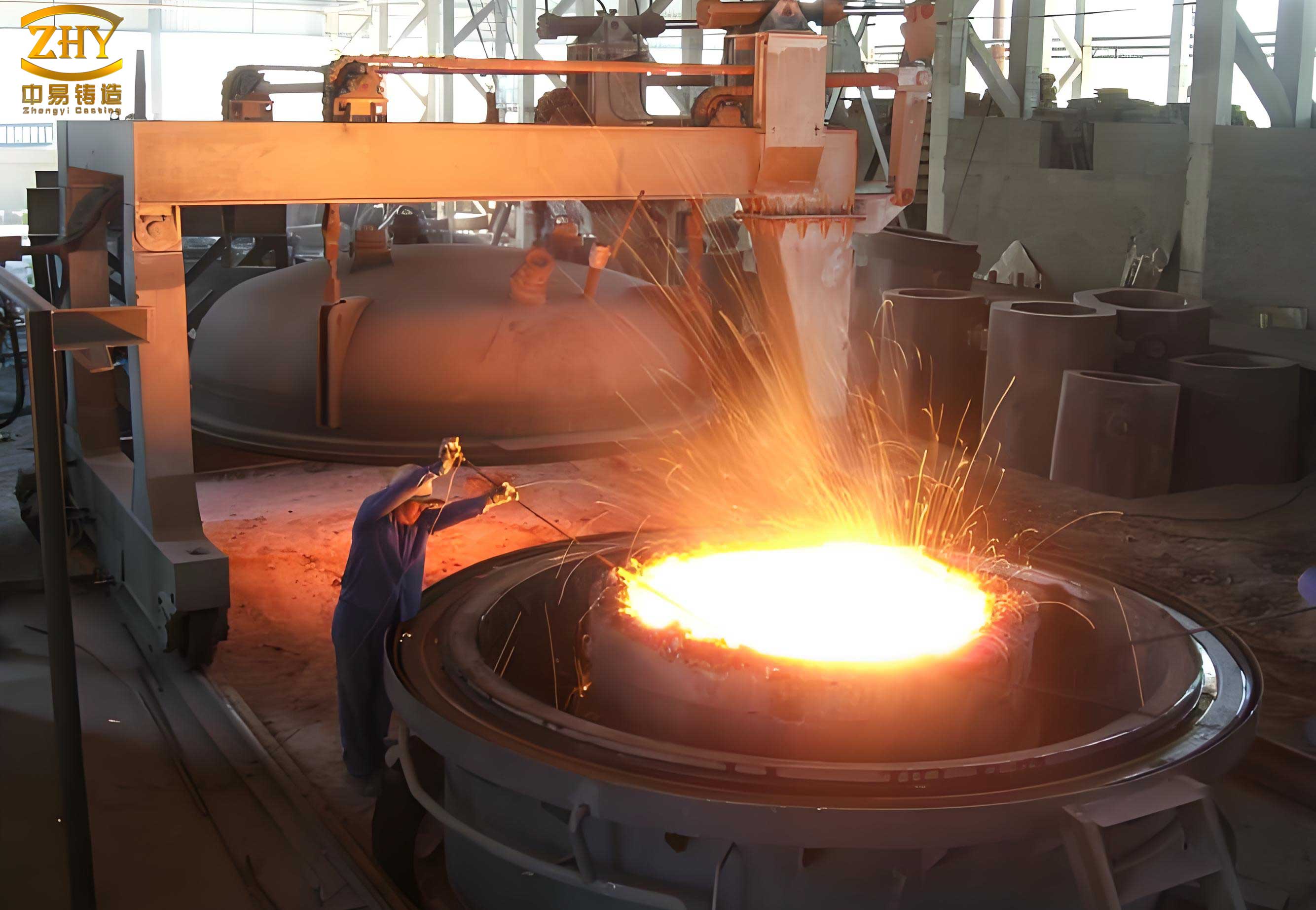
Melting and pouring constitute the dynamic phase where the metallurgical quality is locked in. The charge is melted in a basic arc furnace under a protective slag. Refining and deoxidation are critical. A calcium-silicon-based refining agent, such as the referenced JDJL2, is added at 0.3–0.5% of the metal weight at a temperature around 730°C. This agent aids in deep deoxidation, desulfurization, and modification of non-metallic inclusions, making them globular and less detrimental to toughness—a key consideration for high manganese steel casting. Following refining, a ternary modifier (often containing rare earth elements, calcium, and barium) is introduced for grain refinement. The modification treatment is conducted between 732°C and 740°C with an addition rate of 2.2–3.2%. This treatment is essential for breaking the columnar grain structure and promoting a fine, equiaxed austenitic grain, which enhances both strength and impact toughness. The final liquid metal must be handled with precision. The tapping temperature is strictly controlled between 1485°C and 1500°C. After tapping, the ladle is allowed a minimum of 5 minutes of quiet time for temperature homogenization and inclusion flotation. The target pouring temperature, measured in the ladle, is 1450–1465°C.
The pouring practice itself is a carefully choreographed operation. A bottom-pouring, open gating system with a stopper-rod ladle (nozzle diameter Ø55 mm) is used to ensure a smooth, turbulence-free filling of the mold. Turbulence must be minimized to prevent reoxidation and slag entrainment. The guiding principle is “large stream start, rapid pouring, timely flow reduction, and sufficient follow-up feeding.” The initial pour is done with a full stream to quickly establish a metal cover over the gating system. The mold is filled as rapidly as feasible within the temperature window to maintain the thermal gradient. Just before the mold is full, the flow is reduced to a trickle to minimize momentum that could cause erosion. Finally, the insulating risers are generously topped up (complemented) with hot metal multiple times during their solidification to compensate for pipe shrinkage. The entire pouring sequence for a high manganese steel casting of this size and complexity is a testament to the skill and coordination required in the foundry.
Quality verification is non-negotiable. For the KS60 frog, the primary tool for assessing internal soundness is high-energy X-ray radiography. The specified zones are scanned, and the film is evaluated against reference standards. The initial trial castings, produced using the baseline process, revealed that while surface quality, dimensions, and mechanical properties (tensile strength ~900 MPa, elongation >55%) were excellent, the DEFG weld zones exhibited shrinkage and inclusion levels exceeding the strict A1B1C1 requirement. This triggered a systematic process improvement cycle, which is fundamental to advancing high manganese steel casting techniques. The root cause analysis pointed to insufficient directional solidification and feeding in these bulky end sections. The solution, as previously described, was the integrated use of enhanced chills, exothermic risers, and strategic padding. Furthermore, a 5 mm positive machining allowance was added to the rail base in these areas to provide extra material for cleaning up any minor subsurface defects, ensuring the final machined surface is pristine. These iterative refinements highlight the problem-solving nature of advanced high manganese steel casting.
The thermodynamic and kinetic principles behind defect formation in high manganese steel casting can be further elucidated. Shrinkage porosity occurs when liquid metal补给 is interrupted before the entire cross-section solidifies. The Niyama criterion, often used in casting simulation, relates the temperature gradient (G), solidification rate (R), and the likelihood of microporosity. While a simplified form is: $$ \frac{G}{\sqrt{R}} \geq C $$ where C is a constant for a given alloy. The placement of chills and risers is essentially a practical method of maximizing G and controlling R in critical zones. Similarly, the formation of non-metallic inclusions, another critical defect, depends on factors like deoxidation practice and fluid flow. The efficiency of inclusion removal by flotation can be estimated by Stokes’ law: $$ v = \frac{2 g r^2 (ρ_m – ρ_i)}{9 η} $$ where \( v \) is the rise velocity, \( g \) is gravity, \( r \) is the inclusion radius, \( ρ_m \) and \( ρ_i \) are the densities of metal and inclusion, and \( η \) is the metal viscosity. This underscores why a quiet holding period after refining is vital—it allows larger, harmful inclusions to float out, a critical step for clean high manganese steel casting.
The economic and operational implications of perfecting high manganese steel casting are significant. A railway frog is a critical, high-wear item. A casting with internal defects, even if subsurface, can act as a stress concentrator and lead to premature failure under cyclic impact loading. This not only necessitates costly replacement but also disrupts rail traffic. Therefore, the investment in sophisticated molding techniques, precise metallurgical control, and rigorous non-destructive testing pays dividends in extended service life and reliability. The successful batch production of KS60 frogs for export validates that a robust, science-based approach to high manganese steel casting can consistently meet the most demanding international specifications. The process parameters and lessons learned are applicable to a broad range of heavy-section, high-integrity castings made from this remarkable alloy.
To consolidate the vast array of process parameters involved in a typical high manganese steel casting campaign for a component like the KS60 frog, the following comprehensive table serves as a quick reference guide for foundry engineers and metallurgists.
| Process Stage | Parameter | Specified Range or Value | Remarks |
|---|---|---|---|
| Metallurgy | Carbon (C) | 0.90 – 1.20 wt% | Core specification; Mn/C ≥ 10 is mandatory. |
| Manganese (Mn) | 11.0 – 14.0 wt% | ||
| Refining Agent | 0.3 – 0.5 wt% addition | Added at ~730°C; calcium-silicon type. | |
| Modifier | 2.2 – 3.2 wt% addition | Ternary type; added at 732–740°C. | |
| Mechanical Properties | σ_b ≥ 740 MPa, δ ≥ 35% | Typical results: σ_b=850-970 MPa, δ=55-60%. | |
| Molding & Feeding | Molding Method | Split-pattern, horizontal, tilted pour | Inclination: 550-600 mm. |
| Mold Sand | Resin-bonded sand | For dimensional stability. | |
| Core Sand | Sodium silicate sand | For high strength and penetration resistance. | |
| Primary Feeding | Insulating sleeve risers + open chills | Risers at base, junctions; chills on all top surfaces. | |
| Special Zones (DEFG) | Enhanced Cooling | Thick custom chills on head & sides | Promotes directional solidification. |
| Enhanced Feeding | Exothermic risers + web padding | Ensures liquid feed path to the rail head. | |
| Pouring | Ladle Type | Stopper-rod | Nozzle Ø55 mm for controlled flow. |
| Tapping Temperature | 1485 – 1500°C | Measured in furnace. | |
| Pouring Temperature | 1450 – 1465°C | Measured in ladle after ≥5 min holding. | |
| Pouring Practice | Fast pour with complementing | Large stream start, rapid fill, generous riser topping. | |
| Quality Control | Internal Soundness | High-energy X-ray radiography | A1B1C1 level in weld zones, transitions, throat. |
In conclusion, the art and science of high manganese steel casting reach their zenith in the manufacture of critical railway components. The KS60 frog project exemplifies a holistic approach where theoretical principles of solidification and feeding are translated into practical, robust foundry techniques. Every detail—from the Mn/C ratio calculated during charge make-up to the final radiograph of a weld zone—is interconnected. The consistent production of sound, high-performance castings hinges on unwavering discipline in temperature control, the intelligent application of chills and risers, thorough melt treatment, and a culture of continuous improvement based on quantitative inspection data. As global rail networks demand heavier loads and higher speeds, the role of advanced high manganese steel casting will only grow in importance. The methodologies described here, born from rigorous problem-solving and deep process understanding, provide a reliable blueprint for achieving excellence in this challenging yet rewarding field of metal casting.