
The pursuit of high-performance, corrosion-resistant components in industries such as chemical processing, marine engineering, petroleum extraction, and mining has driven significant demand for titanium alloy castings, particularly complex impellers. Traditionally, the manufacture of these intricate titanium alloy impellers has relied on two primary methods: machining of graphite molds and investment casting (the “lost wax” process). While capable of producing parts with acceptable quality, both traditional approaches suffer from substantial drawbacks, including high tooling costs, extended lead times for mold or pattern die fabrication, and overall elevated production expenses. These economic barriers have historically limited the widespread adoption of titanium alloy impellers in cost-sensitive commercial applications.
In this context, the lost foam casting process emerges as a highly promising alternative. Originally pioneered in the United States in 1958 and subsequently refined in Germany and the US, lost foam casting has matured into a robust manufacturing technology for high-volume production of castings from ferrous and non-ferrous alloys like cast iron, aluminum, and copper. Its application to reactive alloys like titanium, however, has been less documented and presents unique challenges. The core advantages of the lost foam casting process lie in its ability to produce patterns rapidly and at low cost, often via direct machining of foam, while achieving dimensional accuracy and surface finish approaching that of investment casting. This research focuses on the development and implementation of a specialized lost foam casting process tailored for producing complex curved surface titanium alloy impellers, with the ultimate goal of establishing a reliable, low-cost, and rapid production pathway.
Fundamental Principles and Technical Challenges in Titanium Lost Foam Casting
The lost foam casting process for titanium diverges fundamentally from its conventional counterparts for less reactive metals. The process sequence involves: 1) creation of a precise foam pattern, 2) application of a refractory coating (the “shell”) to the pattern, 3) drying and curing of the shell, 4) removal of the foam pattern through thermal decomposition (“burn-out”) within a furnace, leaving a hollow ceramic mold, and 5) pouring molten titanium into the mold under vacuum or inert atmosphere. The successful execution of this lost foam casting process for titanium hinges on overcoming several critical technical hurdles.
Titanium’s high reactivity with oxygen, nitrogen, and hydrogen at elevated temperatures necessitates rigorous environmental control. Any residual carbon from incomplete foam decomposition can lead to severe alpha-case formation (a hard, brittle surface layer), degrading mechanical properties. Therefore, the foam material must exhibit complete, clean pyrolysis with minimal carbonaceous residue. The thermal degradation of the foam is a complex process governed by kinetics and heat transfer. The rate of decomposition can be described by an Arrhenius-type equation:
$$ k = A e^{-E_a / (R T)} $$
where $k$ is the rate constant, $A$ is the pre-exponential factor, $E_a$ is the activation energy for foam decomposition, $R$ is the universal gas constant, and $T$ is the absolute temperature. Selecting a foam with a lower $E_a$ facilitates cleaner removal at lower pre-heat temperatures of the mold.
Furthermore, the sudden evolution of gaseous products during metal pouring creates a transient pressure at the metal-foam interface. To prevent mold wall collapse or metal turbulence, the permeability of the ceramic shell must be precisely engineered. This permeability, $\kappa$, can be related to the pore structure of the stucco and coating layers and is a crucial parameter in the shell design for the lost foam casting process.
Pattern Material Selection and Fabrication for the Lost Foam Casting Process
The pattern is the foundational element of the lost foam casting process. Its quality directly dictates the final casting’s dimensional accuracy and surface quality. For titanium casting, the ideal foam pattern material must meet a stringent set of criteria: excellent machinability to achieve complex geometries, high surface smoothness, complete thermal decomposition with minimal ash content, and good compatibility with refractory coatings.
Several expandable polymer foams are candidates for the lost foam casting process:
| Material | Chemical Name | Key Advantages | Key Disadvantages for Ti | Typical Ash Content |
|---|---|---|---|---|
| EPS | Expandable Polystyrene | Low cost, good machinability, readily available. | Higher carbon residue, can lead to alpha-case. | ~0.02-0.05% |
| PMMA | Polymethylmethacrylate | Cleaner burn-out, lower carbon residue. | More brittle, higher cost than EPS. | <0.01% |
| STMMA | Co-polymer (Styrene-Methylmethacrylate) | Balanced properties: lower residue than EPS, better strength than PMMA. | Higher cost than EPS. | ~0.01-0.03% |
| PU Foam | Polyurethane | High strength, good surface finish. | Decomposition products may be complex, potential for nitrogen pickup. | Varies |
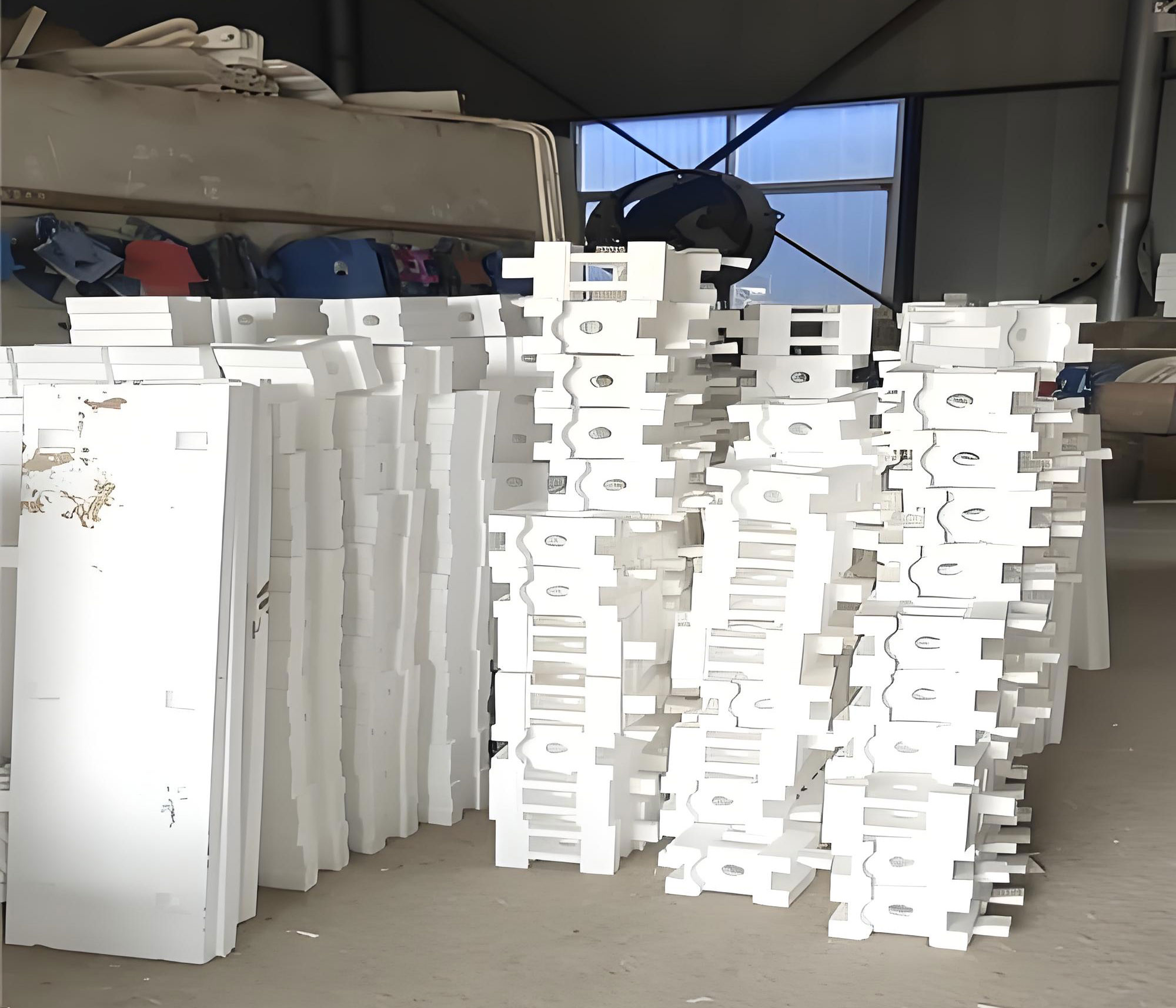
For the complex impeller studied here, machinable EPS blocks were selected as the pattern material due to an optimal balance of cost, machining performance, and achievable pyrolysis cleanliness under controlled conditions. The traditional investment casting route requires expensive metal dies to produce wax patterns. In contrast, the lost foam casting process leverages direct CNC machining of foam blocks. A multi-axis CNC machining center was employed to sculpt the intricate blade profiles and hub geometry directly from a solid EPS block. This method offers exceptional flexibility and speed, as pattern design changes require only software modifications, not hard tooling. The machining tolerance was controlled within ±0.7 mm, comparable to the CT7 grade typical of investment casting.
Post-machining, the foam pattern’s surface was coated with a thin layer of refined wax. This critical step fills minor surface imperfections from machining, dramatically improving the final surface roughness. The wax layer replicates the smoothness of an investment casting wax pattern, enabling the lost foam casting process to achieve surface finishes of Ra = 3.2 µm or better.
Shell System Design and Manufacturing for Reactive Alloys
The ceramic shell in the titanium lost foam casting process serves multiple vital functions: maintaining dimensional stability, resisting metallostatic pressure, allowing gaseous degradation products to escape, and most importantly, acting as a barrier against chemical reaction between molten titanium and the shell material. The shell system is typically a multi-layered structure.
The primary (face coat) layers are in direct contact with the molten metal and must be chemically inert to titanium. Rare-earth oxides like yttria (Y₂O₃) are the gold standard but are costly. This study utilized a cost-optimized face coat strategy: a first prime coat of yttria was applied, followed by a second prime coat based on alumina (Al₂O₃) and zirconia (ZrO₂) fillers. The binder for these prime coats was a zirconium acetate-based solution. The secondary and backup coats provide mechanical strength and are typically based on cheaper refractories like alumino-silicates (e.g., fused silica, mullite) with a colloidal silica binder.
The shell build-up process is a cycle of dipping, stuccoing, and drying. Precise control of parameters at each stage is essential for shell integrity. The table below details an optimized shell-building schedule for the titanium impeller lost foam casting process.
| Layer | Slurry Type | Binder | Slurry Viscosity (Ford Cup, s) | Stucco Material (Mesh) | Drying Temperature (°C) | Drying Relative Humidity (%) | Drying Time (h) | Critical Function |
|---|---|---|---|---|---|---|---|---|
| Face 1 | Yttria Flour | Zirconium Acetate | 20-30 | Yttria Sand (80-120) | 22-24 | 50-70 | 8-10 | Primary reaction barrier |
| Face 2 | Alumina Flour | Zirconium Acetate | 10-15 | Zirconia Sand (40-80) | 22-24 | 50-70 | 8-10 | Secondary barrier, cost reduction |
| Back-up 3-5 | Alumino-Silicate Flour | Colloidal Silica | 8-10 | Mullite Sand (30-60) | 22-24 | 40-50 | 8-10 | Build thickness & strength |
| Back-up 6-7 | Alumino-Silicate Flour | Colloidal Silica | 8-10 | Mullite Sand (20-40) | 22-24 | 40-50 | 8-10 | Final strength and permeability |
| Seal Coat | Colloidal Silica Dip | N/A | N/A | N/A | Ambient | Ambient | 12-24 | Consolidate shell surface |
The total shell thickness achieved was approximately (20 ± 5) mm. After the final drying cycle, the assembly is placed in a furnace for the pattern removal and mold pre-heat stage. The temperature cycle must ensure complete pyrolysis of the EPS and wax without cracking the shell. The final pre-heat temperature is critical for fluidity and feeding during titanium pouring.
Melting, Pouring, and Solidification Dynamics
Titanium for this lost foam casting process was melted using a Vacuum Arc Remelting (VAR) or similar vacuum skull melting furnace. A consumable electrode made from a twice-melted Ti-6Al-4V ingot was used to ensure high purity. The surface was meticulously cleaned to prevent contamination. Melting and pouring parameters are paramount for achieving sound castings.
| Parameter | Value / Range | Influence on Casting Quality |
|---|---|---|
| Electrode Dimensions | Φ200 mm × 1200 mm | Determines melt rate and pool dynamics. |
| Melting Current | 12,000 – 15,000 A | Controls heat input and melting rate. |
| Arc Voltage | 35 – 40 V | Affects arc stability and energy density. |
| Chamber Vacuum | ≤ 10 Pa | Minimizes gas pickup (O, N, H). |
| Melt Pouring Time | ~300 s | Must be synchronized with mold readiness. |
| Centrifugal Rotation Speed | ~200 rpm | Enhances metal feeding, reduces shrinkage in thin sections. |
| Mold Pre-heat Temperature | ~300-500 °C (Estimated) | Reduces thermal shock, improves metal fluidity, aids in complete foam removal. |
Casting was performed under centrifugal force. The centrifugal pressure, $P_c$, aiding feeding is given by:
$$ P_c = \frac{1}{2} \rho \omega^2 (r_{2}^2 – r_{1}^2) $$
where $\rho$ is the density of molten titanium, $\omega$ is the angular velocity, and $r_1$ and $r_2$ are the inner and outer radii of the impeller within the rotating mold. This pressure helps overcome gas back-pressure from foam decomposition and promotes feeding of solidification shrinkage.
Comprehensive Quality Assessment of Lost Foam Cast Impellers
The viability of the lost foam casting process is judged by the quality of the final component. A multi-faceted inspection protocol was implemented.
1. Visual and Dimensional Inspection: After standard knockout, cut-off, and abrasive blasting, castings were visually examined. No major defects like cold shuts, gross mis-runs, or cracks were observed. Surface roughness measurements confirmed values of Ra ≈ 3.2 µm. Dimensional checks against the CAD model validated the accuracy of the process, with most features within the machined pattern’s tolerance band.
2. Chemical Composition: Samples were taken from critical locations on the casting, such as a blade and the shroud. Spectrographic analysis confirmed that the composition met the specification for Ti-6Al-4V, with notably low interstitial element content, demonstrating effective protection from the shell and vacuum environment.
| Element | Specification Target | Blade Sample | Shroud Sample |
|---|---|---|---|
| Aluminum (Al) | 5.5 – 6.75 | 5.90 | 5.80 |
| Vanadium (V) | 3.5 – 4.5 | 4.10 | 4.30 |
| Iron (Fe) | ≤ 0.30 | 0.01 | 0.01 |
| Oxygen (O) | ≤ 0.20 | 0.08 | 0.07 |
| Nitrogen (N) | ≤ 0.05 | 0.035 | 0.030 |
| Carbon (C) | ≤ 0.08 | 0.03 | 0.02 |
| Hydrogen (H) | ≤ 0.015 | 0.0008 | 0.0009 |
| Titanium (Ti) | Balance | Balance | Balance |
3. Non-Destructive Testing (NDT): Radiographic inspection (X-ray) was performed on finished castings. The internal soundness was found to meet stringent aerospace standards (analogous to GJB2896A Class I, Grade B), indicating the absence of significant shrinkage porosity, inclusions, or hot tears. Fluorescent Penetrant Inspection (FPI) further verified the integrity of the surface.
4. Mechanical Properties: Test bars cast simultaneously with the impeller (keel blocks) were subjected to tensile testing. The results, presented below, satisfy the typical minimum requirements for cast Ti-6Al-4V, proving that the lost foam casting process does not introduce detrimental embrittlement.
| Sample ID | Ultimate Tensile Strength, Rm (MPa) | Yield Strength (0.2% Offset), Rp0.2 (MPa) | Elongation, A (%) | Reduction of Area, Z (%) |
|---|---|---|---|---|
| 1 | 900 | 850 | 12 | 18 |
| 2 | 905 | 860 | 14 | 19 |
Process Modeling and Optimization Considerations
To further advance the lost foam casting process for titanium, numerical modeling plays a crucial role. Key phenomena to model include:
Foam Degradation and Gas Pressure: A coupled heat and mass transfer model can predict the rate of foam decomposition and the resulting gas pressure in the pattern-mold cavity, $P_{gas}(t)$. This pressure must be less than the metallostatic plus centrifugal pressure to avoid back-pressure defects:
$$ P_{metal}(t) + P_c > P_{gas}(t) + P_{atm} $$
where $P_{metal}(t) = \rho g h(t)$.
Filling and Solidification: Computational Fluid Dynamics (CFD) simulations can visualize metal front advancement, ensuring complete filling of thin blades. Thermal modeling predicts solidification sequence and identifies potential hot spots for shrinkage porosity, allowing for optimal gating and risering design in the lost foam casting process.
Stress Development: Thermo-mechanical modeling can predict stresses developing in the ceramic shell during pre-heat and cooling, helping to avoid cracking, and in the casting during solidification, to assess hot tear risk.
Conclusion and Future Outlook
The research successfully demonstrates that a well-engineered lost foam casting process is a viable and highly competitive method for manufacturing complex curved surface titanium alloy impellers. By integrating direct CNC machining of low-cost EPS patterns, a tailored ceramic shell system, and controlled vacuum melting/centrifugal pouring, the process achieves castings with chemical, mechanical, and integrity properties meeting high technical specifications. The significant advantages are clear: drastic reduction in lead time and cost associated with hard tooling, dimensional accuracy and surface finish comparable to investment casting, and the flexibility for rapid prototyping or low-to-medium volume production.
The future development of the titanium lost foam casting process will focus on several frontiers: 1) Development of even cleaner-burning, high-strength pattern materials, 2) Optimization of shell compositions for enhanced permeability and refractoriness at lower cost, 3) Advanced process control and real-time monitoring of mold pre-heat and pouring parameters, and 4) Integration of additive manufacturing (3D printing) for direct creation of ultra-complex foam patterns without machining limitations. As these advancements mature, the lost foam casting process is poised to become a mainstream manufacturing solution, breaking down cost barriers and enabling the wider adoption of high-performance titanium castings across civilian industrial sectors.