
In my extensive work within the internal combustion engine industry, I have dedicated considerable effort to optimizing the manufacturing processes for critical components such as valves and cylinder liners. The performance, longevity, and efficiency of an engine are profoundly influenced by the surface integrity of its parts and the quality of their cast structures. Through firsthand experimentation and process refinement, I have observed that techniques like precision roller burnishing for valve sealing surfaces and controlled casting for boron iron cylinder liners offer significant advantages. However, these processes also present challenges, particularly in avoiding metal casting defects that can compromise component reliability. This article elaborates on these methodologies, integrating empirical data, theoretical models, and practical solutions to foster a deeper understanding of advanced engine component manufacturing.
The valve, a crucial component controlling the flow of air and fuel, relies heavily on the quality of its conical sealing surface. Traditional finishing methods like grinding often struggle to achieve the desired surface characteristics economically. In my practice, I have implemented precision roller burnishing as a superior alternative. This cold-working process involves pressing a hardened roller against the machined surface under controlled force, inducing plastic deformation. The benefits are multifaceted: surface roughness is reduced, hardness is increased, and favorable residual compressive stresses are imparted. Specifically, after burnishing, the surface roughness (often quantified as Ra) typically decreases by 1 to 2 grades. The surface hardness, measured on the Vickers or Rockwell scale, increases by 5-10%. Most importantly, the subsurface layer enters a state of residual compressive stress, whereas conventional turning or grinding often leaves detrimental tensile stresses. This stress state is critical for enhancing fatigue life and resistance to wear and spalling.
To quantify the improvements, consider the following relationship between surface parameters and fatigue life. The fatigue strength enhancement can be approximated by considering the combined effect of hardness increase and residual stress. A simplified model for the improvement factor (IF) in fatigue limit might be expressed as:
$$ IF = \left( \frac{H_{after}}{H_{before}} \right)^\alpha \cdot \exp\left(-\beta \cdot \frac{\sigma_{res}}{\sigma_y}\right) $$
Here, \( H_{after} \) and \( H_{before} \) are the hardness values post- and pre-burnishing, \( \sigma_{res} \) is the induced residual stress (negative for compression), \( \sigma_y \) is the material’s yield strength, and \( \alpha \), \( \beta \) are material-specific constants typically ranging from 0.1 to 0.3. The residual compressive stress effectively suppresses crack initiation and propagation. In my comparative tests on diesel engines, the application of roller burnishing to valve seats resulted in a service life extension of approximately 20-50%. This is not solely due to the valve’s improvement; the counterpart valve seat insert’s material and processing must also be optimized. Nevertheless, the valve’s enhanced surface integrity is a primary contributor.
The process economics are equally compelling. Grinding requires significant investment in abrasive wheels, diamond tools, precision machinery, and skilled labor. In contrast, roller burnishing can be performed on a standard lathe or simple dedicated machine. The burnishing tool is mechanically simple, durable, and cost-effective. The rollers have a long service life and can be reground after wear. When automated feeding mechanisms are integrated, the machine can operate unattended, dramatically reducing per-part cost. The table below summarizes a comparative analysis between grinding and precision roller burnishing for valve cone finishing.
| Parameter | Grinding Process | Precision Roller Burnishing | Remarks |
|---|---|---|---|
| Typical Surface Roughness (Ra) | 0.4 – 0.8 µm | 0.1 – 0.2 µm | Burnishing reduces Ra by 1-2 grades. |
| Surface Hardness Increase | Minimal or none | 5-10% (e.g., 50-100 HV) | Due to work hardening. |
| Residual Stress State | Often tensile | Compressive | Key for fatigue resistance. |
| Process Equipment Cost | High (precision grinder, diamonds) | Low (lathe, simple tool) | Burnishing tool is inexpensive. |
| Tooling Consumable Cost | High (grinding wheels) | Very Low (roller lasts for 10k+ parts) | Rollers are durable and regrindable. |
| Automation Potential | Moderate | High (easy auto-load/unload) | Leads to lower labor cost. |
| Environmental Impact | High (swarf, coolant) | Low (dry or minimal lubricant) | Burnishing is cleaner. |
The success of roller burnishing depends on optimal parameters. The force \( F \) applied by the roller, the feed rate \( f \), and the number of passes \( n \) are critical. An empirical formula for the resulting surface roughness \( R_a \) can be proposed based on my observations:
$$ R_a = R_{a0} \cdot \exp(-k_1 \cdot F \cdot n) + k_2 \cdot f $$
Where \( R_{a0} \) is the initial roughness post-turning, and \( k_1 \), \( k_2 \) are constants derived from material-tool interaction. Similarly, the induced compressive stress \( \sigma_c \) at a depth \( z \) can be modeled as:
$$ \sigma_c(z) = \sigma_{c,max} \cdot \exp\left(-\frac{z}{\delta}\right) $$
Here, \( \sigma_{c,max} \) is the peak compressive stress at the surface, and \( \delta \) is the penetration depth characteristic, which is a function of force and material properties. Optimizing these parameters is essential to maximize benefits while avoiding over-hardening or surface damage.
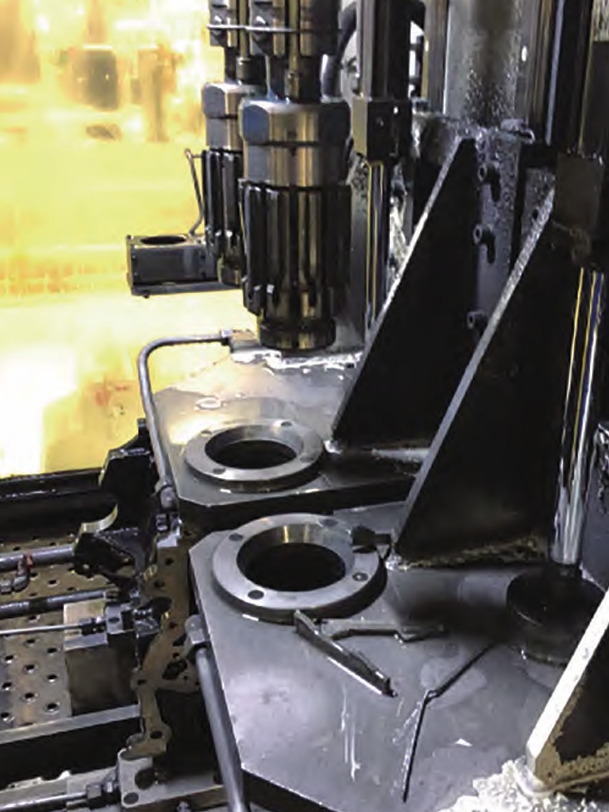
Shifting focus to cylinder liners, the casting of boron iron presents a distinct set of challenges. The pursuit of enhanced wear resistance through boron addition inadvertently increases the susceptibility to specific metal casting defects. In centrifugal casting of cylinder liners using metal molds with thick coatings, the predominant issues are the formation of chilled white iron (carbidic structures) on the outer surface and shrinkage porosity or pinholes on the inner bore. These metal casting defects are detrimental to machinability and pressure integrity.
Boron, even in trace amounts (typically 0.02-0.1%), profoundly alters solidification behavior. It is a strong carbide stabilizer, promoting the formation of hard phases like boron carbides (Fe23(B,C)6 or Fe3(B,C)) and boron-phosphorus complexes. While these hard phases are desirable for wear resistance as they form the primary sliding surface, their macroscopic segregation leads to the dreaded metal casting defect known as “chill” or “mottled” structure—a mixture of hard carbides and pearlite that is extremely difficult to machine. The mechanism is rooted in solidification thermodynamics. Boron lowers both the primary austenite formation temperature and the eutectic temperature, reducing the temperature range for dendritic growth and promoting a more pasty, mushy zone solidification. This volumetric solidification mode severely hinders interdendritic feeding, creating a predisposition for shrinkage porosity, another critical metal casting defect.
The solidification sequence can be described mathematically. The growth velocity of the solidification front \( v \) is governed by the thermal gradient \( G \) and the cooling rate \( \dot{T} \):
$$ v = \frac{\dot{T}}{G} $$
For a cylindrical casting like a liner, the solidification time \( t_s \) from the outer wall (mold side) to the inner bore can be estimated using Chvorinov’s rule modified for centrifugal conditions:
$$ t_s = B \cdot \left( \frac{V}{A} \right)^2 $$
Where \( B \) is the mold constant, \( V \) is the volume of the casting, and \( A \) is the surface area through which heat is extracted. The presence of boron increases the mold constant \( B \) by reducing the thermal conductivity of the solidifying shell and widening the mushy zone. The fraction of solid \( f_s \) as a function of temperature \( T \) in the eutectic range can be modeled using the Scheil-Gulliver equation for a binary Fe-C-B system approximation:
$$ f_s = 1 – \left( \frac{T_f – T}{T_f – T_l} \right)^{\frac{1}{1-k_0}} $$
Here, \( T_f \) is the fusion temperature of pure iron, \( T_l \) is the liquidus temperature, and \( k_0 \) is the partition coefficient for boron between solid and liquid, which is less than 1, leading to microsegregation. This segregation, combined with the pasty solidification, is a direct cause of metal casting defect formation, particularly inner bore porosity.
To combat these metal casting defects, a multi-pronged strategy is essential. The first line of defense is inoculation or孕育处理. Adding a inoculant such as FeSi75 (75% Ferrosilicon) just before pouring promotes graphite nucleation. This action helps to counteract the chilling tendency, break up the continuous carbide network, and refine the distribution of both graphite and hard boron phases. The effectiveness of inoculation decays with time due to fading, so late or stream inoculation is preferred. The number of eutectic cells \( N \) per unit area increases with inoculant addition, which can be expressed as:
$$ N = N_0 + k_i \cdot C_{Si} \cdot \exp(-t/\tau) $$
Where \( N_0 \) is the base count, \( C_{Si} \) is the effective silicon addition from inoculant, \( t \) is the holding time after inoculation, and \( \tau \) is the fading time constant. A higher \( N \) leads to finer microstructure and reduced metal casting defect severity.
Secondly, strict control over melting and pouring practices is paramount. Chemical composition must be stabilized with a slightly hypoeutectic carbon equivalent (CE) to favor graphite formation. Overheating the iron melt should be avoided as it dissolves potential nuclei. The pouring temperature \( T_p \) and mold temperature \( T_m \) are critical interactive parameters. My experiments show that the thickness of the chill layer \( d_{chill} \) on the outer surface follows an inverse relationship with these temperatures:
$$ d_{chill} \propto \frac{1}{(T_p – T_{eutectic}) \cdot (T_m – T_{ambient})} $$
Therefore, to minimize this metal casting defect, I recommend a pouring temperature in the range of 1350-1400°C and a mold preheat temperature of 150-250°C. Furthermore, a faster pouring rate helps establish a steeper thermal gradient, promoting directional solidification from the outer wall inward.
Thirdly, managing solidification through mold design and cooling is vital. A thick-walled metal mold with high thermal mass helps maintain a steep temperature gradient. Delaying the spray water cooling on the mold exterior allows the inner bore to remain liquid longer, facilitating feed metal movement to compensate for shrinkage. The balance is delicate; too slow cooling might promote coarse graphite, while too rapid cooling exacerbates chilling. The table below outlines common metal casting defects in boron iron cylinder liners, their causes, and preventive measures.
| Metal Casting Defect Type | Primary Manifestation | Root Causes | Key Preventive Measures |
|---|---|---|---|
| Chilled White Iron (Surface Chill) | Hard, unmachinable layer on outer diameter. A severe metal casting defect. | Excessive boron content, low CE, low pouring/mold temp, rapid surface cooling. | Inoculation, increase pouring temp (1350-1400°C), control mold temp (150-250°C), adjust coating thickness. |
| Mottled Structure (Macro-carbides) | Mixed hard/soft areas, poor machinability. A common metal casting defect. | Insufficient inoculation, boron segregation, inappropriate cooling. | Effective late inoculation, ensure uniform melt chemistry, optimize cooling rate. |
| Shrinkage Porosity/Pinholes (Inner Bore) | Microscopic or macroscopic voids on inner surface. A critical metal casting defect. | Pasty solidification, low thermal gradient, insufficient feeding pressure. | Increase thermal gradient (higher Tp, thick mold), use slight hypo-eutectic composition, control rotational speed for effective feeding. |
| Micro-shrinkage (Sponginess) | Diffuse micro-porosity throughout wall. A subtle metal casting defect. | Wide mushy zone due to boron, low feeding efficiency. | Enhance nucleation (inoculation), increase cooling rate via mold design, adjust boron level. |
| Segregation Banding | Alternating hard/soft layers radially. A metal casting defect from centrifugal process. | High rotational speed, specific gravity differences between phases. | Optimize rotational speed (G-factor), ensure stable pouring conditions. |
The interaction between process parameters can be analyzed using a quality function. Let \( Q \) represent the overall quality (inverse of metal casting defect severity), which we aim to maximize. A simplified multi-variable model could be:
$$ Q = K \cdot \frac{(T_p – T_{min}) \cdot (CE – CE_{min}) \cdot I_{eff} \cdot G^{1/2}}{(B_{content}) \cdot (t_{hold}) \cdot (\omega / \omega_{opt})} $$
Where \( K \) is a constant, \( T_{min} \) and \( CE_{min} \) are threshold values, \( I_{eff} \) is inoculation effectiveness factor, \( G \) is the average thermal gradient, \( B_{content} \) is the boron percentage, \( t_{hold} \) is melt holding time after treatment, \( \omega \) is rotational speed, and \( \omega_{opt} \) is the optimal speed for impurity separation without severe segregation. This equation underscores the complex trade-offs involved in suppressing metal casting defects.
In conclusion, the advanced manufacturing of engine components like valves and cylinder liners requires a synergistic approach combining innovative finishing techniques and meticulous control over casting metallurgy. Precision roller burnishing for valve seats delivers superior surface integrity, enhancing performance and longevity while reducing costs. For cylinder liners, the addition of boron for wear resistance introduces significant challenges in the form of metal casting defects, primarily chilling and porosity. Through systematic application of inoculation, controlled thermal management, and optimized process parameters, these metal casting defects can be effectively mitigated. Both avenues—finishing and casting—demonstrate that a deep understanding of material science and process mechanics is indispensable for advancing engine technology. The continuous pursuit of such knowledge is what drives reliability and efficiency in the demanding world of internal combustion engines.