
In the field of modern manufacturing, particularly for defense and aerospace applications, the demand for lightweight, high-strength, and corrosion-resistant components has driven significant innovation in casting technologies. Among these, sand casting remains a cornerstone due to its versatility, cost-effectiveness, and suitability for both small and large production runs. As an engineer specializing in foundry processes, I have been involved in the design and validation of sand casting processes for intricate parts, such as skeletal structures used in weapon systems. This article details our comprehensive approach to the sand casting process design and production verification for a complex heterogeneous skeleton component, emphasizing the critical role of sand casting products in achieving stringent technical requirements. Throughout this discussion, we will explore various aspects of the process, leveraging tables and formulas to summarize key data, and repeatedly highlight the importance of sand casting products in industrial applications.
The component in question, referred to as a heterogeneous skeleton, is fabricated from ZL104 aluminum alloy, a material chosen for its excellent castability, mechanical properties, and machinability. ZL104 is a silicon-magnesium-manganese alloy that responds well to heat treatment, making it ideal for applications requiring enhanced strength and hardness. In this project, the skeleton is classified as a Class II aluminum casting, necessitating T6 heat treatment (solution heat treatment followed by artificial aging) to meet performance standards. The technical specifications for sand casting products like this are rigorous, as outlined in national standards, and we ensured compliance through meticulous process control.
To begin, let us examine the structural characteristics and technical requirements of the heterogeneous skeleton. The casting has a rough weight of approximately 58 kg, with overall dimensions of 1150 mm × 660 mm × 300 mm. Its design features a symmetrical layout with numerous reinforcing ribs, thin-walled sections (11 mm nominal thickness), and localized thicker regions (18 mm). Such complexity, including internal cavities and angular profiles, poses challenges for mold making, metal filling, and defect prevention. Common issues in sand casting products of this nature include shrinkage porosity, cold shuts, and distortion, which must be addressed through optimal gating and feeding systems. The chemical composition and mechanical property requirements are specified in Tables 1 and 2, respectively, serving as benchmarks for our process design.
| Element | Specified Range |
|---|---|
| Silicon (Si) | 8.0 – 10.5% |
| Magnesium (Mg) | 0.17 – 0.35% |
| Manganese (Mn) | 0.2 – 0.5% |
| Iron (Fe) – Impurity | ≤ 0.6% |
| Property | Minimum Value |
|---|---|
| Tensile Strength | 225 MPa |
| Elongation | 2% |
| Brinell Hardness (HB) | 70 |
Given the intricate geometry, we adopted a manual sand molding approach using furan resin sand as the molding medium. This choice was motivated by the need for high dimensional accuracy and ease of core assembly, which are essential for producing quality sand casting products. The mold was coated with alcohol-based paint and flame-dried to enhance surface finish and reduce gas evolution during pouring. To address potential distortion, we incorporated process ribs on the side faces of the casting. These ribs, as shown in later discussions, served dual purposes: they prevented angular deformation during pouring, shakeout, and heat treatment, and they facilitated metal flow between the arms of the skeleton. Additionally, they acted as machining fixtures, later removed after final processing. This anti-distortion design is a critical consideration in the manufacture of large, thin-walled sand casting products.
The core system was designed to manage the internal complexity of the heterogeneous skeleton. Instead of a monolithic core, we employed a combination of multiple cores categorized into three types: central cores (forming the main external shape), gating system cores (housing the runners and gates), and skin cores (surrounding the central cores to create the outer shell). This modular approach allowed for precise positioning through interlocking features, ensuring dimensional consistency across multiple castings. The core assembly was secured within a flask using green sand, preventing core shift or fracture under metal pressure. Such core design strategies are vital for achieving intricate internal features in sand casting products, reducing defects like misruns or inclusions.
For the gating system, we positioned the casting horizontally and implemented a two-side slot gating method. This design promotes bottom-up filling, minimizing turbulence and facilitating slag removal and gas venting. The gating ratio was carefully calculated to ensure a semi-closed system, reducing the risk of inclusions. The cross-sectional area relationship is expressed as:
$$ \sum F_{\text{sprue}} : \sum F_{\text{runner}} : \sum F_{\text{ingate}} = 1 : 4.7 : 1.7 $$
where $\sum F_{\text{sprue}}$ is the total sprue area, $\sum F_{\text{runner}}$ is the total runner area, and $\sum F_{\text{ingate}}$ is the total ingate area. The slot gates were cylindrical with a diameter of 35 mm, matching the wall thickness. The runner had a trapezoidal cross-section with a total area of 26.5 cm², and filter screens were placed at junctions to dampen turbulence and capture dross. This gating configuration is particularly effective for thin-walled sand casting products, as it ensures smooth metal flow and reduces defect formation.
The feeding system was designed based on the hot-spot circle method to prevent shrinkage defects. We placed 13 open risers at thermal junctions on the top of the casting, with riser diameters determined by:
$$ D_{\text{riser}} = 1.2 \times D_{\text{hot-spot}} $$
where $D_{\text{hot-spot}}$ is the diameter of the hot-spot circle calculated from the geometry. Chills made of the same alloy were positioned at thick sections and bottom regions to promote directional solidification from bottom to top, enhancing riser efficiency. This combination of risers and chills is a proven technique for soundness in sand casting products, especially those with varying wall thicknesses.
To validate the process, we conducted production trials with one casting per mold. The molding process began with applying a release agent to the wooden patterns (made of red pine with a shrinkage allowance of 1.2% and machining allowances of 5 mm). After core assembly and mold closing, we proceeded to melting and pouring. The melting was performed in a medium-frequency induction furnace, with the aluminum heated to 710°C before transferring to a resistance holding furnace. Key melting parameters are summarized in Table 3, illustrating the meticulous control required for high-integrity sand casting products.
| Process Step | Temperature Range | Time/Duration |
|---|---|---|
| Melting | Up to 710°C | As required |
| Holding and Mg Addition | 680 – 700°C | Until Mg dissolves |
| Refining | 710 – 735°C | 15 minutes |
| Degassing | After refining | 15 minutes |
| Modification | 720 – 730°C | 40 minutes holding |
| Pouring | 690 – 700°C | 18 – 20 seconds per mold |
Refining involved adding 0.15–0.2% of a dry refining flux to remove gases and non-metallic inclusions. After skimming, we performed secondary degassing using a rotary degasser for 15 minutes without additional flux. Modification was carried out with 0.2–0.6% aluminum-strontium master alloy to refine the eutectic silicon structure, improving mechanical properties and fluidity. The modification effectiveness was assessed by observing the melt surface (bright and mirror-like) and fracture appearance of test bars (silvery white and fine-grained). These steps are crucial for ensuring the metallurgical quality of sand casting products, as they directly impact strength and ductility.
Following pouring, the castings were allowed to cool for 8 hours before shakeout and cleaning. Heat treatment was then applied to achieve the T6 condition. The quenching process used a drop-bottom furnace with a solution treatment at (535 ± 5)°C for 6 hours, followed by rapid cooling in 60°C hot water. After quenching, the castings were straightened and measured for dimensional accuracy. Artificial aging was conducted at (175 ± 5)°C for 10 hours in a bench-type aging furnace, with air cooling afterward. The heat treatment cycle is encapsulated in the formula for total processing time $T_{\text{total}}$:
$$ T_{\text{total}} = T_{\text{solution}} + T_{\text{aging}} = 6 \, \text{hours} + 10 \, \text{hours} $$
with temperature controls as specified. This treatment enhances the tensile strength and hardness of sand casting products, making them suitable for demanding applications.
After heat treatment, we conducted thorough inspections on the castings. Visual examination revealed no cracks, shrinkage cavities, cold shuts, or other surface defects. Minor flash at parting lines was easily removed by grinding. The internal quality was assessed through non-destructive testing, confirming soundness. Chemical composition and mechanical properties were evaluated using spectrometric analysis and tensile testing on separately cast test bars. The results, presented in Tables 4 and 5, demonstrate full compliance with requirements, underscoring the success of our sand casting process for complex components.
| Element | Measured Value |
|---|---|
| Silicon (Si) | 9.85% |
| Magnesium (Mg) | 0.26% |
| Manganese (Mn) | 0.27% |
| Iron (Fe) | 0.15% |
| Property | Measured Value |
|---|---|
| Tensile Strength | 288 MPa |
| Elongation | 3.2% |
| Brinell Hardness (HB) | 98.5 |
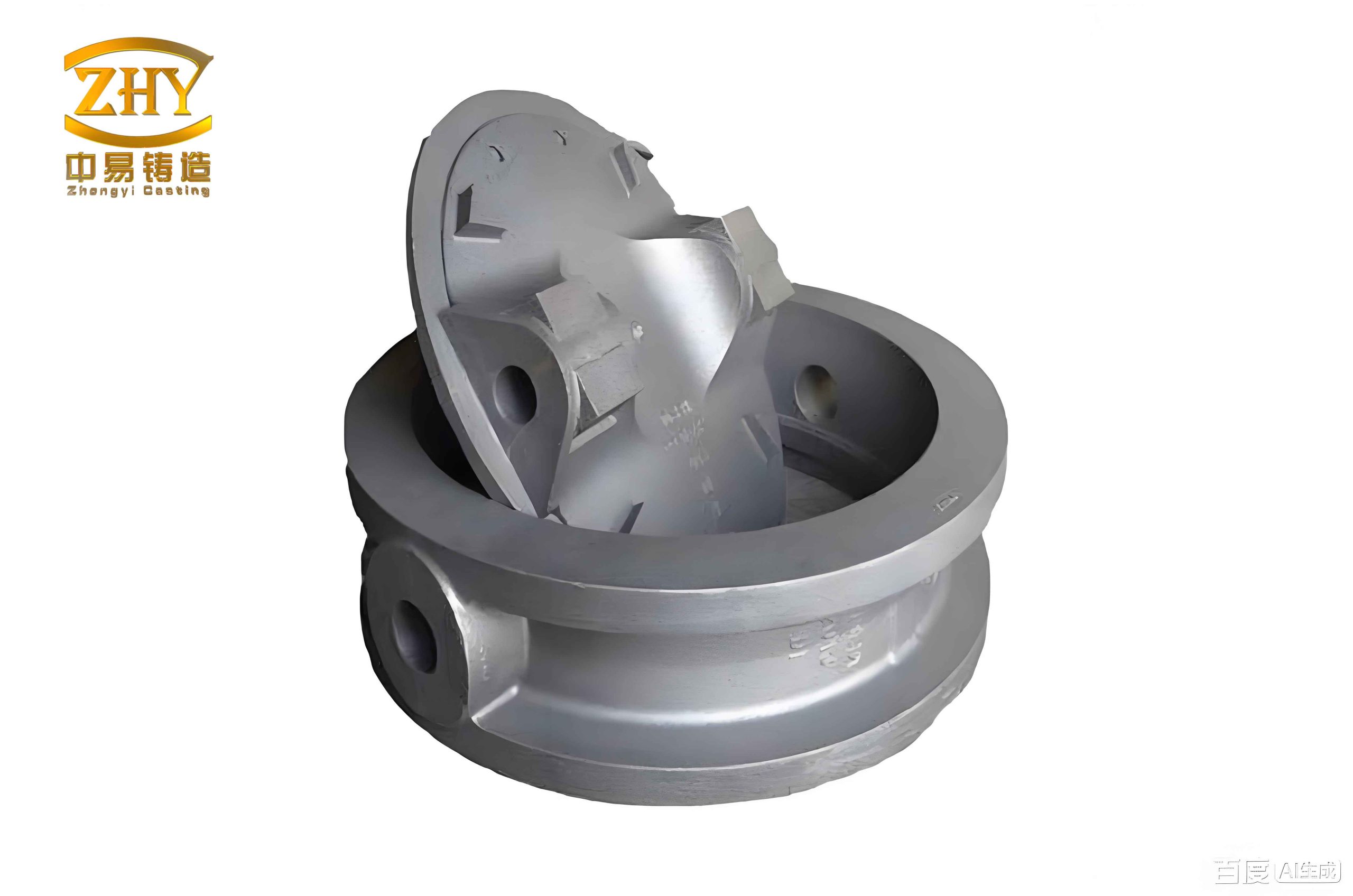
The dimensional accuracy of the machined castings was verified through coordinate measuring machines, meeting all tolerances. Customer joint acceptance confirmed the suitability of these sand casting products for integration into weapon systems. To illustrate the final outcome, below is an image of the produced heterogeneous skeleton casting, showcasing its intricate geometry and surface quality. This visual representation highlights the capabilities of sand casting in manufacturing complex parts.
In conclusion, the sand casting process designed for the heterogeneous skeleton proved highly effective, yielding defect-free components that satisfy all technical criteria. The use of slot gating ensured stable filling and reduced turbulence, while the modular core system facilitated precise mold assembly. The integration of risers and chills enabled effective feeding, minimizing shrinkage defects. Throughout this project, we emphasized the importance of process optimization for sand casting products, particularly those with complex geometries and high-performance demands. The successful production validation underscores the viability of sand casting for advanced applications, and the methodologies discussed here can be extended to other intricate components. As industries continue to seek lightweight and durable solutions, sand casting products will remain integral, driven by continuous improvements in design and process control. Future work may focus on simulating fluid flow and solidification to further refine gating and feeding designs, enhancing the efficiency and quality of sand casting products across various sectors.
From a broader perspective, the economic and technical advantages of sand casting make it indispensable for producing large, complex parts in low to medium volumes. The flexibility in mold materials, such as furan resin sand, allows for rapid prototyping and adjustments. Moreover, the ability to incorporate chills and risers tailored to specific geometries enables the production of sound sand casting products with minimal material waste. In our experience, the key to success lies in a holistic approach that combines empirical knowledge with computational tools, ensuring that every aspect—from melting to heat treatment—is meticulously planned and executed. As we advance, the integration of Industry 4.0 technologies, like real-time monitoring and data analytics, will further elevate the consistency and performance of sand casting products, solidifying their role in modern manufacturing landscapes.