
The pursuit of lightweight, high-performance materials in modern engineering has brought magnesium alloys to the forefront of manufacturing for both defense and civilian applications. My experience in foundry engineering has consistently revolved around harnessing the remarkable properties of magnesium: its low density, high specific strength and stiffness, excellent dimensional stability, superior thermal conductivity, damping capacity, electromagnetic shielding, and recyclability. However, the widespread adoption of sand castings in magnesium is significantly hampered by the metal’s inherent characteristics. Its hexagonal close-packed (HCP) crystal structure offers limited slip systems at room temperature, resulting in low formability. Furthermore, its extreme chemical reactivity with oxygen and nitrogen, coupled with a relatively narrow freezing range for many alloys, leads to poor fluidity and challenging casting performance. These factors traditionally restrict the complexity and minimum wall thickness achievable in magnesium sand castings.
This article details my first-hand investigation and development of a robust sand casting process specifically for a complex, thin-walled magnesium alloy component. The focus is a comparative analysis of different gating and feeding system designs, ultimately leading to the establishment of a practical and reliable foundry practice that minimizes defects and ensures high-quality production.
Casting Requirements and Analysis
The subject component is a cylindrical housing, representing a significant challenge for conventional magnesium casting. The key specifications and challenges are as follows:
- Geometry: A cylindrical筒体 structure with a maximum outer diameter of 480 mm, a length of 600 mm, and an inner diameter of 414 mm.
- Wall Thickness: An average wall thickness of 4 mm, with the thinnest sections measuring only 3 mm, classifying it firmly as a complex thin-walled casting.
- Material: A proprietary modified magnesium casting alloy, based on a national standard composition but with tailored additions and adjustments of alloying elements to enhance castability and final properties.
- Technical Requirements: High dimensional accuracy on the outer surface, internally sound and homogeneous microstructure, and freedom from critical defects such as sand inclusion, gas porosity, shrinkage cavities, shrinkage porosity, and hot tears.
The combination of thin walls, the inherent poor fluidity of magnesium, and its high propensity for oxidation and shrinkage defects made this a non-trivial foundry problem. A standard sand casting approach was deemed insufficient; a meticulously engineered process was required.
Foundry Process Design Philosophy
The foundational process design was built upon several pillars critical for magnesium sand castings. A three-part flask (cope, drag, and intermediate section) with a single core was employed to facilitate molding of the cylindrical shape. The core was made from a synthetic oil sand mixture (comprising sulfur, sodium fluoride, glycerol, and new sand), while the molding sand was a compounded mix of bentonite, boric acid, sulfur, halides, glycerol, and a blend of new and reclaimed sand. Cores were dried using resistance-type ovens.
The gating system was designed as a bottom-fed, choked-pouring basin/runner transitioning to an open system. This design promotes a calm, non-turbulent fill of the mold cavity, which is paramount for minimizing oxide film entrainment and gas pickup in reactive magnesium alloys. The governing principle for flow rate can be related to the Bernoulli equation, simplified for a frictionless system at the choke point:
$$ v = \sqrt{2gh} $$
where \( v \) is the metal velocity at the choke, \( g \) is acceleration due to gravity, and \( h \) is the effective metallostatic head. By controlling the choke cross-sectional area \(A_{choke}\), the initial flow rate \(Q\) is managed:
$$ Q = A_{choke} \cdot v $$
This controlled initial flow prevents splashing and agitation during the critical early stage of mold filling.
However, gating alone cannot address the severe feeding challenges posed by thin-walled magnesium sand castings. The low fluidity and significant solidification shrinkage often lead to macro- and micro-porosity. To achieve directional solidification towards effective feeders (risers), a Vertical Slit Feeding System was integrated. This system consists of vertical channels (slits) connected to the casting at various heights, linked to a central down-sprue/feeder of larger cross-section. The slits solidify last, creating a continuous pressure gradient from the riser through the slit and into the casting section, promoting interdendritic feeding over long distances. The thermal gradient \(G\) and solidification rate \(R\) are key parameters influenced by this design. The goal is to maximize the \(G/R\) ratio in the casting to promote planar or columnar growth and minimize pasty zones prone to shrinkage porosity. The local solidification time \(t_f\) for a section of thickness \(d\) is approximated by Chvorinov’s Rule:
$$ t_f = B \left( \frac{V}{A} \right)^n $$
where \(B\) and \(n\) are constants dependent on the mold material and metal properties, and \(V/A\) is the volume-to-surface-area ratio (modulus). The slit system effectively increases the feeding distance by modifying the thermal modulus of the casting edges.
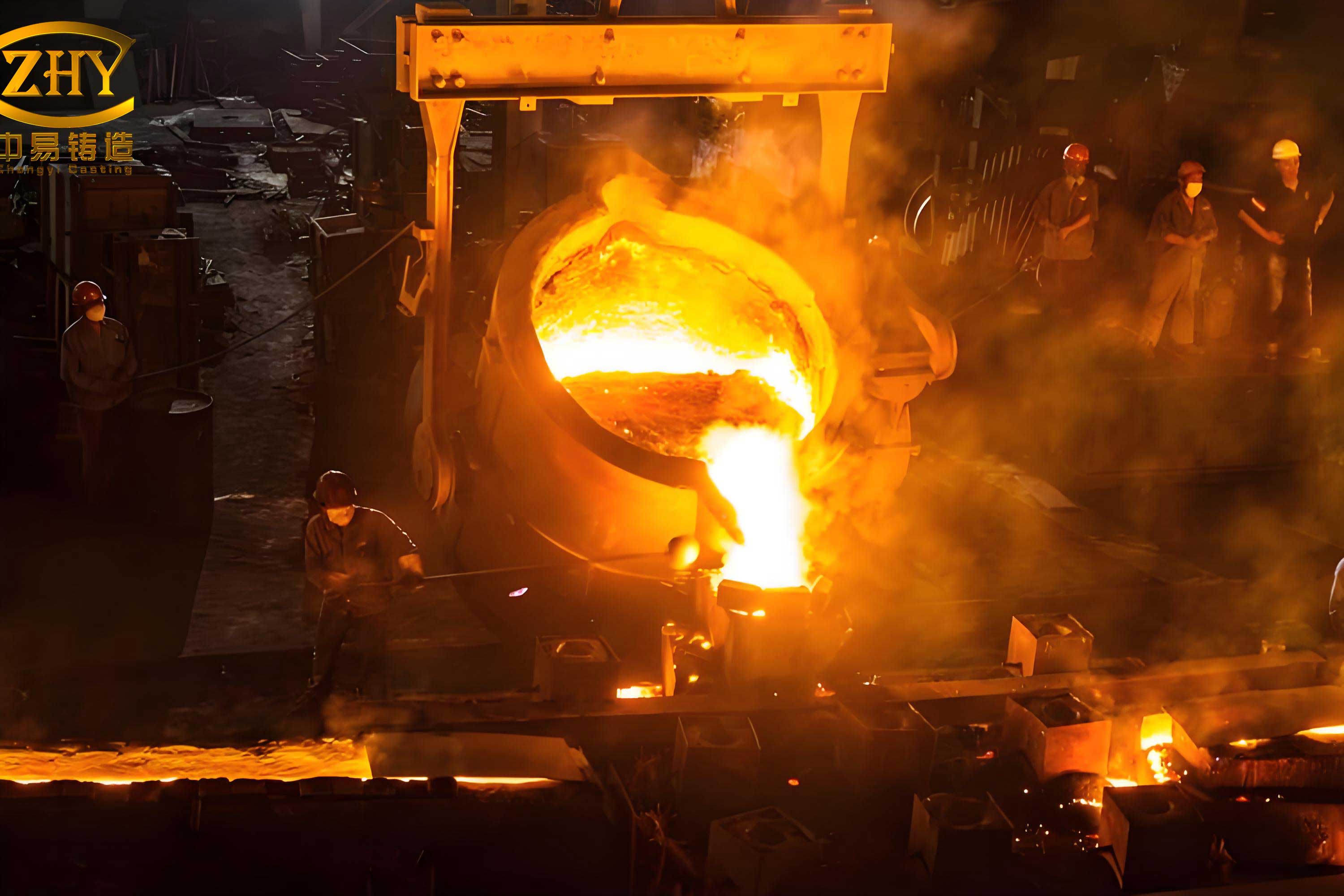
Melting and pouring protection are non-negotiable for magnesium. Melting was conducted in an induction furnace under a cover flux of anhydrous halide salts. During pouring, a protective stream of a mixture containing boric acid and sulfur compounds was maintained over the metal stream to suppress burning.
Comparative Analysis of Two Feeding Strategies
The core of my investigation was comparing two distinct placements for the critical vertical slit feeding system.
Initial Design: Internal Slit System
The first design positioned the vertical slit feeding system inside the cylindrical casting cavity, attached to the core. Metal flowed from the downsprue, through ingates into the base of the casting, and then upward, with the internal slits and top risers intended to provide feeding. The hypothesized advantages were internalized feeding, potential for slag trapping inside the core assembly, and reduced direct impingement on the outer mold walls.
Optimized Design: External Slit System with Chills
The revised design relocated the vertical slit system to the exterior of the cylindrical wall. Additionally, chills (metal inserts with high thermal conductivity) were placed at strategic thermal centers (hot spots) on the mold face to locally increase the solidification rate. The gating and risering remained conceptually similar but were adapted to the external configuration.
The following table summarizes the theoretical and practical outcomes of this critical design change, based on my direct observation and analysis of multiple castings produced with each method.
| Aspect | Internal Slit System (Initial Design) | External Slit System with Chills (Optimized Design) |
|---|---|---|
| Core/Mold Complexity | High. Complex core assembly required to incorporate slits, increasing cost and risk of core shift or failure. | Lower. Standard core; slits are part of the mold cavity, simplifying core making and improving dimensional control. |
| Metal Flow & Fill Stability | Potentially turbulent near the core. Metal can jet into the narrow cavity between the core and slit, causing splash and oxide entrainment. | Superior. Metal fills the annular cavity more uniformly from the bottom. External slits fill passively, minimizing turbulence. |
| Feeding Efficiency & Thermal Gradient | Suboptimal. Feeding occurs radially inward. The thermal gradient is less favorable as both the casting wall and the internal slit cool in a similar environment. Hot spots persist between internal slits. | Excellent. Promotes strong directional solidification from the chilled outer mold wall inwards, and from the top/bottom towards the external slits. The slits act as effective thermal and mass feeders. Chills eliminate isolated hot spots. |
| Defect Proneness | High risk of shrinkage porosity in thick sections between slits, surface defects due to metal/sand interaction on the complex core, and cracks from core restraint. | Low risk. Effective feeding minimizes shrinkage. Simpler mold/ core interface reduces sand inclusion defects. Controlled cooling reduces hot tearing susceptibility. |
| Casting Clean-up | Difficult and costly. Removing the internal slit system from the finished casting is challenging and risks damaging the precise internal surface. | Simpler. External feeding channels are easily removed by standard cutting and grinding operations. |
| Measured Outcome (X-ray & Destructive Test) | Unacceptable. Castings showed significant shrinkage cavities/porosity on inner walls, surface cracks, and non-uniform mechanical properties. Rejection rate >18%. | Excellent. Castings were sound, free from major shrinkage, gas holes, and cracks. Mechanical properties were homogeneous. Rejection rate stabilized below 5%. |
The superiority of the external slit system can be further analyzed through the lens of solidification mechanics. The effectiveness of a feeding system is often quantified by the Feeding Distance. For a plate-like section of thickness \(T\), the total feeding distance \(L\) from a riser can be empirically estimated as:
$$ L = k \sqrt{T} $$
where \(k\) is a constant dependent on alloy and mold characteristics. For poorly feeding alloys like magnesium, \(k\) is small. Placing external slits effectively provides multiple, closely spaced “virtual risers” along the casting height, drastically reducing the required feeding distance for any point on the circumference. The chill inserts further modify the local solidification time \(t_f\), making it shorter than the feeding time available from the slit, thereby preventing shrinkage formation at hot spots. The local solidification time under a chill can be modeled as:
$$ t_{f,chill} = \frac{\Delta T^2}{\pi \alpha \dot{T}^2} $$
where \(\Delta T\) is the freezing range, \(\alpha\) is the thermal diffusivity of the metal, and \(\dot{T}\) is the initial chilling rate, which is very high due to the metal-mold contact.
Defect Formation Mechanisms and Control in Magnesium Sand Castings
The successful process hinged on actively mitigating the primary defect families in magnesium sand castings. The table below outlines these mechanisms and how the optimized external slit process with chills addresses them.
| Defect Type | Formation Mechanism in Magnesium | Mitigation via Optimized External Slit Process |
|---|---|---|
| Shrinkage Porosity/Cavities | High volumetric shrinkage (~4-6%) combined with low fluidity impedes interdendritic feeding during the pasty stage of solidification. | The external slit system provides a continuous liquid path for mass feeding until the final stage of solidification. Chills promote directional solidification towards the slit, ensuring a feeding path remains open. |
| Gas Porosity (Hydrogen, Nitrogen) | High solubility of hydrogen in liquid Mg, which drops sharply upon solidification. Reaction with moisture or nitrogen from the sand or atmosphere. | Bottom gating and protective pouring minimize turbulence and oxide generation, which can entrap gas. Use of inhibitors (Boric Acid, Sulfur) in molding sand creates a protective atmosphere at the metal-mold interface, suppressing reactions. |
| Oxide Inclusions & Dross | Rapid formation of MgO and spinels (e.g., MgAl2O4) upon exposure to air. These films are stable and can be entrained into the melt. | The choked-pouring system reduces surface turbulence. The external slit design avoids impingement and jetting. Flux protection during melting and pouring is rigorously applied. |
| Hot Tears | Form in the coherent mushy zone when thermal contraction stresses exceed the low high-temperature strength of the partially solidified network. Common at hot spots and areas of mold/core restraint. | Chills eliminate isolated hot spots, promoting more uniform cooling. The external core design minimizes mechanical restraint on the contracting casting compared to a complex internal core with slits. Improved feeding reduces strain concentration at interdendritic regions. |
| Sand Inclusion/Erosion | High-velocity metal flow can erode the sand mold, especially in thin sections. Chemical reaction between Mg and sand binders can also weaken the mold surface. | Bottom gating with controlled initial velocity minimizes erosion. The use of sulfur and inhibitor compounds in the sand mix strengthens the interface layer and protects it from chemical attack. |
The thermodynamic driving force for oxide formation is immense. The free energy of formation \(\Delta G_f^\circ\) for MgO is highly negative:
$$ \Delta G_f^\circ (MgO) \approx -569 \, \text{kJ/mol at } 750^\circ\text{C} $$
This underscores why protection from atmospheric oxygen during every stage is not a recommendation but a fundamental requirement for producing sound magnesium sand castings.
Material Considerations and Process Integration
The success of this project was also tied to the customized alloy and sand formulations. While the exact alloy composition is proprietary, the general principles involved tailoring elements like Aluminum (Al), Zinc (Zn), and rare earths (RE) such as Neodymium (Nd) or Yttrium (Y). These elements influence castability through several parameters:
- Fluidity: Often improved by elements that reduce surface tension or form a wider pasty zone. Fluidity length \(L_f\) can be correlated with alloy properties and superheat: \(L_f \propto \frac{\Delta T_{superheat}}{\sqrt{K \rho c}}\), where \(K, \rho, c\) are thermal conductivity, density, and specific heat of the mold/metal system.
- Freezing Range: Controlled to balance fluidity (wider range can be beneficial) versus susceptibility to shrinkage porosity (narrower range is better). The Scheil equation can model microsegregation:
$$ C_s = k C_0 (1 – f_s)^{k-1} $$
where \(C_s\) is solid composition, \(C_0\) is initial liquid composition, \(k\) is the partition coefficient, and \(f_s\) is solid fraction. - Grain Refinement: Critical for improving mechanical properties and reducing hot tearing. Additions like Zr (for Al-free alloys) or carbon-based inoculants promote heterogeneous nucleation, reducing grain size \(d\) according to relationships involving undercooling \(\Delta T\) and nucleation potency.
The integrated process flow for producing high-integrity thin-walled magnesium sand castings is summarized below:
| Process Stage | Key Actions & Controls |
|---|---|
| 1. Pattern & Mold Design | Design for external vertical slit feeders and chills at thermal centers. Calculate modulus for riser and slit sizing. Apply draft and machining allowances. |
| 2. Sand Preparation | Use inhibitor-enriched synthetic molding sand (Bentonite, Boric Acid, S, Halides). Prepare oil-sand cores. Ensure proper drying/dehydration to minimize hydrogen source. |
| 3. Melting & Alloying | Melt under protective halide flux in steel crucible. Add alloying elements and master alloys (e.g., for grain refinement). Maintain temperature control (±10°C). Perform degassing if necessary (e.g., with inert gas bubbling). |
| 4. Mold Assembly & Pouring | Assemble three-part mold with core and chills. Preheat molds to ~150-300°C to reduce thermal shock and remove moisture. Pour using bottom-gated, choked system with continuous protective shrouding of the metal stream. |
| 5. Solidification & Cooling | Allow complete solidification in the mold. The external slit system and chills actively control the thermal profile to ensure directional solidification. |
| 6. Knock-out, Cleaning & Finishing | Remove casting from mold. Cut off external feeding systems (slits, risers). Perform shot blasting. Conduct non-destructive testing (X-ray) and destructive testing (metallography, mechanical tests) on samples. |
Conclusion and Industrial Validation
Through systematic design, comparative analysis, and rigorous testing, I have established that for complex thin-walled magnesium alloy components, a sand casting process centered on an externally placed vertical slit feeding system, complemented by strategic use of chills and a bottom-gated controlled filling system, is not only viable but highly effective. This configuration overcomes the intrinsic poor fluidity and feeding characteristics of magnesium by creating a highly controlled thermal environment that promotes directional solidification.
The key conclusions from this work are:
- The external vertical slit system acts as a distributed feeder network, dramatically extending the effective feeding distance in thin-walled geometries and ensuring soundness throughout the casting. This is the single most critical factor enabling the production of such complex sand castings in magnesium.
- The integration of chills at identified hot spots is essential to eliminate isolated thermal centers that would otherwise become foci for shrinkage porosity or hot tears, issues to which magnesium is particularly susceptible.
- A holistic approach encompassing alloy modification, inhibitory sand chemistry, rigorous melt protection, and controlled gating is non-negotiable. No single element of the process can guarantee success; it is the synergistic integration of all these controls that yields a reject rate consistently below 5% in production.
- This methodology has proven itself beyond the prototype stage. It has been successfully implemented for batch production, with post-machining inspection confirming the elimination of the major casting defects that plagued initial attempts. The process robustness translates directly to economic viability for high-value magnesium components.
The principles developed here—particularly the strategic use of external, conformal feeding channels—provide a valuable framework for expanding the envelope of what is possible with magnesium sand castings. Future work may involve quantitative optimization of slit geometry (width, spacing) using numerical solidification simulation, and further refinement of inhibitor packages in molding sands to push the boundaries of wall thinness and structural complexity even further.