
As an engineer and researcher deeply involved in the foundry industry, I have observed the critical role that cast iron parts play in the manufacturing of internal combustion engines, particularly for components like engine blocks and cylinder heads. These cast iron parts are the backbone of engine durability and performance, yet their production faces significant challenges in meeting modern demands for lightweight, high-strength designs. In this article, I will explore the current state of cast iron parts production in my region, compare it with international standards, discuss emerging trends, and share insights from my investigations into advanced processing techniques. The focus will be on achieving thin-walled, high-strength cast iron parts, a goal that requires overcoming inherent material contradictions and pushing the boundaries of casting technology.
The production of cast iron parts for internal combustion engines has evolved over the years, but in many facilities, traditional methods still dominate. Typically, these cast iron parts are made from gray iron, with compositions and processes that have remained relatively unchanged for decades. However, the drive toward more efficient engines necessitates cast iron parts with reduced wall thickness—often targeting 3–4 mm—while simultaneously increasing tensile strength to grades beyond HT250 or equivalent, such as HT300 or HT350. This creates a fundamental conflict: higher strength in cast iron parts often leads to increased chilling tendencies (like white iron formation), undercooled graphite, shrinkage porosity, and poor fluidity, making it difficult to cast sound, complex thin-walled components. According to local standards, the minimum wall thickness for HT200–HT250 cast iron parts is typically 5 mm, and for HT300, it is 6 mm, highlighting the gap between current capabilities and desired outcomes. Thus, the pursuit of thin-walled, high-strength cast iron parts is not just a technical challenge but an economic imperative to enhance competitiveness in global markets.
To understand the current landscape, I have surveyed several manufacturing plants specializing in cast iron parts for agricultural machinery and engines. The quality of these cast iron parts has improved over the past few years, with reduced scrap rates due to better management and incremental technological upgrades. However, persistent issues remain, largely stemming from limitations in melting, molding, core-making, and material supply. For instance, the lack of high-quality casting coke, controlled melting practices, effective inoculants, and high-pressure molding equipment hampers progress. Additionally, deficiencies in mold sands, binders, and coatings affect the surface finish, dimensional accuracy, and internal integrity of cast iron parts. As a result, common problems include coarse graphite flakes in thick sections (see Figure 1 for reference), undercooled graphite (Type D) and ferrite in thin sections, high section sensitivity, low strength and hardness, fewer eutectic cells, reduced relative strength, and elevated residual stresses. These shortcomings place local cast iron parts at a disadvantage compared to international counterparts.
| Indicator | International Benchmark | Local Typical Performance |
|---|---|---|
| Minimum Wall Thickness (mm) | 3–4 | 5–6 |
| Common Grade (Tensile Strength, MPa) | HT300–HT350 (300–350 MPa) | HT200–HT250 (200–250 MPa) |
| Carbon Equivalent (CE, %) | 3.9–4.2 | 4.0–4.3 |
| Relative Strength, RG (%) | >90 | 75–85 |
| Eutectic Cell Count (cells/cm²) | >150 (thin sections) | 80–120 |
| Graphite Morphology (in thin walls) | Type A (lamellar) | Mixed Types A and D |
| Pearlite Content (%) | >95 | 80–90 |
| Elastic Modulus (GPa) | 110–130 | 100–115 |
| Dimensional Accuracy (ISO standard) | CTG 6–8 | CTG 9–11 |
The table above summarizes key quality metrics for cast iron parts, illustrating the disparities. International producers achieve thinner walls and higher strength by optimizing processes, whereas local cast iron parts often fall short due to technological constraints. This gap is not insurmountable, but it requires a concerted effort to adopt advanced techniques and materials. In my view, the future of cast iron parts manufacturing hinges on several critical developments, which I will discuss in detail.
One promising direction is the use of synthetic cast iron, where scrap steel and returns are melted with carburizers like graphite or petroleum coke, minimizing reliance on pig iron. This approach, common in countries like the UK and Germany, promotes Type A graphite and high pearlite content, enhancing the properties of cast iron parts. However, it necessitates induction furnaces and a steady supply of affordable scrap, which may not be feasible in all locales. Another trend is low-alloying, where elements such as chromium, molybdenum, copper, tin, or antimony are added to cast iron parts to refine graphite, increase strength, and reduce section sensitivity. For example, alloy additions can boost tensile strength by 20–30%, but they also increase chilling tendencies and shrinkage, complicating the casting of thin-walled components like cylinder heads. A balance must be struck, often requiring precise control and additional cooling measures.
In my work, I have focused on “intensified inoculation” as a more accessible method for improving cast iron parts. This involves maintaining a high carbon equivalent (CE) to ensure good castability, while enhancing the nucleation potential of the melt through superheating and targeted inoculation. The carbon equivalent can be calculated as: $$CE = C + \frac{1}{3}(Si + P)$$ where C, Si, and P are the percentages of carbon, silicon, and phosphorus, respectively. By superheating iron to above 1500°C and adding inoculants containing elements like silicon, calcium, aluminum, or rare earths, we can increase eutectic cell counts and promote Type A graphite, even in thin sections. My experiments involved testing various inoculants, such as FeSi75, CaSi, and rare-earth-based compounds, in both induction and cupola furnaces. The results showed that composite inoculants with trace stabilizers (e.g., bismuth or tellurium) significantly reduced undercooled graphite and ferrite, while increasing strength. For instance, with a CE of 4.1–4.3%, tensile strengths of 300–320 MPa were achieved in standard test bars, and the relative strength (RG) approached 90%, defined as: $$RG = \frac{\sigma_b}{CE} \times 100\%$$ where $\sigma_b$ is the tensile strength in MPa.
To illustrate the impact, consider the production of cylinder head cast iron parts. In trials, using intensified inoculation, we cast cylinder heads with wall thicknesses as low as 3.5 mm. These cast iron parts exhibited no chill defects, with graphite primarily Type A and pearlite content over 95%. The eutectic cell count exceeded 150 cells/cm² in thin sections, compared to 80–100 cells/cm² in conventionally processed cast iron parts. This was corroborated by pressure tests, where the inoculated cast iron parts withstood 4.5 bar for 3 minutes without leakage, whereas low-alloyed versions often failed due to shrinkage porosity. The success underscores the potential of inoculation to unify thin walls and high strength in cast iron parts, without the cost and complexity of extensive alloying.
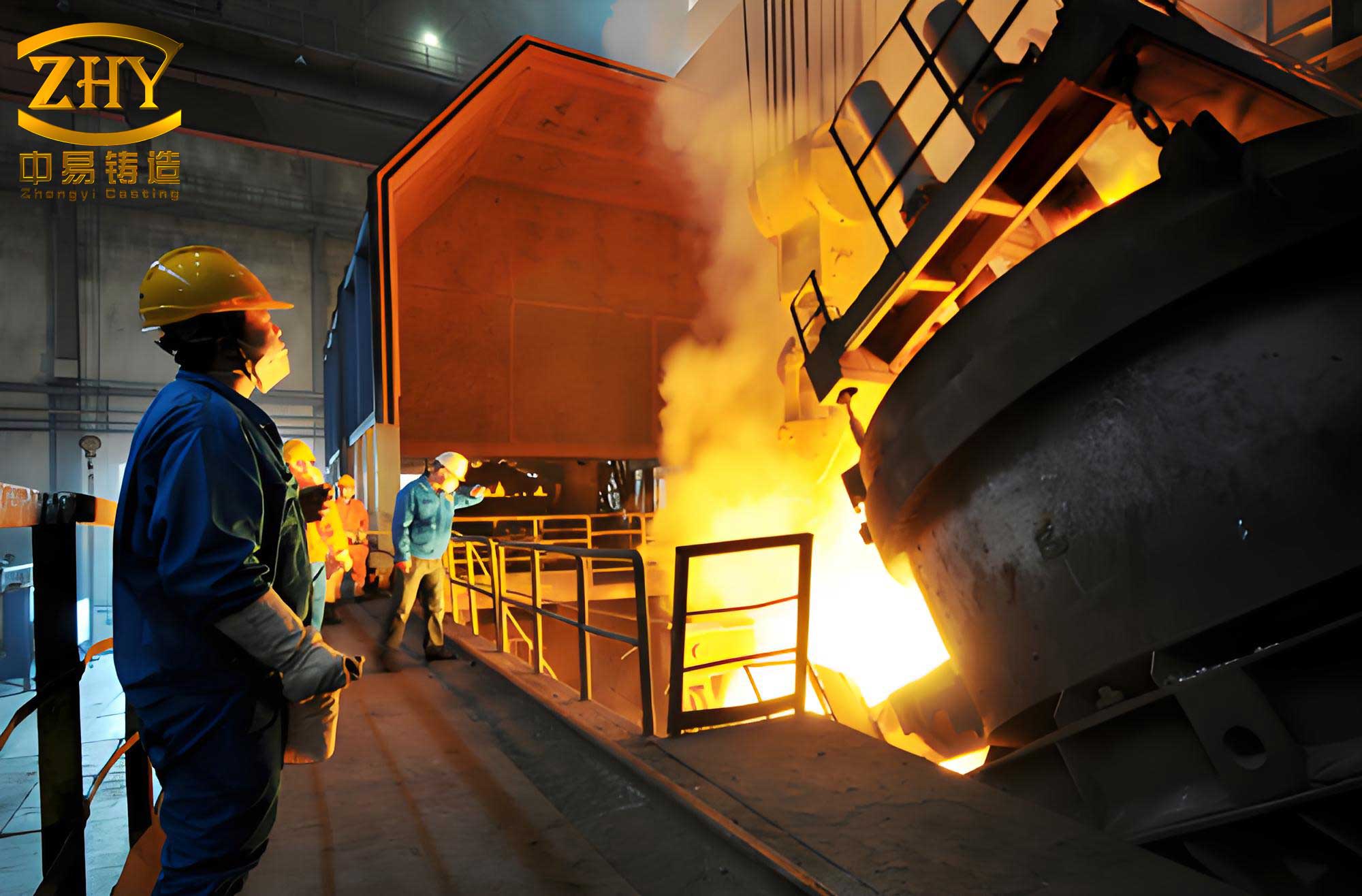
Looking ahead, the target specifications for advanced cast iron parts should include: minimum wall thickness of 3–4 mm, carbon equivalent of 4.0–4.2%, tensile strength over 300 MPa in test bars, eutectic cell count above 150 cells/cm², relative strength over 90%, pearlite content above 95% in all sections, free cementite below 1%, graphite length under 0.2 mm (ISO Type A), hardness of 200–250 HB in thick sections, dimensional accuracy within CTG 6–8 per ISO 8062, and pressure tightness under 4.5 bar. Achieving these goals for cast iron parts requires not only metallurgical innovations but also advancements in molding technology. High-pressure molding, for instance, increases mold rigidity, reducing wall movement and shrinkage during solidification. This is crucial for maintaining the integrity of thin-walled cast iron parts. Similarly, improved core-making processes and specialized coatings can enhance surface quality and dimensional precision.
A critical aspect often overlooked is the section sensitivity of cast iron parts. The mechanical properties of gray iron vary significantly with wall thickness due to differences in cooling rates. For non-alloyed cast iron parts, tensile strength typically decreases in thin sections (below 5 mm) because of undercooled graphite and ferrite formation. This relationship can be modeled using cooling rate parameters: $$V_c = \frac{k}{d^n}$$ where $V_c$ is the cooling rate, $d$ is the wall thickness, and $k$ and $n$ are material constants. In complex cast iron parts like engine blocks, where cores slow cooling, the effect is amplified, leading to softer, weaker zones. However, with proper inoculation or alloying, this trend can be mitigated, as shown in my experiments where thin sections maintained strength comparable to thicker ones. The key is to control the eutectic undercooling, $\Delta T_E$, defined as: $$\Delta T_E = T_E – T_N$$ where $T_E$ is the equilibrium eutectic temperature and $T_N$ is the nucleation temperature. By reducing $\Delta T_E$ through inoculation, we can achieve a more uniform microstructure across varying section thicknesses in cast iron parts.
In summary, the evolution of cast iron parts for internal combustion engines is driven by the dual demands of thin walls and high strength. While challenges persist in local production—such as limited access to advanced equipment and materials—solutions like intensified inoculation offer a viable path forward. My research indicates that by optimizing melting practices, superheating, and using composite inoculants, we can produce cast iron parts that rival international standards. The future will likely see greater adoption of high-pressure molding, synthetic iron melts, and low-alloying, but for now, focusing on inoculation and process control provides a cost-effective strategy. As we continue to refine these techniques, the goal of mass-producing robust, lightweight cast iron parts becomes increasingly attainable, paving the way for more efficient and competitive engines on the global stage.
To further elaborate, let me delve into the technical details of inoculation effects on cast iron parts. The effectiveness of an inoculant depends on its ability to provide nucleation sites for graphite during solidification. Common inoculants like ferrosilicon (FeSi) introduce silicon, which promotes graphitization, but their impact is limited without superheating. By raising the superheating temperature above 1500°C, we increase the dissolution of impurities and enhance the formation of nuclei, measured by the nucleation potential, $NP$, which can be expressed as: $$NP = \frac{N_c}{CE^2}$$ where $N_c$ is the number of eutectic cells. In my trials, with superheating and composite inoculants, $NP$ values doubled, leading to finer graphite and higher strength in cast iron parts. This is particularly important for thin-walled cast iron parts, where rapid cooling favors undesirable microstructures.
| Process Parameter | Conventional Method | Intensified Inoculation | Impact on Cast Iron Parts |
|---|---|---|---|
| Superheating Temperature (°C) | 1450–1480 | 1500–1520 | Increased nucleation, reduced chill |
| Carbon Equivalent (%) | 4.0–4.3 | 4.1–4.2 | Improved fluidity, lower shrinkage |
| Inoculant Type | FeSi75 alone | FeSi75 + CaSi + RE | Enhanced graphite morphology |
| Eutectic Cell Count (cells/cm²) | 80–120 | 150–200 | Better strength uniformity |
| Tensile Strength (MPa, in thin walls) | 200–250 | 280–320 | Higher load-bearing capacity |
| Relative Strength, RG (%) | 75–85 | 85–95 | More efficient material use |
The table above contrasts process parameters and their effects on cast iron parts. Intensified inoculation not only boosts mechanical properties but also reduces defects like porosity and inclusions, which are common in thin-walled cast iron parts. Additionally, the use of mold coatings with high refractoriness can further improve surface finish and dimensional accuracy, critical for engine components where tolerances are tight. In my observations, coatings based on zircon or alumina have shown promise in reducing burn-on and improving the as-cast appearance of cast iron parts.
Another area of interest is the thermal analysis of cast iron parts during solidification. By monitoring cooling curves, we can predict microstructure and adjust inoculation in real time. The recalescence temperature, $T_R$, indicates the onset of eutectic solidification, and a higher $T_R$ suggests better nucleation. For high-quality cast iron parts, we aim for $T_R$ above 1150°C, which can be achieved with effective inoculation. This aligns with the goal of minimizing undercooling, as described by the equation: $$\Delta T = T_E – T_R$$ where lower $\Delta T$ values correlate with Type A graphite and higher strength. Implementing such monitoring systems in production can help consistently produce superior cast iron parts.
In conclusion, the journey toward advanced cast iron parts is multifaceted, involving material science, process engineering, and quality control. My experience reinforces that through techniques like intensified inoculation, we can overcome the thin-wall, high-strength paradox. As the industry moves forward, collaboration across sectors—from coke production to mold manufacturing—will be essential to supply the necessary resources. By setting clear targets and embracing innovation, the future of cast iron parts looks bright, with potential applications expanding beyond engines to other sectors requiring durable, precise components. The key takeaway is that incremental improvements, when combined, can lead to transformative outcomes for cast iron parts, ensuring their relevance in an increasingly demanding technological landscape.