
In my extensive research and practical experience within the foundry industry, I have focused on developing and optimizing binder systems specifically tailored for the manufacturing of complex cast iron parts. The production of high-quality cast iron parts often faces challenges related to core and mold making, including high material costs, difficult shakeout, and environmental concerns. Through systematic investigation, I have explored two primary avenues: the enhancement of cold-box resin sands using ethyl silicate additives and the development of water-soluble cores based on alumina for intricate cast iron parts. This article details my first-person journey, methodologies, findings, and the resulting technological improvements that directly benefit the casting of cast iron parts.
The relentless pursuit of cost-efficiency and performance in foundry operations led me to examine traditional cold-curing resin binders. These resins are pivotal for creating molds and cores for cast iron parts, but their substantial usage drives up production costs. I hypothesized that incorporating ethyl silicate (tetraethoxysilane) as a reinforcing agent could significantly reduce the required resin content. My experimental work confirmed that the addition of ethyl silicate can reduce resin addition by nearly half while maintaining or even improving the mechanical properties of the sand mixture, thereby lowering the overall cost for producing cast iron parts.
The mechanism behind this reinforcement involves the hydrolysis and condensation reactions of ethyl silicate, which form a silica network that complements the resin’s bonding. The process I developed is precise: first, the catalyst is uniformly mixed with the base sand. Simultaneously, ethyl silicate is blended with the resin binder. These two mixtures are then combined rapidly and mixed thoroughly before use. This sequence ensures optimal distribution and reaction initiation. The key reactions can be summarized as:
$$ \text{Si(OC}_2\text{H}_5)_4 + 4\text{H}_2\text{O} \rightarrow \text{Si(OH)}_4 + 4\text{C}_2\text{H}_5\text{OH} $$
$$ \text{Si(OH)}_4 \rightarrow \text{SiO}_2 (\text{network}) + 2\text{H}_2\text{O} $$
This in-situ generation of silica enhances the cohesion between sand grains, allowing for reduced resin dependency. For foundries specializing in cast iron parts, this translates to direct material savings without compromising the integrity of molds and cores needed for complex geometries.
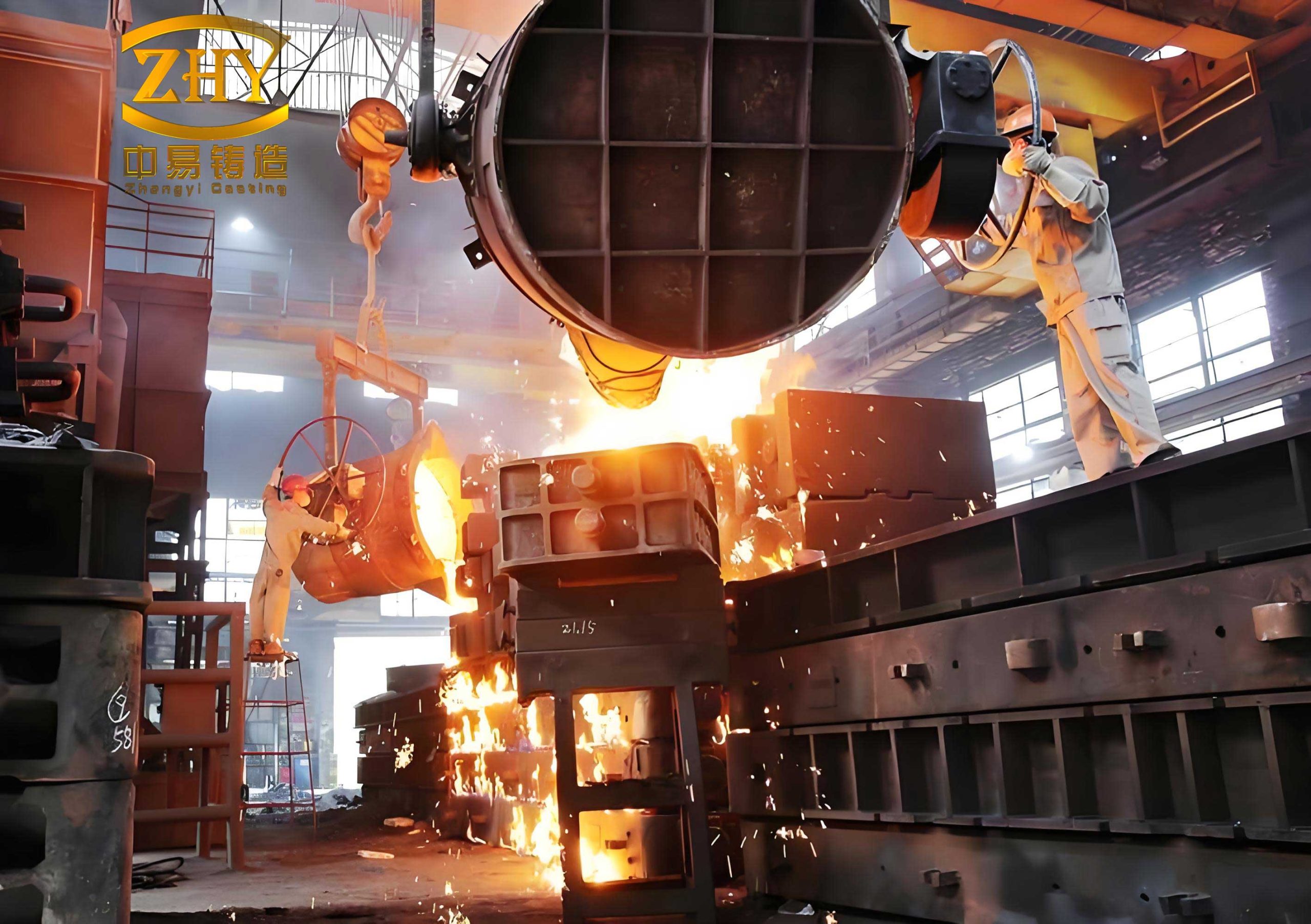
While resin sand improvements address cost, another persistent issue in casting, especially for cast iron parts with intricate internal passages or narrow openings, is core removal. Traditional sand cores can be extremely difficult to dislodge, leading to labor-intensive cleaning, noise, and dust. To solve this, I embarked on developing a water-soluble core system based on alumina (Al$_2$O$_3$) that offers excellent collapsibility after pouring cast iron parts. The core is designed to disintegrate in water post-casting, simplifying cleanup dramatically.
The core material formulation centers on fused brown alumina (electrofused Al$_2$O$_3$) as the refractory aggregate, sodium phosphate (Na$_3$PO$_4$) as the primary inorganic binder, and an organic polymer powder as an additive to enhance certain properties. The chemical composition of the alumina used is critical for high-temperature performance when in contact with molten iron during the casting of cast iron parts. A representative composition is given below:
| Component | Content (wt.%) |
|---|---|
| Al$_2$O$_3$ | > 94.5 |
| SiO$_2$ | < 2.0 |
| Fe$_2$O$_3$ | < 1.0 |
| TiO$_2$ | < 3.0 |
| Other Impurities | < 0.5 |
To determine the optimal mix formulation and processing parameters for cores used in cast iron parts, I employed a structured Design of Experiments (DoE) approach using an orthogonal array. The factors and their levels investigated are summarized in Table 1. The response variables were green compressive strength ($\sigma_{\text{green}}$), dry tensile strength ($\sigma_{\text{dry}}$), and water disintegration time ($t_{\text{dis}}$).
| Factor | Symbol | Level 1 | Level 2 | Level 3 |
|---|---|---|---|---|
| Binder Addition (wt.%) | A | 6 | 8 | 10 |
| Water Addition (wt.%) | B | 4 | 5 | 6 |
| Dry Mixing Time (min) | C | 2 | 3 | 4 |
| Wet Mixing Time (min) | D | 3 | 4 | 5 |
| Drying Temperature (°C) | E | 180 | 200 | 220 |
| Drying Time (min) | F | 40 | 50 | 60 |
| Additive Addition (wt.%) | G | 0.5 | 1.0 | 1.5 |
The sand mixing procedure I standardized is as follows: Alumina sand + Sodium phosphate + Additive are dry mixed for a specified time. Then, water is added, and wet mixing continues. The total mixing time is a key variable. Test specimens were prepared using a standard ramming device: “8”-shaped samples for dry tensile tests and cylindrical specimens (Ø50 mm × 50 mm and Ø30 mm × 50 mm) for green compressive and high-temperature compressive tests, respectively. The preparation process can be modeled as a sequential operation:
$$ \text{Mixing Process} = \text{Dry Blend}(t_{\text{dry}}) \oplus \text{Water Addition} \oplus \text{Wet Blend}(t_{\text{wet}}) $$
Performance testing was rigorous. Green compressive strength was measured on the Ø30 mm × 50 mm specimens using a lever-type sand strength tester. The strength is calculated as:
$$ \sigma_{\text{green}} = \frac{4 F_{\text{max}}}{\pi d^2} $$
where $F_{\text{max}}$ is the maximum force at failure and $d$ is the specimen diameter (30 mm). Dry tensile strength was determined on dried “8”-shaped specimens using a universal strength tester. High-temperature compressive strength ($\sigma_{\text{highT}}$) was evaluated by heating Ø50 mm × 50 mm specimens to a target temperature (e.g., 1200°C), holding for 30 minutes, and then loading until failure. This property is crucial for assessing the core’s resistance to metal pressure and thermal stress during the pouring of cast iron parts.
Water disintegration behavior, the defining feature for cores in difficult-to-clean cast iron parts, was tested by placing dried and then fired (at 1000°C for 30 minutes) specimens into water and recording the time for complete collapse. The test simulates the post-casting cleanup process.
The orthogonal experiment yielded a rich dataset. To analyze the influence of each factor on the core properties, I performed range analysis. The main effects plots for green compressive strength and dry tensile strength are derived from the data. For green strength ($\sigma_{\text{green}}$), the primary influencing factors, in order of significance, are Binder Addition (A), Wet Mixing Time (D), and Dry Mixing Time (C). The relationship can be qualitatively expressed as:
$$ \sigma_{\text{green}} \propto f(A, D, C, B, G, F, E) $$
For dry tensile strength ($\sigma_{\text{dry}}$), which is critical for handling cores before casting cast iron parts, the order of significance is Drying Temperature (E), Additive Addition (G), and Binder Addition (A). The organic polymer additive plays a vital role in forming secondary bonds upon drying, enhancing dry strength significantly. Its effect can be conceptualized as providing a polymeric network:
$$ \text{Strength Contribution}_{\text{additive}} = k_{\text{poly}} \cdot C_{\text{additive}}^{n} $$
where $k_{\text{poly}}$ is a constant and $n$ is an exponent typically between 0.5 and 1.
A remarkable finding was that the water disintegration time remained excellent (under 5 minutes) across all experimental runs. This is attributed to the chemistry of the binder system. Upon exposure to high temperatures from molten cast iron, the sodium phosphate binder and its interaction products with alumina surface impurities form soluble compounds. The primary reactions postulated are:
$$ \text{Na}_3\text{PO}_4 \cdot x\text{H}_2\text{O} \xrightarrow{\Delta} \text{Na}_2\text{O} + \text{P}_2\text{O}_5 (\text{in various forms}) + \text{H}_2\text{O} $$
$$ \text{Al}_2\text{O}_3 + \text{Na}_2\text{O} \rightarrow 2\text{NaAlO}_2 \quad (\text{soluble}) $$
$$ \text{Al}_2\text{O}_3 + \text{P}_2\text{O}_5 \rightarrow 2\text{AlPO}_4 \quad (\text{partially soluble}) $$
Furthermore, the burnout of the organic additive creates porosity, weakening the sintered bridge structure and facilitating rapid water penetration and dissolution when cleaning cast iron parts. The disintegration process can be modeled as a first-order kinetic process relative to the soluble phase volume $V_s$:
$$ \frac{dV_s}{dt} = -k_{\text{dis}} V_s $$
Based on the range analysis and verification tests, I established the optimal formulation and process parameters for producing alumina-based water-soluble cores suitable for cast iron parts. The results are consolidated in Table 2.
| Parameter Category | Optimal Value or Specification |
|---|---|
| Mix Formulation (by weight) | |
| Fused Brown Alumina (Base: 100 parts) | 100 parts |
| Sodium Phosphate Binder (Na$_3$PO$_4$) | 9 parts |
| Organic Polymer Additive | 1.0 part |
| Water Addition | 5.5 parts |
| Mixing Process | |
| Dry Mixing Time | 3 minutes |
| Wet Mixing Time | 5 minutes |
| Drying/Curing Process | |
| Drying Temperature | 200°C |
| Drying Time | 50 minutes |
| Cooling & Storage | Air cool to room temperature, store in dry cabinet |
Cores produced with this optimized system exhibit a balanced set of properties, as shown in Table 3, making them highly suitable for challenging cast iron parts.
| Property | Symbol | Typical Value | Test Method / Condition |
|---|---|---|---|
| Green Compressive Strength | $\sigma_{\text{green}}$ | 0.18 – 0.22 MPa | On Ø30 mm × 50 mm specimen |
| Dry Compressive Strength | $\sigma_{\text{dry-comp}}$ | 4.5 – 5.5 MPa | After drying at 200°C |
| Dry Tensile Strength | $\sigma_{\text{dry}}$ | 1.8 – 2.2 MPa | On dried “8”-shaped specimen |
| High-Temperature Compressive Strength (at 1200°C) | $\sigma_{\text{highT}}$ | 1.0 – 1.4 MPa | Hold 30 min at temperature |
| Gas Evolution | $V_{\text{gas}}$ | 12 – 16 mL/g | Heated to 1000°C |
| Water Disintegration Time | $t_{\text{dis}}$ | 2 – 4 minutes | After firing at 1000°C for 30 min |
The synergy between the ethyl silicate-enhanced resin sand and the water-soluble alumina core technology presents a comprehensive strategy for improving the manufacturing of cast iron parts. The resin sand modification reduces raw material costs for external molds and simpler cores. Simultaneously, the water-soluble core technology solves the post-casting cleanup dilemma for the most intricate internal features of cast iron parts. The high-temperature strength of the alumina core ensures dimensional stability during the pour, while its excellent water collapsibility eliminates destructive mechanical cleaning.
In conclusion, my work demonstrates that through chemical innovation and systematic process optimization, significant advancements are possible in foundry binder systems. The integration of ethyl silicate into resin sands cuts costs, and the development of robust, water-soluble alumina cores addresses a long-standing technical bottleneck. Both technologies are directly applicable and beneficial for enhancing the efficiency, quality, and environmental profile of producing complex and high-value cast iron parts. The future lies in further tailoring these systems for specific alloys and geometries, pushing the boundaries of what is possible in metal casting, particularly for the ever-demanding sector of cast iron parts manufacturing.