
The global transition in energy demand has catalyzed the rapid advancement of the wind power sector. In particular, offshore wind energy is witnessing a paradigm shift towards increasingly powerful turbines, with models reaching 12 MW already in operation and ambitious 16 MW designs under development. This evolution places unprecedented demands on the structural integrity and reliability of critical components. Among these, ductile iron casting plays an indispensable role. Key parts such as rotor hubs, main frames, bedplates, and main shafts are predominantly manufactured using ductile iron (nodular iron) due to its exceptional combination of strength, castability, and damping capacity. The successful capture and conversion of wind energy rely heavily on the performance of these massive ductile iron castings.
However, the progression towards larger component sizes and the harsh operational environments, especially the sub-zero temperatures encountered in northern latitudes and offshore sites, present significant challenges. Traditional grades of ductile iron may not suffice. This necessitates the development and precise production of a new class of materials: low-temperature high-toughness ductile iron. The journey of a ductile iron casting from molten metal to a reliable turbine component is governed by meticulous composition design, melting practice, and process control, with the goal of achieving a microstructure that guarantees performance down to -40°C and beyond.
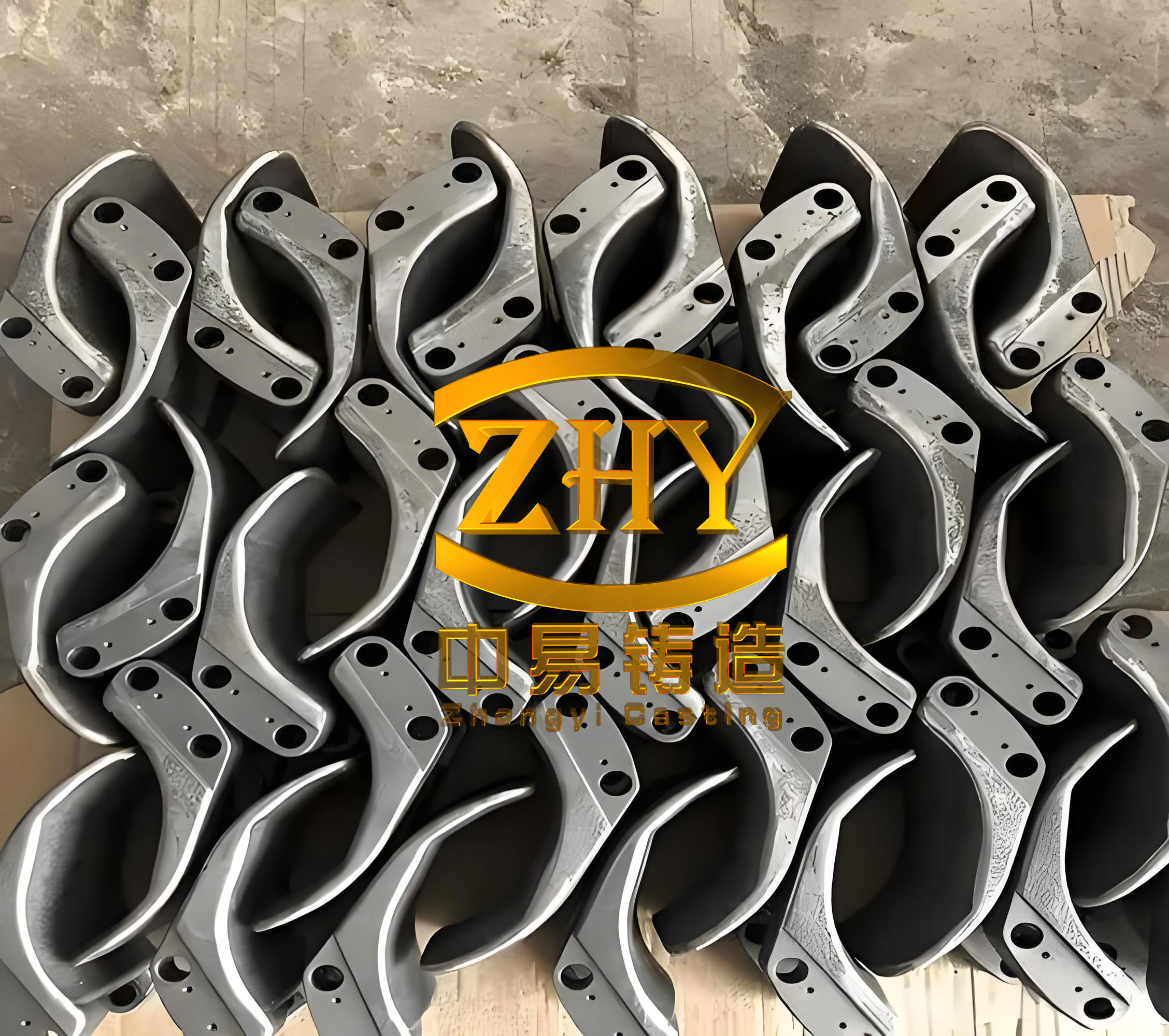
The superiority of ductile iron casting stems from its unique microstructure, where graphite exists as spheroids uniformly dispersed within a metallic matrix. This morphology drastically reduces the stress-concentrating effect of graphite compared to flake graphite in gray iron, resulting in a material with high strength utilization, excellent ductility, and good fatigue resistance. The self-lubricating property of graphite and the inherent damping capacity further enhance its suitability for heavy-duty, dynamic applications like wind turbines.
While standards such as GB/T 1348 or ISO 1083 provide a foundation with grades like QT400-18AL (EN-GJS-400-18-LT), the wind industry imposes far more stringent requirements. These are not just about meeting minimum mechanical properties on separately cast test bars. The focus is on guaranteed performance in the actual heavy-section casting, often verified through attached test blocks or, preferably, samples taken from the component itself (on-machined samples). The industry demands higher baseline strength, stricter control over microstructure (e.g., >90% nodularity, >90% ferrite), and crucially, verified impact toughness at low temperatures, typically with a requirement of Charpy V-notch impact energy ≥12 J at -40°C for relevant section sizes. The table below summarizes the elevated standards for wind turbine ductile iron castings compared to general engineering applications.
| Requirement | General Ductile Iron Casting | Wind Turbine Ductile Iron Casting |
|---|---|---|
| Test Coupon | Separately cast | Attached cast (25/40/70 mm) or on-machined sample |
| Tensile Strength | Meets grade minimum (e.g., 400 MPa) | Higher specified minimum (often >370-400 MPa) |
| Elongation | Meets grade minimum (e.g., 18%) | Higher specified minimum (often >12-18%) |
| Low-Temp Impact (at -40°C) | May not be specified | ≥12 J (for 40mm section), ≥10 J (for 70mm section) |
| Microstructure: Nodularity | ≥70% | ≥90% |
| Microstructure: Ferrite | Not strictly specified | ≥90-95% |
| Microstructure: Carbides | ≤1% (typical) | ≤1% (strictly enforced) |
| Non-Destructive Testing | Optional or customer-specific | Mandatory (UT to ASTM A609/A609M Level 2-3; MT to relevant standards) |
| Weld Repair | Often permitted with procedure | Frequently prohibited on critical areas |
The existing material standards are seen as lagging behind the rapid technological needs of next-generation offshore wind. There is a clear industrial drive to develop new, standardized grades of low-temperature high-toughness ductile iron with even more rigorous property guarantees. This development starts with fundamental composition design.
The Science of Composition Design for Low-Temperature Toughness
The performance of a ductile iron casting is fundamentally dictated by its chemical composition, which in turn controls the solidification process, graphite formation, and matrix structure. For low-temperature applications, the goal is to achieve a fully ferritic matrix with small, well-dispersed, and perfectly spherical graphite nodules, while minimizing all elements that promote pearlite, carbides, or grain boundary segregations that embrittle the material.
A key concept in designing the melt is the Carbon Equivalent (CE), which predicts the eutectic point of the iron composition. It is calculated as:
$$ CE = C + 0.3(Si + P) + 0.4S – 0.03Mn $$
where the elemental symbols represent their weight percentages. For heavy-section ductile iron castings, the CE is typically aimed slightly above the theoretical eutectic point (4.26%) to improve fluidity and feeding, thereby reducing shrinkage porosity. A range of 4.1% to 4.3% is common. However, with a deliberate reduction in Silicon (Si) content for low-temperature toughness, the Carbon (C) content must be carefully adjusted to maintain this optimal CE.
The interplay and precise control of individual elements form the cornerstone of producing a superior low-temperature high-toughness ductile iron casting. The following table provides a comparative overview of target compositions for general, heavy-section, and specifically low-temperature high-toughness grades.
| Element | General Ductile Iron Casting (wt.%) | Heavy-Section Ductile Iron Casting (wt.%) | Low-Temp High-Toughness Ductile Iron Casting (wt.%) |
|---|---|---|---|
| C | 3.5 – 3.8 | 3.4 – 3.8 | 3.65 – 3.85 |
| Si | 2.0 – 2.5 | 1.8 – 2.5 | 1.8 – 2.2 |
| Mn | 0.1 – 0.4 | ≤ 0.3 | ≤ 0.15 |
| P | ≤ 0.06 | ≤ 0.04 | ≤ 0.02 |
| S | 0.01 – 0.03 | ≤ 0.02 | 0.005 – 0.015 |
| Mgres | 0.04 – 0.06 | 0.02 – 0.05 | ≤ 0.03 |
| REres | – | 0.01 – 0.03 | 0.01 – 0.03 |
| Ni | – | ≤ 0.5 | ≤ 1.5 |
| Cu | ≤ 1.2 | ≤ 0.3 | ≤ 0.3 |
| Sn | ≤ 0.08 | ≤ 0.05 | ≤ 0.05 |
| Cr | ≤ 0.05 | ≤ 0.05 | ≤ 0.05 |
Carbon (C) and Silicon (Si): The Primary Graphitizers. Carbon is the primary graphitizing element. A higher C content (within the optimal range) improves graphite nucleation, increases the volume of graphite, and enhances the feeding characteristics during solidification, which is vital for sound, defect-free heavy-section ductile iron castings. However, excessive carbon can lead to graphite flotation in slow-cooling sections. Silicon is a potent ferritizer and graphitizer. While it strengthens ferrite via solid solution hardening, it also significantly increases the ductile-to-brittle transition temperature (DBTT). Research indicates that for every 0.1% increase in Si, the DBTT can rise by 5-7°C. Therefore, the paradigm for low-temperature grades is “high carbon, low silicon.” The C is kept at the upper end (3.65-3.85%) to ensure good castability and graphite formation, while Si is aggressively lowered to 1.8-2.2% to minimize its embrittling effect.
Manganese (Mn), Phosphorus (P), and Sulfur (S): The Harmful Trio. The stringent limits on these elements are critical for achieving high toughness. Mn segregates to cell and grain boundaries, where it stabilizes pearlite and can form brittle carbides. Its effect on DBTT is severe, with an estimated increase of 10-12°C per 0.1% Mn. Thus, levels must be pushed as low as possible, ideally below 0.15%. P forms brittle, low-melting-point phosphide eutectics that segregate at boundaries, acting as potent crack initiators. Its control is paramount, requiring levels ≤0.02%. S reacts with Mg and RE during treatment, consuming the nodularizing agents. While a minimal residual S content (0.005-0.015%) after treatment can aid in nucleation, high initial S levels lead to dross defects and impaired nodularity. The production of high-quality ductile iron casting therefore depends on using high-purity charge materials.
Magnesium (Mgres) and Rare Earths (REres): The Nodularizing Agents. Residual Mg is essential for achieving spheroidal graphite. However, high residual Mg (>0.045%) can increase the tendency for carbides (chill) and shrinkage defects, and may degenerate graphite shape. The trend is to use efficient treatment methods that yield a lower, controlled residual Mg level (≤0.03%). Rare Earths (e.g., Cerium, Lanthanum) help counteract the detrimental effects of trace impurities like Pb, Sb, and Ti (so-called “tramp elements”). They also aid in graphite nucleation. A balance between RE and S is often sought, with a ratio (RE/S) between 1.5 and 2.0 being beneficial for graphite morphology in heavy sections.
Alloying Elements: Nickel (Ni) and the Role of Micro-additions. To compensate for the strength loss from lowering Si and Mn, and to further enhance low-temperature toughness, nickel is the alloying element of choice. Ni is an austenite stabilizer. It dissolves in ferrite, strengthening it without significantly increasing the DBTT. More importantly, it promotes the retention of a small amount of stable, tough austenite at sub-zero temperatures, which can improve fracture resistance. Nickel contents up to 1.5% are used in advanced low-temperature grades. Copper (Cu) is a potent pearlite promoter and is therefore strictly limited (≤0.3%). Micro-additions of elements like Bismuth (Bi) and Antimony (Sb) in the range of 0.002-0.008% are sometimes used in conjunction with specific inoculation practices to refine graphite and counteract fading in heavy sections, but their use requires extreme precision.
The combined effect of these elements on the matrix structure can be estimated using the Pearlite Potential Factor (Px), a useful empirical formula:
$$ P_x = 3.0\text{Mn} – 2.65(\text{Si} – 2.0) + 7.7\text{Cu} + 96\text{Sn} + 357\text{Pb} + 333\text{Bi} $$
For a fully ferritic, low-temperature grade, the goal is to minimize the Px value, which directly guides the strict limits on Mn, Cu, Sn, Pb, and Bi.
Current Research Landscape and Performance Achievements
The principles of composition design are validated through extensive research and industrial practice. The focus has been on achieving the dual targets of maintaining tensile strength above 400 MPa while ensuring Charpy V-notch impact energy exceeds 12 J at -40°C, typically on attached test blocks simulating thick sections.
Key findings from the literature underscore several successful strategies:
- Low Silicon Base: Reducing Si to ~2.0-2.2% is a fundamental step to lower the DBTT.
- Nickel Addition: Alloying with 0.4% to 1.2% Ni, followed by a ferritizing annealing heat treatment, consistently yields excellent low-temperature toughness while maintaining or even enhancing tensile strength.
- High Purity and Process Control: Achieving the low levels of Mn, P, and S is non-negotiable. This often requires dedicated melting practices, such as using primary iron or highly sorted scrap in electric arc or induction furnaces.
- Enhanced Inoculation: Powerful late-stream inoculation with specialized inoculants containing Ba, Sr, or Zr is critical to achieve a high nodule count and prevent undercooled graphite formations in the slowly cooling center of a heavy ductile iron casting.
Experimental studies have demonstrated that through optimized composition and processing, the ductile-to-brittle transition temperature of ferritic ductile iron can be pushed below -80°C, far exceeding the current -40°C industrial requirement. This provides a significant safety margin and points to the material’s potential for even more extreme environments. The synergistic effect of Ni addition and heat treatment is particularly effective. A summary of representative research results, plotting achieved tensile strength against -40°C impact energy, illustrates the successful development window for these advanced ductile iron castings. Most data clusters well above the minimum requirement line, showing that the industry’s goals are attainable and have been repeatedly demonstrated in research settings.
Future Outlook and Concluding Perspectives
The development of low-temperature high-toughness ductile iron casting is a direct response to the demanding frontier of renewable energy technology. As wind turbines grow larger and venture into more hostile environments, the material science behind their components must evolve in tandem. The future direction involves several key aspects:
1. Material System Expansion: Beyond just low-temperature toughness, next-generation offshore ductile iron castings will need integrated properties, including enhanced corrosion resistance against saltwater spray, improved fatigue performance under complex stress spectra, and long-term microstructural stability. The development of alloyed grades (e.g., with Ni, Cu, Mo for specific properties) that retain high toughness will be crucial.
2. Process Intelligence and Digitalization: Moving from experience-based practice to data-driven, smart foundries is essential for consistent quality. The implementation of real-time process monitoring, advanced thermal analysis for predicting microstructure, and simulation-driven optimization of feeding and solidification will reduce variability and improve yield for these high-value, critical ductile iron castings.
3. Standardization and Industry Alignment: Currently, specifications can vary between different wind turbine original equipment manufacturers (OEMs). There is a strong industry need to converge towards unified, internationally recognized material standards for wind turbine components. This would streamline the supply chain, reduce redundant qualification costs, and accelerate innovation by providing clear, common performance benchmarks for ductile iron casting producers.
In conclusion, the successful production of heavy-section, low-temperature high-toughness ductile iron is a multidisciplinary challenge. It requires a deep understanding of metallurgical principles, precise control over chemistry and melting practices, and robust foundry engineering. The composition design philosophy of “high carbon, low silicon, minimal impurities, and judicious use of nickel” has proven effective. As the wind energy sector continues its ambitious growth, the role of advanced, reliably manufactured ductile iron castings will remain foundational, supporting the global transition to sustainable energy with strength and resilience forged in the foundry.