
The pursuit of manufacturing high-integrity, complex titanium alloy components in a cost-effective and environmentally conscious manner has long been a significant challenge in the foundry industry. Traditional methods, such as machined graphite molding, while established, often impose limitations related to casting quality, material reactivity, and rising environmental costs associated with graphite processing. This narrative details my firsthand experience and systematic investigation into developing a viable sand casting process for titanium alloys—specifically, the production of a critical ZTC4 alloy shell component—as a superior alternative. The core objective was to leverage the inherent flexibility and economic advantages of sand casting while overcoming the formidable reactivity of molten titanium, ultimately delivering sand casting products with enhanced quality at a substantially reduced cost.
Titanium alloys, renowned for their high strength-to-weight ratio, excellent corrosion resistance, and good biocompatibility, are indispensable in aerospace, marine, and biomedical applications. However, their extreme chemical reactivity in the molten state presents a unique set of challenges for any casting process. Upon contact, molten titanium readily reacts with most conventional molding materials, such as silica sand, leading to severe surface contamination known as “alpha-case,” a brittle, oxygen-enriched layer that degrades mechanical properties. This fundamental issue has historically limited the widespread adoption of sand casting for titanium. My work focused on deconstructing this problem into two primary, solvable engineering requirements: first, developing a mold system with sufficient high-temperature strength and controlled thermal expansion to prevent cracking during pouring and solidification; and second, creating an effective chemical barrier at the mold-metal interface to prevent detrimental reactions. The successful resolution of these points forms the basis of this process.
1. Foundry Methodology and Material Innovation
The cornerstone of this new approach lies in the design and preparation of a composite sand mold system. This system is strategically layered to address both mechanical and chemical stability.
1.1 Core Mold Fabrication: The Mullite-Silica Sol System
The bulk of the mold, responsible for defining the geometric shape and providing structural support, was fabricated using a mullite-based system. Mullite (3Al2O3·2SiO2) was selected as the principal refractory aggregate due to its favorable combination of properties crucial for titanium sand casting products:
- Moderate Thermal Conductivity: Lower than graphite, promoting slower cooling and reducing thermal shock and the risk of cold shuts or mistruns in thin sections.
- Low Thermal Expansion Coefficient: Minimizes dimensional changes and thermal stress during heating and cooling, reducing the propensity for mold cracking.
- High Refractoriness: Adequate to withstand the pouring temperature of titanium alloys (~1700°C).
- Availability and Cost: More economical and environmentally benign compared to specialty graphite.
The bonding medium chosen was a colloidal silica (silica sol) binder. This inorganic binder provides high green and baked strength without introducing volatile organic compounds that could decompose and cause gas defects in the reactive titanium melt. The process began with thoroughly mixing mullite sand and flour in a predetermined ratio to achieve optimal particle packing and surface finish. Silica sol was then introduced and mixed uniformly to coat the refractory particles. This mixture was rammed or blown around a pattern (in this case, a wooden pattern for prototype development) to form the mold cope, drag, and core. After shaping, the mold was allowed to dry and harden at ambient conditions, forming a rigid green sand mold body.
1.2 The Critical Inert Face Coat: Yttria Barrier
While the mullite body provides the shape, it is still susceptible to reaction with molten titanium. To isolate the reactive melt from the mold body, an inert face coat is imperative. For this, an yttria (Y2O3) based slurry was employed. Yttria possesses exceptional thermodynamic stability in contact with molten titanium, forming only minimal, stable reaction layers. The slurry, akin to those used in investment casting, was applied onto the dried mullite mold surfaces via brushing, ensuring a continuous, uniform coating over all areas that would contact the metal. This layer is the primary defense ensuring the surface quality of the final sand casting products.
1.3 Mold Drying and High-Temperature Firing
A critical, non-negotiable step in the process is the high-temperature firing of the complete mold assembly. This serves multiple essential functions:
- Removal of Volatiles: Eliminates all physically and chemically bound water from the silica sol binder and the face coat.
- Burn-out of Organics: Any incidental organic contaminants are removed.
- Sintering and Strengthening: The silica binder undergoes sintering, dramatically increasing the mold’s hot strength.
- Stabilization of the Face Coat: The yttria coating is consolidated.
The molds were fired in a standard electric resistance furnace to a temperature exceeding 1000°C and held for a sufficient soak time. This step is vital to prevent gas evolution and subsequent bubbling or porosity in the castings during pouring. Post-firing inspection confirmed no cracking or face coat spalling, indicating good thermal shock resistance and adhesion.
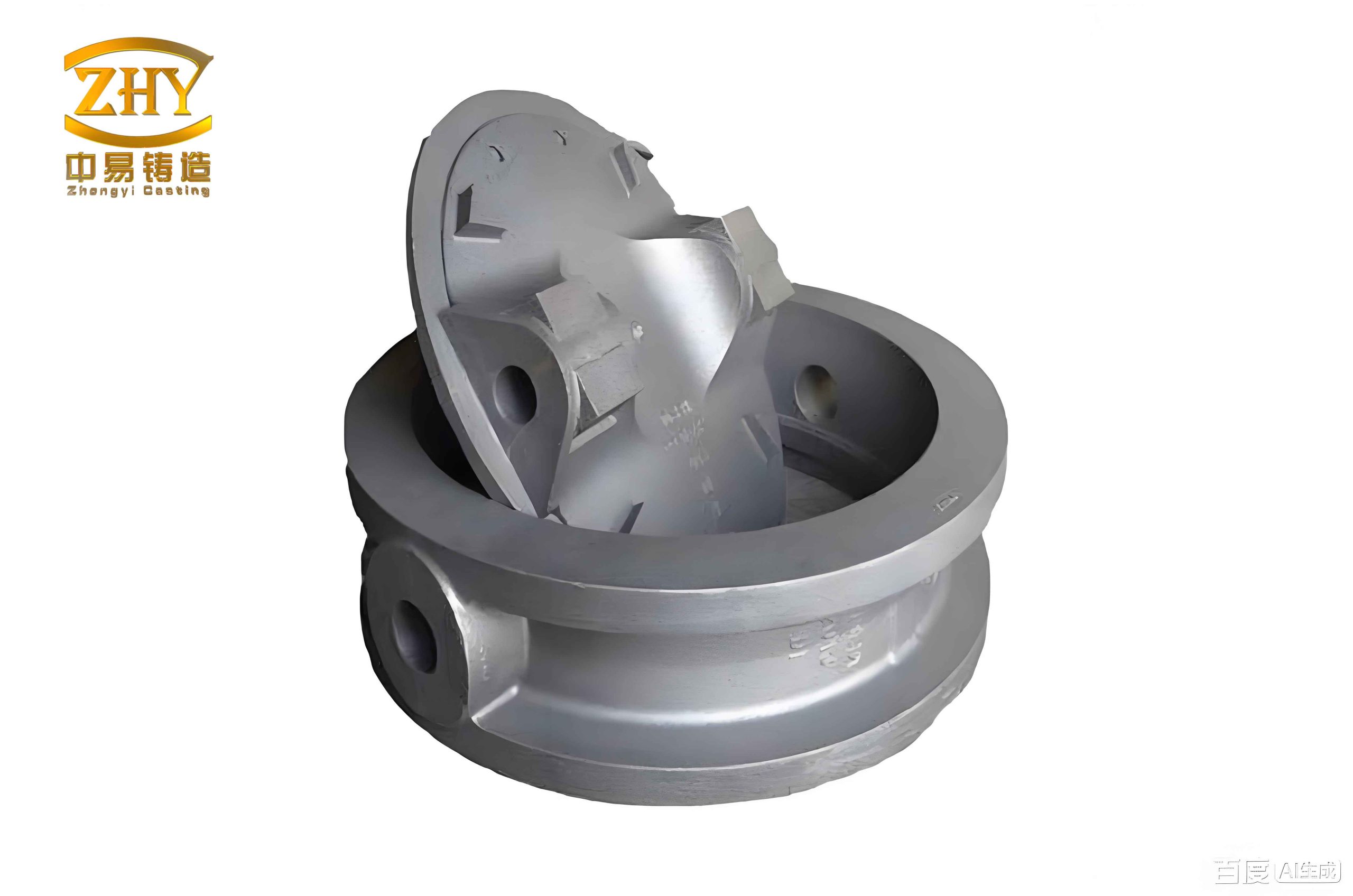
1.4 Melting, Pouring, and Solidification
The melting and pouring operation was conducted in a 150 kg vacuum arc skull furnace. A double-melted ZTC4 ingot was used as the charge material. The fired mold assembly was securely fastened and placed inside the furnace chamber. A high vacuum (below 4 Pa) was established prior to initiating the arc melt to minimize atmospheric contamination. After superheating the melt, it was poured into the preheated sand mold. The entire unit was then furnace-cooled for approximately 1.5 hours under vacuum before removal. This controlled cooling cycle helps mitigate residual stresses in the complex sand casting products.
2. Results, Analysis, and Comparative Evaluation
The success of the developed process was evaluated through a multi-faceted inspection regime covering surface quality, internal integrity, chemical composition, and mechanical performance of the resulting sand casting products.
2.1 Defect Analysis and Quality Assessment
Visual and non-destructive examination (NDE) of the cast shell component yielded highly positive results:
- Surface Quality: The as-cast surface was clean and free from the gross chemical bonding or sand burn-in that characterizes reaction defects. Fluorescent penetrant inspection (FPI) confirmed the absence of surface cracks, cold shuts, or significant folds. This immediately highlighted a key advantage over graphite molds, where the high chilling tendency often leads to surface flow lines and cold shuts.
- Internal Integrity: Real-time X-ray radiography was performed on the castings. The internal structure showed no evidence of hot tears, cracks, or macroscopic slag inclusions. However, areas of micro-porosity or shrinkage porosity were detected in isolated, uniformly thin sections of the casting. This is a common solidification phenomenon in poorly fed areas and is not unique to this process. The equation governing feeding demand can be related to the modulus (Volume/Surface Area ratio):
$$ M = \frac{V}{A} $$
Where a lower modulus $M$ indicates a higher cooling rate and greater difficulty in supplying feed metal to compensate for solidification shrinkage.
To eliminate this micro-porosity and achieve maximum structural integrity, the castings underwent Hot Isostatic Pressing (HIP). The HIP cycle subjects the component to high temperature and isostatic gas pressure (e.g., ~920°C / 100 MPa in Argon), which plastically collapses internal voids and diffusion-bonds the surfaces. Post-HIP radiography confirmed the complete elimination of the previously observed porosity, resulting in sound, fully dense sand casting products.
2.2 Material Property Verification
Verification of the material’s conformance to specification is paramount for critical components. The following tables summarize the test results.
Table 1: Chemical Composition of Sand-Cast ZTC4 Shell (wt.%)
| Element | Standard (GJB2896A) | Measured Value |
|---|---|---|
| Aluminum (Al) | 5.50 – 6.80 | 6.41 |
| Vanadium (V) | 3.50 – 4.50 | 4.35 |
| Iron (Fe) max | 0.30 | 0.04 |
| Oxygen (O) max | 0.20 | 0.15 |
| Nitrogen (N) max | 0.05 | 0.01 |
| Hydrogen (H) max | 0.015 | 0.001 |
| Carbon (C) max | 0.10 | 0.009 |
| Silicon (Si) max | 0.15 | 0.02 |
| Titanium (Ti) | Balance | Balance |
Table 2: Mechanical Properties of HIPed Sand-Cast ZTC4
| Test Temperature | Property | Standard (GJB2896A) | Measured Average |
|---|---|---|---|
| Room Temperature (22°C) | Tensile Strength, Rm (MPa) | ≥ 890 | 926 |
| Yield Strength, Rp0.2 (MPa) | ≥ 820 | 833 | |
| Elongation, A (%) | ≥ 5 | 7.3 | |
| Reduction of Area, Z (%) | ≥ 10 | 17.7 | |
| 350°C | Tensile Strength, Rm (MPa) | ≥ 500 | 628 |
The data conclusively demonstrates that the sand casting process, followed by HIP, produces sand casting products whose chemical and mechanical properties not only meet but often exceed the requirements of the governing aerospace material specification. The low interstitial element levels (O, N, H, C) are particularly noteworthy, confirming the effectiveness of the vacuum melting and inert mold face coat in preventing contamination.
2.3 The Fundamental Advantage: Thermal Management vs. Graphite
The dramatic improvement in surface quality and reduction in hot tearing tendency can be fundamentally traced to the thermal properties of the mold materials. The following comparative analysis elucidates this advantage.
Table 3: Comparative Thermal Properties of Mold Materials
| Property | Synthetic Mullite (Sand Mold Body) | Artificial Graphite (Machined Mold) |
|---|---|---|
| Thermal Conductivity at 1000°C (W/m·K) | ~3.8 | ~60.0 |
| Mean Coefficient of Thermal Expansion (20-1000°C), ×10-6/K | 5.5 – 5.8 | 5.1 – 5.4 |
| Chemical Stability vs. Molten Ti | Reactive (necessitates face coat) | Relatively Inert |
| Oxidation in Air | Stable | Begins >430°C |
| Mold Permeability / Yield | High | None |
The low thermal conductivity of the mullite-based sand mold is its most significant beneficial feature for casting quality. It acts as an insulator, slowing the heat extraction from the solidifying metal. This has several positive effects:
- Improved Fluidity: The metal remains liquid longer, allowing better filling of thin sections and reducing cold shut defects. The fluidity length $L_f$ can be conceptually related to the cooling rate:
$$ L_f \propto \frac{\Delta T_{superheat}}{\sqrt{K_m \cdot \rho_m \cdot C_m}} $$
Where $K_m$, $\rho_m$, and $C_m$ are the thermal conductivity, density, and specific heat of the mold material, respectively. A lower $K_m$ results in a larger $L_f$.
- Reduced Thermal Stress: A shallower temperature gradient within the casting during solidification minimizes thermal stresses, thereby significantly lowering the driving force for hot tear formation. The thermal stress $\sigma_{th}$ can be approximated by:
$$ \sigma_{th} \approx E \cdot \alpha \cdot \Delta T $$
where $E$ is Young’s modulus, $\alpha$ is the coefficient of thermal expansion, and $\Delta T$ is the temperature gradient. A slower cooling rate reduces $\Delta T$.
- Enhanced Mold Yield: The porous sand structure readily compresses and yields in response to the solidification shrinkage of the metal, whereas a rigid graphite mold imposes a rigid constraint, often leading to higher stress and cracking.
Furthermore, the oxidation resistance of mullite allows the sand mold to be preheated to several hundred degrees Celsius—a common practice to improve filling of complex geometries. Graphite molds cannot be similarly preheated in air without significant oxidative degradation.
3. Comprehensive Cost-Benefit and Future Outlook
The economic imperative for adopting this sand casting process is compelling. A detailed breakdown reveals a nearly 50% reduction in total casting cost compared to the incumbent machined graphite process. This saving stems from multiple factors:
- Material Cost: Mullite and silica sol are significantly less expensive than high-purity, machinable graphite blocks. The environmental regulations surrounding graphite production and disposal further add indirect costs to the graphite process.
- Tooling Cost: For low to medium volume production or prototype development, patterns for sand casting (often wood or plastic) are far cheaper and faster to produce than machining complex cavities into solid graphite.
- Yield Improvement: The reduction in surface defects (cracks, cold shuts) directly translates to lower scrap rates and a drastic reduction in labor-intensive weld repair operations. Producing sounder sand casting products from the first pour improves overall throughput and quality.
- Process Flexibility: Design changes are easier and cheaper to implement by modifying a pattern rather than re-machining an expensive graphite mold.
The process also aligns with greener manufacturing initiatives by utilizing more common refractory materials and reducing reliance on specialty graphites. The successful production of high-integrity titanium sand casting products via this method opens the door for its application to a wider range of titanium alloy components, particularly larger or more geometrically intricate parts where the cost of graphite machining becomes prohibitive. Future development work naturally focuses on optimizing the face coat composition (e.g., exploring other stable oxides or compounds), refining the sand binder system for even higher strength or collapsibility, and developing predictive simulation tools tailored to the unique thermal characteristics of the composite sand mold to further optimize gating, risering, and yield for future sand casting products.
In conclusion, the developed composite sand mold casting process—utilizing a mullite-silica sol body with an yttria face coat, coupled with vacuum melting and standard post-processing (HIP)—has proven to be a technically robust and economically superior alternative for producing high-quality titanium alloy castings. It successfully addresses the historical challenges of titanium sand casting by decoupling the mold’s mechanical and chemical functions. The result is a reliable pathway to manufacturing complex, high-performance sand casting products with excellent surface and internal quality, consistent mechanical properties, and at a substantially lower cost, thereby enhancing the competitiveness of titanium cast components across advanced engineering sectors.