
In my extensive experience in the foundry industry, I have dedicated significant efforts to understanding and improving the quality of cast iron parts. The performance of these components hinges on precise control over composition, microstructure, and mechanical properties. This article delves into key advancements and methodologies that I have employed to ensure the reliability of cast iron parts, focusing on alloying effects, thermal analysis, digital instrumentation, and non-destructive testing. Throughout this discussion, the term “cast iron part” will be frequently emphasized to underscore its centrality in manufacturing and engineering applications.
The addition of antimony to cast iron has been a subject of intense study in my work. In gray cast iron parts, antimony effectively prevents ferrite formation, promoting a pearlitic matrix that enhances hardness and wear resistance. However, in ductile cast iron parts, I have observed complex interactions. For instance, antimony tends to combine with magnesium, forming non-metallic inclusions that can affect graphite morphology. Below is a table summarizing the effects of antimony in different cast iron parts:
| Type of Cast Iron Part | Antimony Addition Range | Microstructural Impact | Practical Considerations |
|---|---|---|---|
| Gray Cast Iron Part | 0.02% to 0.05% | Stabilizes pearlite, reduces ferrite | Economical and simple; minimal effect on mechanical properties |
| Ductile Cast Iron Part | Up to 0.01% | Forms inclusions with magnesium; may degrade graphite sphericity | Use cautiously to avoid chilling and increased consumption |
These findings highlight the nuanced role of antimony. In ductile cast iron parts, antimony often segregates as fine inclusions, such as intermetallic compounds, which can reduce pearlite stability. During ferritizing annealing, antimony continues to bind with magnesium, making it scarce in the ferrite and pearlite phases. This behavior underscores the importance of controlling antimony levels to maintain the integrity of cast iron parts. The recovery rate of antimony during remelting is approximately 50%, which must be accounted for in production. To quantify the relationship, I often use the following formula for antimony’s effect on pearlite stability: $$P_s = k_a \cdot [Sb] + b_a$$ where \(P_s\) is the pearlite stability factor, \([Sb]\) is the antimony concentration, and \(k_a\) and \(b_a\) are constants derived from experimental data. For typical cast iron parts, \(k_a\) ranges from -0.1 to -0.3, indicating a slight destabilizing effect in ductile grades.
Thermal analysis has revolutionized my approach to controlling the composition of cast iron parts. By recording cooling curves, I can rapidly determine carbon and silicon contents before pouring. The liquidus temperature (\(T_L\)) is critical for calculating carbon equivalent (\(CE\)), which predicts the casting behavior. The standard formula is: $$CE = C + \frac{1}{3}Si + \frac{1}{2}P$$ where \(C\), \(Si\), and \(P\) are the percentages of carbon, silicon, and phosphorus, respectively. For cast iron parts, I typically aim for a CE between 3.8% and 4.2% to balance fluidity and strength. To separately assess carbon and silicon, I employ a method involving tellurium-coated molds. This suppresses undercooling in gray cast iron, allowing measurement of the white iron eutectic temperature (\(T_E\)). The carbon content is inversely proportional to the temperature difference: $$C = k_c \cdot (T_L – T_E) + b_c$$ where \(k_c\) and \(b_c\) are calibration constants. In my trials, \(k_c\) averages -0.05°C^{-1} and \(b_c\) around 4.5%, with an error margin of ±0.05%. Silicon content can be estimated from \(T_E\) using: $$Si = k_s \cdot T_E + b_s$$ with \(k_s \approx -0.02\)°C^{-1} and \(b_s \approx 12.5\). The accuracy for silicon is ±0.1%, sufficient for adjusting melt chemistry. The table below illustrates typical thermal analysis parameters for cast iron parts:
| Parameter | Symbol | Typical Value | Application in Cast Iron Part |
|---|---|---|---|
| Liquidus Temperature | \(T_L\) | 1150°C to 1250°C | Determines carbon equivalent |
| Eutectic Temperature (White Iron) | \(T_E\) | 1130°C to 1150°C | Estimates silicon content |
| Temperature Difference | \(\Delta T = T_L – T_E\) | 10°C to 50°C | Calculates carbon content |
Digital instruments have streamlined these calculations in my workflow. They provide real-time readouts of CE, carbon, silicon, and temperature, reducing human error. For instance, a digital analyzer might output carbon content as: $$C_{digital} = \alpha \cdot CE + \beta$$ where \(\alpha\) and \(\beta\) are calibration factors specific to the foundry. In one project, I set \(\alpha = 0.95\) and \(\beta = 0.02\) to match chemical analyses. These tools are invaluable for maintaining consistency across batches of cast iron parts. However, I always cross-verify with traditional methods like the chill test, which involves pouring a triangular sample. The white chill depth indicates the tendency for carbide formation; a depth of 3-5 mm is desirable for most cast iron parts to ensure a pearlitic matrix without excessive hardness. The chill test remains a quick, cost-effective way to assess metal quality, especially when paired with thermal analysis.
Non-destructive testing, particularly ultrasonic measurement, has become a cornerstone of my quality assurance for cast iron parts. The speed of sound through a material correlates with its elastic modulus, which varies with graphite morphology. For example, flake graphite cast iron parts have an elastic modulus around 100 GPa, while ductile cast iron parts reach 170 GPa. By measuring ultrasonic pulse transit time, I can estimate the nodularity of graphite in a cast iron part. The formula is: $$v = \frac{2d}{t}$$ where \(v\) is the ultrasonic velocity, \(d\) is the thickness of the cast iron part, and \(t\) is the transit time. I typically classify nodularity into grades: above 80% for high-quality ductile cast iron parts, 60-80% for intermediate, and below 60% for poor sphericity. This method allows for rapid inspection of finished cast iron parts, ensuring they meet specifications without destructive sampling. The table below summarizes ultrasonic testing criteria:
| Nodularity Grade | Ultrasonic Velocity (m/s) | Typical Application in Cast Iron Part |
|---|---|---|
| High (>80%) | >5500 | Critical ductile cast iron parts like gears and crankshafts |
| Medium (60-80%) | 5000-5500 | General engineering cast iron parts |
| Low (<60%) | <5000 | Less demanding gray cast iron parts |
In addition to these techniques, I have explored the combined effects of alloying elements. For instance, copper and antimony can be used together to stabilize pearlite in cast iron parts, though copper is preferred for its lesser impact on graphite shape. The interaction can be modeled as: $$S_{combined} = k_{cu} \cdot [Cu] + k_{sb} \cdot [Sb]$$ where \(S_{combined}\) is the combined stabilization effect, and \(k_{cu}\) and \(k_{sb}\) are coefficients. In my experiments, \(k_{cu} \approx 0.8\) and \(k_{sb} \approx -0.2\), indicating that antimony may partially counteract copper’s benefits in ductile cast iron parts. Nitrogen has been tested as a pearlite stabilizer but showed limited effectiveness, prompting further research into aluminum additions.
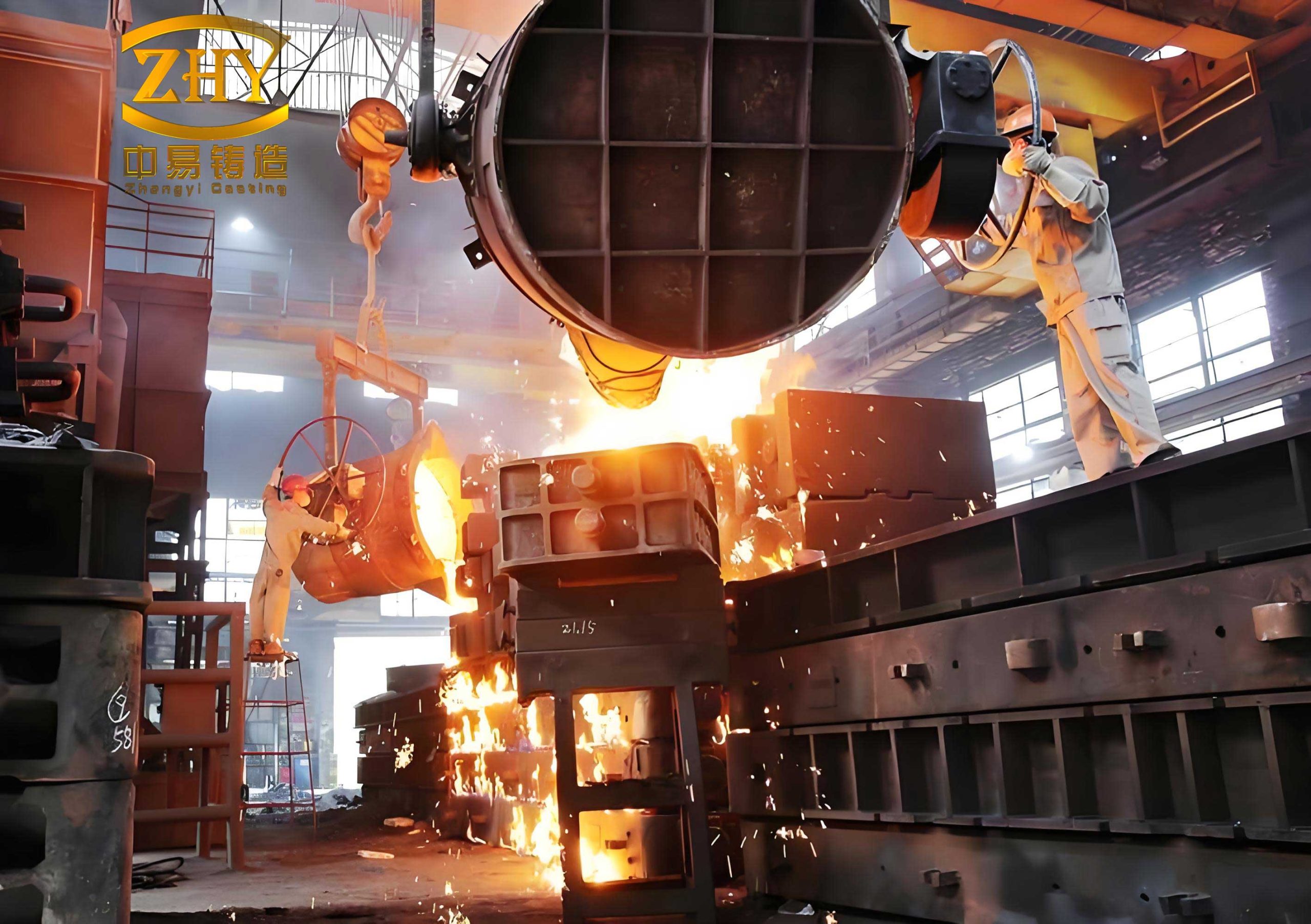
The visual inspection of cast iron parts, as shown in the image, complements quantitative analyses. Surface finish and integrity are critical for applications ranging from automotive to infrastructure. In my practice, I integrate all these methods—thermal analysis, chill tests, ultrasonic testing—into a comprehensive quality control system. This system is tailored to each foundry’s raw materials and processes, as variations in scrap composition or melting practices can significantly affect cast iron part performance. Statistical tracking of data trends allows for proactive adjustments, minimizing defects and ensuring consistency.
Global production trends also inform my work. The latest world casting survey indicates steady growth in cast iron part output, with increasing emphasis on high-strength ductile grades. This aligns with my focus on advanced control techniques to meet evolving market demands. For example, the shift toward electric furnace melting necessitates precise carbon management, as undissolved carbon can lead to graphite flotation in cast iron parts. The carbon coefficient (\(C_{coeff}\)) is adjusted based on thermal analysis: $$C_{coeff} = \frac{C_{thermal}}{C_{chemical}}$$ where \(C_{thermal}\) is the carbon content from thermal analysis and \(C_{chemical}\) is from chemical assay. Values above 1.0 suggest incomplete dissolution, requiring process optimization.
Looking ahead, I am investigating differential cooling curve analysis to assess nucleation states in cast iron parts. The undercooling temperature (\(T_u\)) and recalescence (\(T_r\)) provide insights into graphite formation. The undercooling degree is calculated as: $$\Delta T_u = T_E – T_u$$ where a higher \(\Delta T_u\) indicates poorer nucleation, often leading to undercooled graphite in gray cast iron parts. This parameter helps optimize inoculation practices. For ductile cast iron parts, I monitor the reaction kinetics between magnesium and antimony using time-temperature formulas: $$[Mg]_{effective} = [Mg]_0 \cdot e^{-kt}$$ where \([Mg]_0\) is the initial magnesium content, \(k\) is the decay constant, and \(t\) is time. This explains why prolonged holding can degrade nodularity, emphasizing the need for timely pouring.
In conclusion, the manufacturing of high-quality cast iron parts relies on a multifaceted approach. From alloy design to real-time monitoring, each step contributes to the final properties. My experience underscores the importance of adapting control methods to specific conditions, whether through thermal analysis formulas, digital tools, or ultrasonic testing. As the industry evolves, continued innovation in these areas will drive the production of more reliable and efficient cast iron parts. The integration of data analytics and automation promises further gains, ensuring that cast iron parts remain indispensable in modern engineering. To summarize key formulas and parameters, I have compiled the following table:
| Aspect | Formula/Equation | Relevance to Cast Iron Part |
|---|---|---|
| Carbon Equivalent | $$CE = C + \frac{1}{3}Si + \frac{1}{2}P$$ | Predicts casting behavior and fluidity |
| Carbon from Thermal Analysis | $$C = -0.05 \cdot (T_L – T_E) + 4.5$$ | Ensures precise carbon control in cast iron parts |
| Silicon Estimation | $$Si = -0.02 \cdot T_E + 12.5$$ | Adjusts silicon for matrix structure |
| Ultrasonic Velocity | $$v = \frac{2d}{t}$$ | Assesses graphite nodularity in cast iron parts |
| Antimony Effect | $$P_s = -0.2 \cdot [Sb] + 1.0$$ | Models pearlite stability in ductile cast iron parts |
| Magnesium Decay | $$[Mg] = [Mg]_0 \cdot e^{-0.1t}$$ | Explains球化衰退 in ductile cast iron parts |
Through persistent application of these principles, I have seen significant improvements in the performance and durability of cast iron parts. The journey from molten metal to finished component is fraught with variables, but with rigorous control and innovative techniques, we can consistently produce cast iron parts that meet the highest standards. This holistic view—combining chemistry, physics, and engineering—is what makes the field of cast iron part manufacturing both challenging and rewarding. As I continue to refine these methods, I remain committed to advancing the science and art of casting, ensuring that every cast iron part delivers on its promise of strength, reliability, and efficiency.