
In my extensive research and experience in the field of advanced manufacturing, I have witnessed the critical role that ceramic cores play in precision investment casting, particularly for high-temperature alloy components used in aerospace engines. Precision investment casting is a sophisticated process that enables the production of complex, near-net-shape parts with exceptional dimensional accuracy, and ceramic cores are indispensable for forming internal cavities in these components. The evolution of ceramic core molding technologies has been pivotal in pushing the boundaries of what is achievable in precision investment casting, allowing for thinner walls, more intricate geometries, and improved performance. This article delves into the latest advancements in these molding technologies, emphasizing how they enhance the capabilities of precision investment casting.
The demand for higher efficiency and performance in aerospace engines has driven the need for components that can withstand extreme temperatures and stresses. Precision investment casting is the preferred method for manufacturing such parts, as it offers superior surface finish and dimensional control. Ceramic cores, which are later removed after casting, are essential for creating the internal cooling channels and hollow structures in turbine blades and other critical parts. However, traditional molding methods often fall short in terms of complexity, precision, and production efficiency. In my work, I have explored various advanced molding techniques that address these limitations, revolutionizing the way ceramic cores are fabricated for precision investment casting.
One of the key challenges in precision investment casting is achieving cores with high dimensional stability, adequate strength, and easy removability. Over the years, several innovative molding technologies have emerged, each with unique advantages. These include injection freeze molding, die-less molding techniques such as stereolithography and three-dimensional printing, negative replica methods, and core packing slip casting. Through this article, I aim to provide a comprehensive overview of these technologies, supported by tables and formulas to summarize their characteristics and underlying principles. The integration of these advancements is crucial for advancing precision investment casting to new heights.
To begin, let’s consider the fundamental importance of precision investment casting in modern industry. This process involves creating a wax pattern, coating it with a ceramic shell, melting out the wax, and then pouring molten metal into the cavity. Ceramic cores are inserted into the wax pattern to form internal features, and their quality directly impacts the final part’s integrity. As precision investment casting evolves toward “precision, thin-wall, and near-net-shape” production, the requirements for ceramic cores become more stringent. Innovations in molding technologies are therefore essential to meet these demands, and my research has focused on evaluating and implementing these innovations in practical applications.
Injection Freeze Molding Technology
In my investigations, I have found that injection freeze molding is a promising technique for fabricating ceramic cores with directional pore structures. This method builds upon freeze-drying principles and involves freezing a ceramic slurry in a mold to form a rigid green body. The process starts by mixing ceramic powders with a plasticizer to create a slurry with high solid loading, typically around 58 vol%. The slurry is heated to 60–66°C and then injected into a mold cooled to -30 to -20°C under pressures of 1.4–6.9 MPa. Upon injection, the slurry freezes within 15–60 seconds, solidifying due to the freezing of the liquid binder rather than gelation. The frozen body is then removed and thawed at room temperature, during which gelation occurs, providing sufficient strength for handling.
The advantages of injection freeze molding for precision investment casting are numerous. It allows for near-net-shape成型 with minimal binder usage, eliminating the need for vacuum drying or packing materials during pre-sintering. Additionally, it facilitates the incorporation of ceramic whiskers or fibers, which enhance the core’s sintered properties. After sintering, cores produced via this method exhibit excellent performance, as summarized in the table below:
| Property | Value |
|---|---|
| Room Temperature Bending Strength | 14.5 MPa |
| Apparent Porosity | 33 vol% |
| Volume Density | 1.62 g/cm³ |
| Bulk Density | 2.41 g/cm³ |
| Thermal Expansion (up to 960°C) | 0.31% |
| Cristobalite Content | 25 wt% |
These properties make the cores suitable for casting high-temperature alloys like IN713, and they can be readily removed via alkaline leaching after casting. The process parameters can be optimized using formulas such as the freezing rate equation, which influences pore structure: $$ v_f = \frac{\Delta T}{t_f} $$ where \( v_f \) is the freezing rate, \( \Delta T \) is the temperature difference, and \( t_f \) is the freezing time. Controlling this rate is critical for achieving desired porosity and strength in precision investment casting cores.
Die-less Molding Technologies
In my exploration of die-less molding technologies, I have focused on techniques that eliminate the need for traditional molds, thereby enabling greater design freedom and faster prototyping for precision investment casting. These solid free-form fabrication methods include stereolithography (SL) and three-dimensional printing (3DP), which have revolutionized ceramic core production. The table below compares key die-less molding technologies relevant to precision investment casting:
| Technology | Feedstock | Part Dimension Range | Surface Quality | Precision | Cost of Feedstock | Cost of Process |
|---|---|---|---|---|---|---|
| Stereolithography (SL) | Suspension (layer thickness: 10–50 µm) | 0.1–10 mm | High | <1 µm | Medium-High | Medium |
| Powder 3DP (P-3DP) | Powder (particle size: >20 µm) | 10–1000 mm | Medium | 100 µm | Low | Medium |
| Slurry 3DP (S-3DP) | Suspension (layer thickness: 50–200 µm) | 10–1000 mm | High | 100 µm | Low | Medium |
| Fused Deposition Modeling (FDM) | Paste (filament diameter: 100–1000 µm) | 1–10 mm | Low | 100 µm | Medium | Low |
Stereolithography for ceramic cores involves using a UV-curable resin mixed with ceramic powders to form a slurry. Under computer control, UV light selectively solidifies layers, building the core layer by layer. The slurry must have a high solid content (40–60 vol%) and suitable viscosity (0.1–110 Pa·s at 100 s⁻¹) to ensure proper processing. The curing depth in SL can be described by the formula: $$ C_d = \frac{1}{\alpha} \ln\left(\frac{E}{E_c}\right) $$ where \( C_d \) is the curing depth, \( \alpha \) is the absorption coefficient, \( E \) is the exposure energy, and \( E_c \) is the critical energy for polymerization. This equation helps optimize parameters for precision investment casting cores with fine features.
Three-dimensional printing, on the other hand, uses either powder or slurry feedstocks. In powder 3DP, a binder is jetted onto a powder bed to bond particles, while in slurry 3DP, a ceramic ink is printed directly. Both methods enable rapid fabrication of complex cores for precision investment casting. For instance, the binder penetration in powder 3DP can be modeled using Darcy’s law: $$ v = \frac{k}{\mu} \nabla P $$ where \( v \) is the flow velocity, \( k \) is the permeability, \( \mu \) is the viscosity, and \( \nabla P \) is the pressure gradient. Understanding this is vital for achieving uniform bonding and strength in cores used in precision investment casting.
In my applications, I have utilized these die-less technologies to produce integrated ceramic shells with embedded cores, which simplify the precision investment casting process by ensuring precise core positioning and reducing assembly errors. The ability to create such integrated structures is a significant advancement for precision investment casting, as it enhances dimensional accuracy and reduces lead times.
Negative Replica Method
Another innovative approach I have employed is the negative replica method, which combines additive manufacturing with gel casting to fabricate ceramic cores for precision investment casting. This technique involves first creating a polymer mold with a cavity matching the core geometry using die-less technologies like stereolithography. Then, a ceramic slurry is poured into the mold and solidified via gelation. After drying, the polymer mold is burned out during sintering, leaving behind the ceramic core.
This method leverages the high resolution and surface quality of polymer additive manufacturing, which is more advanced than direct ceramic printing. For precision investment casting, it allows for the production of cores with intricate details that might be challenging with direct methods. The gel casting process typically uses monomers like acrylamide, which polymerize to form a network that binds ceramic particles. The reaction kinetics can be expressed as: $$ \frac{d[M]}{dt} = -k[M][I] $$ where \( [M] \) is monomer concentration, \( [I] \) is initiator concentration, and \( k \) is the rate constant. Optimizing this ensures proper gelation and green strength for precision investment casting cores.
In my work, I have used this method to produce alumina-based cores for turbine blades in precision investment casting. The cores exhibited excellent high-temperature performance due to the formation of multicrystalline phases like yttrium aluminum garnet and magnesium aluminate spinel during sintering at 1550°C. Additionally, integrated shells with complex core structures have been fabricated, enabling the casting of hollow turbine blades with improved accuracy. This underscores the versatility of the negative replica method in advancing precision investment casting capabilities.
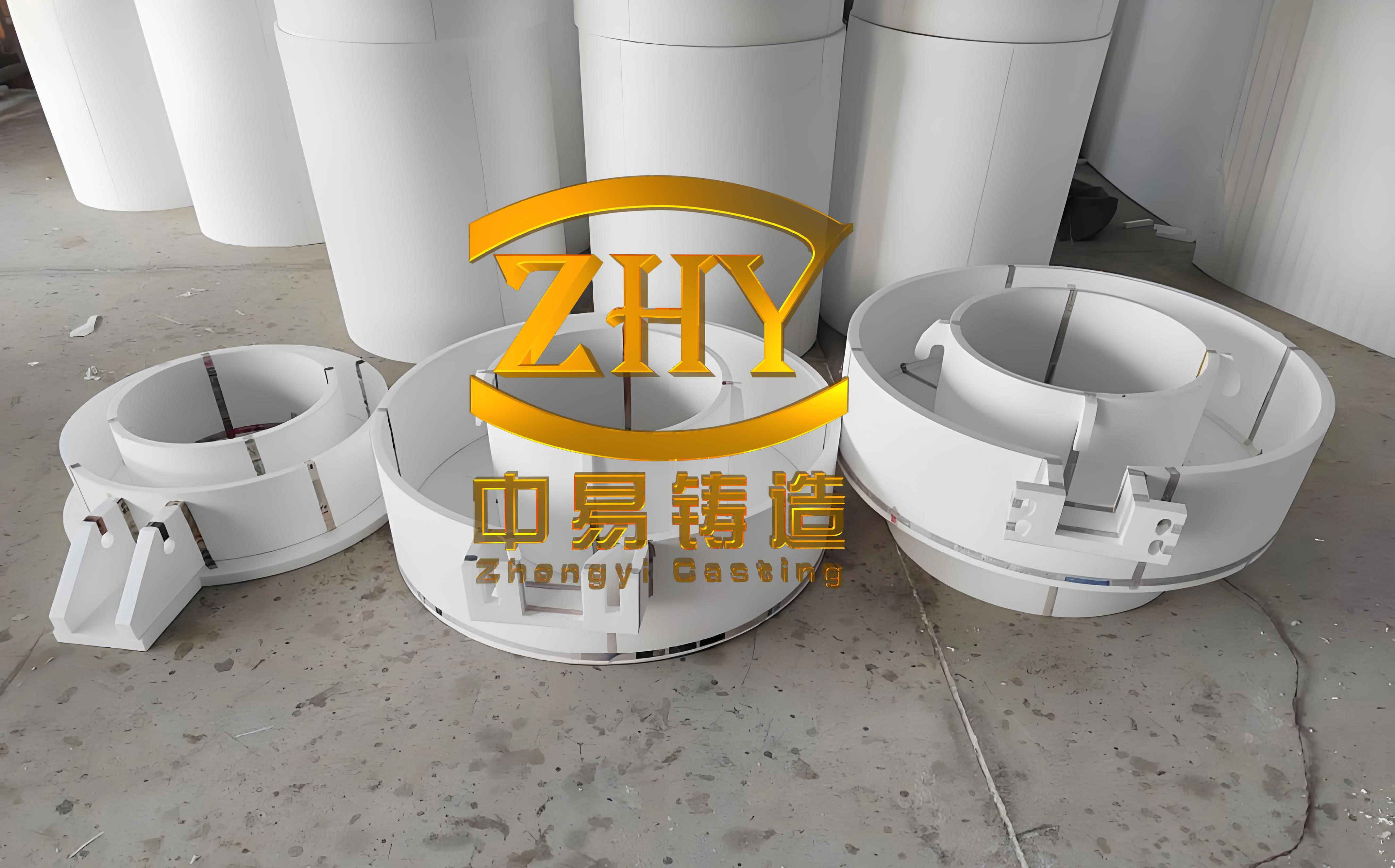
The image above illustrates a casting process related to lost foam casting, which shares some similarities with precision investment casting in terms of using expendable patterns. While lost foam casting uses foam patterns that vaporize, precision investment casting relies on wax patterns and ceramic cores. However, both emphasize the importance of mold and core integrity for achieving high-quality castings. In precision investment casting, ceramic cores must withstand the rigors of metal pouring and be easily removable, making molding technologies critical.
Core Packing Slip Casting Technology
For large castings with internal cavities, such as engine casings in precision investment casting, I have explored core packing slip casting as a practical solution. This technique involves filling the internal cavities of a ceramic shell with a slip (slurry) that solidifies in situ, acting as a core material. Unlike prefabricated cores, this approach is suitable for parts where core insertion is difficult due to size or weight constraints.
The slip must possess good flowability, delayed setting, and high green strength to withstand steam dewaxing stresses. In my research, I have developed slips based on silica sol binders with calcium aluminate additives. The silica sol provides cohesion, while calcium aluminate enhances hydration bonding, leading to high wet strength. The hydration reaction can be summarized as: $$ \text{CaO} \cdot \text{Al}_2\text{O}_3 + \text{H}_2\text{O} \rightarrow \text{CaO} \cdot \text{Al}_2\text{O}_3 \cdot x\text{H}_2\text{O} $$ This reaction forms interlocking hydrates that bond silica particles, crucial for maintaining core integrity during precision investment casting.
Another common system uses phosphate binders, such as ammonium dihydrogen phosphate with magnesium oxide as a hardener. The chemical reactions involved are: $$ \text{MgO} + \text{H}_2\text{O} \rightarrow \text{Mg(OH)}_2 $$ $$ \text{NH}_4\text{H}_2\text{PO}_4 + \text{Mg(OH)}_2 + 4\text{H}_2\text{O} \rightarrow \text{NH}_4\text{MgPO}_4 \cdot 6\text{H}_2\text{O} $$ The formation of ammonium magnesium phosphate hexahydrate consumes water and generates heat, promoting setting. These slips offer high refractoriness and good collapsibility, making them ideal for precision investment casting of complex parts. The table below compares properties of different core packing materials for precision investment casting:
| Material System | Binder | Hardener | Green Strength | Refractoriness | Applications in Precision Investment Casting |
|---|---|---|---|---|---|
| Silica Sol-Based | Silica sol | Calcium aluminate | High | Up to 1600°C | Large thin-wall components |
| Phosphate-Based | Ammonium dihydrogen phosphate | Magnesium oxide | Medium-High | 1300–1600°C | Engine blades and casings |
| Clay-Based | Clay minerals | Water | Low-Medium | 1200–1400°C | General-purpose cores |
Optimizing the slip rheology is essential for successful core packing in precision investment casting. The viscosity (\( \eta \)) as a function of shear rate (\( \dot{\gamma} \)) can be modeled using the Herschel-Bulkley equation: $$ \tau = \tau_0 + K \dot{\gamma}^n $$ where \( \tau \) is shear stress, \( \tau_0 \) is yield stress, \( K \) is consistency index, and \( n \) is flow index. Achieving a shear-thinning behavior (\( n < 1 \)) ensures easy flow during filling and rapid setting afterward, which is vital for precision investment casting processes where time and accuracy are paramount.
Conclusion and Future Perspectives
In summary, my research and experience highlight that advancements in ceramic core molding technologies are revolutionizing precision investment casting. From injection freeze molding to die-less techniques like stereolithography and 3D printing, each method offers unique benefits in terms of complexity, precision, and efficiency. The negative replica method and core packing slip casting further expand the possibilities for producing intricate and large-scale components. Throughout this article, I have emphasized how these technologies contribute to the ongoing evolution of precision investment casting, enabling the manufacture of high-performance aerospace parts with unprecedented accuracy.
However, challenges remain in terms of cost, material availability, and process optimization for industrialization. For instance, die-less technologies often require expensive equipment and proprietary materials, while traditional methods may lack the flexibility for rapid prototyping. Future work should focus on developing more affordable feedstocks, improving software openness, and enhancing the mechanical properties of printed cores. Additionally, integrating digital twins and machine learning could optimize process parameters for precision investment casting, reducing trial-and-error and waste.
The continuous innovation in ceramic core molding is essential for meeting the growing demands of industries reliant on precision investment casting, such as aerospace, energy, and automotive. As these technologies mature, I anticipate broader adoption and further breakthroughs that will push the boundaries of what is possible in precision investment casting. By leveraging formulas, tables, and advanced modeling, researchers and engineers can refine these processes to achieve even greater efficiencies and capabilities. Ultimately, the synergy between ceramic core molding and precision investment casting will drive the next generation of high-temperature alloy components, ensuring superior performance and reliability in critical applications.
In my ongoing efforts, I plan to explore hybrid approaches that combine multiple molding technologies to harness their collective strengths. For example, using stereolithography for fine features and core packing for bulk filling could optimize both precision and cost in precision investment casting. Moreover, sustainability aspects, such as recyclable binders and energy-efficient sintering, warrant attention to align with green manufacturing trends. Through collaborative research and practical implementation, I am confident that the field of precision investment casting will continue to thrive, supported by innovative ceramic core molding technologies that enable the creation of complex, high-integrity parts for the future.