
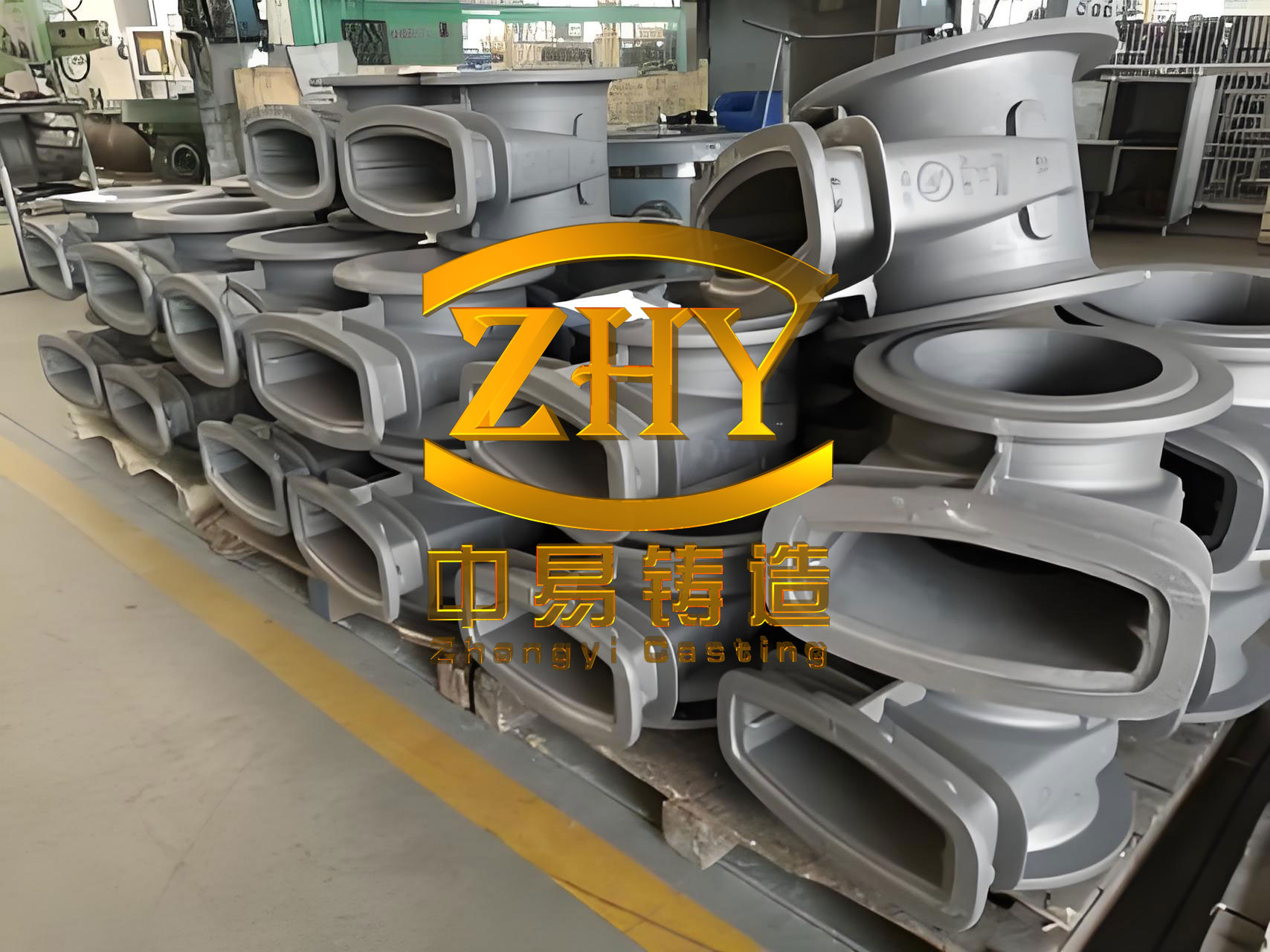
The bearing seat is a critical component in mechanical systems, responsible for supporting and locating rotating shafts while ensuring proper lubrication and sealing. Its performance directly impacts the operational reliability and longevity of the entire machinery. For high-power equipment such as steam turbines, the bearing housing must possess exceptional structural strength, dimensional accuracy, and stability under severe thermal and mechanical loads. Producing large, high-integrity gray iron casting components like these presents significant foundry challenges, primarily due to complex geometries and pronounced variations in wall thickness. This work details a systematic approach to the casting process design for an upper half bearing seat, utilizing numerical simulation as a core tool for optimization to eliminate internal defects and ensure quality.
The successful production of a gray iron casting hinges on a deep understanding of the material’s solidification behavior. Gray iron, particularly grades like HT250, exhibits unique self-compensating properties during solidification. The growth of graphite flakes within the eutectic cells generates internal expansion pressure. This pressure can effectively counteract a portion of the liquid and solidification shrinkage, feeding interdendritic regions and reducing the severity of shrinkage porosity. However, this inherent feeding capacity is limited, especially in heavy sections or isolated hot spots. Therefore, a carefully engineered casting process, combining appropriate gating, risering, and chilling, is essential to guide solidification and direct any remaining shrinkage into the risers.
The first step in any gray iron casting process design is a thorough analysis of the component. The subject of this study is the upper half of a front bearing housing. Its key characteristics, derived from the 3D model, are summarized in Table 1.
| Parameter | Value | Description |
|---|---|---|
| Material | HT250 (Gray Iron) | Specified grade with good castability. |
| Overall Dimensions | 1095 mm × 910 mm × 380 mm | Classified as a medium-sized casting. |
| Finished Part Weight | 566 kg | Target weight after machining. |
| As-Cast Weight (Approx.) | 573 kg | Includes machining allowances, draft, etc. |
| Average Wall Thickness | 25 mm | General section size. |
| Minimum Wall Thickness | 20 mm | Thinnest section requiring fast filling. |
| Maximum Wall Thickness | 153 mm | Major hot spot area prone to shrinkage. |
| Wall Thickness Ratio | ~7.65:1 | High ratio indicating significant thermal gradients. |
The structural complexity is notable. The internal cavity is subdivided by three bearing pedestals with flanges, preventing simple pattern withdrawal. Additionally, side windows (one square, one circular) and a long, curved oil gallery further complicate molding. These features necessitate the use of cores. The primary challenge lies in the extreme variation in wall thickness. The thickest section, at 153 mm, will solidify much later than the surrounding thinner walls, creating a classical hot spot susceptible to macro-shrinkage and porosity if not properly managed. The technical specifications explicitly forbid such defects, mandating a process that ensures directional solidification toward strategically placed feeders.
Casting Process Design Strategy
The foundational decisions in any gray iron casting plan involve the pouring position and parting line. For this bearing seat, the optimal pouring position was determined to be with the large, flat top surface facing upward. This orientation serves two critical purposes: it places the critical bearing mating surfaces (on the sides) in a favorable vertical position for quality, and it conveniently positions the major hot spots at the top for easy riser placement.
Instead of a conventional flat parting plane, a curved parting surface was adopted. This ingenious approach allows the lower mold half to form a significant portion of the internal cavity directly, dramatically simplifying the core assembly. Only two sand cores are required: one for the front bearing pedestal and another, more complex core, to form the oil gallery and adjacent pedestal. This reduction in core count enhances dimensional accuracy, reduces production time and cost, and minimizes potential sources of veining or shifting defects common in complex gray iron casting assemblies.
Gating System Design and Initial Simulation
A bottom-gating system was selected for this gray iron casting. This design promotes calm filling as the mold cavity fills from the bottom up, minimizing turbulence, oxide formation, and air entrapment. A closed system (choke at the sprue base) was chosen to help with slag trapping. The cross-sectional area ratio for the gating system was set as:
$$
\sum A_{\text{Sprue}} : \sum A_{\text{Runner}} : \sum A_{\text{Ingate}} = 1.4 : 1.2 : 1
$$
The total ingate area, acting as the effective choke, was calculated first. The required pouring time (t) is a critical parameter for a successful gray iron casting and was estimated using an empirical formula suitable for iron castings:
$$
t = S \sqrt[3]{\delta G_{\text{casting}}}
$$
Where:
- $t$ is the pouring time (s),
- $\delta$ is the predominant wall thickness (20 mm),
- $G_{\text{casting}}$ is the casting weight (573 kg),
- $S$ is an empirical coefficient (taken as 0.9 for medium-sized iron castings).
This calculation yielded a target pouring time of approximately 35 seconds. Using the choke area calculation method, the total ingate area ($\sum A_{\text{Ingate}}$) was determined to be 26.4 cm². With 8 ingates, each had an area of 3.3 cm². The sprue and runner dimensions were then scaled according to the 1.4:1.2:1 ratio.
To validate the filling behavior and establish a baseline for defect prediction, an initial numerical simulation was performed on the “naked” casting (i.e., the part with only the gating system attached). ProCAST software was used with the following key parameters:
- Pouring Temperature: 1350 °C
- Pouring Time: 35 s
- Material: HT250
- Mold Material: Furan Resin Sand
- Interfacial Heat Transfer Coefficient (Metal-Sand): 1000 W/(m²·K)
The filling sequence confirmed a smooth, quiescent fill from the bottom gates upwards, with no severe splashing or vortexing. However, the solidification and defect prediction analysis revealed the expected problems. Significant surface sinkage was predicted on the top of the massive 153-mm-thick section and on a smaller elliptical boss. More critically, the shrinkage porosity simulation showed extensive defects concentrated in all major hot spots: the central thick section, the side windows, and the small circular bosses. This confirmed that the inherent feeding of the gray iron casting was insufficient for these isolated heavy sections, necessitating the design of a risering and chilling system.
Riser Design and Secondary Simulation
Based on the initial simulation, a risering scheme was devised to promote directional solidification. The goal is to establish a temperature gradient where the casting sections solidify first, followed by the risers, thereby feeding the shrinkage. For this gray iron casting, a combination of riser types was employed:
- A Top Riser (Necking-down type): Placed on the elliptical boss. Its neck helps control the feeding channel and facilitates removal.
- Two Insulating Sleeve Risers: Placed directly on the two thickest hot spots on the main body. Insulating sleeves retard the cooling of the riser, maintaining it liquid longer to feed the casting effectively.
- Four Vent/Atmospheric Risers: Placed at the highest points of the core prints and other elevated sections to allow gas escape during pouring and provide atmospheric pressure to assist feeding.
The dimensions of the main feeding risers were determined using the modulus method, a fundamental approach in gray iron casting design. The modulus (M) is the volume-to-surface-area ratio of a section.
$$
M = \frac{V}{A}
$$
For effective feeding, the riser modulus ($M_r$) must be greater than the modulus of the casting section it feeds ($M_c$). A common rule is $M_r = 1.2 \times M_c$. The casting modulus at the thickest section was calculated, and riser dimensions were selected to satisfy this criterion.
A second simulation was run including the designed gating and risering system. The results showed marked improvement. The surface sinkage was eliminated, and the volume of internal shrinkage was drastically reduced. However, residual micro-porosity was still predicted in several areas: within the small circular bosses and around the edges of the side window openings. These areas, while not the largest, were still solidifying later than their immediate surroundings, creating secondary hot spots. This indicated that risering alone was insufficient to fully control the solidification of this complex gray iron casting; a chilling strategy was required to accelerate cooling in these specific zones.
Chill Design and Final Process Optimization
To eliminate the remaining isolated hot spots and perfect the directional solidification sequence, external chills were incorporated into the process design. Chills are pieces of high thermal conductivity material (often iron or steel) placed in the mold wall. They extract heat rapidly from the adjacent casting section, effectively increasing its solidification rate and shifting its thermal center. For this gray iron casting, five chills were designed:
- Three Conformal Chills: Two were placed on the mold wall adjacent to the side window areas, and one large chill was placed against the lower part of the main thick section. These were shaped to match the casting contour.
- Two Cylindrical Chills: Placed directly underneath the small circular boss sections on the casting’s lower surface.
The chill design must balance effectiveness with avoiding over-chilling, which can cause premature solidification of feeding paths or create hard spots. The thickness of the conformal chills was set to 150 mm, and the cylindrical chills to 20 mm, based on empirical rules related to the adjacent casting wall thickness.
The final simulation integrated the complete system: gating, risers, and chills. The interfacial heat transfer coefficient between the gray iron casting and the iron chills was set to a higher value of 2000 W/(m²·K) to reflect the improved thermal contact. The results of this final simulation were excellent. The predicted shrinkage porosity was completely eliminated from the casting body. The solidification sequence, visualized through temperature field progression, clearly showed the desired directional pattern: thin walls and chilled areas solidified first, followed by progressively thicker sections, with the two insulating sleeve risers remaining liquid longest. All final shrinkage was successfully isolated within the risers.
| Design Stage | Key Features | Simulated Defect Outcome | Action Taken |
|---|---|---|---|
| 1. Initial (Naked Casting) | Bottom gating only. No feeding system. | Severe sink and shrinkage in all thick sections. | Baseline established. Riser design initiated. |
| 2. With Risers | Added 1 open riser, 2 insulating risers, 4 vent risers. | Major shrinkage eliminated. Residual micro-porosity in secondary hot spots (bosses, windows). | Significant improvement. Chill design initiated for local thermal control. |
| 3. Final (With Risers & Chills) | Added 3 conformal chills and 2 cylindrical chills. | Zero shrinkage porosity predicted in the casting body. All shrinkage moved to risers. | Optimal process defined. Directional solidification achieved. |
Analysis of the Final Solidification Process
The efficacy of the final process for this gray iron casting is best understood by analyzing the simulated solidification sequence. At the early stage (t ≈ 1,555 s), solidification is well underway in the thin-walled regions and, critically, in the areas adjacent to the chills. The small circular bosses, aided by the cylindrical chills, have already developed a strong solid shell. The conformal chills around the windows have similarly accelerated cooling in those problematic junctions.
By an intermediate stage (t ≈ 2,585 s), the majority of the casting body is solid. The thermal gradient is clearly visible, with the hottest region now concentrated under the two large insulating risers on the main body. The riser on the elliptical boss has largely solidified, having fed its localized hot spot.
At a late stage (t ≈ 8,635 s), the casting is completely solid. The last regions to solidify are the thermal centers of the two large insulating risers. This confirms that the designed system successfully established the required solidification direction: Casting → Risers. The use of chills was instrumental in “sharpening” this gradient by eliminating intermediate hot spots that could have become isolated and porous. The final calculated yield (casting weight / total poured metal weight) for this optimized gray iron casting process was approximately 85%, which is highly efficient for a complex component requiring extensive feeding.
This project underscores the power of an integrated design and simulation approach for manufacturing high-integrity gray iron casting components. The key conclusions are:
- Process Simplification: The use of a curved parting plane significantly reduced core complexity, enhancing the robustness and repeatability of the production process for this gray iron casting.
- Systematic Design Validation: Numerical simulation was indispensable not just for verifying the initial gating, but for iteratively optimizing the risering and chilling strategy. It provided a clear visual and quantitative prediction of defect formation, guiding each design improvement.
- Achievement of Directional Solidification: Through the combined application of a bottom-gating system, a strategically sized combination of open and insulating risers, and precisely located conformal and cylindrical chills, a controlled thermal gradient was achieved. This ensured that the intrinsic shrinkage of the gray iron casting was systematically fed, resulting in a sound casting free from shrinkage defects.
- Efficiency: The optimized design achieved a high casting yield while meeting all stringent quality requirements, demonstrating that advanced simulation tools are critical for cost-effective and reliable production of complex gray iron castings.
The methodology outlined here provides a proven framework for the design and optimization of similar medium-to-large gray iron casting components, ensuring quality, reducing development time, and minimizing costly trial runs in the foundry.