
In the pursuit of lightweight components for aerospace and aviation industries, magnesium alloys have emerged as pivotal materials due to their high strength-to-weight ratio. However, the inherent flammability of magnesium during casting processes, particularly in sand castings, poses significant safety and technical challenges. This article, from my perspective as a researcher in the field, delves into the current state of flame retardant technologies for magnesium alloys, focusing on both melting and casting stages. I will explore mechanisms, methodologies, and future directions, emphasizing the unique hurdles in aerospace resin-bonded sand castings. The integration of tables and formulas will aid in summarizing key concepts, while a dedicated section on casting process阻燃 will highlight critical advancements.
Magnesium alloys are prone to oxidation and combustion when exposed to oxygen at elevated temperatures, especially during melting and casting. This flammability is exacerbated in sand castings where mold materials, such as resin-bonded sands, release complex gases that can trigger reactions. Traditional阻燃 methods have largely addressed melting过程, but casting过程, particularly for large-scale aerospace components, remains inadequately resolved. My review aims to bridge this gap by synthesizing research from melting to solidification, with a spotlight on sand castings. I will discuss how阻燃 techniques evolve across stages and propose tailored solutions for resin-bonded molds.
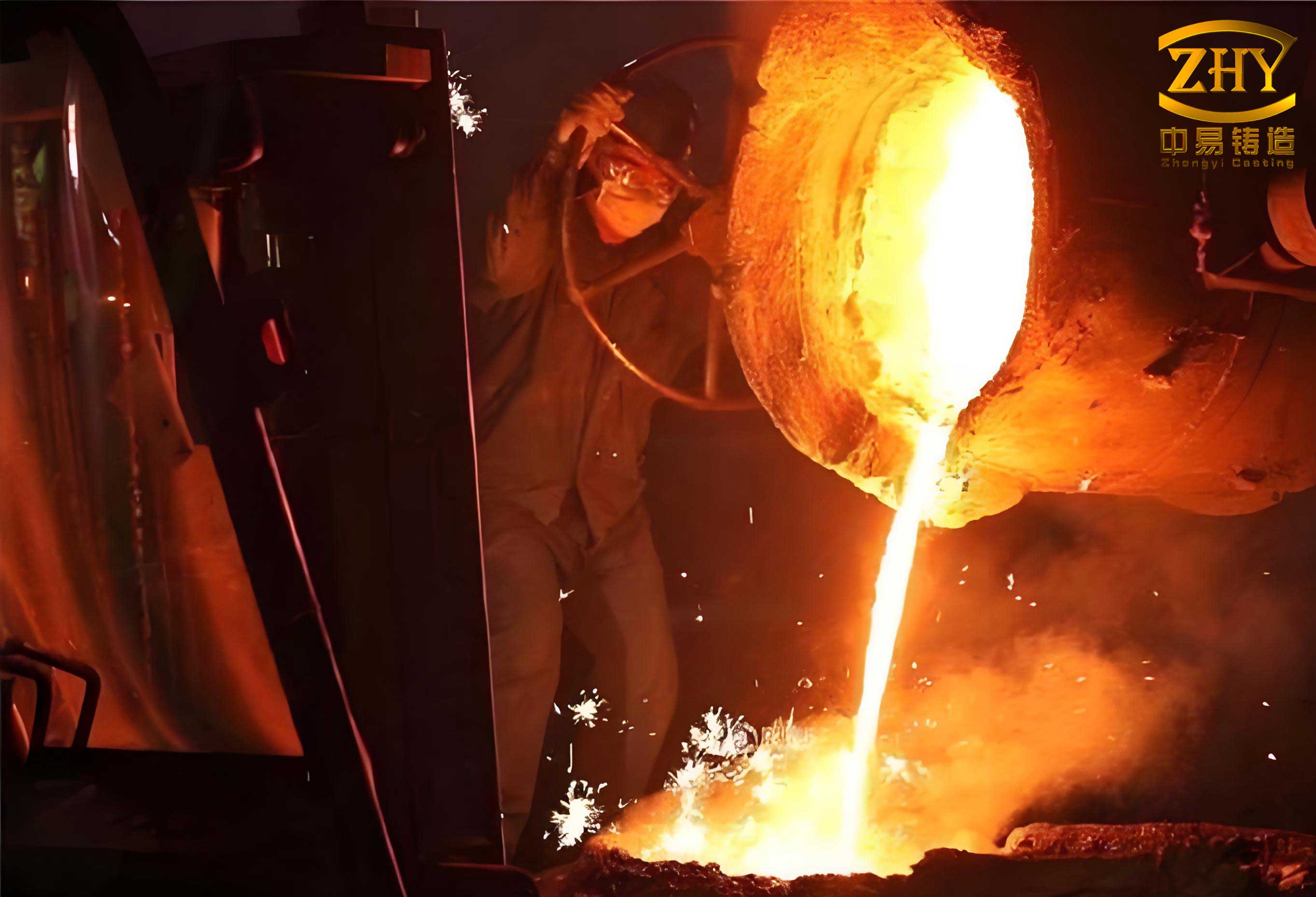
The image above illustrates a typical sand casting setup, underscoring the complexity of mold interactions that necessitate specialized阻燃 strategies. In the following sections, I will dissect阻燃 technologies into melting and casting domains, using tables and formulas to encapsulate data and theories.
Melting Process Flame Retardant Technologies
During melting, magnesium alloys require protection from atmospheric oxygen to prevent ignition. Three primary approaches have been developed: flux protection, gas protection, and alloying阻燃. Each method has distinct mechanisms and applications, which I will detail below.
Flux Protection
Flux protection involves covering the molten alloy with a layer of low-melting-point inorganic compounds that form a liquid barrier. Common fluxes, such as RJ-series fluxes (e.g., RJ-2), comprise mixtures like MgCl₂, NaCl, KCl, BaCl₂, and CaF₂. These fluxes isolate the melt from air, but they introduce issues like secondary pollution, equipment corrosion, and degraded metallurgical quality. The search for alternatives is ongoing, as fluxes, while effective, are less desirable for modern sand castings due to environmental and quality concerns. A comparison of flux compositions and their impacts is presented in Table 1.
| Flux Type | Main Components | Advantages | Disadvantages |
|---|---|---|---|
| RJ-2 | MgCl₂, NaCl, KCl, BaCl₂, CaF₂ | Effective barrier formation | Corrosion, pollution, quality degradation |
| Custom Blends | Varied chlorides and fluorides | Tailored protection | High cost, complexity |
The阻燃 mechanism can be summarized as a physical隔离 layer, but chemical reactions may also occur. For instance, some fluxes react with magnesium to form protective films. However, in sand castings, flux residues can interact with mold materials, complicating casting过程.
Gas Protection
Gas protection relies on atmospheres that either inertly shield or reactively form protective layers on the melt. This method is cleaner than fluxes and is adaptable to casting过程.
Inert Gas Protection
Not all inert gases are suitable for magnesium. Nitrogen, for example, reacts with magnesium as shown in the equation:
$$3Mg + N_2 = Mg_3N_2$$
This reaction yields Mg₃N₂, which is not a致密膜 and fails to prevent continued combustion. Argon, being non-reactive, can serve as a protective gas, but pure Ar allows Mg evaporation. Therefore, mixtures with small amounts of reactive gases like SO₂ or BF₃ are often used to enhance film formation. The efficacy of inert gases depends on their purity and flow rates, critical for sand castings where mold gases may interfere.
Reactive Gas Protection
Reactive gases, such as CO₂, SO₂, and fluorine-containing gases, chemically interact with magnesium to form dense oxide layers. For instance, SF₆ has been widely used but is being phased out due to environmental concerns. Alternatives like HFC-134a (1,1,1,2-tetrafluoroethane) have shown superior阻燃效果, especially at casting temperatures. The reaction with HFC-134a produces a surface film with a “residual effect,” providing prolonged protection even after gas removal. This is particularly beneficial for sand castings where gas coverage may be inconsistent. Table 2 compares common protective gases.
| Gas Type | Chemical Formula | Mechanism | Environmental Impact | Suitability for Sand Castings |
|---|---|---|---|---|
| SF₆ | SF₆ | Forms MgF₂ layer | High global warming potential | Limited due to regulations |
| HFC-134a | C₂H₂F₄ | Forms fluorinated layer with residual effect | Lower impact than SF₆ | High, especially in molds |
| CO₂ | CO₂ | Forms MgO and MgCO₃ | Low | Moderate, but may react with mold gases |
| SO₂ | SO₂ | Forms MgS and MgSO₄ | Toxic, requires handling | Low due to safety concerns |
The阻燃 efficiency of gases can be modeled using kinetic equations. For example, the oxidation rate under a gas atmosphere might follow an Arrhenius-type relation:
$$k = A e^{-E_a / RT}$$
where \(k\) is the rate constant, \(A\) is the pre-exponential factor, \(E_a\) is the activation energy, \(R\) is the gas constant, and \(T\) is the temperature. This highlights the temperature dependence crucial in sand castings where local hot spots can trigger combustion.
Alloying阻燃
Alloying involves adding elements that promote the formation of protective oxide scales. Common阻燃 elements include Ca, Be, Zn, and rare earths (REs) like Ce, La, and Y. These elements integrate into the surface oxide, enhancing its density and adhesion. For instance, Mg-Y-Ce alloys can withstand 900°C for 0.5 hours without protection, showcasing excellent阻燃性. The mechanism often involves the formation of complex oxides, such as Y₂O₃ or CeO₂, which block oxygen diffusion. Multi-element additions, like Ca and Ce, synergize to improve both阻燃 and mechanical properties, vital for aerospace sand castings. Table 3 summarizes key alloying elements.
| Element | Typical Addition (wt%) | Protective Oxide Formed | Effect on Mechanical Properties |
|---|---|---|---|
| Ca | 0.5-2.0 | CaO-MgO混合层 | Improves creep resistance |
| Be | 0.001-0.01 | BeO-rich layer | Enhances ductility but toxic |
| RE (e.g., Ce) | 1-5 | RE₂O₃ or RE oxides | Refines grain, strengthens |
| Y | 2-4 | Y₂O₃ | High-temperature stability |
The oxidation process for alloyed systems can be described using parabolic growth laws, where the oxide thickness \(x\) relates to time \(t\):
$$x^2 = k_p t$$
with \(k_p\) as the parabolic rate constant. Alloying alters \(k_p\) by modifying oxide morphology, a critical factor in sand castings where prolonged exposure to mold atmospheres occurs.
Casting Process Flame Retardant Technologies
The casting process, especially in sand castings, introduces additional challenges due to interactions between the molten alloy and mold materials. While melting阻燃 techniques can be adapted, the dynamic environment of mold cavities demands specialized approaches. I will focus on resin-bonded sand castings, prevalent in aerospace for large, complex components.
Differences from Melting Process阻燃
In casting, the alloy is exposed to mold gases released during thermal decomposition of binders, such as in PEP-SET resin sands. These gases—including CO₂, CO, NO, CH₄, and C₂H₆—can ignite magnesium. Unlike melting, where atmospheres are controlled, mold cavities have variable gas compositions and temperatures, making阻燃 more complex. Moreover, the filling and solidification stages involve turbulent flow and thermal gradients, increasing combustion risks. Therefore,阻燃 strategies must account for实时 atmosphere monitoring and active control.
Current Techniques and Limitations
Traditional casting阻燃 methods include using protective gases like Ar or CO₂/SF₆ mixtures during pouring. For instance, in die casting, Ar protection in hot chambers is common, but for large sand castings, cold chamber processes with gas shrouding are employed. However, these methods are often inadequate for resin-bonded molds due to high gas evolution and complex geometries. Environmental concerns also limit gases like SF₆. Research has thus shifted towards understanding ignition mechanisms in mold cavities.
My collaborative work has involved simulating mold atmospheres to study ignition. By controlling temperature and gas composition in a reaction chamber, we observed the oxidation of magnesium alloys under PEP-SET resin sand conditions. As shown in prior studies, gas evolution follows a sequence: NO, CO, and CO₂ peak first, followed by CH₄ and C₂H₆. This temporal variation affects ignition points, necessitating dynamic阻燃 responses. For pure镁, oxide thickness and morphology change with temperature and time, as captured in kinetics models.
Advanced Research and Future Directions
From my perspective, the key to effective阻燃 in sand castings lies in mechanistic insights. We have developed experimental setups to directly observe ignition, enabling us to identify critical conditions. For example, Mg-Al, Mg-RE, and Mg-Zn alloys exhibit distinct oxidation behaviors in resin sand atmospheres. Based on this, I propose several innovative approaches:
- Hot Spot Control: Optimizing casting designs to minimize thermal gradients and hotspots where ignition initiates. This involves computational fluid dynamics (CFD) simulations to predict temperature fields in sand castings.
- Active Atmosphere Control: Injecting阻燃 gases into mold cavities实时 based on gas sensor feedback. For instance, HFC-134a could be released during critical gas evolution phases.
- Mold Material Modification: Developing low-gas-emitting binders or coatings that reduce combustible gas release. Nanoparticle additives might enhance阻燃 by forming protective layers at the alloy-mold interface.
These strategies integrate melting and casting阻燃, offering holistic solutions. Table 4 contrasts various casting阻燃 techniques.
| Technique | Principle | Advantages | Challenges |
|---|---|---|---|
| Gas Shrouding | Covering pouring stream with inert/reactive gases | Simple, adaptable | Ineffective in deep molds, environmental issues |
| Mold Atmosphere Control | Monitoring and adjusting cavity gases | Real-time adaptation | Requires sensors and complex systems |
| Alloy Design | Using阻燃 alloy compositions | Intrinsic protection, no external agents | May compromise other properties |
| Thermal Management | Controlling solidification patterns | Reduces ignition triggers | Design-intensive, simulation-dependent |
Mathematically, the ignition risk in a mold cavity can be modeled using a critical temperature criterion coupled with gas concentration thresholds. For instance, ignition might occur if:
$$T \geq T_{\text{crit}} \quad \text{and} \quad C_{\text{O}_2} \geq C_{\text{crit}}$$
where \(T\) is local temperature, \(T_{\text{crit}}\) is the ignition temperature (e.g., 600°C for some alloys), and \(C\) represents gas concentrations. This underscores the need for multi-parameter control in sand castings.
Conclusion and Future Outlook
In summary, flame retardant technologies for magnesium alloy sand castings have evolved significantly, yet casting过程阻燃 remains a瓶颈. From my viewpoint, melting process methods like gas protection and alloying provide foundations, but they must be tailored for the dynamic environments of resin-bonded molds. The future of aerospace镁合金铸造 lies in integrated approaches that combine mechanistic understanding, real-time monitoring, and advanced materials. I emphasize that research should prioritize ignition kinetics in mold atmospheres, leveraging simulations and experiments to develop reliable阻燃 protocols. As sand castings continue to enable large, complex components, overcoming flammability will unlock their full potential in lightweight engineering.
This review has synthesized key advancements, using tables and formulas to encapsulate complex data. I hope it inspires further innovation in阻燃 technologies, ensuring safe and efficient magnesium alloy sand castings for high-performance applications.