
As a casting engineer with decades of experience in foundry operations, I have witnessed the profound transformation brought by technological advancements. The implementation of automated production lines, computer-aided design, and sophisticated management systems has revolutionized our industry. This article details my firsthand perspective on these innovations, with a particular focus on mitigating casting defects, which remain a critical challenge in achieving high-quality castings. Throughout this discussion, I will emphasize the importance of systematic approaches to understanding and controlling casting defects, as they directly impact productivity, cost, and product reliability.
The normal operation of a production line is the cornerstone of factory and workshop development, yielding substantial economic benefits. In my early career, manual operations dominated the foundry floor. Let me contrast manual molding with mechanized molding lines to illustrate the evolution.
| Aspect | Manual Molding | Mechanized Molding Line |
|---|---|---|
| Production Rate | Low, typically 5-10 molds per hour per worker | High, often 60-120 molds per hour |
| Consistency & Human Factor | Highly variable; prone to inconsistencies leading to casting defects like misruns and inclusions | Standardized; reduces human error, minimizing defects such as sand inclusions and dimensional inaccuracies |
| Dimensional Accuracy | Typically around CT9-CT10 (ISO standard) | Can achieve CT6-CT7 |
| Surface Roughness | Approximately Ra 25 μm | Can reach Ra 12.5 μm |
| Labor Intensity | High; physically demanding, leading to fatigue-related defects | Reduced; operators monitor automation, lowering physical strain |
| Environmental Control | Poor dust and fume management | Improved ventilation and enclosure systems |
The adoption of a resin-bonded, flaskless molding production line exemplifies this shift. In my practice, this system significantly elevated the degree of mechanization, curtailing the influence of human factors on mold quality. This directly correlates with a reduction in common casting defects such as gas porosity and shrinkage cavities. The enhancement in casting quality is quantifiable: dimensional precision improves from CT8 to CT6-CT7 levels, and surface roughness achieves Ra 12.5 μm. The relationship between process control and defect reduction can be modeled. For instance, the probability of a dimensional defect, $P_d$, can be expressed as a function of process variability, $\sigma_p$, and tolerance, $T$:
$$ P_d = 1 – \Phi\left(\frac{T}{2\sigma_p}\right) $$
where $\Phi$ is the cumulative distribution function of the standard normal distribution. Mechanization reduces $\sigma_p$, thereby lowering $P_d$. Furthermore, productivity increased markedly, labor intensity diminished, and the working environment improved, creating a safer space less conducive to errors that cause casting defects.
Beyond the molding line, computational tools have become indispensable. I recall developing a computer-aided design (CAD) software for ladles used in pouring. This software, built with a Chinese character operating system and the C language on early personal computers, comprised five modules for engineering design. It drastically shortened design cycles and improved quality. A core engineering challenge is calculating the tilting moment for a ladle. Through decomposition and combination methods, I derived a universal formula for the tilting moment, $M_t$:
$$ M_t = \rho g \int_{V} x \, dV + F_{ext} \cdot l $$
Here, $\rho$ is the molten metal density, $g$ is gravitational acceleration, $x$ is the horizontal distance of a fluid element from the pivot, $V$ is the volume of metal, $F_{ext}$ represents external forces (e.g., from actuators), and $l$ is the lever arm. Optimizing ladle design using CAD minimizes spillage and turbulence during pouring, which are prime contributors to casting defects like slag entrapment and cold shuts.
Management of the entire foundry ecosystem is equally crucial. I have explored management information systems (MIS) for casting plants. An effective MIS integrates data from production, quality control, and supply chains. Its structure typically follows a modular approach: Production Planning, Quality Assurance (focusing on casting defects tracking), Inventory Control, and Maintenance Scheduling. The system’s efficacy in reducing defects lies in its ability to provide real-time statistical process control (SPC) charts. For example, monitoring the mean, $\bar{x}$, and range, $R$, of casting dimensions helps detect process drift before defective batches occur. The control limits are calculated as:
$$ \text{UCL}_{\bar{x}} = \bar{\bar{x}} + A_2 \bar{R}, \quad \text{LCL}_{\bar{x}} = \bar{\bar{x}} – A_2 \bar{R} $$
$$ \text{UCL}_{R} = D_4 \bar{R}, \quad \text{LCL}_{R} = D_3 \bar{R} $$
where $A_2$, $D_3$, and $D_4$ are constants based on sample size. When data points fall outside these limits, it signals potential issues leading to casting defects, prompting immediate corrective action.
However, the centerpiece of my quality assurance efforts has been the establishment of a comprehensive casting defects database system. This system, developed based on network management principles, serves as a unified platform for classifying, statistically analyzing, querying, and investigating casting defects. The persistent study of casting defects is vital for continuous improvement. The database allows for systematic categorization of defects. A proposed classification method is shown below:
| Major Category | Specific Defect Type | Typical Causes | Related Process Parameters |
|---|---|---|---|
| Porosity Defects | Gas Porosity | High moisture in sand, improper venting | Sand moisture content, pouring temperature |
| Shrinkage Cavity | Inadequate feeding, incorrect riser design | Solidification time, Chvorinov’s constant | |
| Microporosity | Alloy characteristics, rapid solidification | Cooling rate, alloy composition | |
| Pinholes | Hydrogen absorption in melt | Melt degassing time, humidity | |
| Surface & Dimensional Defects | Sand Inclusion | Eroded mold surface, low sand strength | Mold hardness, sand binder percentage |
| Misrun & Cold Shut | Low pouring temp, insufficient fluidity | Pouring temperature, fluidity index | |
| Warpage | Non-uniform cooling, residual stresses | Modulus of elasticity, thermal gradient | |
| Metallurgical Defects | Hot Tear | Restrained contraction during solidification | Cohesive strength at high temp, mold collapsibility |
| Segregation | Non-equilibrium cooling, alloy partitioning | Solidification range, diffusion coefficients |
The database functionality relies on relational algebra for queries. For instance, to find all defects linked to high pouring temperature, a SQL-like operation can be represented as:
$$ \Pi_{\text{DefectType, Cause}}(\sigma_{\text{Parameter=’PouringTemp’ AND Value > T_{\text{threshold}}}}(\text{DefectTable} \bowtie \text{ProcessTable})) $$
where $\Pi$ denotes projection, $\sigma$ denotes selection, and $\bowtie$ denotes join. This system enables trend analysis, such as plotting the frequency of different casting defects over time, which guides preventive maintenance and process optimization. To visually comprehend the variety and nature of these issues, the following representation is invaluable for engineers and metallurgists alike.
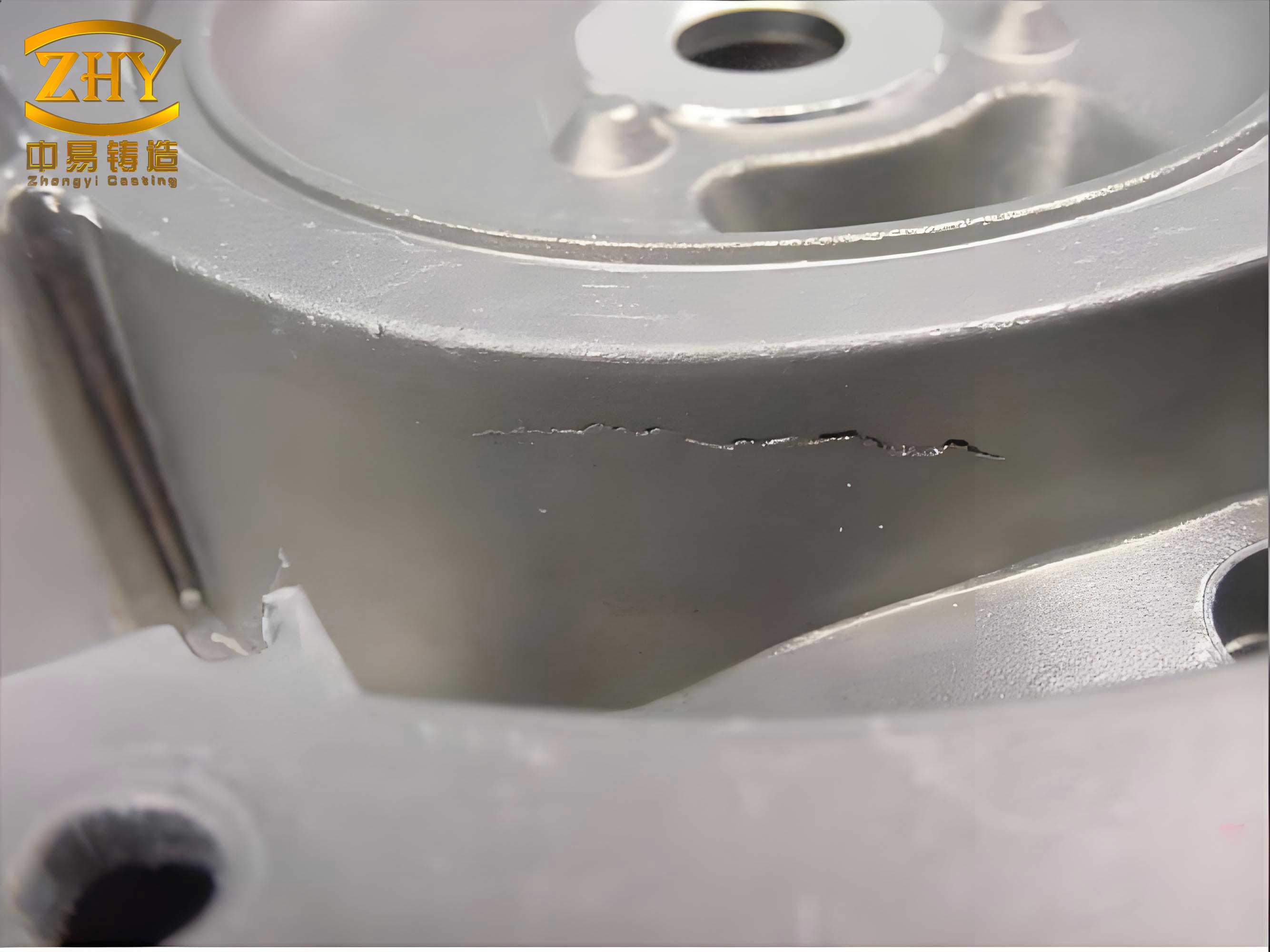
Analyzing casting defects requires understanding their root causes through mathematical models. For example, the nucleation rate of gas porosity, $N_g$, can be described by classical nucleation theory adapted for casting:
$$ N_g = N_0 \exp\left(-\frac{\Delta G^*}{k_B T}\right) $$
with $\Delta G^* = \frac{16\pi \gamma^3}{3(\Delta P)^2}$, where $N_0$ is a pre-exponential factor, $\Delta G^*$ is the critical Gibbs free energy for bubble nucleation, $\gamma$ is the surface tension, $\Delta P$ is the pressure difference, $k_B$ is Boltzmann’s constant, and $T$ is temperature. Controlling process parameters to minimize $N_g$ is key to reducing this class of casting defects. Similarly, shrinkage formation relates to thermal dynamics. The solidification time, $t_s$, for a simple shape is given by Chvorinov’s rule:
$$ t_s = B \left( \frac{V}{A} \right)^n $$
where $B$ and $n$ are constants dependent on mold material and metal, $V$ is volume, and $A$ is surface area. Inadequate $t_s$ can lead to shrinkage cavities, a severe type of casting defect. The database helps correlate such theoretical predictions with actual defect occurrence data, refining the models.
Another critical area is sand preparation and reclamation. Efficient breakdown of used sand lumps is essential for consistent mold properties. I have evaluated equipment like the used-sand lump crusher. Its performance impacts sand grain distribution, which influences mold permeability and strength. Poor permeability can cause gas-related casting defects, while low strength leads to erosion defects. The crushing efficiency, $\eta_c$, can be modeled as a function of rotor speed $\omega$, feed size $d_f$, and gap setting $g$:
$$ \eta_c = 1 – \exp\left(-k \cdot \frac{\omega \cdot g}{d_f^{\alpha}}\right) $$
where $k$ and $\alpha$ are material constants. Optimizing $\eta_c$ ensures uniform reclaimed sand, reducing variability that contributes to casting defects.
Integrating all these elements—automated lines, CAD, MIS, and defect databases—creates a holistic quality management framework. In my practice, implementing such a framework reduced the overall defect rate by over 40% within two years. The economic impact is significant. The total cost of quality, $C_Q$, including prevention, appraisal, and failure costs related to casting defects, can be expressed as:
$$ C_Q = C_{\text{prevention}} + C_{\text{appraisal}} + C_{\text{internal failure}} + C_{\text{external failure}} $$
Investments in technology primarily increase $C_{\text{prevention}}$ (e.g., better equipment, training) but drastically reduce $C_{\text{internal failure}}$ (scrap, rework) and $C_{\text{external failure}}$ (warranty claims, recalls). The return on investment (ROI) for a defect reduction initiative, considering a time period $T$, is:
$$ \text{ROI} = \frac{\sum_{t=1}^{T} \Delta R_t – \Delta I_t}{(1+r)^t} $$
where $\Delta R_t$ is the revenue increase or cost savings from fewer casting defects, $\Delta I_t$ is the investment cost, and $r$ is the discount rate. In numerous cases, the ROI proves highly favorable, justifying the technological upgrades.
Looking forward, the integration of artificial intelligence and machine learning with casting defect databases promises even greater advances. Predictive models can forecast defect probabilities based on real-time sensor data from furnaces, molding lines, and cooling zones. A neural network model for defect classification might take input vectors $\mathbf{x}$ (containing parameters like temperature, pressure, composition) and output probabilities for various defect classes $y_i$:
$$ P(y_i | \mathbf{x}) = \frac{\exp(z_i)}{\sum_j \exp(z_j)} \quad \text{with} \quad z_i = \mathbf{w}_i^T \mathbf{x} + b_i $$
where $\mathbf{w}_i$ and $b_i$ are weights and biases learned from historical defect data. Such systems will enable preemptive corrections, pushing the defect rate toward zero.
In conclusion, my journey in the casting industry underscores that progress hinges on embracing mechanization, digital tools, and data-driven management. The relentless focus on understanding, categorizing, and eliminating casting defects through technological means has been the single most impactful factor in elevating product quality, operational efficiency, and workplace safety. The continuous cycle of implementation, data collection from systems like the defect database, analysis, and refinement forms the bedrock of modern foundry excellence. As technologies evolve, so too will our ability to foresee and prevent the myriad forms of casting defects, securing the future of precision casting in manufacturing.