
As a researcher deeply engaged in the field of metallic materials, particularly cast irons, I have witnessed a significant paradigm shift in the understanding and application of silicon in ductile iron casting. For decades, the prevailing wisdom, stemming from early patents, cautioned that silicon contents above 2.5 wt.% would embrittle the material. This perspective largely confined ductile iron casting to strength enhancement methods reliant on increasing hard phase fractions, such as pearlite, invariably at the expense of ductility. The emergence of silicon solution-strengthened ferritic ductile iron (SSFDI), or high-silicon ductile iron (HSI), represents a fundamental breakthrough, enabling superior combinations of strength and elongation. This article, from my perspective, synthesizes the research progress on this pivotal material, focusing on its performance metrics, underlying mechanisms, and future potential, with a particular emphasis on quantitative comparisons through tables and theoretical models.
1. The Evolution and Significance of High-Silicon Ductile Iron
The journey of ductile iron casting has been intertwined with a re-evaluation of silicon’s role. The initial perception of silicon as an embrittling element has been systematically overturned through rigorous investigation. The development of SSFDI can be traced to industrial needs in the late 20th century, such as Volvo’s search for more uniform properties and better machinability in the 1980s. This research unveiled that elevating silicon content not only met these practical goals but also unlocked a new strengthening mechanism: solid solution strengthening. Silicon atoms, with a smaller atomic radius (117 pm) than iron (124 pm), dissolve in the ferritic matrix, creating lattice strain that impedes dislocation motion, thereby enhancing strength without relying on brittle phases.
This discovery led to the classification of SSFDI as a “second-generation” ductile iron casting material, alongside Austempered Ductile Iron (ADI). Its commercial and technical importance is underscored by its formal inclusion in international standards (e.g., BS EN 1563, ISO 1083, GB/T 1348) with grades such as EN-GJS-450-18, 500-14, and 600-10. The industrial adoption is growing, with estimates suggesting that up to 20% of traditional pearlitic grades could be replaced by SSFDI. Applications are expanding from wind energy castings and water pipes to automotive components like differential cases, driven by the promise of lightweight design, cost-effectiveness over the full product lifecycle, and excellent recyclability.
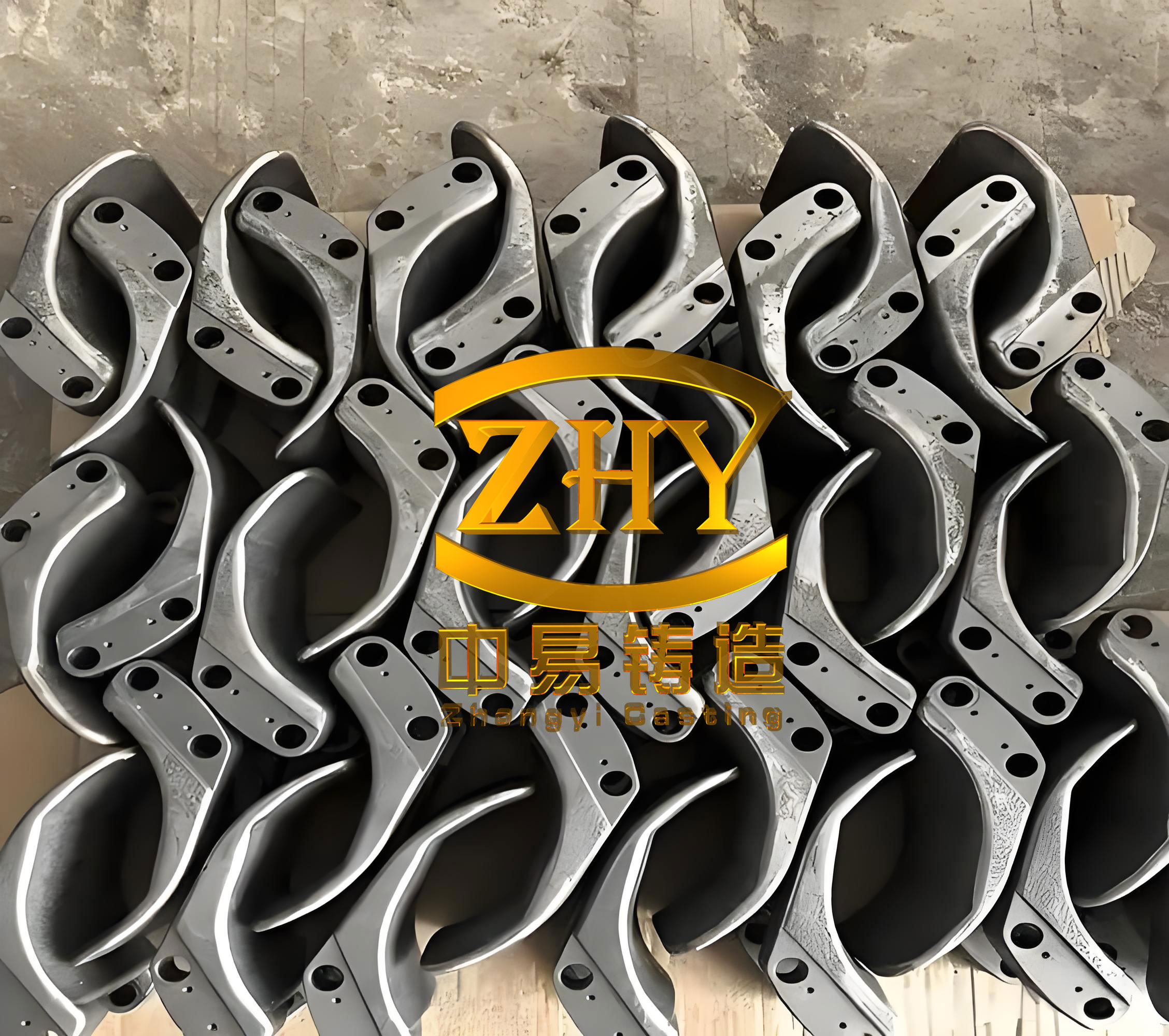
2. Comprehensive Performance Analysis of High-Silicon Ductile Iron
The superior performance of high-silicon ductile iron casting is not monolithic; it presents a complex interplay of enhanced and, in some aspects, compromised properties compared to conventional grades. A detailed, quantitative analysis is essential.
2.1 Tensile Properties and the Strength-Ductility Balance
The hallmark of SSFDI is its improved tensile property profile. Silicon content is the primary variable, and its effect follows a distinct pattern. Data from numerous studies can be consolidated to reveal trends.
| Material Type (Approx. Si wt.%) | Tensile Strength, Rm (MPa) | Yield Strength, Rp0.2 (MPa) | Elongation, A (%) | Yield Ratio (Rp0.2/Rm) |
|---|---|---|---|---|
| Conventional EN-GJS-500-7 (~2.4%) | 500 | 320 | 7 | 0.64 |
| SSFDI EN-GJS-500-14 (~3.8%) | 500 | 380 – 420 | 14 | 0.76 – 0.84 |
| SSFDI EN-GJS-600-10 (~4.3%) | 600 – 660 | 480 – 550 | 10 – 20 | 0.80 – 0.83 |
| High-Si Experimental (~5.0%) | 700+ | 560+ | < 10 | > 0.80 |
The table clearly shows that for equivalent tensile strength, SSFDI offers significantly higher yield strength and elongation. The yield ratio, a critical design parameter, is substantially higher (0.76-0.83) for SSFDI compared to conventional grades (~0.52-0.64). This implies better utilization of the material’s strength, facilitating lightweight design, though it also demands careful attention to safety factors.
The relationship between silicon content and strength can be modeled. The solid solution strengthening contribution ($\Delta \sigma_{ss}$) from silicon in ferrite is often described by a relationship of the form:
$$ \Delta \sigma_{ss} = k_{Si} \cdot (C_{Si})^m $$
where $k_{Si}$ is a strengthening coefficient, $C_{Si}$ is the silicon concentration, and $m$ is an exponent typically between 0.5 and 1. Research indicates that both Rm and Rp0.2 increase with Si up to a critical point (≈4.3-4.9%), beyond which they plateau or decrease, while elongation shows a more pronounced decline, marking the onset of room-temperature embrittlement.
2.2 Impact and Fracture Toughness
The toughness of ductile iron casting is multifaceted. Charpy impact tests reveal a sensitivity to both silicon content and temperature.
| Material Grade | Charpy Impact Energy at 23°C (J) | Charpy Impact Energy at -20°C (J) | Note |
|---|---|---|---|
| EN-GJS-400-15 | 15 | 12 | Conventional Ferritic |
| EN-GJS-500-7 | 7 – 11 | 5 – 8 | Conventional Pearlitic-Ferritic |
| EN-GJS-500-14 (SSFDI) | 3 – 8 | ~5 | Higher Strength SSFDI |
SSFDI generally exhibits lower Charpy impact energies than conventional ferritic grades of similar strength, with a notable drop observed as Si exceeds ~3.8%. This embrittlement is more acute in notched impact tests than in plain tensile ductility. However, fracture toughness under dynamic or cyclic loading presents a different picture. While static fracture toughness ($K_{IC}$) decreases linearly with increasing Si, the threshold stress intensity factor for fatigue crack growth ($\Delta K_{th}$) is often higher for SSFDI. This suggests that high-silicon ductile iron casting may be more resistant to crack initiation under cyclic loads, a property crucial for components like crankshafts or gearbox housings.
2.3 Fatigue Performance
Fatigue strength is a key advantage of SSFDI. The absence of hard, brittle pearlite colonies, which can act as fatigue crack initiation sites, combined with a more homogeneous ferritic matrix, contributes to improved performance. Experimental data shows:
$$ \sigma_{w}(SSFDI, \text{ e.g., 500-14}) \approx 280 – 350 \text{ MPa} $$
$$ \sigma_{w}(Conventional, \text{ e.g., 500-7}) \approx 170 – 260 \text{ MPa} $$
where $\sigma_w$ is the fatigue endurance limit at 10⁷ cycles. This significant enhancement, often 20-40% higher, makes SSFDI exceptionally suitable for dynamically loaded ductile iron casting components, directly supporting weight reduction strategies in automotive and machinery sectors.
2.4 Thermal Properties: Conductivity and Volume Stability
Alloying elements, particularly silicon, reduce the thermal conductivity ($\lambda$) of iron. For ferritic ductile iron casting, the conductivity can be approximated as a function of silicon content and temperature (T).
$$ \lambda(T, C_{Si}) \approx \lambda_0(T) – \beta \cdot C_{Si} $$
where $\lambda_0(T)$ is the conductivity of pure ferritic iron and $\beta$ is a positive coefficient. Consequently, SSFDI has lower thermal conductivity than conventional grades. This influences solidification patterns, leading to higher thermal gradients and a tendency toward more concentrated shrinkage, which must be accounted for in riser design.
Regarding volume stability, SSFDI exhibits superior performance during thermal cycling. Conventional pearlitic grades undergo irreversible growth due to the decomposition of cementite (Fe₃C) into graphite and ferrite:
$$ Fe_3C \rightarrow 3Fe(\alpha) + C(graphite) $$
This graphitization expansion is absent in the fully ferritic matrix of SSFDI. Studies show SSFDI components experience minimal permanent volume change after repeated heating-cooling cycles between room temperature and 600°C, enhancing dimensional stability in applications like exhaust manifolds or brake discs.
2.5 Machinability
The uniform, carbide-free ferritic microstructure of SSFDI dramatically improves machinability. Tool life during machining operations is reported to be 70% to over 100% longer compared to machining conventional pearlitic grades of equivalent hardness or strength. This translates directly into lower production costs, higher throughput, and better surface finish for ductile iron casting components.
3. Underlying Mechanisms and the Challenge of Embrittlement
The performance characteristics, both advantageous and limiting, are rooted in microstructural mechanisms. A critical analysis of these is vital for future progress.
3.1 Solid Solution Strengthening and Ductility
The primary strengthening mechanism is the lattice strain caused by dissolved Si atoms. The increase in yield strength is well-correlated with Si content up to the solubility limit in ferrite. However, the concomitant decrease in ductility and impact toughness, especially beyond ~4.3% Si, points to additional factors. Research suggests the formation of ordered intermetallic phases, such as Fe₃Si (DO₃) or FeSi (B2), which are brittle. These nanoscale phases may form via a spinodal decomposition reaction in supersaturated ferrite:
$$ \alpha (Fe-Si solid solution) \rightarrow \alpha_1 (Si-lean) + \alpha_2 (Fe-Si ordered phase) $$
The critical silicon content for this transition in ductile iron casting is still debated (between 3% and 5%), but its occurrence is a leading hypothesis for room-temperature embrittlement.
3.2 Intermediate-Temperature Embrittlement (ITE)
The pronounced ductility minimum observed around 400-500°C in both conventional and high-silicon ductile iron casting is a major concern. The dominant theory involves the segregation of surface-active elements like magnesium (Mg) to austenite grain boundaries during solidification and their subsequent retention. Upon exposure to intermediate temperatures, these segregants weaken the grain boundaries. The embrittlement susceptibility ($ES$) might be empirically related to residual Mg content:
$$ ES \propto [Mg]_{residual} $$
Mitigation strategies include minimizing residual Mg (aiming for <0.045%), adding trace elements like P or Sb to form stable compounds with Mg (e.g., Mg₃P₂), and increasing cooling rate to refine grain structure and reduce segregation. While helpful, these methods do not completely eliminate ITE, indicating that other mechanisms, possibly involving other impurities or dynamic strain aging, may also contribute.
4. Future Research Directions and Application Prospects
Based on the current state of knowledge, I foresee several key avenues for advancing high-silicon ductile iron casting.
4.1 Fundamental Research Focus
The paramount challenge remains a complete understanding of the embrittlement mechanisms. Future work must employ advanced characterization techniques (APT, HR-TEM) to definitively identify the nature, composition, and distribution of brittle ordered phases and grain boundary segregants in SSFDI. Computational thermodynamics and kinetics modeling will be crucial in predicting phase stability and segregation behavior. Furthermore, research should explore multi-element solid solution strengthening, partially substituting Si with elements like Al or Mn to achieve high strength while delaying or suppressing detrimental phase formation.
4.2 Expanding the Application Landscape
The superior property combination—high yield ratio, excellent fatigue strength, good dynamic fracture toughness, and outstanding machinability—positions SSFDI as an ideal material for lightweight engineering. I anticipate its increased adoption in:
- Automotive: Suspension components, differential cases, and engine brackets where weight savings and fatigue performance are critical.
- Energy: Wind turbine hubs and frames, benefiting from the high integrity and stability of large ductile iron casting.
- Infrastructure: Pipes and fittings requiring high durability and corrosion resistance.
The decision to use SSFDI should be based on a holistic life-cycle cost analysis, factoring in raw material, manufacturing (including saved heat treatment and machining costs), performance, and recyclability benefits.
4.3 Process Optimization and Sustainability
Developing robust foundry processes for complex and heavy-section SSFDI castings is essential. This includes optimizing inoculation practices to ensure graphite nodularity even with high Si, managing shrinkage behavior due to lower conductivity, and establishing reliable quality control metrics. From a sustainability perspective, the ability to use higher percentages of steel scrap in the charge and the material’s full recyclability align perfectly with the green manufacturing trends, further enhancing the appeal of this advanced ductile iron casting material.
5. Conclusion
In my assessment, silicon solution-strengthened ferritic ductile iron represents a transformative advancement in ductile iron casting technology. It successfully decouples the traditional strength-ductility trade-off by employing a fundamental solid solution strengthening mechanism. While challenges persist, particularly regarding a comprehensive understanding of its embrittlement tendencies at room and intermediate temperatures, the performance benefits are substantial and well-documented. Its high yield strength, exceptional fatigue resistance, superior machinability, and thermal stability offer compelling advantages for weight-sensitive and dynamically loaded components. As research continues to unravel the underlying microstructural science and foundry processes mature, I am confident that high-silicon ductile iron will solidify its role as a cornerstone material for efficient, sustainable, and high-performance metal casting in the 21st century.