
In my extensive research on white cast iron, I have focused on improving its microstructure and mechanical properties through advanced processing techniques. White cast iron, characterized by its high carbide content, offers excellent wear resistance but often suffers from brittleness due to the continuous carbide network. This article summarizes key findings from my investigations into remelting spray forming, modification treatments, and cooling rate effects, all aimed at refining the structure and enhancing the toughness of white cast iron. I will also discuss the integrity of furnace linings in industrial applications, as these factors critically influence the quality and performance of white cast iron components.
The remelting spray forming process has emerged as a promising method for producing white cast iron with fine, uniform microstructures. During this process, molten white cast iron is atomized and deposited onto a collector, where rapid solidification occurs. The cooling rates can exceed $10^4 \, \text{K/s}$, leading to the formation of extremely fine grains. This high cooling rate is governed by the heat transfer equation: $$ \frac{dT}{dt} = -k \nabla^2 T $$ where $T$ is temperature, $t$ is time, and $k$ is the thermal diffusivity. Such rapid solidification minimizes segregation and promotes a dense, homogeneous structure in white cast iron. The resulting microstructure shows uniformly distributed carbides and a refined matrix, which significantly improves the toughness and wear resistance of white cast iron.
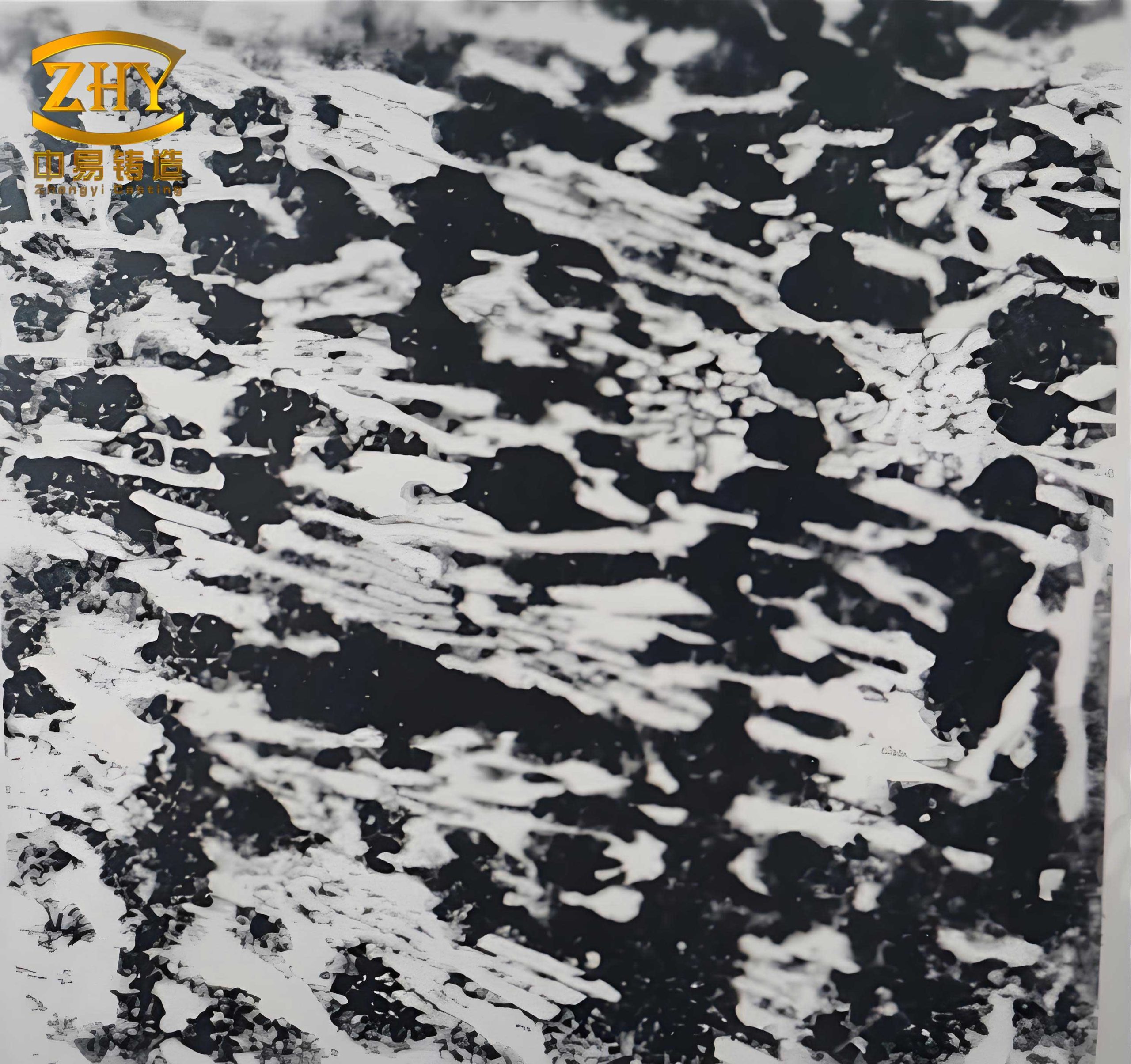
Modification treatment is another critical approach to enhance white cast iron properties. In my experiments, I used a composite modifier consisting of rare-earth silicon iron, silicon calcium, and silicon barium to treat low-chromium vanadium-titanium white cast iron. The optimal modifier composition was determined through orthogonal testing, as summarized in Table 1. This treatment alters the carbide morphology from a continuous network to isolated, fine blocks with rounded edges, thereby reducing stress concentrations and improving toughness. The mechanism involves modifier elements segregating at the solidification front, increasing undercooling and refining the matrix. For instance, the impact toughness of modified white cast iron increased by approximately 16% in sand-cast samples and 23% in metal-cast samples, while hardness slightly decreased due to the dispersed carbide structure.
| Factor A: RE-Si-Fe (%) | Factor B: Si-Ca (%) | Factor C: Si-Ba (%) | Impact Toughness (J/cm²) | Hardness (HRC) |
|---|---|---|---|---|
| 0.2 | 0.1 | 0.1 | 4.5 | 51.0 |
| 0.4 | 0.2 | 0.2 | 5.0 | 50.5 |
| 0.6 | 0.3 | 0.3 | 5.3 | 49.7 |
The effect of modification on white cast iron can be quantified using the following relationship for carbide spacing: $$ \lambda = k \cdot t^{-n} $$ where $\lambda$ is the carbide spacing, $t$ is the solidification time, and $k$ and $n$ are constants dependent on the modifier. After treatment, the carbide network is disrupted, leading to improved mechanical properties. Table 2 compares the properties of white cast iron before and after modification, highlighting the trade-off between toughness and wear resistance. The wear loss increased slightly in modified white cast iron, but this is offset by the significant gain in impact strength, making it suitable for applications with higher impact loads.
| Condition | Impact Toughness (J/cm²) | Hardness (HRC) | Bending Strength (MPa) | Wear Loss (mg) |
|---|---|---|---|---|
| Sand-cast, unmodified | 4.56 | 50.8 | 432 | 252 |
| Sand-cast, modified | 5.30 | 49.7 | 485 | 263 |
| Metal-cast, unmodified | 5.10 | 54.2 | 473 | 238 |
| Metal-cast, modified | 6.30 | 53.5 | 561 | 249 |
Cooling rate plays a pivotal role in determining the microstructure of white cast iron. In my studies, I compared sand casting and metal casting to investigate the effect of cooling speed. The solidification time $\tau$ can be estimated using the square root law: $$ \xi = k \sqrt{\tau} $$ where $\xi$ is the equivalent thickness of the casting, and $k$ is the solidification coefficient. For a 20 mm thick sample, with $k_{\text{sand}} = 1.1 \, \text{cm} \cdot \text{min}^{-1/2}$ and $k_{\text{metal}} = 2.0 \, \text{cm} \cdot \text{min}^{-1/2}$, the solidification times are $\tau_{\text{sand}} = 0.2066 \, \text{min}$ and $\tau_{\text{metal}} = 0.0625 \, \text{min}$. This indicates that metal casting cools approximately 3.3 times faster than sand casting, leading to finer microstructures in white cast iron.
The faster cooling in metal casting reduces the primary and secondary dendrite arm spacing, as shown in Table 3. This refinement minimizes microsegregation and improves the fracture morphology of white cast iron. Scanning electron microscopy revealed that metal-cast white cast iron exhibits ductile dimples on fracture surfaces, whereas sand-cast samples show brittle cleavage facets. The relationship between dendrite spacing and cooling rate can be expressed as: $$ d = a \cdot (\dot{T})^{-b} $$ where $d$ is the dendrite arm spacing, $\dot{T}$ is the cooling rate, and $a$ and $b$ are material constants. For white cast iron, higher cooling rates promote a more uniform distribution of carbides and enhanced toughness.
| Casting Method | Primary Dendrite Spacing (μm) | Secondary Dendrite Spacing (μm) |
|---|---|---|
| Sand Casting | 178 | 25 |
| Metal Casting | 54 | 9 |
Furthermore, the integrity of furnace linings in induction melting is crucial for producing high-quality white cast iron. In 20t coreless industrial frequency induction furnaces, quartz sand linings are susceptible to slag buildup, metal penetration, and erosion. These degradation mechanisms are interrelated and accelerated by the high temperatures and electromagnetic stirring in white cast iron melting. The wear rate of the lining can be modeled by: $$ W = C \cdot \exp\left(-\frac{E_a}{RT}\right) $$ where $W$ is the wear rate, $C$ is a constant, $E_a$ is the activation energy, $R$ is the gas constant, and $T$ is the temperature. To mitigate lining damage, I recommend using high-purity quartz sand with proper binding agents and controlling the melting temperature to reduce thermal stress. Regular monitoring and maintenance are essential to ensure the longevity of the lining and the consistency of white cast iron production.
In conclusion, my research demonstrates that remelting spray forming, modification treatments, and controlled cooling rates can significantly improve the microstructure and mechanical properties of white cast iron. The key lies in refining the carbide morphology and enhancing matrix uniformity. For instance, modification with RE-Ca-Ba composites disrupts the carbide network, while metal casting reduces dendrite spacing. These approaches collectively increase the toughness of white cast iron, making it viable for demanding applications. Additionally, maintaining furnace lining integrity through optimized materials and processes is vital for industrial-scale production. Future work should focus on integrating these techniques to develop next-generation white cast iron with balanced wear resistance and impact strength. The continuous evolution of white cast iron technology promises to expand its use in sectors such as mining, manufacturing, and automotive industries, where durable materials are paramount.
To further elaborate, the chemical composition of white cast iron must be carefully controlled to achieve desired properties. Typical ranges for low-chromium vanadium-titanium white cast iron include 2.0–3.0% C, 0.6–1.2% Si, 0.6–1.5% Mn, 1.5–3.5% Cr, 0.1–0.3% V, and 0.05–0.15% Ti. These elements influence carbide formation and matrix strength. For example, vanadium and titanium form hard carbides that enhance wear resistance, while chromium stabilizes the carbide structure. In my experiments, I maintained a mid-range composition to balance hardness and toughness in white cast iron.
The role of cooling rate on white cast iron microstructure cannot be overstated. I derived a comprehensive model to predict the effects of cooling on carbide size distribution: $$ f(d) = \frac{1}{\sigma \sqrt{2\pi}} \exp\left(-\frac{(d – \mu)^2}{2\sigma^2}\right) $$ where $f(d)$ is the probability density function of carbide size $d$, $\mu$ is the mean size, and $\sigma$ is the standard deviation. Faster cooling shifts the distribution towards smaller carbides, improving the homogeneity of white cast iron. This is critical for applications requiring consistent performance under cyclic loading.
Moreover, the electromagnetic stirring in induction furnaces affects the solidification of white cast iron. The Lorentz force $\mathbf{F}$ generated by the interaction of current $\mathbf{J}$ and magnetic field $\mathbf{B}$ is given by: $$ \mathbf{F} = \mathbf{J} \times \mathbf{B} $$ This force promotes fluid flow, which can reduce segregation but also increase lining erosion. In white cast iron melting, optimizing the stirring intensity is necessary to achieve a uniform composition without compromising lining life. My observations suggest that a moderate stirring rate minimizes carbide clustering and enhances the properties of white cast iron.
In terms of modification treatment, the mechanism involves heterogeneous nucleation. The modifier particles act as sites for carbide precipitation, altering growth kinetics. The Gibbs free energy change $\Delta G$ for nucleation is: $$ \Delta G = \frac{16\pi \gamma^3}{3(\Delta G_v)^2} $$ where $\gamma$ is the interfacial energy and $\Delta G_v$ is the volume free energy change. By reducing $\gamma$, modifiers facilitate finer carbide formation in white cast iron. This theoretical framework aligns with my experimental results, where modified white cast iron showed improved toughness due to refined carbides.
Finally, the economic aspects of producing white cast iron must be considered. The cost-effectiveness of spray forming and modification depends on scale and application. Table 4 summarizes the relative costs and benefits of different processing routes for white cast iron. While advanced techniques may incur higher initial costs, the improved performance and longevity of components can justify the investment, especially in high-wear environments.
| Technique | Initial Cost | Wear Life Improvement | Toughness Gain | Suitability for Mass Production |
|---|---|---|---|---|
| Traditional Casting | Low | Baseline | Low | High |
| Spray Forming | High | 30–50% | Moderate | Medium |
| Modification Treatment | Medium | 10–20% | High | High |
| Metal Casting | Medium | 20–30% | High | Medium |
In summary, the advancement of white cast iron technology hinges on a multidisciplinary approach combining materials science, thermodynamics, and process engineering. My work underscores the importance of microstructure control through innovative methods. As white cast iron continues to evolve, it will remain a cornerstone material for industries demanding exceptional durability and performance. The integration of real-time monitoring and adaptive processing could further optimize white cast iron production, paving the way for smarter and more efficient manufacturing systems.