
In my extensive experience within the foundry industry, the production of high-quality sand casting products consistently presents challenges related to feeding and solidification control. Traditional methods often rely on metallic pads or chills to enhance riser efficiency, but these approaches incur significant material waste and energy costs during removal, especially for premium alloys like duplex stainless steels. This drove our investigation into alternative materials, leading to the adoption of exothermic padding systems. The goal was to maintain the integrity of sand casting products while reducing resource consumption and overall expenses.
The fundamental principle behind exothermic pads involves substituting metallic sections with combustible materials that generate heat upon contact with molten metal. This heat input prolongs the liquid state in strategic areas, effectively creating feeding channels without the need for additional metal. For sand casting products requiring rigorous nondestructive testing, such as valve bodies in corrosive environments, this innovation holds promise. Our focus was on a specific exothermic blend, known for its superior thermal properties, which we integrated into the production of duplex steel castings.
| Parameter | Metallic Pad Design | Exothermic Pad Design (EX5 BLEND) |
|---|---|---|
| Pad Dimensions (mm) | 270 × 260 × 90 | 270 × 260 × 90 |
| Number of Pads per Casting | 2 | 2 |
| Theoretical Metal Weight per Pad (kg) | 35 | 0 (replaced by exothermic material) |
| Total Added Metal Weight (kg) | 70 | 0 |
| Casting Pouring Weight (kg) | 1050 | 980 |
| Process Yield (Calculated) | 51.4% | 55.1% |
| Post-casting Removal Method | Mechanical cutting (plasma, sawing) | Vibration shakeout (self-disintegrating) |
| Estimated Energy Cost for Removal | High | Negligible |
The thermal performance of an exothermic material is critical for its success in sand casting products. We analyzed the heat release profile, which can be approximated by a modified exponential decay function representing the sustained temperature plateau above the solidus point. For a generic exothermic system, the effective feeding time, $t_f$, can be related to the heat generation rate:
$$ Q(t) = Q_{max} \cdot e^{-\lambda t} + Q_{base} $$
where $Q(t)$ is the instantaneous heat flux (W/m²), $Q_{max}$ is the peak exothermic heat release, $\lambda$ is the decay constant specific to the material composition, and $Q_{base}$ represents the insulating properties that maintain temperature. For the EX5 BLEND material, empirical data showed a prolonged duration where the metal temperature remained above 1,147 °C, a key threshold for feeding duplex steel sand casting products. The holding time, $\Delta t_{hold}$, satisfies the condition for adequate feeding:
$$ \Delta t_{hold} \geq \frac{V_{feed} \cdot \rho \cdot L_f}{A_{pad} \cdot k \cdot \Delta T} $$
Here, $V_{feed}$ is the volume requiring feeding (m³), $\rho$ is the metal density (kg/m³), $L_f$ is the latent heat of fusion (J/kg), $A_{pad}$ is the pad cross-sectional area (m²), $k$ is the thermal conductivity of the mold (W/m·K), and $\Delta T$ is the temperature difference between the liquidus and solidus. This formula underscores why selecting an exothermic material with high $Q_{max}$ and low $\lambda$ is vital for complex sand casting products.
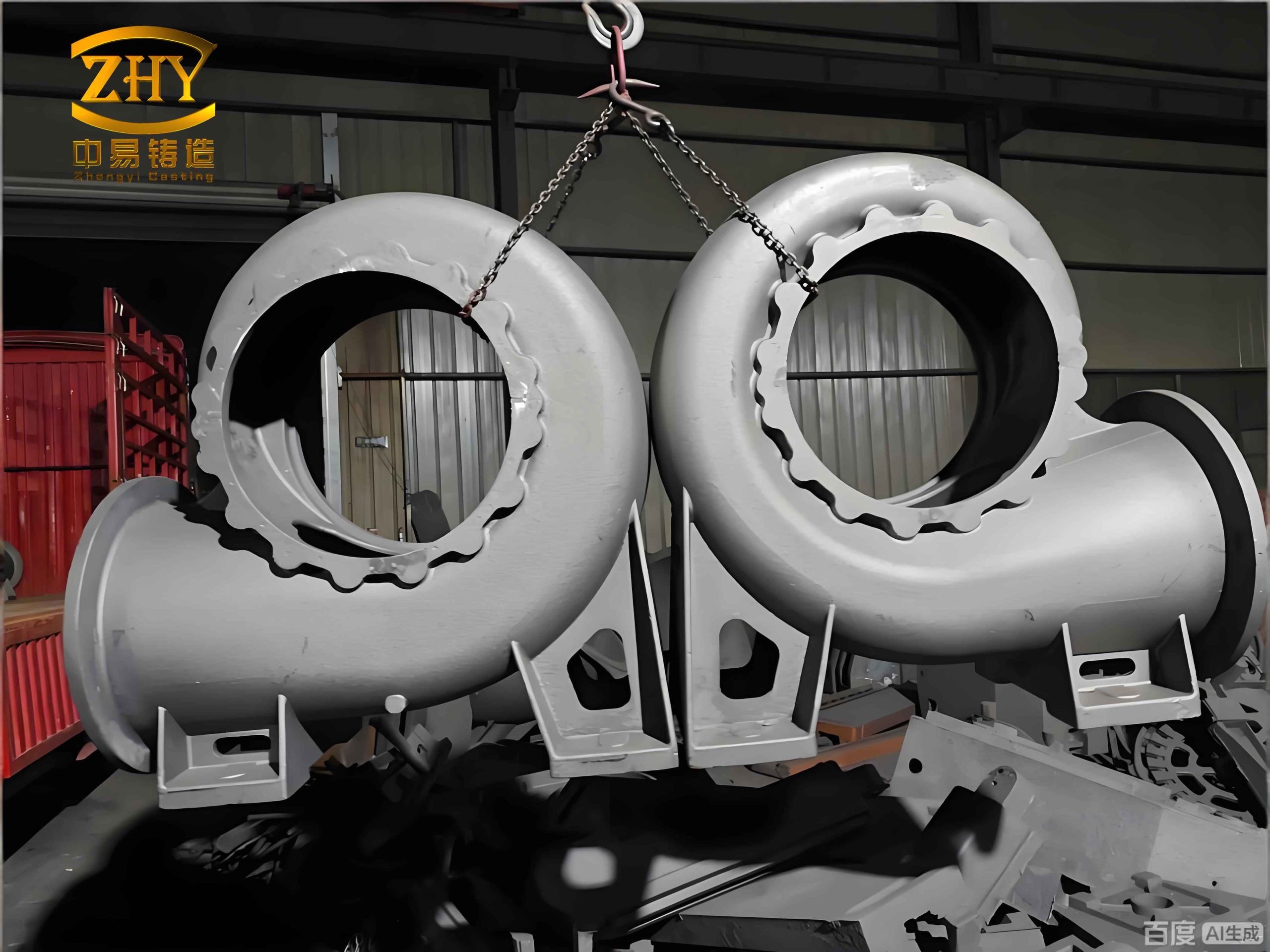
The selection of an appropriate exothermic blend was paramount. After evaluating several commercial options, we identified a proprietary EX5 BLEND formula that demonstrated exceptional exothermic and insulating characteristics. When compared to standard exothermic compounds, this material extended the temperature maintenance period by over 150% under identical conditions, which directly translates to more reliable feeding for thick-section sand casting products. The enhanced performance is attributed to a balanced mix of oxidizers, metallic fuels, and ceramic insulating agents, which react synergistically upon metal contact.
Our experimental subject was a gate valve body, a representative heavy-section sand casting product with stringent quality requirements. The casting outline dimensions were 830 mm × 500 mm × 440 mm, with a rough weight of 540 kg, manufactured from duplex stainless steel ASTM A890 Grade 5A. This alloy is widely used in demanding applications due to its corrosion resistance and mechanical strength, making it a perfect candidate for testing improvements in sand casting product manufacturing. The design process involved both conventional metallic pad calculation and novel exothermic pad simulation.
For the metallic pad design, we referenced established foundry engineering charts that account for casting geometry and solidification moduli. The pad dimensions were initially calculated based on the flange’s modulus and then refined using solidification simulation software. The iterative simulation process aimed to eliminate shrinkage porosity, a common defect in sand casting products. The final metallic pad design had a volume calculated to compensate for the shrinkage in the flange region. The process yield, a key metric for cost-efficiency in sand casting products, was determined as:
$$ Yield = \frac{W_{casting}}{W_{pouring}} \times 100\% $$
where $W_{casting}$ is the finished casting weight and $W_{pouring}$ is the total metal poured, including risers, gates, and pads. For the metallic pad design, the yield was 51.4%, indicating substantial metal usage in non-product features.
| Simulation Aspect | Metallic Pad Configuration | Exothermic Pad Configuration |
|---|---|---|
| Feeding Distance Criteria (mm) | Based on geometric modulus | Adjusted for exothermic heat input |
| Thermal Properties of Pad in Model | Steel (ASTM A890 5A) | EX5 BLEND custom material data | Critical Solidification Time (s) | $$ t_{crit, metal} = \frac{(T_{pour} – T_{solidus})^2}{4 \alpha \cdot \pi} $$ | $$ t_{crit, exo} = t_{crit, metal} + \Delta t_{hold} $$ |
| Predicted Shrinkage Location | None in fed regions | None in fed regions |
| Software-Validated Feeding Efficiency | Adequate | Superior due to extended feeding time |
Designing the exothermic pad required integrating the material’s thermophysical properties into the simulation software. We input parameters such as specific heat capacity, thermal conductivity, and the exothermic reaction enthalpy as a function of temperature. The pad geometry was kept identical to the metallic version to facilitate direct comparison. The simulation predicted that the exothermic pad would create a favorable temperature gradient, directing solidification toward the riser. This is crucial for producing sound sand casting products without internal defects. The modified Niyama criterion, often used to predict shrinkage in simulations, was satisfied in both designs, confirming their viability.
The production trial involved casting two identical valve bodies in the same heat of molten duplex steel. One utilized traditional metallic pads on its flanges, while the other employed preformed EX5 BLEND exothermic pads. The fabrication of the exothermic pads involved mixing the powdered material with a binder in precise ratios, then compacting it in a core box to achieve the desired 270 mm × 260 mm × 90 mm dimensions. These pre-cast pads were then positioned on the pattern during molding, ensuring proper venting channels were incorporated to allow gases from the exothermic reaction to escape—a critical step to prevent gas defects in the final sand casting products.
During molding, the exothermic pads were treated like any other sand core: they were coated with a refractory wash and dried. This process ensured a smooth metal-pad interface and prevented sand fusion. For sand casting products of this size and alloy type, maintaining mold stability is essential. The pouring temperature was carefully controlled at approximately 1,580 °C, consistent with standard practice for duplex steels. The exothermic reaction initiated immediately upon metal contact, generating intense local heating that was visually evident through the vent ports.
After shakeout, the visual inspection revealed stark differences. The metallic pads required aggressive mechanical removal, a process that consumes energy and tooling. In contrast, the spent exothermic material had largely disintegrated during vibration cleaning, leaving a relatively smooth casting surface. The surface finish of the casting adjacent to the exothermic pad was comparable to areas formed against the sand mold, with no signs of burning-in or metal penetration. This ease of cleanup represents a significant operational advantage for high-volume sand casting products.
To quantitatively assess internal quality, both castings underwent full volumetric radiographic inspection per stringent customer specifications. The results confirmed that neither casting exhibited shrinkage cavities, porosity, or hot tears in the flange sections fed by the respective pads. This validated the simulation predictions and proved that the exothermic pad could reliably ensure soundness in critical sand casting products. The ability to pass such rigorous NDT standards is non-negotiable for components used in pressure-containing applications.
The economic analysis further underscores the value of this technology for sand casting products. The direct material saving is evident from the increased process yield—from 51.4% to 55.1%. This 3.7 percentage point improvement may seem modest, but for a 540 kg casting, it translates to saving approximately 38 kg of high-alloy duplex steel per unit. The cost savings, $S$, can be modeled as:
$$ S = (W_{metal, saved} \cdot C_{metal}) + (E_{removal, metal} – E_{removal, exo}) \cdot C_{energy} – C_{exo, material} $$
where $C_{metal}$ is the cost per kg of duplex steel, $E_{removal}$ is the energy required for pad removal, $C_{energy}$ is the energy cost, and $C_{exo, material}$ is the cost of the exothermic pad material. For our trial, even accounting for the price of the EX5 BLEND material, the net saving per casting was substantial. Furthermore, eliminating the cutting/grinding step reduces labor time, consumable costs (e.g., plasma gas, cutting blades), and improves workshop safety by minimizing fumes and sparks—all beneficial for the sustainable production of sand casting products.
| Cost Factor | Metallic Pad Method | Exothermic Pad Method | Net Difference |
|---|---|---|---|
| Metal Cost (Alloy Duplex Steel) | Based on 1050 kg poured | Based on 980 kg poured | Savings of 70 kg metal |
| Pad Material Cost | Zero (recyclable but accounted as loss) | Cost of EX5 BLEND for two pads | Additional material cost |
| Removal Energy (kWh) | Estimated 15-20 kWh (plasma cutting) | ~0.5 kWh (shakeout energy) | Savings > 14.5 kWh |
| Labor for Removal (hours) | 1.5 – 2 hours | 0.2 hours (inspection/cleaning) | Savings > 1.3 hours |
| Total Estimated Cost Saving per Casting | Approximately 12-18% of pad-related costs | Positive | |
The successful implementation of exothermic pads also has implications for the design flexibility of sand casting products. By providing a more predictable and controllable heat source, designers can potentially reduce riser sizes or optimize their placement, further improving yield. The technology is not limited to duplex steels; it can be adapted for other high-alloy sand casting products, such as those in super duplex, high-nickel alloys, or even heavy-section carbon and low-alloy steels. The key is matching the exothermic material’s reaction kinetics to the solidification characteristics of the specific alloy.
From a quality assurance perspective, the consistency of the exothermic reaction is vital. We conducted multiple tests to verify that the EX5 BLEND material produced repeatable thermal curves. The time-temperature integral, $I_{heat}$, which influences the feeding capacity, was calculated for each batch:
$$ I_{heat} = \int_{0}^{t_{end}} (T_{pad}(t) – T_{solidus}) \, dt $$
where $T_{pad}(t)$ is the temperature at the pad-metal interface derived from thermocouple data or simulation. The low variance in $I_{heat}$ across different production lots confirmed the material’s reliability, making it suitable for quality-critical sand casting products manufactured in large batches.
In conclusion, the integration of high-performance exothermic padding materials like EX5 BLEND represents a significant advancement in the manufacture of sand casting products. Our comprehensive trial, encompassing simulation design, practical foundry operations, and rigorous inspection, demonstrated that these pads can effectively replace traditional metallic pads. They fulfill the feeding function while delivering tangible benefits: reduced consumption of expensive alloy metal, lower energy expenditure during cleanup, decreased labor input, and an overall improvement in process yield. For foundries aiming to enhance the competitiveness and sustainability of their sand casting products, adopting such exothermic technologies is a strategically sound decision. The future work will involve optimizing pad geometries specifically for exothermic performance and extending the application to even more complex sand casting products with varying wall thicknesses and alloy systems.