
In the steel casting industry, achieving a balance among cost, quality, and environmental sustainability has long been a persistent challenge. As a foundry specializing in the production of duplex stainless steel valve castings, we have embarked on an extensive journey of exploration and experimentation. Over the years, we have successfully stabilized and mass-produced high-quality castings by adopting the alkaline phenolic resin sand process. Our experience demonstrates that this process is not only capable of yielding superior steel castings but also offers controllable costs and reduced environmental impact. This article delves into the application intricacies and environmental performance of alkaline phenolic resin in steel casting, presenting detailed insights from a first-person perspective.
The pursuit of excellence in steel casting necessitates innovative approaches to traditional foundry practices. We observed that conventional methods, such as furan resin or sodium silicate sand, often led to issues like surface defects, cracking, and environmental hazards. The shift to alkaline phenolic resin sand marked a turning point. This binder system, characterized by its absence of nitrogen, sulfur, and phosphorus, minimizes defects such as hot tearing and gas porosity in steel castings. Moreover, its thermal plasticity and secondary hardening at high temperatures reduce cracks and fins, making it ideal for complex steel casting geometries. Our focus on steel casting, particularly for high-pressure valves requiring stringent non-destructive testing, underscores the critical role of this process.
Alkaline phenolic resin is a brown-red liquid binder that cures via organic esters. Its key attributes include: (1) No N, S, or P content, preventing surface carburization, hot cracks, and nitrogen pores in steel castings. (2) Thermal plasticity and secondary hardening during pouring, which mitigates stress concentrations in steel castings. (3) Minimal emission of harmful or刺激性 gases during mixing, molding, and casting, improving workplace conditions. (4) High dimensional accuracy and surface finish in steel castings, reducing cleaning time. (5) Versatility for steel casting, iron casting, and non-ferrous alloys. These properties align perfectly with the demands of modern steel casting operations.
To optimize the alkaline phenolic resin sand process for steel casting, we established rigorous control parameters. The foundation lies in raw sand selection. We use quartz scrubbed sand from Zhangpu, Fujian, with high SiO₂ content (>97%) and excellent refractoriness. The physical indicators for new sand are meticulously monitored, as summarized in Table 1.
| Parameter | Control Range | Significance |
|---|---|---|
| Clay Content | ≤0.3% | Minimizes interference with binder adhesion. |
| Moisture Content | 0.05%–0.15% | Optimal wetting; too low or high reduces strength. |
| Loss on Ignition (LOI) | ≤0.3% | Indicates organic impurities affecting steel casting quality. |
| AFS Grain Fineness Number | ~30 | Coarser, rounded grains suit steel casting valve parts. |
| Acid Demand Value | 15–20 | Ensures compatibility with alkaline resin. |
| pH | 7–8 | Neutral to slightly alkaline for stable curing. |
The mixing process follows a sequence: raw sand + curing agent + resin, mixed for 1–2 minutes before molding. For steel casting, we use a high-quality alkaline phenolic resin (e.g., HA 9210) with ester curing agents (e.g., 915, 930, 960) offering varying speeds. The resin addition rate is critical; for new sand, it is set at 1.3% with curing agent at 22% of resin weight, while for reclaimed sand, it is 1.4% with curing agent at 25%. The workable time, crucial for molding steel casting cores, is calculated as: $$ \text{Workable Time} = \text{Strip Time} \times 0.2 $$ For instance, with a fast curing agent (strip time 15 minutes), workable time is 3 minutes. Strip time is maintained at 20–40 minutes for optimal handling.
Strength development in sand molds is vital for steel casting integrity. We control compressive strength to ensure stability: new (face) sand ≥0.6 MPa, reclaimed (backing) sand ≥0.4 MPa. The relationship between resin addition and strength can be approximated by: $$ \sigma = k \cdot R^2 \cdot e^{-\alpha T} $$ where $\sigma$ is compressive strength (MPa), $R$ is resin addition percentage, $T$ is sand temperature (°C), and $k$, $\alpha$ are material constants. This emphasizes the need for temperature control in steel casting operations.
Reclaimed sand management is equally important for sustainable steel casting. Our reclaimed sand indicators are shown in Table 2.
| Parameter | Control Range | Impact on Steel Casting |
|---|---|---|
| Clay Content | ≤0.7% | High levels reduce permeability in steel casting molds. |
| Moisture Content | ≤0.3% | Prevents curing issues and gas defects in steel castings. |
| LOI | ≤1.8% | Lower LOI ensures consistent strength for steel casting molds. |
| Sand Temperature | 15°C–38°C | Critical for resin reactivity; high temps weaken steel casting molds. |
To maintain these parameters, we employ efficient dust collection systems and sand cooling methods, such as extended storage or water cooling, essential for high-volume steel casting production. The reuse cycle of sand impacts cost; with advanced alkaline phenolic resins, we achieve better regeneration, reducing new sand consumption to approximately 1 ton per ton of steel castings produced.
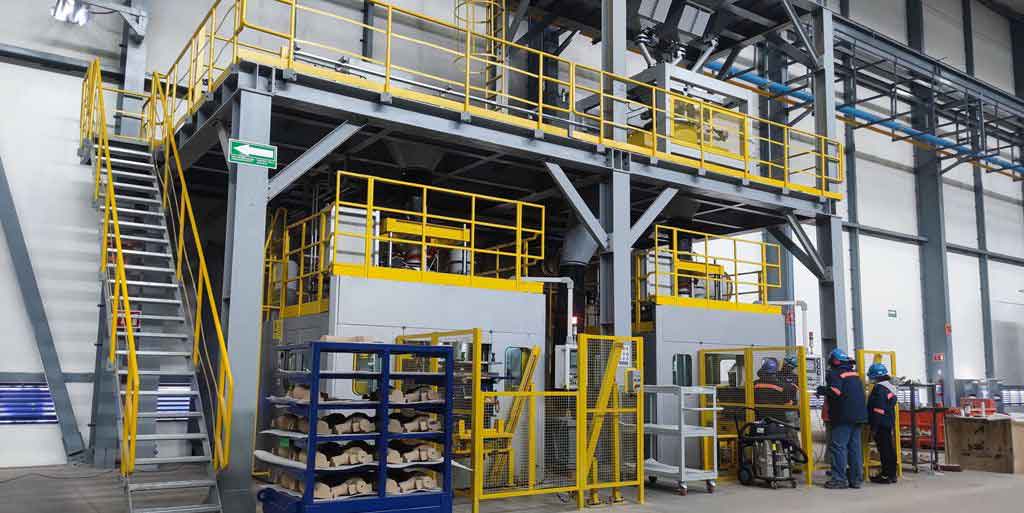
The quality of steel castings produced via alkaline phenolic resin sand is exceptional. For instance, duplex stainless steel valves, prone to cracking and carburization with other binders, exhibit smooth surfaces, minimal defects, and enhanced mechanical properties. This aligns with the stringent requirements of steel casting for critical applications like oil and gas valves. Non-destructive testing results, such as ultrasonic and X-ray inspections, consistently meet Grade 1 standards, underscoring the reliability of this process for high-integrity steel castings.
Environmental performance is a cornerstone of modern steel casting. We evaluated alkaline phenolic resins based on emissions and waste reduction. Key aspects include volatile organic compounds (VOCs) and waste sand. Compared to conventional resins, high-quality alkaline phenolic resins exhibit lower free harmful content, as shown in Table 3.
| Resin Type | Free Phenol | Free Formaldehyde |
|---|---|---|
| HA Alkaline Phenolic Resin | <0.1% | <0.1% |
| Standard Alkaline Phenolic Resin | ≤0.5% | ≤0.3% |
Emission reductions are quantified through third-party testing. For benzene, the emission concentration over time can be modeled as: $$ C(t) = C_0 \cdot e^{-\beta t} + \gamma $$ where $C(t)$ is concentration at time $t$, $C_0$ is initial peak, and $\beta$, $\gamma$ are constants. Using HA resin, benzene peak concentration dropped by approximately 35%, and total aromatic hydrocarbons decreased by 25%. Similarly, formaldehyde emissions reduced by 44%, and odor concentration by 24%, significantly improving the workplace environment in steel casting foundries.
Waste sand排放 is another critical factor in steel casting sustainability. Alkaline phenolic resin sand traditionally faces regeneration challenges, with strength degrading over cycles: $$ \sigma_n = \sigma_0 \cdot (1 – \delta)^{n-1} $$ where $\sigma_n$ is strength after $n$ cycles, $\sigma_0$ is initial strength, and $\delta$ is degradation rate. With improved resins, $\delta$ is reduced, enhancing recyclability. We observed a 5% monthly reduction in waste sand disposal, easing environmental burdens in steel casting operations.
From a broader perspective, the economic viability of alkaline phenolic resin in steel casting hinges on optimized parameters. Cost per ton of steel castings can be expressed as: $$ \text{Cost} = C_{\text{sand}} + C_{\text{resin}} + C_{\text{energy}} + C_{\text{waste}} $$ where each component is minimized through efficient practices. Our data shows that with proper control, resin costs are manageable, and the high yield of quality steel castings offsets initial investments.
In conclusion, the alkaline phenolic resin sand process is a robust solution for steel casting, particularly for complex, high-quality components like valves. It ensures dimensional precision, defect reduction, and environmental compliance. By selecting stable, high-performance resins and adhering to strict process controls, foundries can achieve a harmonious balance in steel casting production. The future of steel casting lies in embracing such sustainable technologies, driving innovation while meeting global environmental standards. We continue to refine our methods, contributing to the advancement of steel casting worldwide.