
The quest for high-integrity castings in high-volume production environments is perpetually challenged by the myriad of potential sand casting defects. Among these, scabbing and its related sand inclusion defects present a particularly insidious problem, often leading to catastrophic failures such as leakage in pressurized channels of critical components. This article details a systematic investigation and resolution of persistent scabbing defects encountered in the mass production of a gray iron engine cylinder block using a high-pressure green sand molding line. The component, with a weight of approximately 35 kg and a nominal wall thickness of 3.5 mm, demands flawless internal soundness for oil and water galleries post-machining. The initial scrap rate due to leakage reached an unacceptable level, prompting a deep dive into the root cause and the implementation of robust, multi-faceted solutions.
1. Problem Characterization and Defect Identification
The primary issue manifested as leakage during pressure testing of machined oil and coolant passages. A thorough examination of the scrap parts revealed the underlying cause: localized “excess metal” or protrusions on the interior surfaces of these channels. Upon sectioning and grinding these protrusions, clusters of sand particles were frequently found embedded within, clearly indicating a sand inclusion defect. Further analysis using penetrant testing on sectioned parts confirmed that these defects were through-thickness, creating a path for fluid leakage. The morphological features—layered sand detachment and subsequent metal penetration into the cavity—are classic hallmarks of a scabbing defect, a severe form of sand casting defects related to mold surface instability.
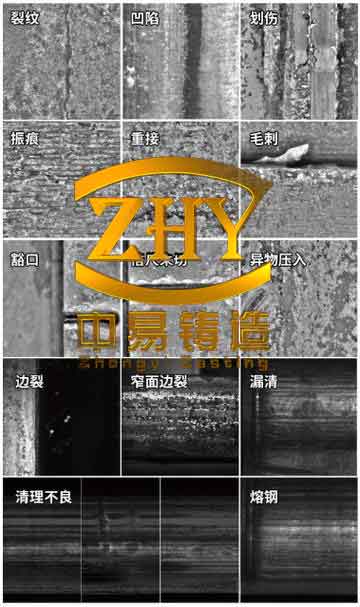
Defect analysis in sand casting often requires visual reference to understand the failure mode. The following image provides a clear example of typical sand casting defects, including manifestations similar to the scabbing described, where mold surface failure leads to irregular metal surfaces and inclusions.
2. Fundamental Mechanism of Scabbing Defect Formation
The genesis of scabbing defects in green sand casting is universally attributed to the volumetric expansion of silica sand and the associated migration of moisture within the mold wall upon exposure to molten metal heat. When liquid iron fills the mold cavity, intense thermal energy rapidly heats the surface layer of the sand mold. This heat drives moisture away from the hot face, creating a distinct moisture gradient. Three key zones develop:
- A Dry, High-Strength Surface Layer: Immediately adjacent to the metal, moisture is completely evaporated, significantly increasing the cohesive strength of the clay-bonded sand.
- A Condensation Zone (High-Humidity Layer): Inward from the dry layer, migrating vapor condenses, creating a zone with exceptionally high moisture content. This zone becomes plasticized and mechanically weak, acting as a failure plane.
- The Unaffected Bulk Sand: Further inward, the sand remains at its original compaction and moisture level.
The critical failure occurs because the hot, expanding dry surface layer is restrained by the cooler, bulk sand behind it. However, it is separated from this restraint by the weak, high-humidity layer. The resulting compressive stresses can cause the dry layer to buckle, crack, and lift away from the mold body. This lifted layer, or fragments of it, can then be swept away by the flowing metal, leading to sand inclusions (sand holes) elsewhere, or it can remain attached but displaced, allowing metal to infiltrate beneath it and form a scab. The process is governed by the interplay of thermal diffusion, moisture transport, and the thermo-mechanical properties of the mold material.
The moisture migration can be described conceptually by Fick’s second law of diffusion:
$$ \frac{\partial C}{\partial t} = D \frac{\partial^2 C}{\partial x^2} $$
Where \( C \) is the moisture concentration, \( t \) is time, \( x \) is the distance from the mold-metal interface, and \( D \) is the effective moisture diffusivity, which is highly temperature-dependent. The stress \( \sigma \) leading to buckling in the dry layer can be approximated by considering the thermal expansion mismatch:
$$ \sigma_{critical} \propto E \cdot \alpha \cdot \Delta T $$
where \( E \) is the effective modulus of the dry sand layer, \( \alpha \) is the coefficient of thermal expansion of silica sand, and \( \Delta T \) is the temperature rise. When this stress exceeds the bond strength at the weakened condensation zone, scabbing initiates.
3. Systematic Resolution of Scabbing Defects
The resolution strategy followed a logical progression, starting with the most direct factor—sand properties—and evolving to more process-oriented and finally barrier-based solutions.
3.1 Primary Correction: Optimization of Green Sand Properties
The first and most impactful line of defense against scabbing and other sand casting defects is maintaining optimal and consistent green sand properties. Initial data analysis revealed significant deviations from the normative control limits:
| Parameter | Initial State | Target Range | Issue Identified |
|---|---|---|---|
| Moisture Content | ~3.7% | 3.0 – 3.4% | Excessively High |
| Clay Content (M.A.F.T.) | >11.5% | 9.5 – 11.0% | Excessively High |
| Compactibility (C.B. Value) | 31-32% | 35-42% | Too Low |
| Moisture-to-Clay Ratio | ~8.5-9.0 | 10 – 11 | Too Low |
The high clay and moisture content, coupled with low compactibility, indicated a sand system that was “over-mulled” and loaded with dead, inactive fines. This condition leads to low “toughness” or deformability. The sand becomes brittle and lacks the ability to accommodate the thermal expansion stress through plastic deformation, making it prone to crack and spall. The low moisture-to-clay ratio confirmed that the moisture was not effectively activating the bentonite bond but was merely filling pores between excess fines.
Corrective Action: The root cause was traced to inadequate dust collection, allowing fines to accumulate. By restoring the dust collection system’s efficiency and introducing a regimen of fresh sand additions, the system was purged of excess fines. Within two production shifts, key parameters were restored:
| Parameter | After Correction | Improvement Direction |
|---|---|---|
| Clay Content (M.A.F.T.) | ~10.6% | Decreased |
| Moisture Content | ~3.22% | Decreased |
| Compactibility (C.B. Value) | ~33% | Increased |
| Moisture-to-Clay Ratio | ~10.2 | Increased |
Result: A controlled batch trial immediately showed a dramatic reduction in scabbing-related leakage, validating sand properties as the primary lever for controlling this category of sand casting defects.
| Condition | Clay (%) | Moisture (%) | C.B. (%) | Pcs Cast | Scab Defects | Leakage Rate (%) |
|---|---|---|---|---|---|---|
| Degraded Sand | 11.5 | 3.65 | 32 | 96 | 46 | 7.29 |
| Corrected Sand | 10.6 | 3.22 | 33 | 224 | 32 | 2.23 |
3.2 Secondary Process Adjustment: Modulating Pouring Temperature
Given that the driving force for moisture migration and sand expansion is thermal input, adjusting pouring temperature was investigated as a secondary mitigation strategy. Lowering the metal temperature reduces the peak heat flux into the mold wall, slowing down the rate of dry zone formation and moisture condensation, thereby reducing the thermal shock and stress on the sand surface.
The heat flux \( q” \) at the mold-metal interface can be modeled as:
$$ q” = h (T_{melt} – T_{mold}) $$
where \( h \) is the heat transfer coefficient and \( T \) represents temperature. Reducing \( T_{melt} \) directly reduces \( q” \), subsequently lowering the rate of temperature rise in the sand \( \frac{dT}{dt} \) and the associated moisture migration speed.
A series of trials were conducted with descending pouring temperatures:
| Pouring Temp. Range (°C) | Pieces Cast | Scab Defects | Gas/Shrinkage Defects | Scab Rate (%) | Other Defect Rate (%) |
|---|---|---|---|---|---|
| 1430 – 1435 | 34 | 5 | 1 | 14.7 | 2.9 |
| 1425 – 1430 | 36 | 3 | 0 | 8.3 | 0.0 |
| 1420 – 1425 | 36 | 0 | 3 | 0.0 | 8.3 |
| 1415 – 1420 | 36 | 0 | 2 | 0.0 | 5.6 |
Analysis: The trials confirmed the theoretical expectation: lower pouring temperatures effectively eliminated scabbing defects. However, they introduced a new, unacceptable risk: a sharp increase in other sand casting defects, primarily gas porosity and mistruns, attributable to reduced fluidity and impaired feeding capability of the iron. This created a process window conflict, demonstrating that while pouring temperature is a useful parameter, it cannot be used in isolation to solve scabbing without compromising other aspects of quality.
3.3 Definitive Solution: Application of Refractory Mold Coatings
The most robust and targeted solution involved applying a protective barrier between the molten metal and the vulnerable sand surface. A refractory coating, specifically an alcohol-based aluminosilicate slurry with a Baume density of 25-35°Bé, was sprayed onto the critical areas of the mold cavity prone to scabbing. This coating performs multiple protective functions:
- Thermal Barrier: It creates a layer of low thermal conductivity between the metal and the sand, drastically reducing the initial heat flux and attenuating the temperature spike in the underlying sand. The thermal resistance \( R”_{coat} \) of the coating is given by:
$$ R”_{coat} = \frac{t_{coat}}{k_{coat}} $$
where \( t_{coat} \) is the coating thickness and \( k_{coat} \) is its thermal conductivity. This added resistance slows heat transfer, protecting the sand bond. - Mechanical Isolation: Once sintered by the molten metal, it forms a hard, ceramic-like shell that is integrally bonded to the sand grains. This shell has its own structural integrity and can withstand the expansive forces of the underlying sand without cracking or detaching.
- Chemical Isolation: It prevents direct interaction between the sand binder and the metal or its oxides.
The coating’s effectiveness was tested under both normal and intentionally degraded sand conditions. The results were conclusive and transformative for process stability.
| Trial Group | Sand Condition (Clay/Moisture/C.B.) | Coating Applied? | Pieces Cast | Scab Defects | Leakage from Scabs |
|---|---|---|---|---|---|
| A (Baseline – Bad Sand) | 11.5% / 3.65% / 32% | No | 96 | 46 | 7 (7.3%) |
| B (Baseline – Good Sand) | 10.6% / 3.22% / 33% | No | 224 | 32 | 5 (2.2%) |
| C (Coating Test 1) | 11.7% / 3.72% / 31% | Yes | 60 | 0 | 0 |
| D (Coating Test 2) | 10.8% / 3.38% / 34% | Yes | 112 | 0 | 0 |
| E (Production Validation) | 10.4% / 3.26% / 34% | Yes | 660 | 0 | 0 |
The coating completely eliminated scabbing defects, even when the sand properties were outside the optimal window. This provided a critical safety margin for the production process, making it robust against normal fluctuations in sand system parameters. It is the most direct and effective method for suppressing these specific sand casting defects on critical surfaces.
4. Conclusion and Broader Implications for Sand Casting Defects Control
The successful resolution of the engine block scabbing issue underscores a fundamental hierarchy in managing sand casting defects: process foundation first, followed by targeted interventions. The journey from a 7% leakage rate to near-zero defects provides a clear blueprint:
- Foundation is Key: Consistent and optimal green sand properties are the primary defense against a wide range of defects, including scabbing. Regular monitoring and control of active clay content, moisture, compactibility, and strength are non-negotiable for stable high-volume casting. The relationship between moisture-to-clay ratio and sand toughness is a critical metric often overlooked.
- Process Parameters Have Limits: Adjusting variables like pouring temperature can mitigate specific issues but often within a narrow window before inducing other defects. It is a balancing act rather than a standalone solution for chronic sand casting defects.
- Targeted Barrier Technology is Highly Effective: The application of refractory coatings to vulnerable mold areas represents a powerful, localized solution. It decouples the casting quality from minor sand system instabilities, providing exceptional robustness. The selection of coating type (alcohol-based for rapid drying), refractory grade (aluminosilicate for iron), and application density (controlled by Baume) are crucial for success.
This case study reinforces that scabbing is not an inevitable sand casting defect but a manageable one. It results from a predictable thermo-mechanical failure mechanism in the mold surface. By first ensuring the sand matrix is healthy and deformable, and then applying a protective thermal barrier where needed, this defect can be completely eradicated. This systematic approach—combining fundamental process control with precise engineering solutions—is essential for achieving and maintaining the zero-defect standards required in modern, high-performance cast component manufacturing. The principles elucidated here for combating scabbing are directly applicable to the prevention of other expansion-related sand casting defects such as rat-tails and buckles, emphasizing the importance of understanding and controlling the sand-metal interface behavior.