
In the production of thin-walled cylinder blocks for modern automotive engines, utilizing green sand molds and cold-box cores presents a unique set of challenges. The pursuit of light-weighting leads to complex geometries with wall sections as thin as 3 mm, demanding precise control over every aspect of the casting process. Even minor deviations can manifest as significant casting defects, impacting structural integrity, engine performance, and ultimately, production yield. Over years of development and production for a major automotive series, a systematic approach has been essential to diagnose and resolve recurrent casting defect issues. This account details the analytical journey and practical countermeasures implemented to overcome three predominant types of casting defects: internal core fracture, scabbing on cope surfaces, and metal penetration on external surfaces. Each solution was forged through rigorous experimentation and a deep understanding of the interactions between material properties, process parameters, and thermal dynamics during solidification.
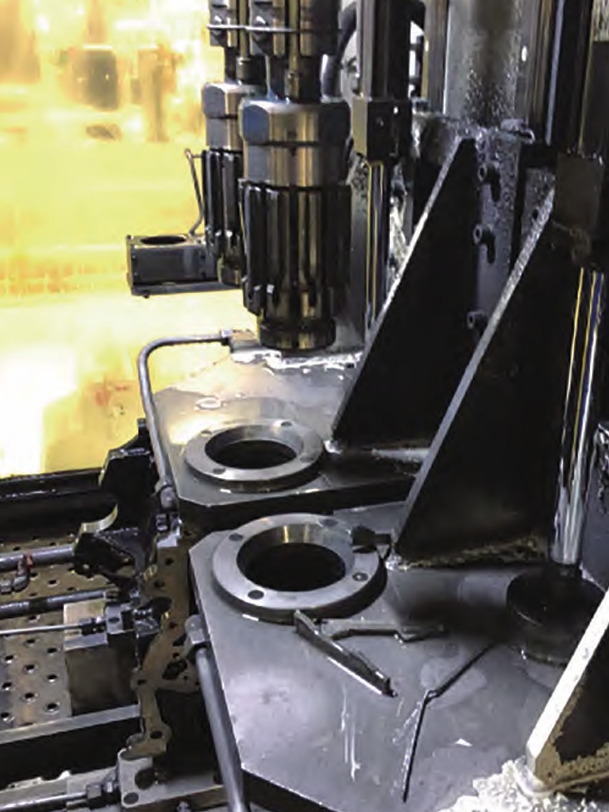
The foundational process involves high-pressure molding with green sand and the use of amine-cured cold-box cores for internal passages. Typical pouring temperatures range from 1410°C to 1450°C for a material grade equivalent to HT220 gray iron. It is within this demanding thermal and mechanical environment that specific casting defect patterns emerged, each requiring a tailored strategy for mitigation. The following sections dissect these critical casting defect scenarios, their root causes, and the multi-faceted solutions that led to stable, high-quality production.
1. Internal Jacket Core Local Fracture: A Thermal Expansion Challenge
The first major casting defect encountered was the localized fracture of the water jacket core at its thin, vulnerable sections, specifically at the bottom center of both ends. This casting defect resulted in core debris trapped in the water jacket, obstructing coolant flow and leading to mandatory scrap. The scrap rate for this specific casting defect occasionally exceeded 10%, posing a severe economic and quality challenge.
Root Cause Analysis: The fractured areas corresponded to the thinnest sections of the core (approx. 3 mm), often located near the edge of the shooting nozzle, which can lead to lower local density and strength. The primary driver of this casting defect, however, is the dramatic volumetric expansion of silica sand upon heating. When the sand in contact with the molten iron heats above 573°C, it undergoes a phase transformation from β-quartz to α-quartz. This transformation is accompanied by a sudden volume increase, generating significant internal stress within the core binder bridge network. This thermal expansion stress can be represented by a simplified relation considering the coefficient of thermal expansion:
$$ \sigma_{thermal} \propto E \cdot \alpha \cdot \Delta T $$
where \( \sigma_{thermal} \) is the induced thermal stress, \( E \) is the effective modulus of the core material, \( \alpha \) is the coefficient of thermal expansion, and \( \Delta T \) is the temperature change driving the phase transition. For silica sand, \( \alpha \) is particularly high around the transition point. When \( \sigma_{thermal} \) exceeds the high-temperature strength of the resin-bonded core (\( \sigma_{core} \)), cracking or fracture occurs:
$$ \sigma_{thermal} > \sigma_{core}(T) $$
These cracks then provide easy paths for molten iron to penetrate and erode the core, leading to the final casting defect.
Implemented Countermeasures:
A multi-pronged strategy was deployed to combat this core fracture casting defect.
1.1. Substitution of Silica Sand with Low-Expansion Aggregates
The most direct approach was to reduce \( \alpha \) in the stress equation by replacing a portion or all of the silica sand in the core mix. Sands with low or no crystalline phase transformations were trialed.
| Trial Date | Core Sand Type | Pieces Cast | Local Fracture Casting Defect Count | Defect Rate (%) | Comparative Silica Sand Defect Rate (%) |
|---|---|---|---|---|---|
| July 8 | Ceramic Sand | 102 | 2 | 2.0 | 11 |
| July 11 | Chromite Sand | 118 | 0 | 0.0 | 8 |
| July 14 | Calcined Sand | 100 | 2 | 2.0 | 9 |
| July 14 | Blended Sand | 100 | 3 | 3.0 | 9 |
The table clearly demonstrates the effectiveness of alternative sands in suppressing this casting defect. Chromite sand, with its neutral thermal behavior, eliminated the defect entirely in this trial.
1.2. Enhanced Coating Process for Core Protection
The standard process of dipping cores in a water-based refractory coating was modified to add an extra defensive layer. A specialized “veining prevention” coating was first brushed onto the critical thin sections of the water jacket core ends before the standard dipping and drying process. This dual-layer system served two purposes: it formed a glassy layer upon heating, which helped to absorb and redistribute thermal stress, and it reacted with silica to create a sintered barrier, insulating the core from the intense initial heat radiation. Trials confirmed its benefit.
| Date | Coating Process | Trial Quantity | Fracture Casting Defect Count | Defect Rate (%) |
|---|---|---|---|---|
| 2007.07.22 | Water-based only | 120 | 3 | 2.5 |
| 2007.07.22 | Veining coat + Water-based | 104 | 0 | 0.0 |
| 2007.07.23 | Water-based only | 100 | 3 | 3.0 |
| 2007.07.23 | Veining coat + Water-based | 200 | 1 | 0.5 |
1.3. Strict Control of Raw Material and Process Parameters
The inherent strength of the cold-box core (\( \sigma_{core} \)) is paramount. This strength is highly dependent on raw material quality and process consistency. Key controls established include:
- Acid Demand Value (ADV): High ADV indicates excessive impurities or alkaline substances in the sand, which can neutralize the polyisocyanate (Part II) of the binder, inhibiting complete curing. A strict upper limit for ADV was enforced, as higher values correlated directly with increased incidence of this casting defect.
- Core Storage Time: Cold-box cores are hygroscopic. Strength degradation over time was monitored, showing a marked drop after three days. A maximum shelf-life of 72 hours for water jacket cores was instituted to ensure sufficient strength at pouring.
- Equipment Maintenance: Regular cleaning of vent blocks, replacement of worn shooting nozzles, and prevention of air leaks ensured cores were shot with optimal density and uniformity, eliminating weak spots prone to this casting defect.
2. Scabbing on the Cope-Side Jacket Wall: A Mold Surface Failure
The second significant casting defect manifested as scabs or buckling on the top surface (cope side) of the cylinder block, specifically on the outer wall of the water jacket. This surface casting defect, often occurring between oil gallery bosses, led to scrap rates above 3% at times.
Root Cause Analysis: This is a classic expansion-related casting defect of green sand molds. The large, flat area of the cope mold above the water jacket is exposed to prolonged radiant heat from the rising metal and the underlying core. The surface layer of the mold heats rapidly, expanding. However, it is constrained by the cooler, stronger sand beneath. This differential expansion creates compressive stresses that can cause the surface layer to buckle and detach. If the metal level rises too slowly, this detached layer is not reincorporated and forms a scab. The condition is exacerbated by local hot spots, such as those near oil gallery bosses.
Implemented Countermeasures:
2.1. Utilization of Natural Sodium Bentonite
A key factor in resisting this casting defect is the sand’s high and stable hot strength. Artificial activation of calcium bentonite can be inconsistent. Replacing a portion of the system clay with natural sodium bentonite provided several benefits: higher and more consistent thermophysical properties (hot strength, thermal stability), and better durability through the sand system loop. To counteract its excellent durability which reduced shakeout, a portion of calcium bentonite was retained to maintain system balance. The introduction of natural sodium bentonite led to a pronounced and sustained reduction in the scabbing casting defect, as evidenced by scrap rate trends.
2.2. Reducing Heat Radiation Exposure Time
Prolonged exposure of the cope mold surface to heat before metal coverage was identified as a contributor. A frequent issue was metal “run-out” or penetration between the water jacket and crankcase cores, which delayed the rise of metal in the main cavity. This was addressed by ensuring precise core placement and inserting ceramic fiber pads (sealing gaskets) at the interface between these cores. This effectively sealed the gap, preventing premature metal leakage and allowing the metal level to rise rapidly and uniformly, covering the vulnerable cope surface before it could buckle.
2.3. Enhancing Mold Venting and Reducing Core Gas
Inadequate venting increases back-pressure in the mold cavity, which can further slow metal rise and exert pressure on the fragile baked sand layer, promoting the scabbing casting defect. Two actions were taken:
- Reduced Core Gas Evolution: The design of the water jacket and top cover cores was modified by adding and enlarging “lightening” recesses. This reduced the overall sand mass and, consequently, the total gas generated during pouring.
- Increased Venting Capacity: Additional open vents (pencil-sized) were added in the cope mold at strategic locations: directly above the crankcase core prints and above the vulnerable flat area of the water jacket wall. This improved the pressure ratio between the gating system and venting system, facilitating faster metal advance and quicker pressure release.
The combined effect was a more tranquil and rapid filling of the cope, drastically reducing the conditions favorable for this surface casting defect.
3. Metal Penetration (Burning-on) on External Surfaces
The third major category of casting defect was severe metal penetration, or mechanical burn-on, on the external surfaces of a particularly complex, thin-wall block. High pouring temperatures (~1450°C) necessary for mold filling intensified this issue, leading to difficult cleaning, machining tool damage, and downstream leakage problems.
Root Cause Analysis: Mechanical penetration is a capillary phenomenon where molten metal invades the pores between sand grains. The penetration depth ( \( d_p \) ) can be modeled by considering the pressure balance at the metal-sand interface, often simplified by Darcy’s law for flow in porous media and the Young-Laplace equation for capillary pressure:
$$ d_p \propto \sqrt{ \frac{P_{metal} \cdot t}{\mu \cdot \phi} } \cdot r_{pore} $$
where \( P_{metal} \) is the metallostatic and dynamic pressure, \( t \) is the contact time, \( \mu \) is the metal viscosity, \( \phi \) is the sand porosity, and \( r_{pore} \) is the effective pore radius. High pouring temperature decreases \( \mu \), increasing penetration. A coarse sand grain distribution increases \( r_{pore} \), also promoting this casting defect.
Implemented Countermeasures:
3.1. Refining Sand Grain Distribution
To decrease \( r_{pore} \), the base sand grain fineness was increased. The system was transitioned from a coarse three-screen distribution (e.g., 50/100) to a finer four-screen distribution (e.g., 50/140) by systematically adding finer base sand (70/140 mesh). This filled the voids between larger grains, increasing the capillary resistance to metal intrusion and directly combating this casting defect.
3.2. Increasing Mold Gas Back-Pressure
Gas back-pressure (\( P_{gas} \)) in the sand pores acts against \( P_{metal} \), hindering penetration. \( P_{gas} \) is a function of gas generation rate and mold permeability. The sand’s volatile content was carefully optimized within a higher, controlled range. This increased the instantaneous gas generation upon metal contact, raising \( P_{gas} \) without creating actual gas hole casting defects. The modified pressure balance for preventing penetration becomes:
$$ P_{metal} < P_{gas} + P_{capillary} $$
where \( P_{capillary} \) is the resistance from fine pores. By raising \( P_{gas} \), the threshold for this casting defect is raised.
3.3. Controlling Return Sand Temperature and Moisture
Uncontrolled, hot return sand leads to low moisture content, poor clay activation, and weak, friable molds more susceptible to erosion and metal penetration. In the absence of a functional sand cooler, auxiliary systems were installed:
- Water misting nozzles on return sand conveyors to add moisture.
- High-volume fans to evaporate this moisture, utilizing the latent heat of vaporization to cool the sand (\( Q = m \cdot L_v \), where \( m \) is mass of water evaporated and \( L_v \) is latent heat).
This stabilization of sand temperature and moisture was critical, especially in summer, to maintain consistent mold strength and minimize this casting defect.
3.4. Systemic Sand Parameter Optimization
All parameters were dynamically managed:
- Active Clay & Additives: Maintained at optimal levels for strength without compromising shakeout.
- Moisture & Compactibility: Tightly controlled, with higher compactibility targets in summer to compensate for faster moisture loss.
These comprehensive measures transformed the surface finish of the castings, virtually eliminating the severe mechanical penetration casting defect.
4. Internal Core Sintering and Burning-on
Alongside external penetration, the high pouring temperatures also caused severe sintering and burning-on casting defects inside complex internal cavities like oil galleries and tight water jacket corners.
Countermeasures: A focused set of actions on the core-making side resolved this internal casting defect:
- Core Assembly Stress Reduction: Modified the oil core assembly method and reduced fastening screw size to minimize pre-stress on the cores.
- Core Material and Process Upgrade: Adopted blended specialty sands for the oil gallery cores to improve flowability during shooting, resulting in denser, more refractory cores.
- Reduced Core Drying Temperature: Lowered the oil core baking temperature to prevent thermal degradation of the binder, preserving high-temperature strength.
- Core Design Modification: Reduced fillet radii in critical areas to increase local core sectional strength.
- Refractory Coating Optimization: Developed a dedicated coating formulation with superior refractoriness and sintering resistance specifically for these high-temperature application cores.
Conclusion
The successful mitigation of these diverse and challenging casting defects in high-volume cylinder block production underscores the necessity of a holistic, scientifically-grounded approach. Each casting defect—whether internal core fracture, surface scabbing, or metal penetration—was addressed not with a single solution, but with a synergistic set of interventions targeting root causes: material properties (thermal expansion, grain size, binder strength), process parameters (temperature, moisture, venting), and design aspects (core geometry, gating/venting ratio). The continuous refinement of raw material specifications, process controls, and core/mold engineering has proven essential. Mastering the interplay between these factors is the key to transforming persistent casting defect challenges into a stable, high-quality casting process capable of meeting the stringent demands of modern engine manufacturing.