
In the demanding environment of an internal combustion engine, the piston ring performs a critical function. Operating under conditions of extreme temperature, pressure, and corrosive combustion gases, it must maintain an effective seal, manage lubrication, and facilitate heat dissipation. The performance, fuel economy, and reliability of the engine are directly contingent upon the quality of this seemingly simple, yet highly engineered component. Its slender cross-section, however, imposes stringent requirements on the foundry process. Among the various challenges in piston ring manufacturing, the formation of shrinkage porosity stands as a significant and costly sand casting defect. This analysis delves into the root causes of this porosity in sand-cast, single-alloy piston rings produced from vanadium-titanium (V-Ti) pig iron and presents a comprehensive set of mitigation strategies derived from both theoretical understanding and practical foundry experience.
The prevalent melting equipment for such production includes coreless induction furnaces and electric arc furnaces, chosen for their ability to achieve high tapping temperatures, accommodate frequent chemistry adjustments, and recycle machining swarf efficiently. From a molding perspective, the process under examination is the single or double-stack sand casting method using machines like the Z145. The alloy system primarily involves cast iron with additions such as chromium, molybdenum, copper, and notably, V-Ti. Utilizing V-Ti pig iron is particularly attractive for agricultural engine rings due to the inherent wear resistance imparted by these elements, offering a cost-effective solution. However, this practice is frequently plagued by subsurface shrinkage porosity, a flaw often only revealed after phosphating, leading to substantial financial loss. This work systematically investigates the metallurgical and process origins of this sand casting defect.
Foundry Conditions and Material Specifications
The melting was conducted in a 0.5-ton electric arc furnace and a 3-ton line-frequency coreless induction furnace. Temperature was measured at the spout using a quick-immersion thermocouple. Molding was performed on a Z145 molding machine employing a stacked green sand mold configuration. The base material was V-Ti pig iron, modified with a fraction of Benxi pig iron. The chemical compositions for the original process and the improved process are detailed in Table 1.
| Element | Original Process (V-Ti Pig Iron) | Improved Process (V-Ti + Benxi Pig Iron + RE) |
|---|---|---|
| C | 3.77 – 3.89 | 3.80 – 3.90 |
| Si | 2.42 – 2.55 | 2.41 – 2.55 |
| Mn | 0.80 – 0.85 | 0.80 – 0.85 |
| P | 0.36 – 0.41 | 0.35 – 0.40 |
| S | < 0.05 | < 0.05 |
| V | 0.20 – 0.30 | 0.15 – 0.18 |
| Ti | 0.20 – 0.30 | 0.15 – 0.18 |
| W | 0.20 – 0.30 | 0.30 – 0.40 |
| Sb | 0.01 – 0.02 | 0.01 – 0.02 |
| RE (Rare Earth) | – | 0.02 – 0.04 |
Theoretical and Practical Causes of Shrinkage Porosity
1. Solidification Temperature Fields and Graphite Expansion
In the typical gating system for a single piston ring, metal enters the ring cavity via a sprue and ingate. A slag trap or feeder head (collector) is placed opposite the ingate to capture first-run, cooler metal. Post-pour, the temperature distribution is non-uniform: the ring segment adjacent to the ingate is hottest, the junction between the ring and the feeder head neck is the next hottest (“thermal hotspot”), and the remainder of the ring is cooler and relatively uniform. This pattern is corroborated by hardness measurements, where softer areas correspond to slower cooling.
The formation of shrinkage porosity is fundamentally linked to the volumetric changes during solidification. The total contraction from pouring to complete solidification comprises liquid contraction and solidification contraction. However, in gray cast iron, this is counteracted by the graphite expansion during the eutectic reaction. The net volume change, $V_{net}$, can be conceptually represented as:
$$V_{net} = V_{liquid\ shrinkage} + V_{solidification\ shrinkage} – V_{graphite\ expansion}$$
where $V_{graphite\ expansion}$ is positive. As the carbon equivalent (CE) increases and more graphite precipitates, the expansion term grows. With a high CE and effective inoculation—common in piston ring iron—the graphite expansion can be substantial.
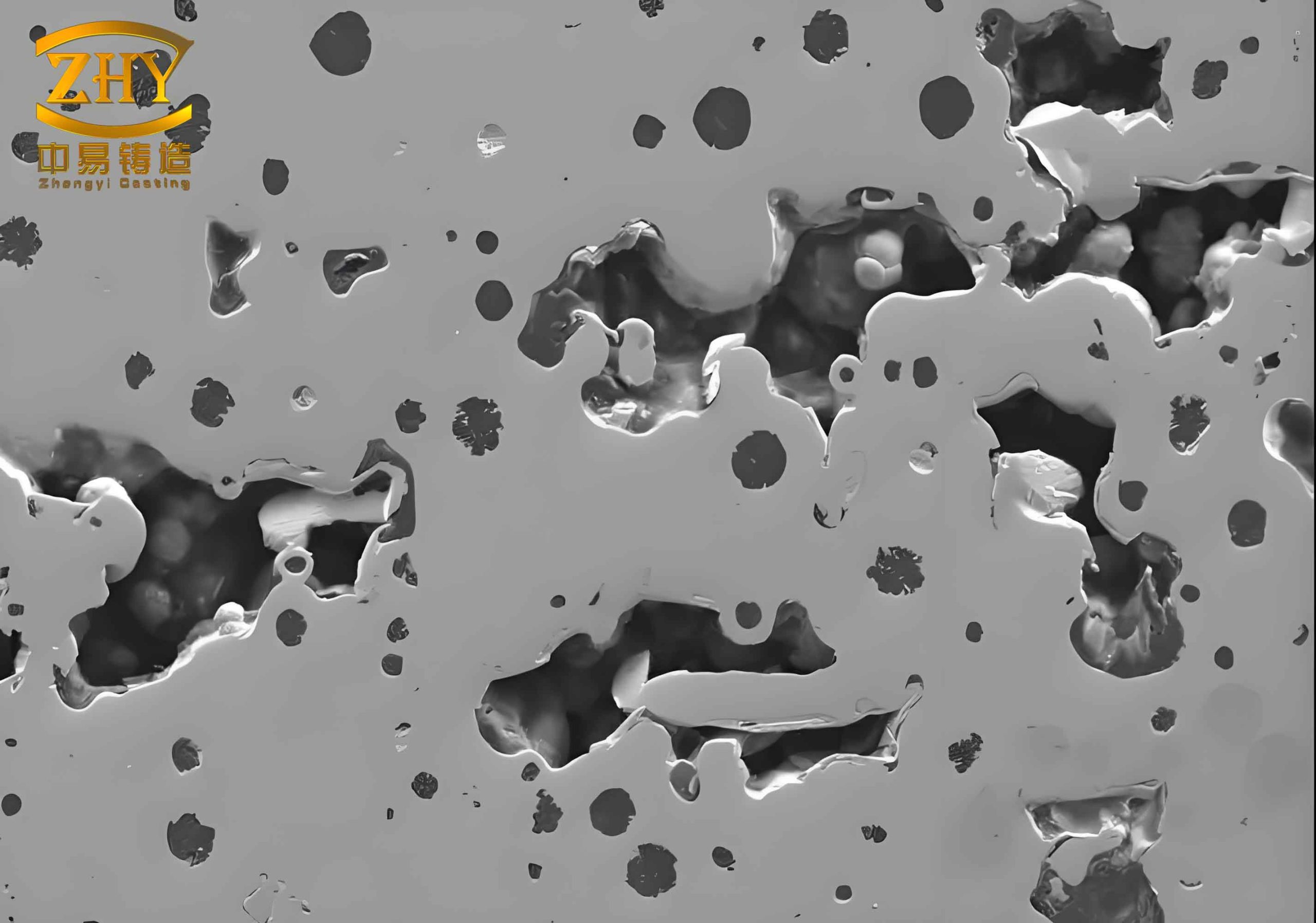
The critical factor in sand casting is mold wall movement. In green sand molds with limited rigidity, the internal pressure from graphite expansion can push the mold walls outward. This enlargement increases the internal volume of the mold cavity during solidification, creating an artificial demand for additional feed metal. If this demand cannot be met by the feeder, micro-shrinkage (porosity) forms in the last-to-freeze regions. The thermal hotspot at the ring-feeder neck junction is particularly susceptible. Metallographic examination of such defects consistently shows areas of coarser, more abundant graphite, confirming localized excessive expansion.
2. Special Case: Thin-Section Rings
Empirical data shows that thinner rings are more prone to this sand casting defect. The geometry provides an explanation. The feeder neck thickness remains relatively constant across different ring designs. For a thin ring, the difference between its cross-section and the neck’s cross-section is small. During solidification, the thin ring body and the feeder neck begin freezing at nearly the same time. Graphite expansion in the ring can push residual liquid back through the still-molten or mushy neck into the feeder. However, when the hotspot at the ring-neck junction finally solidifies, the neck itself may have already solidified, cutting off the feeding path and leading to porosity.
For a thicker ring, the neck freezes significantly earlier than the ring body. Once solid, the rigid neck cannot be displaced by expansion occurring in the ring. Furthermore, the solid neck acts as an improved heat sink, accelerating cooling at the junction, reducing graphite expansion there, and thereby minimizing the risk of shrinkage porosity.
3. Role of Alloying Elements
The alloying elements V, Ti, and W are added for specific performance benefits but also influence solidification behavior.
| Element | Primary Effects | Potential Impact on Shrinkage/Solidification |
|---|---|---|
| Tungsten (W) | Refines graphite and eutectic cell; forms hard, isolated carbides for wear resistance; increases thermal stability. | Refinement can slightly alter expansion characteristics but generally benefits homogeneity. |
| Vanadium (V) | Forms hard carbides (VC, V4C3); promotes and refines pearlite; improves high-temperature strength. | Strong carbide former can stabilize undercooled structures; associated with brittle phases that may segregate. |
| Titanium (Ti) | Powerful deoxidizer and denitridier; promotes fine undercooled (Type D) graphite in small amounts. | Excess Ti (>0.15%) can promote undesired undercooled graphite and segregation of complex Ti-containing inclusions. |
4. Deleterious Role of Trace Elements and Gases
Spectrographic and Auger electron spectroscopy (AES) analysis revealed critical differences between sound castings and those with shrinkage. The V-Ti pig iron contained trace amounts of Arsenic (As). The shrinkage zones showed elevated levels of Oxygen (O), Nitrogen (N), and traces of Tellurium (Te) and As. Sound areas had negligible amounts.
- Tellurium (Te) & Arsenic (As): Both are potent graphitizing inhibitors. As little as 0.005-0.01% Te can severely undercool the iron, promoting the formation of fine, directional Type D and mesh graphite. Heavy inoculation to counter this can easily lead to coarse graphite if slightly overdone, creating a delicate balance that favors sand casting defect formation.
- Oxygen (O) & Nitrogen (N): While small amounts can increase pearlite content, higher levels are detrimental. Their solubility decreases during cooling, causing them to precipitate, often as molecular gas. This precipitation is accompanied by a volume increase. In the final stages of solidification at a hotspot, this “gas evolution” can synergize with the volumetric shrinkage of the remaining liquid, exacerbating pore formation—a phenomenon known as “gas-shrinkage” porosity.
The AES analysis quantified this gas issue:
- Sound Ring: C: 77%, O: 14%, Fe+Na: 15%
- Porosity in Large Ring: C: 53%, O: 26%, Fe+Na: 11% + 10%
- Porosity in Small Ring: C: 35%, O: 34%, Fe+Na: 15% + 15%
The high oxygen in defective zones is clear. Sodium (Na) was attributed to subsequent phosphating/plating operations entering the porous region.
Integrated Strategies to Mitigate the Sand Casting Defect
Based on the causative analysis, a multi-pronged approach is required to suppress shrinkage porosity.
1. Mitigating Metallurgical Inheritance and Trace Element Effects
“Inheritance” refers to the tendency of a melt to retain structural characteristics of its charge materials. Using 100% V-Ti pig iron (which is often white iron) imparts a strong tendency for chill and undercooled graphite, requiring high CE and excessive inoculation to counter—a recipe for coarse graphite and shrinkage.
Solution: Diluting the V-Ti pig iron with 30-40% Benxi pig iron (a high-quality foundry iron) achieves two goals:
- It weakens the inherited tendency for undercooled structures, allowing for better control over graphite morphology with standard inoculation practices.
- It dilutes the concentration of V, Ti, and associated trace elements (Te, As) to a level where their beneficial effects (wear resistance) are retained while their detrimental effects on solidification are minimized.
Addition of Rare Earth (RE): The analysis confirmed the presence of harmful O, N, Te, and As in shrinkage zones. RE elements are highly reactive scavengers.
- They combine with O and N to form stable oxides/nitrides. Some act as heterogeneous nucleation sites for graphite, while others float out into the slag.
- They effectively “neutralize” the harmful effects of trace elements like Te, As, and even excess Ti/V, though the precise mechanism requires further study.
Crucially, RE should be added at the furnace stage, not as an inoculant. Its strong anti-graphitizing effect is undesirable for the final mold inoculation step. A post-furnace addition of 0.02-0.04% RE serves primarily as a purification and modification agent.
2. Process Control and Optimization
| Process Stage | Action | Purpose & Effect |
|---|---|---|
| Melting & Holding | Effective slag formation, stirring, and skimming. A brief holding period before tap. | Reduces inclusions and allows gases/impurities to float out. Improves melt homogeneity. |
| Superheating | Achieving a sufficiently high superheating temperature. | Improves fluidity, enhances purification, and is a recognized metallurgical method for breaking down inheritance effects. |
| Inoculation | Use of potent inoculants (e.g., Sr-containing). Switching from bottom-of-ladle to in-stream inoculation. | Promotes uniform, fine Type A graphite without over-inoculation. In-stream addition improves recovery and consistency, reducing the risk of localized coarse graphite that drives shrinkage. |
| Mold Rigidity | Maximizing mold compaction (while maintaining permeability). Ensuring flat stacking of molds. | Directly counteracts mold wall movement due to graphite expansion. A rigid mold cavity minimizes the extra feeding demand, directly attacking the root cause of this sand casting defect. Flat stacking ensures consistent feeder neck geometry and cooling. |
| Feeder Design | Optimizing feeder neck size and feeder volume. | A smaller neck freezes earlier, isolating the ring body and preventing late-stage liquid backflow. An adequately sized but not excessive feeder provides necessary feed metal without creating a larger thermal mass. |
The effectiveness of mold rigidity cannot be overstated. The transition from a yielding green sand mold to a more rigid system (whether through high-pressure molding or other means) fundamentally alters the solidification dynamics. The net volume change equation must then account for the mold’s resistance $R_{mold}$:
$$V_{net\_rigid} = V_{liquid\ shrinkage} + V_{solidification\ shrinkage} – \eta(V_{graphite\ expansion}, R_{mold})$$
where the function $\eta$ represents the fraction of graphite expansion actually translated into cavity enlargement. For a rigid mold, $\eta \rightarrow 0$, meaning the expansion is used internally to compensate for shrinkage, promoting self-feeding and eliminating the sand casting defect.
Conclusions
The investigation into shrinkage porosity in sand-cast single-alloy piston rings reveals a complex interplay of metallurgy and process. The sand casting defect is not merely a feeding issue but a consequence of excessive graphite expansion in thermal hotspots, exacerbated by mold yield, specific geometry, and the presence of detrimental trace elements and gases. The following integrated measures are essential for its elimination:
- Charge Modification: Diluting strong V-Ti pig iron with 30-40% high-quality Benxi pig iron mitigates unfavorable genetic inheritance and reduces the concentration of critical alloying and trace elements to an optimal range.
- Melt Purification: The addition of small amounts of Rare Earth (0.02-0.04%) effectively scavenges oxygen, nitrogen, and neutralizes the harmful effects of trace elements like tellurium and arsenic.
- Process Discipline: High superheat temperature, proper slag handling, and controlled in-stream inoculation are fundamental to achieving a clean, homogeneous melt with consistent, fine graphite structure.
- Mold and Gating Optimization: Maximizing mold compactness to increase rigidity is paramount to resist wall movement. Redesigning the feeder neck to be smaller promotes its early solidification, isolating the casting and preventing unfavorable feeding dynamics. Ensuring consistent mold stacking is critical for repeatability.
By addressing the problem from both a materials science and a foundry engineering perspective, the propensity for shrinkage porosity can be dramatically reduced, leading to higher yields, lower costs, and more reliable piston rings for demanding engine applications. This systematic approach underscores that controlling a sand casting defect like this requires a holistic view of the entire manufacturing chain, from raw material selection to final mold packing.