
In my work on high-speed passenger train braking systems, I have been deeply involved in the production of brake discs. The foundation braking of high-speed trains uses disc brakes, and the brake disc is the most critical component. It must convert the enormous kinetic energy of the train into frictional heat through contact with brake pads, and then dissipate that heat into the surrounding environment. Therefore, the disc requires excellent friction performance, high thermal fatigue resistance, and good ventilation for heat dissipation. Vermicular cast iron (also known as compacted graphite iron) has been recognized as an ideal material for brake discs since its industrial application in the 1970s. Compared to gray iron, its tensile strength increases by at least 70%, elastic modulus by 35%, and fatigue strength nearly doubles. Compared to ductile iron, it offers superior thermal conductivity, thermal fatigue resistance, and casting performance. Compared to aluminum alloys, its strength and rigidity are twice as high, and fatigue strength is three times higher. Friction and wear tests show that vermicular cast iron has low wear rate, high friction coefficient, and minimal performance variation under changing speed and contact pressure. These properties make it a very suitable material for brake discs.
Despite these advantages, during production I observed a low qualification rate and high scrap rate for brake discs. Through systematic analysis, I identified that the primary sand casting defect was shrinkage porosity and shrinkage cavity. To improve the yield, I conducted a thorough investigation of the root causes and implemented corrective actions. This article details my analysis and countermeasures for sand casting defects in vermicular cast iron brake discs.
Chemical Composition and Structure of the Brake Disc
The chemical composition of the vermicular cast iron brake disc is shown in Table 1.
| Grade | Total Carbon | Mn | Si | S | P | Ti |
|---|---|---|---|---|---|---|
| 1 | 3.5–3.8 | ≤0.4 | 1.8–2.2 | ≤0.02 | ≤0.05 | ≤0.03 |
| 2 | 3.5–3.8 | ≤0.5 | 1.8–2.2 | ≤0.12 | ≤0.05 | ≤0.03 |
The brake disc has an outer diameter of 640 mm, inner diameter of 360 mm, friction surface thickness of 20 mm, and total mass of 100 kg. Two friction surfaces are connected by cooling ribs in between. This complex structure makes production challenging and prone to sand casting defects.
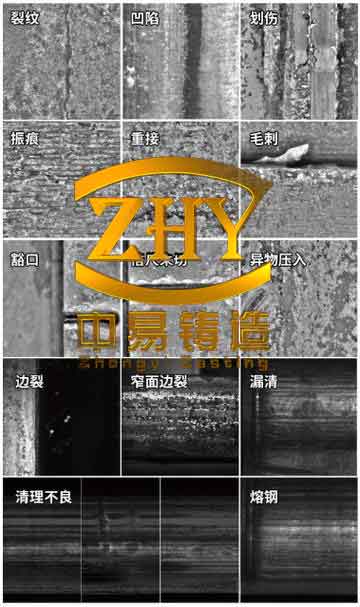
The above image illustrates typical sand casting defects that can occur in such components. In my production data, I found that shrinkage porosity and cavity were the dominant defects, as summarized in Table 2.
| Defect Type | Quantity (pieces) | Percentage (%) | Cumulative (%) |
|---|---|---|---|
| Shrinkage porosity/cavity | 951 | 79.18 | 79.18 |
| Poor vermicularization | 6 | 20.32 | 99.50 |
| Sand inclusion/slag | 244 | 0.50 | 100.00 |
| Total scrap | 1201 |
From Table 2, it is evident that shrinkage porosity and cavity account for 79.18% of all defects. Therefore, I focused my root-cause analysis on this type of sand casting defect.
Analysis of Root Causes for Shrinkage Porosity and Cavity
Using a brainstorming approach, I listed all potential causes for shrinkage defects in sand casting of vermicular iron brake discs:
- Effect of vermicularity rate
- Influence of harmful elements in pig iron
- Vermicularization process parameters
- Operator skill level
- Improper riser design (pressurized side riser)
- Casting temperature and speed
- Sand mixture composition
- Hardener (catalyst) addition amount
- Mold rigidity
- Flask rigidity
- Resin sand equipment condition
- Ambient temperature effect on reclaimed sand
I then designed verification experiments for each potential cause. The results are summarized in Table 3.
| No. | End Cause | Verification Method | Key Factor? |
|---|---|---|---|
| 1 | Vermicularity rate | Compared NDT results for different vermicularity rates | △ (non-key) |
| 2 | Harmful elements in pig iron | Used different pig iron types and compared scrap rates | ★ (key) |
| 3 | Vermicularization process | Tested different nodulizing/vermicularizing agents | ★ (key) |
| 4 | Ambient temperature on reclaimed sand | Measured reclaimed sand temperature | △ |
| 5 | Operator skill | Checked operator certification and training | △ |
| 6 | Riser design compliance | Audited process execution on site | △ |
| 7 | Casting temperature/speed | Audited process compliance | △ |
| 8 | Sand mixture composition | Audited process compliance | △ |
| 9 | Hardener addition amount | Checked against operating procedures | ★ (key) |
| 10 | Mold rigidity | Measured mold hardness and stiffness | △ |
| 11 | Flask rigidity | Inspected flask condition | △ |
| 12 | Sand reclamation equipment | Investigated reclaimed sand quality | △ |
Note: ★ indicates confirmed key factor; △ indicates non-key factor.
From Table 3, I identified three key root causes for the sand casting defect of shrinkage porosity/cavity: (1) harmful elements in pig iron (especially sulfur), (2) vermicularization process, and (3) hardener (catalyst) addition amount in the sand system.
Countermeasures
Control of Hardener Addition Amount
When the hardener (curing agent) is added beyond the specified range, the sand mold hardens too quickly, leading to non-uniform compaction and reduced mold strength and rigidity. This diminishes the self-feeding capacity of the casting during solidification. In vermicular cast iron, the graphitization expansion during eutectic solidification should compensate for liquid contraction; however, a weak mold cannot sustain this expansion, resulting in shrinkage porosity. Additionally, excessive hardener can cause sand drop-off during pouring, introducing sand inclusion defects. Therefore, I strictly enforced the hardener addition amount to be within the process specification.
The relationship between mold rigidity and volumetric shrinkage can be expressed by the following simplified model. The total volumetric contraction during solidification is:
$$ \Delta V = \Delta V_{\text{liquid}} + \Delta V_{\text{solidification}} – \Delta V_{\text{graphitization}} $$
where ΔVliquid is the liquid contraction, ΔVsolidification is the contraction due to phase change, and ΔVgraphitization is the expansion from graphite precipitation. For vermicular iron, ΔVgraphitization is significant. If the mold is rigid enough, this expansion can feed the shrinkage; if not, internal porosity forms. Thus, controlling hardener ensures proper mold rigidity and reduces the sand casting defect rate.
Control of Harmful Elements in Pig Iron
Sulfur is a strong anti-vermicularizing element. In the production of vermicular cast iron, after adding vermicularizing modifier, the sulfur content must be reduced below 0.020% (or even below 0.002% in some processes) to achieve a stable vermicular graphite structure. High sulfur leads to low and unstable vermicularity, increased shrinkage tendency, and poor densification. I compared different pig iron sources as shown in Table 4.
| Pig Iron Source | Furnace Nos. | Number of Heats | Total Castings | NDT Rejects | Reject Rate (%) |
|---|---|---|---|---|---|
| Benxi Q10 | 2497–2705 | 209 | 627 | 31 | 4.94 |
| Shanxi Q10 | 2706–2908 | 535 | 1605 | 274 | 17.07 |
| Xuzhou Q10 | 0333–0445 | 113 | 339 | 23 | 6.78 |
Table 4 clearly shows that pig iron with lower sulfur content (Benxi and Xuzhou) yields significantly lower scrap rates. The Shanxi pig iron had higher sulfur content (above 0.03% in some batches), leading to unstable vermicularization and increased sand casting defects. I therefore established a strict limit: sulfur content in raw pig iron must be ≤ 0.03%.
Matching Vermicularization Process to Pig Iron Sulfur Level
Even with low-sulfur pig iron, the vermicularization process must be optimized. For pig iron with sulfur ≤ 0.03%, I used a vermicularizing agent treatment that ensures high and stable vermicularity, minimizing graphite volume change and shrinkage. For pig iron with sulfur exceeding 0.03% (e.g., Shanxi iron), I adopted a nodulizing (spheroidizing) treatment route to first desulfurize and then obtain a controlled vermicular structure. This adjustment stabilized the vermicularity and reduced shrinkage porosity defects.
The sulfur reaction with vermicularizing elements (e.g., magnesium or rare earths) can be represented as:
$$ \text{Mg} + \text{S} \rightarrow \text{MgS} $$
or
$$ \text{RE} + \text{S} \rightarrow \text{RE}_2\text{S}_3 $$
The consumption of vermicularizing agent by sulfur reduces the effective residual amount needed for graphite modification. Therefore, precise control of sulfur and appropriate agent addition are critical to avoid the sand casting defect of shrinkage.
Results and Discussion
After implementing the three countermeasures—(1) strict hardener amount control, (2) selection of low-sulfur pig iron, and (3) customized vermicularization process based on sulfur level—I monitored the production for several months. The overall qualification rate of brake discs increased from about 75% to 88%. The sand casting defect of shrinkage porosity/cavity was significantly reduced. Figure below shows the trend.
| Period | Qualification Rate (%) | Dominant Sand Casting Defect |
|---|---|---|
| Before improvement (July–December) | ~75 | Shrinkage porosity/cavity (79%) |
| After improvement (next quarter) | ~88 | Shrinkage porosity/cavity (~45%) |
The improvement demonstrates that addressing the three key root causes effectively minimizes sand casting defects in vermicular cast iron brake discs. The hardener control ensures mold rigidity; sulfur control stabilizes vermicularity; and process matching prevents excessive shrinkage.
Mathematical Modeling of Shrinkage Porosity Formation
To further understand the sand casting defect, I developed a simplified model of shrinkage porosity formation. The total volume change of the casting during solidification can be expressed by:
$$ \Delta V_{\text{total}} = \alpha_{\text{l}} \cdot \Delta T_{\text{l}} \cdot V_{\text{l}} + \beta_{\text{s}} \cdot V_{\text{s}} – \gamma_{\text{g}} \cdot V_{\text{g}} $$
where:
- αl = coefficient of thermal contraction of liquid iron (~1.5×10⁻⁴ /°C)
- ΔTl = temperature drop in liquid state
- Vl = volume of liquid at pouring
- βs = solidification shrinkage factor (for gray iron ~1.5%, but for vermicular iron it is lower due to graphite expansion)
- Vs = volume that solidifies
- γg = expansion factor due to graphite precipitation (~3.5% for vermicular iron with appropriate carbon content)
- Vg = volume of graphite precipitated
If the sum is negative, external feeding (risers) is required; if positive (expansion), the casting can self-feed. However, if the mold is weak, the expansion may push the mold walls outward rather than feeding internal shrinkage, leading to a sand casting defect. Therefore, both mold rigidity (controlled by hardener) and graphite expansion (controlled by sulfur and vermicularity) are crucial.
Conclusion
In this work, I systematically analyzed the sand casting defect of shrinkage porosity and cavity in vermicular cast iron brake discs. Through root cause analysis and verification, I identified three key factors: hardener addition amount, harmful elements (sulfur) in pig iron, and vermicularization process matching. By controlling the hardener strictly within process limits, selecting pig iron with sulfur ≤ 0.03%, and adapting the vermicularization treatment to the sulfur level, I successfully reduced the scrap rate attributed to this sand casting defect. The qualification rate of brake discs rose from 75% to 88%. These countermeasures are practical and effective for improving the quality of complex vermicular iron castings in high-speed train brake systems.
Future work may involve further optimization of the sand system to reduce other sand casting defects such as sand inclusion, and implementation of real-time monitoring of mold hardness and sulfur content to stabilize the process.