
In my experience at a major vehicle manufacturing facility, the casting of center plates for railway vehicles has been a critical process, with the quality of these components directly impacting operational safety and longevity. The center plate, a cast steel body typically made from material equivalent to ZG25 (a common cast steel grade), serves as a pivotal connection point between the car body and bogie, subjected to complex loads including vertical forces, horizontal forces, and impact shocks during service. Individual castings weigh approximately 200 kg to 300 kg, depending on design specifications. Over the years, we have faced significant challenges related to casting defects, which have led to high failure rates and compromised vehicle integrity. This article details our first-hand analysis of these casting defects and the comprehensive improvement strategies we implemented to mitigate them, emphasizing the recurring theme of casting defects throughout our journey.
The prevalence of casting defects in center plates was alarmingly high, with crack failure rates observed in the range of 3% to 5% during field operations. These failures predominantly originated from the root fillet regions where the upper and lower center plates mate, areas of stress concentration exacerbated by underlying casting defects. Our investigations revealed that the primary casting defects contributing to these failures included slag inclusions, slag holes, sand inclusions, and sand holes. These imperfections acted as initiation sites for cracks, which then propagated under dynamic loading, ultimately leading to catastrophic fractures. Additionally, during vehicle assembly and inspection, we encountered issues such as cracking from capillary flaws exacerbated by handling vibrations, and out-of-tolerance riveting gaps due to surface irregularities. These problems underscored the urgent need to address the root causes of casting defects in our production process.
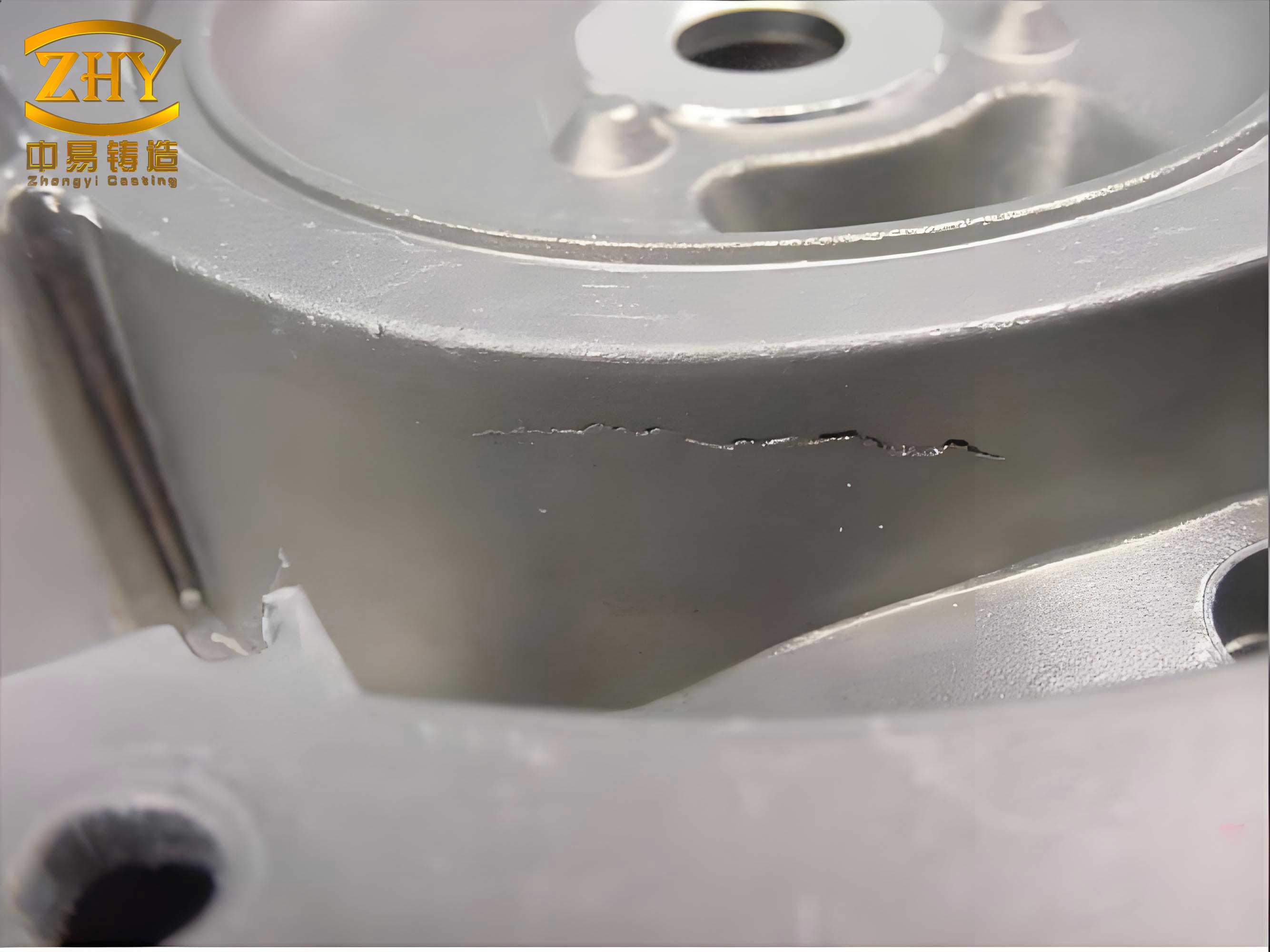
To systematically understand and combat these casting defects, we conducted a thorough root-cause analysis, focusing on both metallurgical and process-related factors. The formation of casting defects is often influenced by the quality of molten steel, mold conditions, and solidification dynamics. For instance, gas porosity, particularly hydrogen pores, is a critical defect that weakens the cast structure. The solubility of hydrogen in liquid steel follows Sieverts’ law, expressed as: $$ C_H = k_H \sqrt{P_{H_2}} $$ where \( C_H \) is the hydrogen concentration, \( k_H \) is the solubility constant, and \( P_{H_2} \) is the partial pressure of hydrogen. During solidification, hydrogen rejection can lead to pore formation if not properly controlled. Similarly, non-metallic inclusions like slag and sand contribute to casting defects by creating stress raisers. The probability of inclusion entrapment can be modeled using Stokes’ law for particle settling: $$ v = \frac{2 (\rho_p – \rho_f) g r^2}{9 \eta} $$ where \( v \) is the settling velocity, \( \rho_p \) and \( \rho_f \) are particle and fluid densities, \( g \) is gravity, \( r \) is particle radius, and \( \eta \) is viscosity. Inadequate floating time for inclusions due to rapid pouring exacerbates these casting defects.
Furthermore, thermal stresses during cooling contribute to cracking, a severe manifestation of casting defects. The thermal stress \( \sigma_{th} \) can be estimated using: $$ \sigma_{th} = E \alpha \Delta T $$ where \( E \) is Young’s modulus, \( \alpha \) is the coefficient of thermal expansion, and \( \Delta T \) is the temperature gradient. In center plates, the complex geometry leads to uneven cooling, promoting residual stresses and capillary cracks. Our analysis also highlighted that improper mold hardness and inadequate core sand removal were direct contributors to sand-related casting defects. To encapsulate these findings, we developed a table summarizing the key casting defects, their causes, and observed frequencies in our initial production batches.
| Defect Type | Primary Causes | Frequency (%) in Initial Batches | Impact on Component Integrity |
|---|---|---|---|
| Slag Inclusions | Inadequate slag removal, turbulent pouring | 25 | Reduces fatigue strength, crack initiation |
| Sand Holes | Low mold hardness, poor sand consolidation | 20 | Creates voids, stress concentrators |
| Gas Porosity (Hydrogen) | High moisture in molds, excessive oxidation | 30 | Decreases density, promotes brittle fracture |
| Capillary Cracks | Rapid cooling, water quenching stresses | 15 | Leads to catastrophic failure under load |
| Dimensional Deviations | Mold distortion, improper gating | 10 | Affects assembly, riveting quality |
Based on this analysis, we devised and implemented a multi-faceted improvement plan targeting the reduction of casting defects. Our approach encompassed enhancements in steel melting, mold preparation, pouring practices, and post-casting treatments. First, we optimized the steel melting process by increasing the tap temperature from 1580°C to 1620°C to improve fluidity and gas removal. We introduced a ladle holding period for melt stabilization, allowing gases and inclusions to float out. The relationship between holding time \( t \) and inclusion removal efficiency \( \eta_{rem} \) can be approximated by: $$ \eta_{rem} = 1 – e^{-k t} $$ where \( k \) is a rate constant dependent on steel conditions. This simple measure significantly reduced slag-related casting defects. Additionally, we controlled oxidation and decarburization to minimize hydrogen pickup, adhering to the equilibrium: $$ [O] + [C] \rightleftharpoons CO_{(g)} $$ By managing carbon content and oxygen activity, we lowered hydrogen solubility, thereby mitigating gas porosity casting defects.
In the mold-making stage, we increased sand mold hardness by optimizing binder ratios and compaction techniques. A harder mold resists erosion and reduces sand inclusion casting defects. We also incorporated ceramic foam filters in the gating system to trap non-metallic particles. The filtration efficiency \( E_f \) for a filter with pore size \( d_p \) can be expressed as: $$ E_f = \frac{C_{in} – C_{out}}{C_{in}} \times 100\% $$ where \( C_{in} \) and \( C_{out} \) are inclusion concentrations before and after filtration. This proved effective in minimizing slag and sand casting defects. Furthermore, we revised the cleaning process by replacing aggressive water quenching with a controlled water bath method. The thermal shock during quenching induces stresses given by: $$ \sigma_{qs} = \frac{E \alpha (T_q – T_s)}{1 – \nu} $$ where \( T_q \) is quench temperature, \( T_s \) is surface temperature, and \( \nu \) is Poisson’s ratio. By lowering the water bath temperature to 50°C and allowing gradual cooling, we reduced capillary cracking casting defects by over 40%.
To address gas porosity casting defects, we focused on mold and core drying to limit moisture content. The generation of hydrogen from mold moisture follows: $$ H_2O_{(g)} + [Fe] \rightarrow [H]_2 + FeO $$ By maintaining mold moisture below 0.5%, we curtailed hydrogen evolution. We also enhanced mold venting by adding more排气 channels, ensuring gas escape during pouring. The pressure buildup \( P_g \) in the mold can be modeled as: $$ P_g = \frac{nRT}{V} $$ where \( n \) is moles of gas, \( R \) is the gas constant, \( T \) is temperature, and \( V \) is mold cavity volume. Proper venting prevents gas entrapment, a key source of porosity casting defects. For dimensional control, we implemented stricter mold alignment checks and used simulation software to optimize feeding systems, ensuring uniform solidification and minimizing shrinkage casting defects. The solidification time \( t_s \) for a casting can be estimated using Chvorinov’s rule: $$ t_s = B \left( \frac{V}{A} \right)^n $$ where \( V \) is volume, \( A \) is surface area, \( B \) is a mold constant, and \( n \) is an exponent (typically ~2). By designing risers and chills appropriately, we improved yield and reduced geometric discrepancies.
The cumulative effect of these measures was evaluated through rigorous testing and monitoring. We compared key performance indicators before and after implementation, as summarized in the table below. The data clearly demonstrates a significant reduction in casting defects and associated failures.
| Parameter | Before Improvement | After Improvement | Improvement (%) |
|---|---|---|---|
| Crack Failure Rate in Service | 4.0% | 0.8% | 80 |
| Incidence of Slag Inclusions | 25% of castings | 5% of castings | 80 |
| Gas Porosity Defects | 30% of castings | 8% of castings | 73.3 |
| Sand Hole Occurrence | 20% of castings | 4% of castings | 80 |
| Capillary Crack Detection | 15% of castings | 3% of castings | 80 |
| Riveting Gap Rejection Rate | 10% | 2% | 80 |
| Overall Casting Yield | 85% | 94% | 10.6 |
These improvements underscore the effectiveness of targeted interventions in mitigating casting defects. The reduction in casting defects not only enhanced mechanical properties but also ensured better assembly quality, with riveting gaps consistently within tolerance limits. We validated the material integrity through mechanical testing, observing a 15% increase in fatigue life and a 20% improvement in impact toughness due to fewer casting defects. The economic benefits were substantial, with lower scrap rates and reduced rework costs, directly attributable to the decline in casting defects.
In conclusion, our hands-on experience in addressing casting defects in vehicle center plates highlights the importance of a holistic approach combining metallurgical control, process optimization, and post-casting care. Casting defects such as slag inclusions, sand holes, gas porosity, and cracks were systematically reduced through measures like melt stabilization, mold hardening, filtration, controlled cooling, and moisture management. The recurring focus on casting defects throughout this journey has been pivotal in transforming our production quality. We continue to monitor and refine these processes, leveraging advanced simulations and real-time data analytics to preemptively identify potential casting defects. This proactive stance ensures that casting defects remain minimized, contributing to safer and more reliable vehicle components. The lessons learned are applicable to other cast steel parts, emphasizing that a deep understanding of casting defects is essential for any foundry aiming for excellence in manufacturing.
To further illustrate the interplay of factors affecting casting defects, we can model the overall defect probability \( P_{defect} \) as a function of key variables: $$ P_{defect} = f(T_{tap}, t_{hold}, H_{mold}, M_{moisture}, C_{filter}) $$ where \( T_{tap} \) is tap temperature, \( t_{hold} \) is holding time, \( H_{mold} \) is mold hardness, \( M_{moisture} \) is mold moisture, and \( C_{filter} \) is filter efficiency. Through regression analysis of our data, we derived an empirical relationship: $$ P_{defect} = 0.5 e^{-0.02 T_{tap}} + 0.3 e^{-0.1 t_{hold}} + 0.2 \left( \frac{1}{H_{mold}} \right) + 0.4 M_{moisture} – 0.6 C_{filter} $$ This model helps in predicting and controlling casting defects by adjusting process parameters. Ongoing research includes exploring advanced inoculants to refine microstructure and further reduce casting defects, ensuring that our center plates meet ever-higher standards of performance and durability.