
As a foundry engineer specializing in high-performance automotive components, I have been deeply involved in the transition from gray iron to nodular iron for manufacturing piston rings. This shift is driven by the relentless demand for higher power density, increased durability, and improved efficiency in modern engines. While nodular iron offers superior tensile strength and toughness, its production introduces a significantly higher degree of complexity into the casting process. The very characteristics that give it strength—namely, the intentional modification of graphite morphology from flakes to spheres—make the process highly sensitive to a multitude of variables. In our production line, scaling up the output of nodular iron piston rings was initially hampered by a persistent and costly array of casting defects. This article details my first-hand analysis of these defects, the investigative methodologies employed, and the comprehensive corrective measures we implemented to achieve stable, high-quality production.
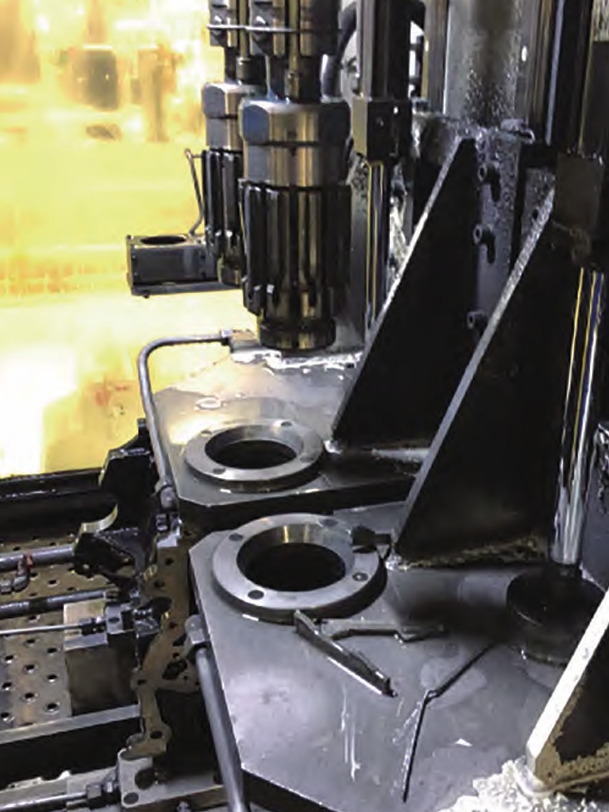
The piston ring operates in one of the most severe environments within an internal combustion engine, subject to high thermal loads, abrasive wear, and cyclic stresses. Its primary functions are to seal the combustion chamber, manage oil control, and transfer heat from the piston to the cylinder liner. Therefore, any casting defect compromising its structural integrity, wear resistance, or elastic properties can lead to catastrophic engine failure. Our challenge was to master the metallurgy and foundry practices specific to nodular iron to eliminate defects such as poor nodularization, shrinkage porosity, gas holes, and excessive carbides.
Comprehensive Analysis of Prevalent Casting Defects
1. Poor Nodularization and Coarse Graphite
The most critical casting defect in nodular iron is the failure to achieve a high percentage of perfectly spherical graphite nodules. In our initial batches, metallographic examination frequently revealed structures with less than 80% nodularity, containing vermicular, chunky, or exploded graphite forms. Furthermore, even within acceptable nodules, the size distribution was often inconsistent, with many particles exceeding 50 µm in diameter. Coarse graphite acts as a stress concentrator, significantly reducing the material’s fatigue strength and ductility.
The formation of spheroidal graphite is a complex process governed by nucleation and growth kinetics, heavily influenced by residual magnesium and cerium (from rare earth elements) in the melt. The primary factors contributing to this casting defect were identified as:
- Inconsistent Charge Composition: Fluctuations in the sulfur content of the incoming pig iron and scrap directly compete with magnesium, forming MgS slag and reducing the effective spheroidizing agent available for graphite modification.
- Suboptimal Inoculation Practice: Inoculation, intended to enhance graphite nucleation, was sometimes erratic. The fading effect of inoculants, especially with long holding times between treatment and pouring, led to insufficient nucleation sites, promoting coarse graphite growth.
- Unstable Spheroidization Process: The “sandwich” or “trench” method for adding MgFeSi alloy, if not properly executed, could lead to either violent, inefficient reaction (Mg vapor escaping too quickly) or a sluggish, incomplete reaction.
We can model the effective nodularizing potential ($N_{eff}$) considering these losses:
$$N_{eff} = M_{g,added} – M_{g,oxidized} – M_{g,reacted\ with\ S} – M_{g,faded}$$
Where $M_{g,added}$ is the total magnesium added, and the subtracted terms represent losses to atmosphere oxidation, reaction with sulfur, and fade over time, respectively. A low $N_{eff}$ directly correlates with the casting defect of poor nodularization.
2. Shrinkage Porosity and Micro-shrinkage
Unlike gray iron, which experiences a marked expansion during the eutectic graphite precipitation, nodular iron has a “pasty” or “mushy” solidification mode. The expansive force of graphite precipitation is partially counteracted by the deformation of the weak, semi-solid dendrite network in the later stages of solidification. This unique behavior makes nodular iron highly prone to a casting defect known as interdendritic shrinkage or micro-shrinkage. Macroscopically, it appeared as areas of spongy, dark fracture; microscopically, it was a network of tiny, interconnected voids between dendrite arms.
This type of casting defect is particularly insidious because it cannot be reliably fed by conventional risers. Its severity is governed by the thermal gradient ($G$) and the local solidification rate ($\dot{T}$). The Niyama criterion, often adapted for ferrous alloys, provides a useful indicator:
$$N_y = \frac{G}{\sqrt{\dot{T}}}$$
Regions with a low Niyama value (low thermal gradient, high solidification rate) are prone to shrinkage porosity. In our thin-section piston rings, the high surface-area-to-volume ratio often led to high cooling rates ($\dot{T}$) and unpredictable thermal gradients ($G$), creating perfect conditions for this casting defect.
3. Subsurface Pinhole and Blowhole Defects
Another frequent casting defect was the appearance of small, spherical or pear-shaped cavities just beneath the casting surface, often visible only after machining or shot blasting. Energy-dispersive X-ray spectroscopy (EDS) analysis on the walls of these holes detected traces of sodium, chlorine, and sulfur.
This pointed decisively towards a hydrogen and/or nitrogen pinhole mechanism, often catalyzed by residual magnesium. The sources were twofold:
- Endogenous Gases: Hydrogen can originate from moisture in charge materials (rusty scrap), poorly dried ladles, or damp spheroidizing/inoculating alloys. Nitrogen can come from certain alloying elements or air entrainment during turbulent pouring.
- Exogenous Gases: The high reactivity of residual magnesium with water vapor in the green sand mold is a classic source. The reaction $Mg + H_2O \rightarrow MgO + H_2$ generates hydrogen gas at the metal-mold interface, which can be forced into the still-solidifying skin of the casting.
The solubility of hydrogen in iron follows Sieverts’ law, and its sudden drop during solidification can cause supersaturation and bubble formation:
$$[H] = K_H \sqrt{P_{H_2}}$$
Where $[H]$ is the dissolved hydrogen concentration, $K_H$ is the temperature-dependent equilibrium constant, and $P_{H_2}$ is the partial pressure of hydrogen at the interface. Any factor increasing $[H]$ or decreasing solubility during cooling promotes this gaseous casting defect.
4. Excessive Carbide Formation and Inverse Chill
The desired as-cast microstructure for these piston rings was a ferritic matrix with nodular graphite, offering optimal machinability and elastic properties. However, we often encountered a casting defect characterized by high volumes of hard, brittle iron carbides (cementite, $Fe_3C$), particularly at the sharp edges and corners of the ring profile. In severe cases, a more alarming casting defect called “inverse chill” appeared in the thermal center of thicker sections: a white, carbide-rich region surrounded by a softer, graphite-rich periphery.
Carbide promotion is primarily a function of chemistry and cooling rate. The identified culprits were:
- Alloying Element Segregation: Elements like molybdenum (Mo), tungsten (W), and chromium (Cr), added for solid solution strengthening and wear resistance, are strong carbide stabilizers. If not perfectly homogenized, they segregate to intercellular/last-to-freeze regions, pushing the local composition into the carbide-stable zone of the phase diagram.
- Excessive Cooling Rate: Thin edges cool very rapidly, pushing the solidification path past the graphite-forming metastable equilibrium into the stable Fe-Fe3C system.
- Inverse Chill Mechanism: This peculiar casting defect is linked to the segregation of carbide-promoting elements like magnesium and cerium (from rare earths) to the center of the casting. These elements can suppress graphite nucleation in the last solidifying liquid, forcing carbide formation even where cooling is slowest.
Systematic Corrective Actions and Process Optimization
Addressing these interconnected casting defects required a holistic approach, targeting every stage from furnace charging to final cooling. The following table summarizes the root causes and our implemented countermeasures.
| Casting Defect | Primary Root Causes | Implemented Corrective Actions |
|---|---|---|
| Poor Nodularization & Coarse Graphite | High/fluctuating S content, Inoculant fade, Unstable Mg recovery. | Stricter charge control, Use of pre-conditioned low-sulfur pig iron. Implemented late-stream inoculation. Added Sb for graphite refinement. Standardized Mg-treatment practice. |
| Shrinkage Porosity | Pasty solidification of nodular iron, Low thermal gradients in thin sections. | Increased mold rigidity using high-pressure molding. Optimized Carbon Equivalent (CE) to maximize graphite expansion. Adopted “stack” molding to create favorable thermal gradients. |
| Subsurface Pinholes | Moisture in molds/alloys/ladles, High residual Mg. | Strict drying protocols for all tools and additives. Controlled green sand moisture to ≤3.5%. Reduced residual Mg to the minimum effective level (0.03-0.04%). |
| Excessive Carbides & Inverse Chill | Segregation of Mo, W, Cr; Excessive cooling at edges; Segregation of Mg/RE. | Tightened alloying element ranges and improved melt homogenization. Used insulating sleeves on mold edges. Enhanced inoculation to combat inverse chill. |
1. Metallurgical Process Refinements
Charge and Melt Control: We established a strict raw material specification, mandating the use of low-sulfur, high-purity pig iron. The scrap steel fraction was limited to clean, uncoated materials. A dedicated computer system was used to calculate charges, aiming for a consistent target chemistry, particularly for Carbon Equivalent (CE):
$$CE = \%C + \frac{\%Si + \%P}{3}$$
We targeted a hypereutectic CE of approximately 4.4 to 4.6 to ensure ample graphite precipitation for feeding and to reduce chilling tendency. All charge materials were pre-heated to remove surface moisture.
Spheroidization and Inoculation Overhaul: The Mg-treatment process was standardized. The FeSiMg alloy was compacted at the bottom of a preheated, deep-pocket ladle and covered with a steel punch plate. Exactly 2/3 of the total iron weight was tapped onto it at 1520°C. After a controlled reaction time of 70-90 seconds, slag was thoroughly removed, and the remaining 1/3 of iron was added. This “sluggish” reaction improved Mg recovery and reproducibility.
To combat inoculation fade and refine graphite, we adopted a dual-strategy:
1. Late-Stream Inoculation: A fine-grade FeSi inoculant (75% Si) was added using an automatic feeder during the transfer of treated metal to the pouring ladle.
2. Antimony Addition: A minute, controlled amount of antimony (0.002-0.005%) was added during the Mg-treatment. Sb is a potent graphitizer in the presence of cerium and profoundly refines graphite size, as shown in the micrograph below. The challenge was precise control, as excess Sb leads to embrittlement.
Gas Defect Prevention: Beyond drying, we focused on minimizing turbulence during pouring by using tapered sprue systems and enlarged ingates. The residual magnesium was spectroscopically monitored and maintained at the lower end of the specification. The green sand system’s clay content and mulling efficiency were optimized to maintain strength at lower moisture levels (3.5-4.0%), drastically reducing the potential for the $Mg-H_2O$ reaction.
2. Casting and Solidification Engineering
To tackle the inherent casting defect of shrinkage porosity, we moved from conventional green sand molding to a high-pressure, high-density molding line. This dramatically increased mold rigidity, resisting the expansion of the early graphite precipitation and thereby creating a self-feeding effect through micro-expansion.
We also redesigned the gating and pouring practice. Instead of pouring single rings, we designed a mold that poured a vertical “stack” or “column” of multiple rings (e.g., 4-6 rings high). This configuration altered the solidification dynamics. The rings in the center of the stack solidified slower and under a more favorable thermal gradient (higher $G$) from the hotter metal above and below, effectively reducing the severity of interdendritic shrinkage. These columns were then cut into individual rings.
To prevent carbide formation at edges, we implemented thin, exothermic insulating pads placed in the mold at locations corresponding to sharp ring features. This moderated the local cooling rate, keeping it within the graphite-forming regime.
3. Process Verification and Quality Gates
A robust process is defined by its controls. We instituted several in-process checkpoints:
- Thermal Analysis: A cup sample from each treated ladle was used for thermal analysis, providing a rapid check of CE and nucleation potential before pouring.
- Wedg Sample: A quick-chill wedge sample was poured and fractured to visually assess nodularity and shrinkage tendency.
- On-line Spectroscopy: Final chemistry, including residual Mg, was verified via optical emission spectroscopy for every ladle.
- Statistical Process Control (SPC): Key parameters—pouring temperature, mold hardness, sand moisture, Mg recovery—were charted in real-time to detect and correct process drift.
Quantitative Results and Microstructural Evidence
The implementation of these integrated measures yielded transformative results. The rate of scrapped castings due to major casting defects fell by over 70%. Metallographic quality became consistently high.
The microstructure transformed from one with irregular, coarse graphite and variable nodularity to a uniform, fine dispersion of well-formed spheroidal graphite (ASTM Type I, size 6-7) in a predominantly ferritic matrix. The characteristic field of fine, dark-etching nodules against the light ferrite background is the hallmark of a successfully processed nodular iron, free from the casting defect of poor nodularization.
Ultrasonic testing and machining yield confirmed the drastic reduction in subsurface shrinkage and gas holes. The formation of carbides, particularly inverse chill, was virtually eliminated, ensuring consistent hardness and machinability across the entire casting.
| Process Parameter | Target Range | Monitoring Method |
|---|---|---|
| Charge Sulfur (S) | < 0.015% | OES for incoming material |
| Final Carbon Equivalent (CE) | 4.4 – 4.6 | Thermal Analysis / Calculation |
| Residual Magnesium (Mg) | 0.030 – 0.040% | OES of treated metal |
| Pouring Temperature | 1380 – 1400°C | Immersion thermocouple |
| Mold Hardness | 85 – 90 (B-scale) | Hardness tester |
| Green Sand Moisture | 3.5 – 4.0% | Loss on ignition |
| Inoculant Addition Rate | 0.10 – 0.15% (stream) | Calibrated feeder |
Conclusion
The successful production of high-integrity nodular iron castings, such as piston rings, is a testament to the precise control of metallurgical and foundry variables. Each casting defect—be it poor nodularization, shrinkage porosity, gas holes, or excessive carbides—is not an isolated failure but a symptom of a deviation in a complex, interdependent system. Our experience underscores that there is no single “magic bullet.” Rather, the solution lies in a systematic, scientific approach: understanding the root cause through rigorous analysis (using tools like EDS, thermal analysis, and solidification modeling), and then implementing a synchronized set of controls across the entire process chain, from raw material selection to final solidification. The transition from a defect-plagued process to a reliable one required treating the foundry as a integrated system of chemistry, thermal management, and process engineering. The strategies detailed here, centered on meticulous melt control, optimized treatment practices, and engineered solidification, provide a proven framework for mitigating the key casting defects in nodular iron and achieving the consistent, high-performance material required for demanding automotive applications.