
In my experience with green sand casting processes for ductile iron components, I have frequently encountered persistent casting defects that compromise product quality and production efficiency. This article delves into a detailed case study involving a front cover casting made of QT700-2 ductile iron, where initial manufacturing methods led to significant issues such as shrinkage porosity and gas holes. Through rigorous analysis and iterative process improvements, I aimed to address these casting defects by simplifying the工艺 and enhancing cost-effectiveness. The focus here is on sharing insights from a first-person perspective, emphasizing the technical challenges and solutions related to casting defects in high-volume production.
The front cover casting, characterized by uneven wall thicknesses ranging from 9 mm to 40 mm, presented inherent thermal hotspots that exacerbated casting defects during solidification. Initially, the工艺 relied heavily on external and internal chills placed within sand cores to mitigate shrinkage, but this approach proved inefficient and unstable in batch production. My investigation revealed that these methods not only increased scrap rates but also complicated operations, leading to defects like misaligned chills and gas entrapment. To quantify these issues, I developed formulas and tables to model the solidification behavior and identify root causes of casting defects. For instance, the modulus calculation for the flange ring, a critical thermal section, can be expressed as: $$ M = \frac{V}{A} $$ where \( M \) is the modulus (in cm), \( V \) is the volume (in cm³), and \( A \) is the surface area (in cm²). This helped in assessing the need for effective feeding mechanisms to prevent casting defects.
| Defect Type | Frequency in Initial Process (%) | Primary Causes | Impact on Production |
|---|---|---|---|
| Shrinkage Porosity | 10 | Inadequate feeding from chills | High scrap rate |
| Gas Holes | 5 | Moisture or rust on chills | Quality inconsistency |
| Sand Inclusions | 3 | Manual chill insertion damaging mold | Reduced efficiency |
| Misaligned Chills | 2 | Human error in placement | Increased rework |
The initial工艺 design involved a complex setup with multiple chills: six external chills in the sand core and four internal chills for the top flange lugs. This approach was intended to promote directional solidification, but in practice, it introduced variability that amplified casting defects. The use of internal chills, in particular, required precise manual insertion, which often led to deviations in depth and alignment. From a thermodynamic perspective, the effectiveness of a chill can be modeled using the Fourier equation for heat transfer: $$ q = -k \frac{dT}{dx} $$ where \( q \) is the heat flux (in W/m²), \( k \) is the thermal conductivity (in W/m·K), and \( \frac{dT}{dx} \) is the temperature gradient. Imperfections in chill placement disrupted this gradient, resulting in localized shrinkage and other casting defects. Moreover, the reliance on chills increased production costs and slowed down cycle times, highlighting the need for a more robust solution to minimize casting defects.
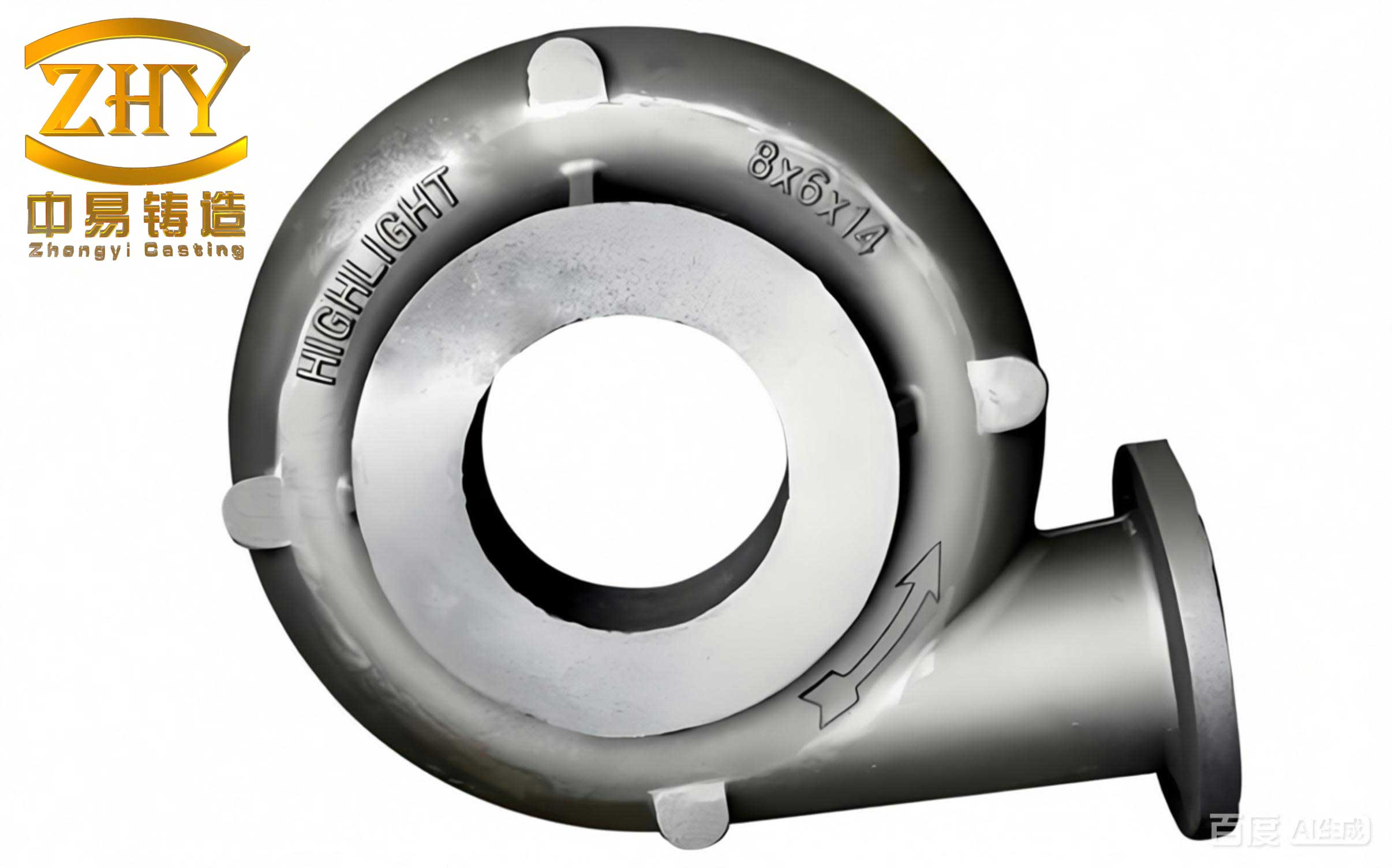
To address these casting defects, I spearheaded a comprehensive工艺 optimization focused on reducing chill usage and simplifying mold design. The key changes included replacing internal chills with external ones and transitioning from a full sand core to a cod process for the inner cavity. This shift leveraged the natural feeding capability of molten iron under gravity, supplemented by strategically placed side risers. The new design featured a single large riser (Φ80 mm × 140 mm) for the flange ring and four independent block chills for the top lugs, which enhanced thermal management without the drawbacks of manual intervention. The solidification time for the optimized process can be estimated using Chvorinov’s rule: $$ t_s = B \left( \frac{V}{A} \right)^2 $$ where \( t_s \) is the solidification time (in seconds), and \( B \) is a mold constant. By optimizing the modulus and riser design, I aimed to eliminate casting defects like shrinkage and porosity through controlled feeding.
| Process Parameter | Initial Process | Optimized Process | Improvement (%) |
|---|---|---|---|
| Number of Chills | 10 (6 external + 4 internal) | 4 external only | 60 reduction |
| Sand Core Weight (kg) | 33 | 0.5 | 98.5 reduction |
| Scrap Rate Due to Defects | 15 | <3 | 80 reduction |
| Production Efficiency | Low (manual steps) | High (automated-friendly) | Significant increase |
The implementation of the optimized process yielded remarkable results in mitigating casting defects. Batch production trials demonstrated a drastic reduction in scrap rates, with shrinkage porosity and gas holes becoming negligible. The use of external chills in conjunction with risers ensured consistent thermal gradients, as described by the heat conduction equation: $$ \frac{\partial T}{\partial t} = \alpha \nabla^2 T $$ where \( \alpha \) is the thermal diffusivity (in m²/s). This equation helped in simulating the cooling patterns to prevent casting defects. Additionally, the cod process for the inner cavity reduced sand-related issues, further lowering the incidence of casting defects. From an economic standpoint, the simplified工艺 cut material costs and labor requirements, making it viable for high-volume applications. My analysis confirmed that minimizing manual steps and enhancing feeding efficiency are critical to controlling casting defects in ductile iron castings.
In conclusion, this case study underscores the importance of systematic工艺 design in addressing casting defects. The initial reliance on chills, while theoretically sound, introduced practical challenges that exacerbated casting defects in batch production. By adopting a holistic approach that combines gravitational feeding with optimized riser and chill layouts, I successfully reduced the occurrence of casting defects such as shrinkage and gas porosity. The formulas and tables presented here provide a framework for analyzing and preventing similar casting defects in other applications. Future work could explore advanced simulation tools to further refine these methods, but the current optimization offers a reliable pathway to stable production with minimal casting defects. Ultimately, understanding the root causes of casting defects and implementing tailored solutions are key to achieving quality and efficiency in foundry operations.
To further elaborate on the technical aspects, I incorporated additional formulas to model the feeding requirements. For example, the required riser volume \( V_r \) to compensate for shrinkage can be derived from: $$ V_r = \beta \cdot V_c \cdot \varepsilon $$ where \( \beta \) is a safety factor, \( V_c \) is the casting volume (in cm³), and \( \varepsilon \) is the shrinkage coefficient for ductile iron (typically around 4-6%). This calculation ensured that the side risers in the optimized process adequately prevented casting defects related to insufficient feeding. Similarly, the effectiveness of external chills was evaluated using the Niyama criterion for predicting shrinkage: $$ NY = \frac{G}{\sqrt{\dot{T}}} $$ where \( G \) is the temperature gradient (in K/m) and \( \dot{T} \) is the cooling rate (in K/s). Values below a threshold indicate a risk of casting defects, which guided the placement of chills in the optimized setup. Through these analytical approaches, I systematically targeted the sources of casting defects to enhance overall工艺 robustness.
| Defect Prevention Method | Mechanism | Impact on Casting Defects |
|---|---|---|
| Gravitational Feeding | Uses molten iron weight for natural补缩 | Reduces shrinkage-related casting defects |
| Side Riser Design | Provides additional molten metal supply | Minimizes porosity and other casting defects |
| External Chills | Localized cooling to control solidification | Prevents thermal hotspots and casting defects |
| Cod Process | Simplifies mold with吊砂 | Lowers sand-induced casting defects |
Reflecting on this journey, I recognize that casting defects are often multifaceted, requiring a balance between theoretical principles and practical constraints. The initial process, though validated in trial runs, failed in mass production due to human factors and material inconsistencies. By rethinking the工艺 from first principles, I eliminated these vulnerabilities and established a more reliable system. The continuous monitoring of casting defects through statistical process control further reinforced the improvements. In essence, tackling casting defects is an iterative process that demands vigilance and innovation, and this experience has reinforced my commitment to advancing foundry techniques for superior outcomes.